← All women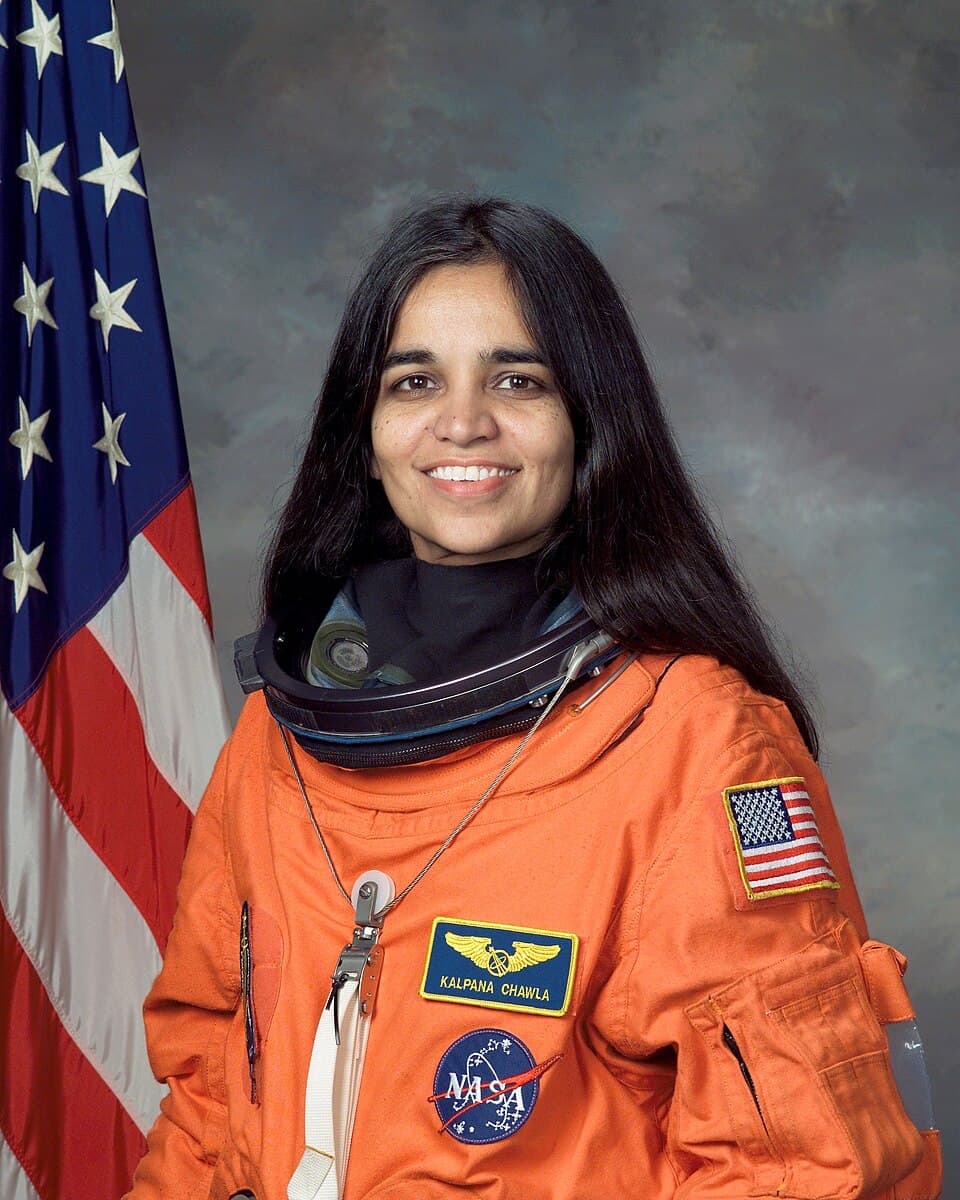
Indian, American · Science · Aviation
Kalpana Chawla
March 17, 1962 – February 1, 2003
Early Life and Background
Kalpana Chawla was born on March 17, 1962, in Karnal, India, to a family of modest means. From a young age, she was fascinated by aviation and space exploration, drawing inspiration from pilots and scientists. She attended Tagore School, where her passion for science was nurtured. Kalpana obtained a Bachelor of Engineering degree in Aeronautical Engineering from Punjab Engineering College, Chandigarh, in 1982.
Education and Career Beginnings
Following her undergraduate studies, Kalpana moved to the United States to pursue higher education. She completed her Master of Science in Aerospace Engineering at the University of Texas at Arlington in 1984 and subsequently earned a Ph.D. in the same field from the University of Colorado Boulder in 1988. Her academic excellence led her to work as a post-doctoral fellow at NASA Ames Research Center and later as an aerospace engineer, contributing to research in vertical/short takeoff and landing concepts.
Astronaut Selection and Notable Achievements
Selected by NASA in 1994, Kalpana Chawla became part of a prestigious group of astronauts and embarked on her first space flight aboard Space Shuttle Columbia STS-87 in 1997. This mission marked her as the first woman of Indian origin to go to space, a monumental milestone that inspired countless individuals worldwide. During this mission, Chawla's work focused on deploying satellites and conducting microgravity experiments.
Legacy and Tragic Incident
Chawla's enduring legacy, however, is intertwined with tragedy. On February 1, 2003, she was part of the Columbia STS-107 mission. The shuttle disintegrated during re-entry, leading to the loss of all seven crew members. This devastating event highlighted the risks of space exploration but also underscored the bravery and curiosity required to advance human understanding of the universe.
Awards and Recognition
In acknowledgment of her pioneering contributions, Kalpana Chawla was posthumously awarded the Congressional Space Medal of Honor and the NASA Space Flight Medal. Numerous institutions and scholarships, both in India and the United States, have been named in her honor, serving as a testament to her enduring influence on aspiring scientists and engineers.
Personal Life
Kalpana Chawla was married to Jean-Pierre Harrison, an aviator and flight instructor, with whom she shared her deep passion for flying and exploration. Her personal life was marked by her relentless pursuit of knowledge and her commitment to inspiring future generations, regardless of their gender or nationality.
Influence and Commemoration
Kalpana Chawla's story continues to inspire individuals worldwide, reminding them that dreams are achievable regardless of one's background. Her story has been immortalized through films, documentaries, and memorials, ensuring that her contributions to science and humanity's quest to explore the cosmos are never forgotten.
Dated achievements
3 indexed.
- Mar171962Science
Kalpana Chawla's birth
Birth of Kalpana Chawla in Karnal, India.
View details Space.com Biography of Kalpana Chawla - Nov191997Science
First Woman of Indian Origin in Space
Kalpana Chawla flies to space on Space Shuttle Columbia STS-87.
View details