← All women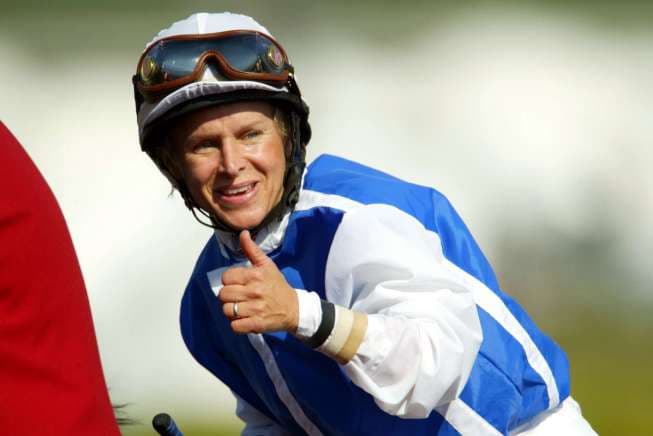
American · Sports
Julie Krone
July 24, 1963 – present
Early Life and Background
Julieann Louise Krone, universally known as Julie Krone, was born on July 24, 1963, in Benton Harbor, Michigan, a small industrial city on the eastern shore of Lake Michigan.[3][15] She was the daughter of Judi Krone, an accomplished horsewoman, and Don KroneEau Claire, Michigan, where Judi trained and showed horses.[3][4] Growing up in this rural environment, Julie was immersed in equine culture from her earliest years.
Krone began riding almost as soon as she could walk. According to the National Women’s Hall of Fame, she won her first horse show at age five, demonstrating a precocious feel for balance, speed, and communication with horses.[4] As a child she competed in pony clubs and local shows, often against older and larger riders. Her small stature—eventually about 4 feet 10 inches tall and roughly 100 pounds—made her distinctive in the ring and would later prove ideal for a jockey’s demands.[13]
Beyond the farm, Krone’s formative influences were deeply shaped by Thoroughbred racing’s emerging legends. At age fourteen she watched the young jockey Steve Cauthen win the 1978 Triple Crown on Affirmed and later read his autobiography.[4][9] That story of a teenage rider reaching the pinnacle of American racing crystallized her own ambitions. As the Women’s Hall of Fame notes, "At the age of 14, after watching 18-year-old Steve Cauthen win a Triple Crown race, she set her sights on becoming a jockey."[4] The idea of a girl from small-town Michigan becoming a professional rider in a male-dominated sport was then audacious; yet Krone’s environment, skills, and temperament made it more than a dream.
In her mid‑teens, Krone increasingly oriented her activities toward race riding. She galloped horses at regional training centers and spent time at Tampa Bay Downs in Florida, where she would soon make her professional debut.[9] These early experiences introduced her to the intense speed, danger, and tactical complexity of race riding, and gave her opportunities to learn from experienced horsemen who were initially skeptical about a young woman pursuing such a path.[7][5]
Career Beginnings and Development
Krone’s professional career began in earnest in 1981. On January 30, 1981, she rode in her first official Thoroughbred race at Tampa Bay Downs, finishing second.[4][9] This debut signaled her transition from show rings and exercise gallops to the competitive heart of American pari‑mutuel racing. Less than two weeks later, on February 12, 1981, she captured her first career win aboard the horse Lord Farkle, also at Tampa Bay Downs.[4] These early successes, recorded in an editorially vetted Britannica Students article, mark the beginning of an extraordinary two‑decade journey.
In the early 1980s, female jockeys remained a rarity on major North American circuits. Although pioneers such as Diane Crump had broken initial barriers by riding in pari‑mutuel races and the Kentucky Derby, women still faced widespread prejudice from trainers, owners, and male riders.[10][7] Krone confronted skepticism about her physical strength, tactical acumen, and emotional resilience, compounded by her diminutive frame. Yet she quickly gained a reputation as a fearless, aggressive rider with exceptional timing and an intuitive connection to her mounts.
By 1982–1983, Krone had become a leading jockey at Atlantic City Race Course, according to Encyclopedia.com, marking her emergence as a consistent winner rather than a novelty.[4] Throughout the mid‑1980s she expanded her presence at Monmouth Park, The Meadowlands, and other tracks, gradually earning better mounts and more frequent rides. Her work ethic and ability to communicate with trainers and owners helped chip away at the prejudices that limited opportunities for female riders.
A pivotal highlight of her early rise came on August 20, 1987, when Krone won five races in a single day at Saratoga Race Course, becoming only the third jockey in 126 years to accomplish such a feat at that storied track.[4] Saratoga, renowned for its deep fields and competitive intensity, is among the most challenging venues for any jockey. Krone’s five‑win spree demonstrated that she could not only compete but dominate on racing’s most prestigious stage.
Within the same period, Krone became the first woman to win four races in one day and the first woman named top rider at a major racetrack, milestones noted by Encyclopedia.com but without specific dates.[4] She began collecting riding titles at Monmouth Park, The Meadowlands, and Atlantic City, and later at Gulfstream Park and Belmont Park’s spring meeting, as highlighted by the National Museum of Racing.[2] These accomplishments established her as a fixture at major tracks and laid the groundwork for her later national prominence.
Rise to Prominence and Major Accomplishments
By the late 1980s and early 1990s, Julie Krone was widely recognized as one of North America’s leading jockeys, regardless of gender. In 1988–1990, she was champion at The Meadowlands, and sources note that she became the all‑time winningest female jockey during this period.[4][7] In 1992, she ranked ninth among all North American jockeys by wins, underscoring her status among the sport’s elite, not just among women.[4]
One of the earliest high‑profile barriers she broke came on June 8, 1991, when she became the first woman to ride in the Belmont Stakes.[8] This historic entry into the "Test of the Champion" at Belmont Park was significant because, for more than a century, the race had been contested exclusively by male jockeys. Krone’s ride demonstrated that owners and trainers were finally willing to entrust a woman with a mount in one of racing’s most prestigious classics.[3] The event foreshadowed her later triumphs and expanded the range of opportunities open to female riders.
Krone’s defining achievement came two years later. On June 5, 1993, she rode Colonial Affair to victory in the Belmont Stakes, making history as the first woman ever to win an American Triple Crown race and the first woman to win the Belmont.[1][3][2] The 1½‑mile Belmont is considered one of the sport’s most grueling tests, and her tactically astute ride—saving ground early, positioning for a strong stretch run, and maintaining composure under pressure—was widely applauded. According to Encyclopedias and Hall of Fame sources, this victory established her as a global symbol of women’s potential in elite racing.[7][15]
Throughout the 1990s, Krone continued to accumulate significant wins and riding titles while recovering from numerous serious injuries, including falls that resulted in broken bones and other trauma.[7][16] Her resilience became a central part of her public image. She was often described as fearless and relentlessly determined, returning to competition after hospitalizations that might have ended other careers.
By the late 1990s, Krone had amassed more than 3,500 wins and over $81 million in purse earnings, figures cited by Encyclopedia.com, which ranked her 16th in all‑time earnings at that stage.[8] She initially retired from riding in 1999, following a nineteen‑year career, but her story in the saddle was not yet complete.[5]
Hall of Fame Induction and Historic Firsts
Krone’s trailblazing record was formally recognized when she was inducted into the National Museum of Racing and Hall of Fame in Saratoga Springs, New York, on August 4, 2000.[2][1] She was the first woman jockey ever to receive this honor, and one of a very small number of women in any role to be so recognized at the time. The Hall of Fame profile emphasizes that she became the first woman to win a riding title at a major racetrack and the first to ride the winner of an American Triple Crown event, achievements that underpinned her induction.[2]
After her initial retirement, Krone returned to race riding in the early 2000s, embarking on a remarkable comeback that would yield additional historic firsts. In 2003, she enjoyed a celebrated season highlighted by major stakes victories, including the Hollywood Derby and the Pacific Classic.[1][16] On August 24, 2003, she rode Candy Ride to victory in the Pacific Classic Stakes at Del Mar, becoming the first woman to win a million‑dollar Thoroughbred race.[4][1] Candy Ride’s performance, which included a track record, drew wide acclaim and further demonstrated Krone’s capacity to excel at the highest levels even after years away from full‑time riding.
That same year, Krone achieved another landmark. On October 25, 2003, she piloted Halfbridled to victory in the Breeders’ Cup Juvenile Fillies at Santa Anita Park, making her the first female jockey to win a Breeders’ Cup race (non‑steeplechase).[2][4][17] The Breeders’ Cup World Championships represent one of the sport’s premier international events, and her success on championship day underscored her enduring talent and calm under extreme pressure. The Breeders’ Cup organization later highlighted this moment as a historic breakthrough, noting her status as the first woman jockey to win a non‑steeplechase Breeders’ Cup event.[17]
By the time she retired definitively from race riding in early 2004, Krone had amassed 3,704 victories and more than $90 million in purse earnings, according to the National Museum of Racing and other sources.[2][16] Across various encyclopedias and Hall of Fame profiles, she is consistently described as the winningest female jockey in Thoroughbred history.[2][4][8]
Awards, Honors, and Recognition
In addition to her Hall of Fame induction, Krone received numerous other forms of recognition for her barrier‑breaking career. The National Women’s Hall of Fame includes her among its inductees, emphasizing her role in transforming expectations for women in horse racing and highlighting her key "firsts"—Belmont Stakes victory, Breeders’ Cup win, and million‑dollar race triumph.[4] EBSCO’s research starter on women’s studies and feminism identifies her as a significant figure in gender history, noting her as the first woman to win a Triple Crown race and a major track riding title.[5]
Throughout the 1990s and 2000s, racing media and mainstream outlets frequently referred to Krone as the top female jockey of all time, a description echoed by Encyclopedia.com and JockeySite.com, which call her "thoroughbred racing’s top female jockey" and the "world’s winningest female jockey," respectively.[7][13] She also became a sought‑after speaker and commentator, using her story to inspire broader audiences beyond the racing world.
Krone’s autobiography, "Riding for My Life", is cited by America’s Best Racing as an important source on her career and personal journey.[9] Through this work and numerous interviews, she has contributed to the documentation of women’s experiences in professional sport, including the physical, emotional, and institutional challenges they face.
Personal Life
Sources note that Krone married Matthew Muzikar, a television sports producer, on August 26, 1995
In later years, she has been involved in broadcasting and motivational speaking, appearing on television and at industry events to discuss topics such as resilience, goal‑setting, and women’s advancement in sports.[5][9] She has also served as an equine consultant, drawing on decades of experience to advise owners and trainers on horse behavior and performance.[1] Her personal commitment to animal welfare and to nurturing young riders, particularly girls, has been noted in several profiles.[16] Krone’s family connections to horses remained strong throughout her life, and she often credits her mother Judi as a central influence in shaping both her horsemanship and her determination to succeed in a male‑dominated environment.[4][16] Julie Krone’s legacy in horse racing and women’s sports is profound. Across authoritative sources, she is consistently described as the winningest female jockey in Thoroughbred history, with 3,704 career wins and more than $90 million in purse earnings.[2][16] She broke multiple barriers at major tracks, became the first woman to win a Triple Crown race, the first woman jockey inducted into the National Museum of Racing and Hall of Fame, the first woman to win a million‑dollar race, and the first female jockey to win a Breeders’ Cup race.[1][2][4][14] Her successes helped transform perceptions of what women could achieve in a sport that, for decades, had been hostile to female participation. By consistently winning and holding riding titles at tracks such as Monmouth Park, The Meadowlands, Gulfstream Park, Belmont Park, and Atlantic City, she demonstrated that women could not only compete but dominate at the highest levels of racing.[2][4] This shift encouraged owners and trainers to book female jockeys more frequently and with higher‑quality mounts. Beyond statistics, Krone’s story of resilience in the face of repeated injuries has resonated widely. She survived multiple serious falls, including one in 1993 that nearly ended her life, yet returned each time to top‑level competition.[7][14][16] Her perseverance became a symbol of tenacity for athletes across disciplines, and her later work as a mentor and speaker has extended that influence to younger generations. In the broader context of women’s history, Krone occupies a key place among athletes who challenged structural barriers in professional sport. Like tennis players, runners, and other female pioneers of the late twentieth century, she fought for recognition in an institution that initially marginalized women. Her record undermined arguments that women lacked the strength or temperament for such high‑risk competition and contributed to the gradual normalization of female participation in elite racing. Krone also helped shift media narratives around female athletes. Coverage of her Belmont Stakes victory and Breeders’ Cup win frequently emphasized her talent and tactical intelligence rather than only her novelty as a woman.[1][3][14] This more balanced recognition reinforced the message that women’s achievements deserved to be evaluated on the same terms as men’s. After her final retirement from race riding in early 2004, Krone transitioned into a multifaceted career that included broadcasting, consulting, and motivational speaking.[2][5] She has appeared as an analyst and commentator for racing coverage, offering insights into race strategy and horse behavior drawn from decades of experience. As an equine consultant, she has worked with owners and trainers on conditioning and communication with their horses.[1] Krone continues to be recognized in both racing and women’s-history contexts. The National Museum of Racing’s Hall of Fame profile and the National Women’s Hall of Fame biography situate her among the most influential figures in modern Thoroughbred racing.[2][4] EBSCO’s women’s studies overview presents her as a case study in breaking gender barriers in professional sports, emphasizing how her achievements challenged a masculine culture and opened new pathways for women.[5] As of mid‑2020s reference sources, Julie Krone remains alive and active in equine and motivational fields.[1][2][4] She is frequently cited in discussions of female jockeys’ progress and is often invited to speak about the mental toughness required for high‑risk athletic careers. Through her autobiography "Riding for My Life", interviews, and public appearances, she continues to shape the narrative of women’s participation in horse racing and to inspire athletes navigating similarly male‑dominated spaces.[9] Krone’s story is now embedded in educational resources, from children’s encyclopedias to university‑level women’s studies materials.[4][5] In this way, her legacy has moved beyond the racetrack to become part of the documented history of women’s struggle for equal opportunity in sport. Her pioneering achievements at Belmont Park, the Hall of Fame, Del Mar, and the Breeders’ Cup remain landmarks in that ongoing story.Legacy and Historical Impact
Later Life and Continuing Influence
Dated achievements
9 indexed.
- Jul241963Sports
Birth of Julie Krone
Julieann Louise Krone was born in Benton Harbor, Michigan, becoming the future pioneering American Thoroughbred jockey Julie Krone.
View details Encyclopedia - Julie Krone - Jan301981Sports
First professional race (finishes second)
Julie Krone finished second in her first official race as a jockey at Tampa Bay Downs in Florida, marking her debut as a professional rider.