← All women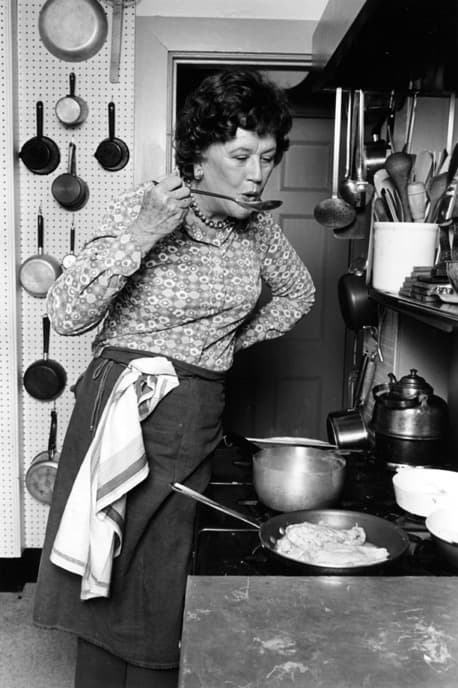
American · Arts · Literature
Julia Child
August 15, 1912 – August 13, 2004
Early Life and Background
Julia Carolyn McWilliams Child was born on August 15, 1912, in Pasadena, California, into an affluent family that enjoyed social prominence and economic security.[2][3][13] Her father, John McWilliams Jr., was a Princeton-educated land manager and investor, and her mother, Julia Carolyn "Caro" Weston McWilliams, came from a well-established New England family.[1][3] Growing up in a large house with domestic staff and exposure to travel and leisure, Julia experienced what PBS later described as a "life of ease and privilege," though without particular emphasis on gourmet food in her childhood home.[7]
Child attended private schools in California before enrolling at Smith College in Northampton, Massachusetts, one of the leading women’s colleges in the United States.[9][14] At Smith she studied history and pursued campus activities that capitalized on her height—she stood over six feet tall—and outgoing demeanor. Biographical accounts note that she was not particularly interested in cooking during these years; the culinary passion that would define her later life had yet to emerge.[1][3]
After graduating from Smith College in 1934, Child worked briefly in advertising and public relations in California.[1][9] These early jobs honed her communication skills and comfort with public-facing work, though she later characterized her prewar career as relatively aimless. The outbreak of World War II opened new opportunities for women, and Child seized the chance to serve.
World War II and the OSS
With the United States’ entry into World War II, Julia Child joined the Office of Strategic Services (OSS), the wartime intelligence agency that preceded the Central Intelligence Agency.[1][9][11] Too tall to qualify for the Women’s Army Corps according to some accounts, she instead found a position in Washington, D.C., working as a research assistant and later in more specialized roles.[9] Her OSS service took her to posts in Ceylon (Sri Lanka) and China, where she handled classified documents and administrative responsibilities for high-level officers.[1][11]
While stationed in Asia, Child met Paul Cushing Child, a cultured, French-speaking civil servant and artist who worked with the OSS.[1][9] Their shared interest in art, culture, and travel formed the basis of a lasting partnership. Julia’s wartime experience broadened her worldview, exposing her to international environments and the possibility of a life beyond conventional domestic expectations for women of her class.[11]
Marriage, Move to France, and Culinary Education
Julia McWilliams and Paul Child married in 1946, after the end of the war.[1][14] Paul’s postwar appointment with the U.S. Information Service led the couple to move to Paris in 1948, a relocation that proved pivotal for Julia’s development.[5][9] In Paris, they immersed themselves in the city’s artistic and culinary scenes. Paul introduced Julia to fine restaurants, wine, and the pleasures of French cuisine—experiences that awakened her enduring love of food.[3][7]
Determined to learn to cook at a professional level, Child enrolled at the famed Le Cordon Bleu cooking school in Paris.[1][9][11] She studied the fundamentals of classic French technique and further trained with master chef Max Bugnard, gaining skills in knife work, sauces, and the rigorous methods associated with haute cuisine.[5][11] For an American woman in the late 1940s, this was an unusual path: professional culinary education was dominated by men, and women were generally expected to cook at home rather than in formal training programs.
Outside of school, Julia joined forces with two French colleagues, Simone "Simca" Beck and Louisette Bertholle, to teach cooking to American women living in Paris.[1][15] Together they established L’École des Trois Gourmandes, a small cooking school that allowed them to refine their teaching methods and begin translating complex French recipes into clear instructions for home cooks.[9][15] This collaborative work laid the foundation for their future cookbook.
Mastering the Art of French Cooking
As Beck and Bertholle labored on a French-language manuscript aimed at introducing French cuisine to Americans, Julia Child took on the task of reworking and expanding the recipes to suit U.S. ingredients, kitchen equipment, and expectations.[1][13] The project evolved over many years and became a massive, detailed cookbook emphasizing technique, explanation, and reliability. After the Childs moved to Cambridge, Massachusetts in 1961, she continued revising the manuscript and participating in recipe testing.[9][15]
In 1961, the first volume of Mastering the Art of French Cooking was published in the United States.[1][5][12] Coauthored by Julia Child, Simone Beck, and Louisette Bertholle, the book offered meticulous guidance on soups, sauces, meats, vegetables, and desserts, all framed within the philosophy that serious French cooking could be achieved in the American home.[13][15] Reviewers praised its clarity, thoroughness, and scientific approach to recipe testing. Britannica notes that the book was a bestseller and played a central role in educating the U.S. public about traditional French cuisine.[5]
According to women’s‑studies analyses, the cookbook represented not just a culinary milestone but a cultural shift in how Americans engaged with cooking.[11] It encouraged readers to view the kitchen as a site of craft, pleasure, and intellectual engagement. The success of Mastering the Art of French Cooking also established Julia Child as a credible expert at a time when few women occupied recognized authority roles in food writing.
Television Career and The French Chef
Child’s transition to television began somewhat serendipitously. After Mastering the Art of French Cooking garnered critical acclaim, she appeared on a book-review program produced by Boston public television station WGBH
The resulting show, The French Chef, premiered on public television in 1963, with its national debut recorded on February 11, 1963.[1][2] Filmed initially in black and white and later in color, the series featured Child preparing classic French dishes while explaining techniques in an approachable style. Unlike many later food programs, the show was produced with limited editing; mistakes remained on screen, and Child turned them into teaching moments.[1][4] The French Chef ran through the 1960s and early 1970s, amassing 206 episodes and airing widely across the United States.[9][11] It is frequently credited with making Julia Child a household name and with establishing cooking shows as a significant genre in public broadcasting.[1][5] Child’s generous use of butter, her distinctive voice, and her open enjoyment of food contrasted sharply with contemporary diet culture and reinforced the idea that cooking could be joyful rather than burdensome. The program also had gendered significance. As the National Women’s History Museum points out, Child was "one of the first women to host her own cooking show on television," offering viewers an image of a woman who was both domestic and professionally authoritative.[3] Her presence on screen helped legitimize women’s culinary expertise as public knowledge, not merely private household labor. Following the success of The French Chef, Julia Child produced and appeared in a succession of television series and specials, often co-hosting with other chefs.[1][11] Programs such as Julia Child & Company, Julia Child & More Company, and collaborative series with chefs including Jacques Pépin extended her teaching into new themes, from entertaining to fast but refined cooking. Over four decades, PBS notes, Child’s television work "revolutionized American cuisine" by presenting sophisticated French cooking in an approachable way.[15] Child continued to write cookbooks that reflected her evolving interests and collaborations. A second volume of Mastering the Art of French Cooking appeared in 1970, extending the original work and further elaborating advanced techniques.[13][15] Subsequent books and companion volumes to her television series reinforced the connection between page and screen, allowing readers to follow along with episodes. In her later years, Child coauthored the memoir My Life in France with her grandnephew Alex Prud’homme, reflecting on the formative period of her culinary education and early marriage.[18] The book, published posthumously, offers insight into her personal experiences in Paris and Marseille and the collaborative process that produced her first cookbook. Through such writings, Child contributed to a genre of culinary autobiography that blends food history, travel narrative, and personal reflection. Julia Child’s influence brought her numerous awards and formal recognitions. She received both a Peabody Award and a Emmy Award for The French Chef, honors confirming the show’s significance in television history.[14] Sources note that she won an Emmy in 1966, though specific presentation dates are less commonly documented in general reference materials.[13] Beyond broadcasting accolades, Child’s contributions to American culinary culture were acknowledged at the highest national level. In 2003, she was awarded the Presidential Medal of Freedom, the United States’ highest civilian honor, for her role in popularizing the culinary arts and educating the public about food.[11] This decoration underscored the extent to which cooking—once considered a routine domestic duty—had come to be recognized as a domain of cultural and intellectual significance. Child was also inducted into institutions celebrating women’s achievements, such as the National Women’s Hall of Fame, which credits her with forty years as "America’s leading chef" starting in the early 1960s.[4] These honors situate her work within broader narratives of women’s history, emphasizing her role in expanding the possibilities for women in media and professional food writing. Julia and Paul Cushing Child remained married from 1946 until his death in 1994
The Childs lived in various cities due to Paul’s postings, including Paris, Marseille, Bonn, and finally Cambridge, Massachusetts, where Julia’s famous kitchen became the center of her television productions.[1][9] Paul’s declining health in later years influenced some of Julia’s decisions about work and residence, but she continued to appear on television and write books well into her seventies and eighties. Julia Child is frequently remembered for her generous hospitality, her delight in conversation, and her preference for unpretentious enjoyment of food. Biographical accounts emphasize that she valued friendship and mentoring younger cooks, contributing to a supportive network within the emerging American food world.[7][11] Julia Child’s legacy rests on several intertwined contributions: she transformed American home cooking, legitimized culinary instruction as serious educational content on television, and offered an enduring model of female expertise in a field historically dominated by male restaurant chefs.[1][3][11] Through Mastering the Art of French Cooking, Child and her collaborators introduced detailed, reliable recipes and emphasized the importance of understanding technique. The book encouraged many Americans to try dishes such as coq au vin, boeuf bourguignon, and soufflés, and it helped set a new standard for cookbook writing.[5][13] Women’s‑studies commentators highlight the text’s role in encouraging readers—especially women—to approach cooking as a skill worthy of study and mastery.[11] Her television series, starting with The French Chef, changed the medium’s relationship to food. By treating cooking as both educational and entertaining, Child laid groundwork for the explosion of food programming that later emerged on public television and dedicated cable networks.[1][4] She demonstrated that an expert instructor could carry a show with relatively simple production values, relying on pedagogy, personality, and authenticity rather than elaborate sets. From the perspective of women’s history, Child’s career stands out because she turned a gendered domestic activity into a pathway to public authority and national recognition. The National Women’s History Museum emphasizes that she made French cuisine "accessible to American audiences" and was among the first women to host her own cooking show, thereby expanding the range of roles women could occupy in media.[3] Her success helped pave the way for later generations of female chefs, restaurateurs, and television personalities. Child’s story also influenced cultural representations of cooking, inspiring biographies, documentaries, and feature films. Her life and work have been portrayed in books such as Appetite for Life: The Biography of Julia Child and dramatized in later films and television adaptations, ensuring continued public engagement with her legacy.[6][18] In her later years, Julia Child maintained a high public profile while gradually retiring from active television production. She eventually moved to California, where she spent her final period of life.[2][14] Despite health challenges associated with aging, she remained a respected figure and occasionally appeared in interviews and specials. On August 13, 2004, Child died in the Santa Barbara/Montecito area of California from kidney failure.[2][14][16] She was 91 years old, two days shy of her ninety-second birthday.[11][14] Her death prompted widespread tributes in newspapers, magazines, and television, many of which reiterated her importance as "America’s cooking teacher" and a transformative figure in both culinary arts and public broadcasting.[5] Julia Child left behind a rich archive of books, video recordings, and personal papers, many preserved by institutions such as the Smithsonian, which reconstructed her Cambridge kitchen as a museum exhibit. These collections continue to support scholarship on food history, media, and women’s roles in 20th‑century culture. Today, Julia Child is remembered not only for her distinctive voice and love of butter but for her insistence that anyone can learn to cook well with patience, practice, and enthusiasm. Her life trajectory—from privileged Pasadena youth to OSS officer, French-trained chef, bestselling author, and iconic television personality—offers a compelling example of how women in the 20th century navigated and expanded their opportunities in public life.Later Television Work and Publications
Awards, Honors, and Recognition
Personal Life
Legacy and Historical Impact
Later Life and Death
Dated achievements
3 indexed.
- Aug151912Arts
Birth of Julia Child in Pasadena, California
Julia Carolyn McWilliams was born in Pasadena, California, on August 15, 1912.
View details Julia Child - Britannica - Feb111963Arts
Premiere of *The French Chef* on Public Television
Julia Child's groundbreaking cooking show *The French Chef* debuted on WGBH-TV, launching her career as America's first television chef celebrity.