← All women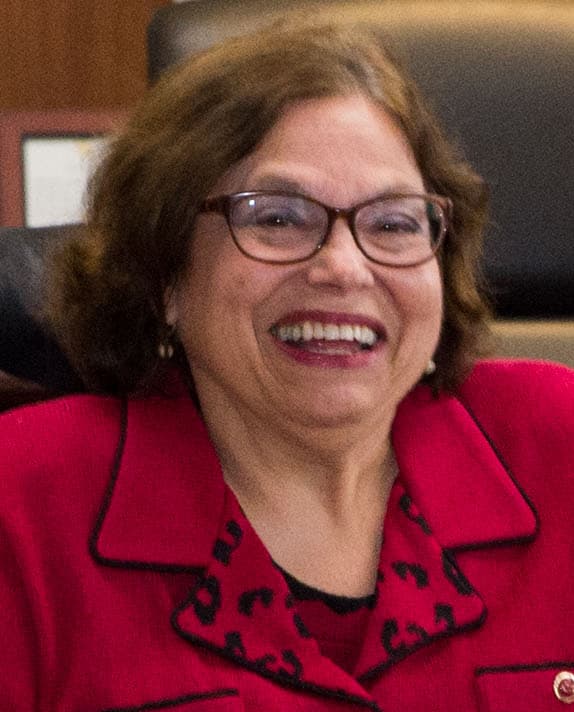
American · Activism · Law
Judith Heumann
December 18, 1947 – March 4, 2023
Early Life and Background
Judith Ellen Heumann was born on December 18, 1947, in Philadelphia, Pennsylvania, to Jewish German immigrants Werner and Ilse Heumann, who had fled Nazi persecution in the mid-1930s.[2][6][1] Shortly after her birth, the family settled in Brooklyn, New York, where her parents ran a small butcher shop.[1] Growing up as the child of Holocaust survivors shaped Heumann’s understanding of state violence, exclusion, and the necessity of collective resistance.[1]
At approximately 18 months of age, Heumann contracted polio in Brooklyn and became a wheelchair user.[4][1][15] In mid-20th-century America, polio was a feared epidemic, and rehabilitation and education for disabled children were limited and segregated. Local public schools refused to enroll her, labeling her a “fire hazard” and deeming the building inaccessible.[1][10][15] Until age nine, she was either educated at home or in a “special” school for disabled children, experiences that taught her how policy decisions could systematically exclude disabled people from public life.[1][10]
Heumann’s parents advocated relentlessly for her education, and their insistence on her right to participate in community life became a model for her later activism.[1] As a teenager, she began to encounter disability-led communities, including summer camps like Camp Jened, where disabled youth experimented with self-governance, mutual support, and political consciousness.[3] These spaces helped Heumann see disability as a basis for solidarity and collective action rather than individual tragedy.
She attended Long Island University, earning a bachelor’s degree in 1969, and later obtained a master’s degree in public health from the University of California, Berkeley.[10][3] Her academic training in public health and policy provided tools that she would use to navigate and reshape governmental systems from the inside.
Career Beginnings and the Fight to Teach
Heumann’s early career was defined by direct confrontation with institutional discrimination. After completing her teacher education, she applied for a license with the New York City Board of Education. Despite passing the required written and oral examinations, she was denied solely because officials claimed her wheelchair posed a fire hazard.[10][1] This denial crystallized the ableist logic that treated disabled people as risks rather than rights-bearing citizens.
On March 6, 1970, Heumann filed the federal lawsuit Heumann v. Board of Education of the City of New York.[10][4] The case is widely recognized as the first disability civil rights case brought to U.S. federal court, reframing her exclusion as a matter of civil rights rather than administrative discretion.[4][10] Media coverage, including a New York Times article titled “Woman in Wheel Chair Sues to Become Teacher,” drew public attention to the injustice she faced.[10]
Following judicial pressure on the Board of Education to reconsider its position, Heumann was hired as a teacher. On June 29, 1970, she became the first wheelchair-using teacher in New York City’s public school system and, more broadly, the first wheelchair user to teach in New York State.[15][4][3] In practical terms, this required the school to make adjustments for her mobility and safety, demonstrating that accommodations were feasible and undermining arguments that disabled professionals were inherently unfit for standard employment.
Her success in securing the license and position inspired other disabled people to contest discriminatory policies. It also demonstrated how individual legal action could catalyze broader changes, foreshadowing the role she would play in larger legislative struggles.
Organizing and the Emergence of Disability Rights
In the early 1970s, Heumann moved from individual litigation to movement-based organizing. She helped found Disabled in Action, a disability-rights organization that organized demonstrations, lawsuits, and advocacy campaigns for accessible transportation and public buildings.[4][7][5] The group protested in New York City against buses and subway stations that were inaccessible to wheelchair users, arguing that public services funded by taxpayers should be open to all.
During this period, Heumann and her peers situated disability rights within the broader civil-rights ecosystem. They drew strategic lessons from movements led by Black activists, feminists, and antiwar organizers, emphasizing direct action, coalition building, and media engagement. Heumann’s activism contributed to shifting disability from a medical issue to a civil-rights cause in the public imagination.
In 1972, after President Richard Nixon vetoed an early version of the Rehabilitation Act, Heumann joined advocates pressing for federal recognition of disability civil rights.[4][10] The ensuing campaigns laid groundwork for the passage of the Rehabilitation Act of 1973, including Section 504, which prohibited discrimination on the basis of disability in programs receiving federal financial assistance.[2][6][14]
Heumann worked in Washington, D.C., including a period in the mid-1970s for a U.S. senator, contributing to policy discussions that would lead to the Education for All Handicapped Children Act, later renamed the Individuals with Disabilities Education Act (IDEA).[10][1] This law guaranteed the right to a free appropriate public education for children with disabilities, reflecting the very issue that had shaped her childhood exclusion.
The 504 Sit-in and Federal Civil-Rights Enforcement
Although Section 504 became law on September 26, 1973, the federal government delayed issuing regulations needed to implement it.[2][14] For years, agencies avoided specifying how schools, hospitals, and other institutions should achieve accessibility and non-discrimination. Heumann and other activists recognized that without regulations, the law’s protections remained largely symbolic.
On April 5, 1977, Heumann helped launch the San Francisco Section 504 sit-in at the Department of Health, Education, and Welfare’s regional headquarters at 50 UN Plaza.[6][14][3] Disabled activists occupied the building, demanding that HEW Secretary Joseph Califano sign strong regulations for Section 504. The protesters included wheelchair users, blind and low-vision people, Deaf activists, people with chronic illnesses, and allies.
Inside the building, Heumann emerged as a key leader and negotiator. She coordinated delegations, delivered speeches articulating the stakes of the protest, and helped manage logistics such as attendant care, medical equipment, and food—often supplied by local organizations and unions.[14][3] The sit-in lasted nearly four weeks, widely described as the longest occupation of a federal building in U.S. history.[3][6]
Around April 28, 1977, the sit-in ended when the Carter administration approved and signed the long-awaited Section 504 regulations.[7][14] For the first time, there were enforceable federal civil-rights rules requiring entities that received federal funds to provide access and refrain from disability discrimination.[7][6] The victory validated direct action as a strategy and solidified Heumann’s status as a central architect of disability civil-rights enforcement.
Independent Living and Institutional Leadership
In the late 1970s and 1980s, Heumann played a major role in building the infrastructure of the independent living movement. She co-founded and led organizations such as the World Institute on Disability, working alongside other prominent activists including Ed Roberts.[1][4] These organizations promoted the principle that disabled people should control the services and policies affecting their lives, emphasizing community-based supports over institutionalization.
The World Institute on Disability and related initiatives conducted research, developed policy proposals, and offered technical assistance to governments and NGOs on disability inclusion.[1] Through this work, Heumann helped connect grassroots experiences of disabled people to high-level policy discussions, influencing the design of programs that supported independent living, vocational rehabilitation, and accessible transportation.
Heumann’s organizational leadership coincided with key legislative developments, including the Americans with Disabilities Act (ADA) of 1990, a landmark civil-rights law that extended protections against disability discrimination to private employers, public accommodations, and public services.[1][3][4][7] While the ADA’s passage was the product of many advocates, Heumann’s sustained policy work and public testimony contributed to the environment that made such comprehensive legislation politically possible.[13]
Federal Service: Education Policy and Implementation
On June 21, 1993, President Bill Clinton appointed Heumann as Assistant Secretary for the Office of Special Education and Rehabilitative Services (OSERS) in the U.S. Department of Education.[1][4] In this role, she oversaw programs implementing IDEA and the Rehabilitation Act, supervising efforts to ensure disabled students received appropriate services and accommodations in schools and that adults had access to rehabilitation services.
Heumann used her position to strengthen federal enforcement of disability laws, encouraging collaboration between state education agencies, school districts, and families.[1] She emphasized inclusive education, the inclusion of disabled students in general classrooms where possible, and the importance of transition services to support disabled youth moving from school to employment and independent living.
Her tenure at OSERS exemplified the principle of disabled leadership in governance: someone who had been excluded from school as a child now directed the federal office dedicated to making education accessible to disabled children nationwide.[1] While sources do not definitively label her as the first disabled person in such a role, they consistently note that she was one of the highest-ranking federal officials with a disability at the time.[10]
Global Development and International Disability Rights
In 2002, Heumann became the World Bank’s first Advisor on Disability and Development.[1][3][15] This pioneering role aimed to integrate disability considerations into the Bank’s global development projects, recognizing that around one billion people worldwide live with disabilities. She worked to ensure that development policies and programs addressed barriers faced by disabled people in areas such as education, employment, health care, and infrastructure.
Heumann’s work at the World Bank helped mainstream disability in international development discourse, emphasizing that poverty and disability are deeply intertwined and that inclusive development requires accessible schools, transportation, and public services.[3] Her efforts influenced donor policies and encouraged governments to consider disability in poverty-reduction strategies.
Between 2006 and 2008, Heumann was active in advocacy surrounding the UN Convention on the Rights of Persons with Disabilities (CRPD), which established an international human-rights framework for disabled people.[3][4][7] She participated in negotiations and worked with governments and NGOs to promote ratification and implementation. The CRPD reflected principles she had long championed: autonomy, accessibility, and full participation in society.
After participating in the Obama administration’s transition on disability policy around 2009, Heumann was appointed on September 28, 2010 as the first Special Advisor for International Disability Rights at the U.S. Department of State.[4][1][9] In this capacity, she advanced disability rights as a core element of U.S. foreign policy, engaging with partners worldwide to strengthen legal protections, data collection, and programmatic inclusion for disabled people.
Writing, Public Storytelling, and Cultural Impact
Heumann increasingly turned to storytelling as a form of activism. In 2020, she published her memoir Being Heumann: An Unrepentant Memoir of a Disability Rights Activist, co-authored with Kristen Joiner.[3][1] Released on February 25, 2020, the book recounts her life from childhood exclusion and early protests to national and international policymaking, offering readers an intimate view of disability rights struggles.
The memoir quickly became a key text in disability studies and social-justice education, used in classrooms and book clubs to illustrate how structural barriers intersect with personal experiences.[3] It foregrounded disabled voices and highlighted cross-disability organizing, intersectional identities, and the emotional labor of activism.
On March 25, 2020, Netflix released the documentary Crip Camp: A Disability Revolution, which prominently features Heumann.[3][10] The film traces how Camp Jened—a summer camp for disabled youth—helped foster a generation of activists, including Heumann, who would lead the 504 sit-in and influence the ADA. The documentary received critical acclaim and a duPont-Columbia Silver Baton, dramatically expanding public awareness of disability rights history.[10]
In 2022, Heumann co-authored a young-adult adaptation of her memoir titled Rolling Warrior: The Incredible, Sometimes Awkward, True Story of a Rebel Girl on Wheels Who Helped Spark a Revolution.[15][3] This version translated her story for younger readers, helping introduce adolescents to disability rights and encouraging disabled youth to see themselves as potential movement leaders.
Awards, Honors, and Recognition
Across her life, Heumann received numerous honors reflecting her status as a global disability-rights leader. She was widely referred to as the “mother of the disability rights movement” by activists, scholars, and institutions such as the National Park Service and the National Women’s History Museum.[6][1][11] Her contributions were highlighted in tributes by organizations including the Ford Foundation, Georgetown University’s Center for Child and Human Development, and the American Foreign Service Association.[13][14][9]
In 2017, Heumann was appointed a Senior Ford Fellow and worked with philanthropic organizations to establish structures such as the President’s Council on Disability Inclusion in Philanthropy, urging foundations to integrate disability rights into broader social-justice agendas.[13] Her work in philanthropy underscored that disability is a cross-cutting equity issue, relevant to education, health, economic justice, and civil rights.
Her role in Crip Camp was recognized indirectly through the film’s awards, which celebrated the storytelling of disability rights and brought more attention to her leadership.[10] Universities, nonprofits, and governmental bodies frequently invited her as a keynote speaker, and posthumous memorial lectures and programs continue to honor her work.[14][16]
Personal Life
Judith Heumann married Jorge (George) Heumann, who shared her commitment to disability rights and supported her extensive travel and public speaking.[3] They lived in various cities over the course of her career, including Berkeley, Washington, D.C., and New York, as she moved between roles in government, NGOs, and international organizations.[3]
While detailed public information about her immediate family life is limited, sources emphasize that Heumann’s personal relationships and networks of friends, attendants, and colleagues were integral to sustaining her activism.[3][4] She often highlighted the importance of community, interdependence, and mutual aid among disabled people, resisting narratives of individual heroism by situating her achievements within collective efforts.
Legacy and Historical Impact
Judith Heumann’s legacy is expansive. She played critical roles in the development, passage, or implementation of several landmark laws and frameworks: Section 504 of the Rehabilitation Act, the Education for All Handicapped Children Act / IDEA, the Americans with Disabilities Act, and the UN Convention on the Rights of Persons with Disabilities.[13][3][4][7] Her work helped embed the notion that disability rights are human rights in domestic and international law.
She championed the concept of "nothing about us without us," insisting that disabled people must lead decisions about policies and programs affecting them.[3][4] By serving in high-level government positions and international agencies, she demonstrated that disabled leadership is not only possible but essential. Her career helped normalize disabled presence in corridors of power and challenged institutions to address their own structural ableism.
Heumann also transformed public narratives. Through interviews, speeches, her memoirs, and documentaries, she reframed disability from a personal tragedy to a political identity tied to systemic barriers and collective resistance.[3][10] Her storytelling encouraged broader recognition of disability as a dimension of diversity and justice, influencing academic fields, activism, and media representation.
Her impact is visible in the increased accessibility of schools, universities, public transportation, and government buildings across the United States; in the more robust enforcement mechanisms for disability civil rights; and in global development programs that now routinely consider disability inclusion.[1][3][14] Generations of disabled activists cite her as a mentor and inspiration, and many organizations continue to build on frameworks she helped create.
Later Life and Death
In her later years, Heumann remained an active advocate, consultant, and public intellectual. She continued to speak at conferences, advise organizations, and mentor emerging leaders in disability rights around the world.[3][14] She engaged with digital platforms and community projects to ensure that disability history reached new audiences.
On March 4, 2023, Judith Heumann died in Washington, D.C. at the age of 75.[2][3][6][14] Her death prompted widespread tributes from the disability community, mainstream media, and institutions such as the National Park Service, the Ford Foundation, Harvard Law Review, and the American Foreign Service Association.[6][13][11][9][14] She was buried at Judean Memorial Gardens in Olney, Maryland.[5]
Obituaries emphasized her role as a "prime mover" in disability rights, noting that she had "been a part of almost every pivotal moment" in the U.S. disability rights movement.[1][9] Many memorials concluded not with closure but with calls to continue her work, reflecting her own insistence that disability justice requires ongoing vigilance and collective struggle.
Judith Heumann’s life story—from a child barred from school to a global leader influencing international treaties—epitomizes the transformation of disability rights over the second half of the twentieth century and the early twenty-first. Her legacy endures in law, institutions, and the everyday lives of disabled people who benefit from the freedoms she fought to secure.
Dated achievements
12 indexed.
- Dec181947Activism
Birth of Judith Heumann
Judith Ellen Heumann was born in Philadelphia, Pennsylvania, later becoming known as the 'mother of the disability rights movement.'
View details Judith Heumann - Britannica - Mar061970Law
Filed first U.S. federal disability civil rights lawsuit
Heumann filed Heumann v. Board of Education, the first disability civil rights case brought to U.S. federal court, after being denied a teaching license.