← All women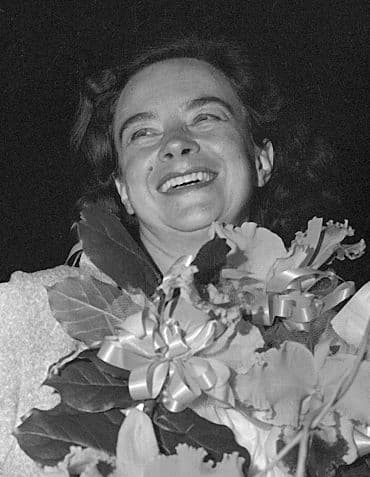
American · Aviation · Exploration
Jerrie Mock
November 22, 1925 – September 30, 2014
Early Life and Background
Geraldine “Jerrie” Lois Fredritz Mock was born on November 22, 1925, in Newark, Ohio, United States.[2][3][13] She was the daughter of Timothy and Blanche Fredritz.[13] Growing up during the Great Depression, she developed an early fascination with aviation. Multiple accounts note that she first flew in an airplane as a young child, an experience that left a powerful impression and sparked her desire to become a pilot.[1][3][16]
By the age of seven, around 1932, she already knew she wanted to be a pilot and disliked her given name, preferring “Jerrie,” the nickname that would stay with her throughout her life.[16] Her childhood interests extended beyond aviation; she was also curious about geography and foreign cultures, poring over atlases and imagining distant places she might one day visit.[1][4] This combination of aviation enthusiasm and global curiosity formed the foundation for her later ambition to fly around the world.
Mock attended Newark High School, graduating in 1943.[3] At a time when women were strongly discouraged from entering technical fields, she chose a path that defied expectations. After high school she enrolled at The Ohio State University, majoring in aeronautical engineering.[1][3][16] Sources emphasize that she was one of the first women aeronautical engineering students at the university and that she was reportedly the only woman in her engineering class.[1][16] She joined the Phi Mu sorority, balancing the social world of campus life with rigorous technical coursework.[1]
Her decision to study aeronautical engineering in the 1940s placed her within a tiny minority of women in U.S. engineering education, reflecting both her determination and the barriers she would face. Although she did not complete the degree—leaving Ohio State in 1945—she gained technical knowledge and confidence that later proved invaluable in planning and executing complex flights.[3]
Career Beginnings and Development
In 1945, Mock left Ohio State University to marry Russell Mock, beginning a partnership that would intertwine domestic life with aviation ambitions.[3][14] Russell was involved in radio and later broadcasting; some sources note that the couple worked together in the radio industry, which exposed Jerrie to technologies and communications practices that would later be useful in flight planning.[2][3]
Through the late 1940s and early 1950s, Mock focused primarily on raising their three children and running a household, yet she retained her interest in flying and global travel.[3][10] In the mid‑1950s, her aviation career began to take shape more concretely. Around 1956, she started flying lessons at a small airport near Columbus, Ohio.[16] She progressed rapidly, earning her pilot’s license approximately two years later.[16] At that time, the number of licensed women pilots was relatively small, and the role of “housewife pilot” challenged conventional ideas about what married women with children could or should do.
Mock soon became an active private pilot. She and her husband purchased a 1953 Cessna 180, which she flew on cross‑country trips and used to build experience in long‑distance navigation.[7][12] Her competence as a pilot grew alongside her familiarity with logistics such as fuel management, weather planning, and international clearances.
The idea of flying around the world emerged in 1962. According to later accounts, Russell jokingly suggested that she “fly around the world” to add some excitement to her life.[7] Mock took the suggestion seriously. Combining her childhood dreams of travel, her technical background, and her practical flying experience, she began researching the requirements for a global flight. She discovered that while men had already circumnavigated the globe by air, no woman had yet completed a solo flight around the world.[2][5][10] The possibility of becoming the first woman to achieve this milestone gave shape and urgency to her planning.
Planning the Round‑the‑World Flight
Mock’s preparation for the world flight was extensive and methodical. She worked with her husband and technical contacts to modify the Cessna 180 for long‑range travel, adding auxiliary fuel tanks, updating avionics, and equipping the aircraft—nicknamed Spirit of Columbus and affectionately called “Charlie”—for oceanic and desert crossings.[2][5][7][12] She also assembled maps, charts, and navigation aids for a route that would cross multiple continents and oceans.
Her planned route started and ended at Port Columbus Airport in Ohio, with stops in Bermuda, the Azores, North Africa, the Middle East, South Asia, Southeast Asia, the Pacific Islands, Hawaii, and California before returning to Ohio.[2][5][12] She had to secure permissions from numerous countries, coordinate fuel supplies, and prepare contingency plans for weather or mechanical issues. The logistics were complicated by the political climate of the early 1960s, including Cold War tensions and bureaucratic hurdles for a woman pilot seeking authorizations in countries where women rarely flew aircraft.[5][8]
Mock also faced time pressure. Another woman pilot, Joan Merriam Smith, was preparing a similar around‑the‑world flight, and the U.S. aviation community was aware that a race of sorts was underway.[10][12] Although Mock publicly downplayed any competitive motives, the parallel flights added an element of urgency and media interest.
The 1964 Solo Flight Around the World
On March 19, 1964, Mock departed Port Columbus Airport in Columbus, Ohio, at the controls of the Spirit of Columbus, commencing her attempt to become the first woman to fly solo around the world.[1][3][4][10][12] She was 38 years old and a mother of three, a fact that reporters repeatedly emphasized, often referring to her as the “flying housewife.”[5][10]
The journey lasted 29 days, with 21 stopovers and a total distance of about 23,103 miles (37,180 kilometers).[2][5][12] Early legs took her from Columbus to Bermuda and then to the Azores, followed by North Africa. She continued through Casablanca and then to Algiers, eventually crossing into Egypt and other points in the Middle East.[2][5][12] Navigation challenges were significant; at times, she flew by dead reckoning when radio navigation aids were unavailable.
During the journey, Mock achieved several notable firsts. She became the first woman to fly solo across the Pacific Ocean from west to east and the first woman to fly a single‑engine aircraft across the Pacific in either direction.[2][5][7] She was also the first woman to fly from the United States to Africa via the North Atlantic and the first woman to fly solo across both the Atlantic and Pacific Oceans.[2][5][7][13] In Saudi Arabia, she became the first woman to land a plane in that country, a milestone noted informally though not entered into official record books.[8][13] These accomplishments occurred as part of her larger circumnavigation, usually documented without exact day‑month dates but recognized collectively as breakthroughs for women in aviation.
Mock confronted multiple hazards, including storms, turbulence, and unexpected mechanical issues. In some regions, she encountered cultural barriers, such as skepticism from officials unaccustomed to women pilots, and she had to navigate language differences and bureaucratic delays.[5][7] Nonetheless, she maintained the schedule closely enough to remain on track for a successful circumnavigation.
On April 17, 1964, Mock touched down at Port Columbus Airport, completing the first solo flight around the world by a woman.[2][3][4][5][7][10][12][13] She had flown 23,103 miles in 29 days, 11 hours, and 59 minutes.[5][12] Thousands of spectators gathered to welcome her home; local accounts estimate crowds of several thousand people at the airport.[4][10] Her arrival was widely covered by newspapers, radio, and television, and she was hailed as a pioneering aviator, though often framed through the lens of domesticity.
Records and Technical Achievements
Beyond the headline achievement of being the first woman to fly solo around the world, Mock’s 1964 flight generated a cluster of officially recognized aviation records. Over the course of the circumnavigation, she set seven recognized aviation records, including speed around the world for Class C1‑c aircraft and feminine categories.[2][5][7][13] Additional records covered speed and distance on specific segments, such as:
- Guadalcanal to Rabaul
- Tarawa to Guadalcanal
- Columbus to San Juan
- Honolulu to Tarawa
- San Juan to Columbus
- Columbus to San Juan to Columbus
[5] These records reflect both her careful route planning and her ability to optimize performance within the constraints of her aircraft.
Mock continued to fly and compete in aviation record attempts through the late 1960s. Sources from Women in Aviation International note that she ultimately achieved 21 records for speed and distance between 1964 and 1969.[7] Her accomplishments demonstrated that a non‑military, non‑commercial pilot, equipped with determination and technical skill, could contribute meaningfully to the body of world aviation records.
Awards, Honors, and Recognition
Mock’s achievements were recognized both in the immediate aftermath of her flight and in subsequent decades. In 1964, she received the Federal Aviation Administration’s Gold Medal for Exceptional Service, presented by President Lyndon B. Johnson at a ceremony in the White House Rose Garden.[3][5][7][14] This decoration, one of the FAA’s highest honors, acknowledged her contributions to aviation and the demonstration of safe, long‑range flight operations in light aircraft.
In 1965, she became the first woman and first American to receive the prestigious Louis Blériot Medal, awarded by the Fédération Aéronautique Internationale (FAI) for notable achievements in aviation.[7] The medal historically recognized pioneering flights and technical improvements in aviation; Mock’s inclusion signaled international recognition of her circumnavigation as a major milestone.
Over later decades, Mock was inducted into several halls of fame and honored by museums and civic institutions. She is an enshrinee of the National Aviation Hall of Fame, which highlights her role as a pioneering pilot.[1] The City of Columbus established a local Hall of Fame that includes Mock among its honored figures, emphasizing her ties to central Ohio and Port Columbus Airport.[3] Women in Aviation International features her in its Pioneer Hall of Fame directory, underscoring her significance for women pilots.[7]
Various exhibitions and educational programs have highlighted her story. The Smithsonian National Air and Space Museum has produced editorial features detailing her flight and its technical aspects.[12] The National Women’s History Museum includes a profile emphasizing her role in women’s history and the barriers she overcame.[1] These recognitions collectively demonstrate how her achievements have been reframed from a novelty—"the flying housewife"—to a symbol of women’s capability in demanding technical domains.
Personal Life
Mock’s personal life was deeply intertwined with her aviation career. She married Russell Mock in 1945, and together they had three children.[3][10][14] Russell’s background in radio and communications played a practical role in the couple’s aviation activities, and he was supportive of her ambitions, helping with aircraft modifications and logistical planning for the world flight.[2][3][7]
Despite media portrayals that sometimes depicted her as a novelty—a housewife taking a break from domestic chores to fly around the world—Mock approached aviation with seriousness and professionalism. She carefully balanced family responsibilities with flight planning and record attempts.[5][10] Her success challenged the mid‑20th‑century assumption that married women with children could not or should not pursue demanding technical or adventurous endeavors.
Later in life, Mock lived in several locations, including Florida, and maintained connections to Ohio through family ties and commemorative events.[2][3] She granted interviews and occasionally participated in public programs, though she did not seek extended celebrity. Accounts from family members portray her as modest about her achievements and sometimes surprised that her 1964 flight continued to attract interest decades later.[16]
Later Life and Death
In the years after her record‑setting flights, Mock gradually stepped back from active competition, though she remained an important figure in aviation circles and women’s history. She continued to be referenced in publications and was the subject of biographies and educational materials, including The Jerrie Mock Story: The First Woman to Fly Solo Around the World, which presents her life for younger readers.[11]
Mock spent her later years largely out of the spotlight, living in Florida. On September 30, 2014, she died at her home in Quincy, Florida, at the age of 88.[2][3][6][14] Obituaries and tributes marked her passing by revisiting her 1964 flight and its significance. For many, her death served as a reminder of how easily women’s achievements can fade from public memory and how important it is to preserve such stories.[9][16]
Legacy and Historical Impact
Jerrie Mock’s 1964 solo flight around the world stands as a landmark in both aviation history and women’s history. As the first woman to complete a solo circumnavigation by air, she extended the lineage of women pilots who had pushed beyond conventional boundaries, following figures like Amelia Earhart while achieving a distinct, formally recognized record.[2][5][12]
Her legacy encompasses several dimensions:
- Aviation innovation: Mock demonstrated that a relatively modest, single‑engine aircraft could safely complete a long‑range, multi‑continent flight when properly modified and carefully piloted. Her records contributed data and experience to the understanding of small‑aircraft capabilities on global routes.[5][7]
- Women’s participation in STEM and exploration: By studying aeronautical engineering, earning a pilot’s license, and planning a complex global flight, Mock embodied a multidimensional technical competence that challenged stereotypes about women’s aptitudes.[1][16]
- Cultural impact: The media narrative of the “flying housewife” paradoxically highlighted and limited her achievement. While the phrase drew attention to her role as a mother, it also risked trivializing her skills. Later historiography has worked to reframe her story in terms of expertise, courage, and endurance.[5][10][12]
- Inspiration for future generations: Educational organizations, local historical societies, and national museums use Mock’s story to encourage girls and young women to pursue aviation and engineering. Her example shows that major technical achievements can emerge from outside traditional institutional pathways.[1][4][9][16]
Mock’s achievements also highlight the importance of record‑keeping and institutional recognition. The National Aeronautic Association’s 1964 announcement and the FAI’s awarding of the Louis Blériot medal helped ensure that her flight would not be forgotten or dismissed as a curiosity.[5][7] Today, the Spirit of Columbus and her records are part of the narrative that defines women’s contributions to aviation.
In local memory, particularly in Newark, Bexley, and Columbus, Mock is celebrated as a hometown hero who carried the name of her city—and the idea of women’s potential—around the world. In broader historical terms, she is recognized as an aviation pioneer whose courage and meticulous planning opened doors for subsequent women pilots and contributed to the gradual normalization of women in cockpits and technical careers.
Dated achievements
5 indexed.
- Nov221925Aviation
Birth of Jerrie Mock
Geraldine "Jerrie" Fredritz Mock was born in Newark, Ohio, later becoming the first woman to fly solo around the world.
View details Jerrie Mock - Wikipedia - Mar191964Aviation
Departure on solo round-the-world flight
Mock departed Port Columbus Airport in her Cessna 180 'Spirit of Columbus,' beginning her attempt to become the first woman to fly solo around the world.