← All women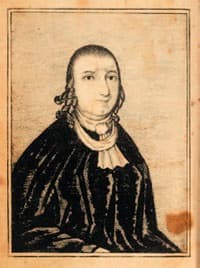
American · Activism · Science
Jemima Wilkinson
November 29, 1752 – July 1, 1819
Early Life and Background
Jemima Wilkinson was born on November 29, 1752, in Cumberland, Rhode Island, to Amy (Whipple) and Jeremiah Wilkinson, a well-respected Quaker family. Growing up in a devout community, she was influenced by the principles of simplicity, peace, and equality inherent in Quaker teachings. Her early education and upbringing were deeply rooted in the religious and moral codes of her society, which later informed her own spiritual journey.
Career Beginnings and Development
In 1776, during a severe illness where she was presumed near death, Jemima claimed to have been miraculously revived, declaring that Jemima Wilkinson had died, and in her place now lived the Public Universal Friend, a genderless spirit. Guided by this revelation, she began her mission to preach and establish a religious community. Her assertion of spiritual rebirth and the renouncement of gender was a radical departure from societal norms and led her to gather followers and establish the Society of Universal Friends.
Major Works and Accomplishments
The Society of Universal Friends emphasized gender equality, pacifism, and celibacy. Under her leadership, the community purchased land in the Finger Lakes region of New York and founded the town now known as Jerusalem. The Friend’s charismatic ability to gather followers and maintain a cohesive community was significant, showcasing her leadership and spiritual influence in an era where women's participation in religious leadership was rare.
Awards, Honors, and Recognition
While Jemima Wilkinson did not receive formal awards or honors in her lifetime, her legacy as a religious leader and early advocate for gender equality and non-binary identity continues to highlight her historical significance. Her formation of the Society of Universal Friends was a pioneering endeavor in American religious history.
Personal Life
Jemima Wilkinson lived a life that defied conventional gender roles and norms. As the Public Universal Friend, she never married or had children, instead dedicating her life to her religious mission. Her personal choice to live without traditional gender identity marked her as an early figure in the broader discourse on gender identity.
Legacy and Historical Impact
Jemima Wilkinson's legacy is marked by her role as one of the first American-born individuals to lead a religious movement. Her life challenges modern understandings of gender binary and offers an early example of gender non-conformity. The Society of Universal Friends influenced later religious and communal experiments, and her life continues to be studied as a manifestation of early American religious diversity.
Later Life and Death
Jemima Wilkinson continued her work with the Society of Universal Friends until her death on July 1, 1819. She spent her later years in the established community in New York, where her leadership remained unchallenged. Her passing marked the end of one of the early unconventional spiritual experiments in American history, leaving behind a community and a legacy of spiritual leadership.
Dated achievements
2 indexed.
- Nov291752Activism
Birth of Jemima Wilkinson
Jemima Wilkinson was born on November 29, 1752, in Rhode Island.
View details Public Universal Friend on Wikipedia - Jul011819Activism
Death of Jemima Wilkinson
Jemima Wilkinson died on July 1, 1819, marking the end of her religious leadership.
View details