← All women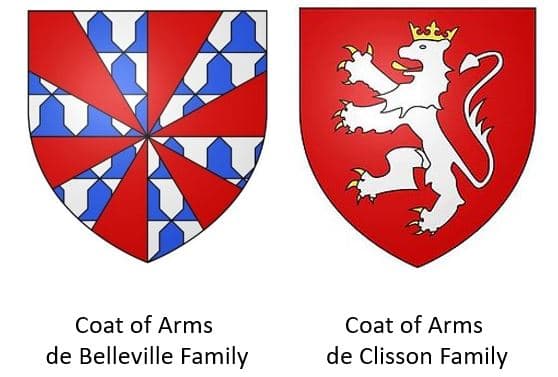
French · Exploration · Activism
Jeanne de Bellville
1300 – 1359
Early Life and Background
Jeanne de Belleville, also known as Jeanne de Clisson and remembered by epithets such as the Lioness of Brittany or the Breton Tigress, was born around 1300 into the French–Breton nobility, probably in Belleville-sur-Vie in Poitou (modern Vendée) in western France.[4][6][18] She came from a landowning noble family whose estates lay between Poitou and Brittany, a region that in the early fourteenth century formed part of a politically unstable frontier zone between Capetian royal power and competing aristocratic interests.[4][6] Very little is securely documented about her childhood or upbringing; as with many medieval noblewomen, later chroniclers focused on her marriages and political actions rather than her formative years.[3][6][11]
Nonetheless, it is clear that Jeanne received the kind of training customary for a noblewoman of her rank, including household management, estate administration, and familiarity with legal contracts and feudal obligations.[11][13] These skills would prove crucial later in life when she defended her marriage contract in court, managed lands through periods of war, and organized armed resistance by land and sea. Her Poitevin background also placed her at a cultural crossroads—between French royal authority and the semi-autonomous Breton aristocracy—an environment in which feudal loyalties were contested and the stakes of political conflict were high.[9][13]
Marriages and Noble Status
Like many aristocratic women of her era, Jeanne’s social and political position was shaped by marriage. Sources disagree on the exact sequence and identities of her husbands, reflecting the fragmentary nature of fourteenth-century documentation and centuries of legendary elaboration.[4][6][11][20] Some accounts state that she first married a Breton nobleman, Geoffroy de Châteaubriant, and was widowed relatively young, though this cannot be confirmed in primary sources.[6][15][20] A more firmly attested marriage is to Olivier III de Clisson
Jeanne’s marriage into the Clisson family elevated her into the upper tier of Breton nobility. As Dame de Clisson, she shared in the management of Clisson’s estates and participated in the complex network of alliances that linked Breton families to the French crown and, increasingly, to the English monarchy as tensions rose toward the Hundred Years’ War.[4][9][11] She bore several children, including a son who would later become Olivier V de Clisson, noted in later history as constable of France, one of the kingdom’s highest military offices.[4][11][13] Through motherhood, estate administration, and participation in local politics, Jeanne occupied a conventional but significant role within the Breton aristocratic order.
The surviving evidence also shows Jeanne asserting herself within the legal framework of noble marriage. Modern research summarized in regional press and historical studies notes that she initiated legal action—effectively a lawsuit—against Olivier de Clisson to enforce clauses of their marriage contract, particularly concerning her property rights and financial security.[13][9] This episode illustrates her familiarity with feudal law and her willingness to challenge her husband within accepted legal structures, foreshadowing her later, more radical opposition to royal authority.
Political Context: The Breton Succession and the Hundred Years’ War
Jeanne’s adult life unfolded against the backdrop of the Breton War of Succession (from 1341) and the wider Hundred Years’ War between France and England.[4][9][16] After the death of Duke John III of Brittany without direct heirs, rival claimants—Charles of Blois, backed by the French king Philip VI, and John of Montfort, supported by King Edward III of England—contested control of the duchy.[4][9][16] Breton nobles were forced to choose sides, often enmeshing local disputes in larger dynastic and international conflicts.
The Clisson family’s position in this struggle was complex, and later historians have debated Olivier de Clisson’s loyalties and the reasons for his downfall.[9][14][16] Some sources suggest he was suspected of sympathizing with the Montfort faction or of failing to support the French king vigorously enough; others emphasize personal rivalries and accusations of treason brought by political enemies.[11][16] Regardless of the precise cause, the key event that transformed Jeanne’s life was the arrest, trial, and execution of her husband on charges of treason in 1343, ordered by King Philip VI.[4][11][13][16]
The Execution of Olivier de Clisson and Jeanne’s Turn to Rebellion
According to the most widely cited accounts, Olivier de Clisson was arrested and tried for treason, found guilty, and executed in Paris in 1343 on the king’s orders.[4][11][16] Chroniclers and later commentators describe his punishment as particularly degrading: his body was hanged on the gibbet at Montfaucon outside Paris, while his severed head was displayed on the walls of Nantes, the principal city of Brittany.[8][16] These brutal public spectacles were meant to signal royal power and deter noble dissent.
Jeanne’s reaction to her husband’s fate became the centerpiece of her legend. She reportedly traveled to Nantes to see Olivier’s head mounted on the city ramparts and swore vengeance against King Philip VI and those she held responsible.[8][1][2] Contemporary records of her speech do not survive, but later narratives emphasize her determination to avenge the dishonor done to her family and to challenge the monarchy that had treated a Breton noble so harshly.[1][6][11] Her story thus joins a broader medieval tradition of widows who responded to political violence by entering the public sphere, sometimes through legal action and sometimes through armed resistance.
Following her husband’s execution, royal authorities confiscated much of the Clisson property and pursued Jeanne and her supporters.[11][16] Facing dispossession and danger, Jeanne left the conventional world of noble estate management and moved toward open revolt. She joined or organized armed bands of discontented minor nobles and retainers who attacked royalist supporters and royal property, operating both on land and, increasingly, at sea.[11][1][9]
From Noblewoman to Privateer and Pirate
The most famous phase of Jeanne’s life is her transformation into a maritime raider. Modern summaries, including the Library of Congress guide on French women and medievalist essays, describe her as becoming a privateer or pirate in the aftermath of Olivier’s execution, targeting French shipping in the English Channel.[1][2][4] According to these accounts, she formed alliances with the English crown, which, eager to weaken France during the early stages of the Hundred Years’ War, provided arms and ships to support her campaign against Philip VI.[1][11][2]
Jeanne is said to have raised a force of around 400 men and outfitted several warships, often described collectively as a small squadron.[1][2] One vessel, nicknamed the “Black Fleet” in later retellings, reportedly flew black sails and displayed the decapitated head of an axe-wielding figure as a kind of heraldic emblem—a grim reminder of Olivier’s execution and a warning to her enemies.[2][6][20] Her ships patrolled the Channel, attacking merchant convoys and naval vessels associated with the French crown. Some narratives emphasize that she spared few survivors, deliberately leaving one or two alive to carry word of her vengeance back to the king.[1][2][4]
Historians caution that many details of these episodes derive from later chronicles and romanticized retellings, and the precise scale and duration of her maritime activities remain debated.[14][6][9] While popular accounts often claim she pursued a 13-year career as a pirate or privateer, Dutch and French encyclopedic entries argue that this figure is likely exaggerated and that intense naval activity probably lasted for a shorter period, concentrated in the mid-1340s.[14][6][18] Nonetheless, there is broad agreement that Jeanne did command or direct ships in cooperation with English forces and that she targeted French royal interests at sea, an unusual and striking role for a woman of her time.
Alliance with England and Service to the Montfort Cause
Jeanne’s maritime actions fit within the broader strategy of Edward III of England, who sought to destabilize French control of Brittany by supporting the Montfort faction and other dissident nobles.[4][9][11] Encyclopedia entries and modern research indicate that Edward III loaned Jeanne arms and English warships, effectively commissioning her as a privateer whose attacks on French shipping complemented English military operations.[11][1][2] In this sense, she was not a purely independent pirate but a politically aligned raider whose activities served specific dynastic and strategic goals.
In Brittany, Jeanne’s support for the Montfort cause is evident in her later residence at Hennebont Castle, held by John of Montfort’s widow and allies during key phases of the Breton succession conflict.[3][5][16] Hennebont served as a strategic stronghold for Montfort supporters, and Jeanne’s presence there in her final years suggests close association with that faction. Her maritime raids in the Channel would have put additional pressure on French supply lines and royal supporters, underscoring her role as an actor in feudal and international warfare, not merely a figure of personal revenge.
The combination of personal vendetta, feudal loyalty, and international politics makes Jeanne’s career difficult to categorize in modern terms. Some historians emphasize her as a pirate, highlighting her attacks on commerce; others prefer privateer, noting that she operated with royal support from England; still others frame her as a rebel noblewoman waging irregular warfare.[4][6][9][11] Whatever the label, she clearly stepped far outside the conventional expectations for a medieval noblewoman, commanding armed men and ships and engaging directly in military operations.
Later Life: Return to Landed Status and Final Marriage
After several years of conflict, Jeanne appears to have gradually withdrawn from active raiding and returned to a more conventional noble lifestyle. Modern summaries, including maritime history blogs and secondary essays, suggest that by the mid-1350s she had ceased her most aggressive privateering activities.[2][14][9] A key marker of this transition is her final marriage, to Walter (Gautier) de Bentley, an English knight or courtier associated with Edward III.[2][11][20]
Sources describe Bentley as a prominent English commander in Brittany, and Jeanne’s marriage to him in the 1350s symbolized both her close ties to England and her reintegration into the structures of aristocratic society.[2][11][20] Through this union, she relocated more fully into the network of English-allied nobles in Brittany, continuing to hold lands and exercise influence but no longer functioning primarily as an independent raider. Some accounts date this marriage to around 1356, though surviving records do not offer precise confirmation.[2][11]
In her later years, Jeanne resided at Hennebont in Brittany, a stronghold of her Montfort allies.[3][5] The castle, held by Montfort supporters and featured in notable sieges during the Breton succession conflict, provided a secure base where she could live as a noble widow or wife, managing her affairs in relative stability. According to medieval women’s biographical compilations and regional archives, she died at Hennebont in 1359.[3][5][18]
Death
Jeanne de Belleville’s exact date of death is not known, but multiple reference works agree that she died in 1359, most likely at Hennebont Castle in Brittany.[3][5][18] She would have been close to sixty years old, an advanced age for the period, particularly for someone who had lived through multiple wars, disinheritance, and years of armed conflict. Her burial place is not securely documented, and no contemporary epitaph has survived, but local tradition in Brittany and Poitou remembers her as a figure associated with both regions.[3][6][9]
Unlike her husband Olivier de Clisson, whose execution was staged as a public spectacle, Jeanne’s passing appears to have been comparatively quiet, occurring after she had re-established her social position through her marriage to Walter de Bentley and her residence among Montfort allies. Yet her life story—moving from noble daughter to widow, rebel, maritime raider, and finally respected noblewoman again—left a durable imprint on regional memory and later historiography.[1][3][9]
Legacy and Historical Impact
Jeanne de Belleville’s legacy rests on several intertwined aspects of her life. She is widely remembered as one of the few medieval women to command armed forces on land and sea, crossing gender boundaries in military leadership and maritime warfare.[1][4][8] Modern popular accounts often describe her as the first female pirate or first female corsair in history or in France, though historians caution that such claims are difficult to verify and may reflect later romanticization.[6][7][12][18] Still, her documented role as a noblewoman leading raids and naval operations remains exceptional.
Within women’s history, Jeanne functions as an example of how medieval noblewomen could leverage their social position, legal knowledge, and personal networks to act as agents in political conflict. Her legal dispute with Olivier de Clisson over marriage contract terms, her decision to resist royal confiscation, and her organization of armed retaliation illustrate a spectrum of strategies—from litigation to armed rebellion—that women might employ in defense of their interests and honor.[11][13][9] This has made her a subject of renewed scholarly attention in studies of female power, widowhood, and political agency in the fourteenth century.[9][15][16]
In Breton and Poitevin regional memory, Jeanne is celebrated as a symbol of resistance to unjust royal authority. Local histories, municipal publications, and cultural programs depict her as a heroine who challenged the French monarchy’s treatment of Breton nobles and defended her family’s honor through extraordinary means.[6][7][13][17] She is sometimes invoked in discussions of regional identity and autonomy, as her actions intersected with the broader struggle over Brittany’s status vis-à-vis France and England.
In the broader popular culture of piracy and maritime legend, Jeanne’s story has been retold in television documentaries, blogs, and social media, often emphasizing the dramatic elements of vengeance, black-sailed ships, and ruthless attacks on French vessels.[2][8][15][20] These narratives occasionally blur the lines between documented history and imaginative reconstruction, but they also introduce wider audiences to the existence of a medieval woman who played an active role in sea warfare.
Historiographically, Jeanne’s case highlights the challenges of reconstructing women’s lives from fragmentary medieval sources. Much of the information about her comes from later chronicles, regional traditions, and nineteenth- and twentieth-century historians who sought to fill gaps with plausible conjecture.[6][9][15][18] Modern scholars increasingly distinguish between verifiable facts—such as her noble status, her marriage to Olivier de Clisson, his execution for treason in 1343, her association with English forces, and her death in 1359—and elements that may reflect legend, such as precise numbers of ships or men and dramatic speeches of vengeance.[4][11][14][16]
Despite these evidentiary limits, Jeanne de Belleville endures as a compelling figure in women’s and maritime history. Her life suggests that even in a period when formal political power was concentrated in male hands, noblewomen could and did intervene decisively in war and politics, sometimes in ways that confounded gender norms and reshaped the course of regional conflicts.[1][9][16]
Dated achievements
1 indexed.
- Aug021343Science
Execution of Olivier de Clisson
Jeanne's husband Olivier de Clisson was executed in Paris on charges of treason, an event that triggered her transformation into a vengeful pirate lord.
View details Jeanne de Clisson - Wikipedia