← All women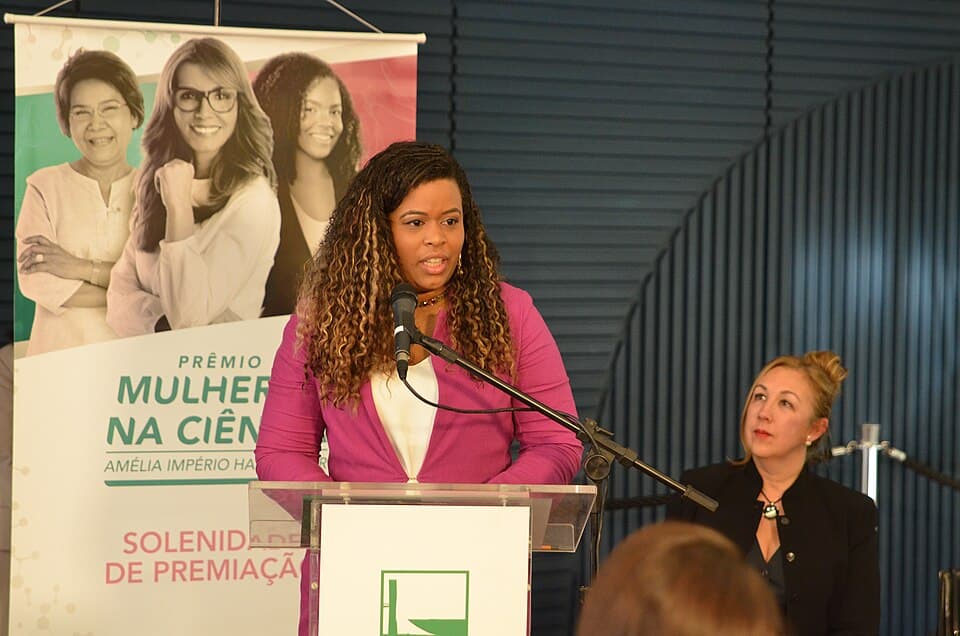
Brazilian · Science · Medicine
Jaqueline Goes de Jesus
October 19, 1989 – present
Early life and background
Jaqueline Góes de Jesus was born on 19 October 1989 in Salvador, Bahia, Brazil, in the country’s Northeast.[2] She has frequently described her family as a central influence in her life, emphasizing that her parents strongly encouraged her education and interest in science from an early age.[11][13] Growing up as a Black girl in a region marked by pronounced social and racial inequalities, she developed both an awareness of structural barriers and a determination to pursue a scientific career that could contribute to public health.
During adolescence, Góes de Jesus decided that she wanted to study Biomedicine, a field that combines biological science with clinical applications.[1][2] At that time, Black women remained underrepresented in laboratory sciences and academic research in Brazil, and she would later become a visible example of how such pathways could be opened and sustained.
Education and training
Góes de Jesus completed her undergraduate degree in Biomedicine at the Escola Bahiana de Medicina e Saúde Pública (EBMSP) in Salvador.[2][4][8][10] As an undergraduate, she engaged in scientific initiation projects at the Fundação Oswaldo Cruz (Fiocruz) Bahia, working with retroviruses and beginning to build the expertise in virology that would define her later career.[9] This early experience introduced her to research environments and helped integrate her into Brazil’s network of public health laboratories.
She then pursued a master’s degree in Biotechnology in Health and Investigative Medicine (Biotecnologia em Saúde e Medicina Investigativa) at the Instituto de Pesquisa Gonçalo Moniz, part of Fiocruz in Bahia.[4][8][10] Her graduate work continued to focus on infectious diseases and molecular biology, sharpening her skills in genetic and genomic techniques.
Góes de Jesus went on to earn a PhD in Human and Experimental Pathology (Patologia Humana e Experimental) from the Universidade Federal da Bahia (UFBA), in a joint program with the Gonçalo Moniz Institute of Fiocruz.[2][4][8][10] Her doctoral training consolidated her expertise in pathology and virology and exposed her to collaborative work between universities and public health institutions.
After completing her doctorate, she began a postdoctoral fellowship at the Instituto de Medicina Tropical da Universidade de São Paulo (IMT‑USP), funded by the São Paulo Research Foundation (FAPESP).[4][8][10] At IMT‑USP she joined research groups working on genomic surveillance of emerging and re‑emerging viruses, including arboviruses such as dengue, chikungunya, and yellow fever.[8][9][11]
Career beginnings and development
Góes de Jesus’s early career unfolded largely in the interface between academic research and public health. At Fiocruz in Bahia, she worked on projects involving retroviruses, including HIV and HTLV, which provided technical foundations in molecular virology and public health surveillance.[9]
During the Zika virus epidemic of 2015–2016, she participated in the ZIBRA Project (Zika in Brazil Real Time Analysis), an international collaboration led by Brazilian and British researchers that sought to sequence Zika virus genomes in real time to understand the spread of the epidemic.[2][3][5][11][13] Within this project, researchers deployed portable sequencing technologies in the field to generate genomic data and track transmission patterns. Sources describe Góes de Jesus as part of the team that sequenced the Zika virus genome and contributed to methodological advances in real‑time genomic surveillance.[2][3][5][11][13] This work helped establish the protocols and networks that would later be repurposed for SARS‑CoV‑2 surveillance.
As she transitioned into her postdoctoral position at IMT‑USP, Góes de Jesus became increasingly involved in genomic monitoring of arboviruses and other pathogens. Reports highlight her participation in studies of dengue, chikungunya, yellow fever, and other viruses relevant to Brazil’s public health landscape.[8][9][11] Through these projects, she honed her expertise with next‑generation sequencing platforms and bioinformatics analyses, positioning herself at the forefront of Brazil’s emerging field of pathogen genomics.
Parallel to her research activities, she built an academic career as a university professor. Biographical profiles note that she has served as a professor at the Instituto de Medicina Tropical at the University of São Paulo and as an adjunct professor of biochemistry at the Escola Bahiana de Medicina e Saúde Pública, combining teaching with active research.[2][4][5][8] Her dual engagement in São Paulo and Salvador enabled her to maintain ties with her home state while participating in one of Brazil’s major research hubs.
Major works and scientific accomplishments
Contribution to Zika virus genomic surveillance
During the mid‑2010s, Brazil faced a severe outbreak of Zika virus, associated with congenital malformations and neurological complications. Góes de Jesus joined international collaborations aiming to understand the virus’s spread through genomic analysis.[2][3][5][11][13] The ZIBRA Project deployed mobile sequencing devices to generate real‑time genomic data, enabling researchers to reconstruct transmission chains and estimate the timing of Zika’s introduction and expansion in Brazil.
Although the precise dates of specific sequencing runs are not always specified in public biographies, sources agree that Góes de Jesus’s participation in Zika genomics was a turning point in her career.[2][5][11][13] The experience familiarized her with portable sequencing technologies, logistical challenges of fieldwork, and the importance of rapid data sharing during health emergencies. Later accounts repeatedly emphasize that the technical and collaborative infrastructure developed for Zika laid the groundwork for the rapid genomic response to COVID‑19.
Rapid sequencing of SARS‑CoV‑2 in Brazil
Góes de Jesus became widely known during the COVID‑19 pandemic for her role in sequencing the virus responsible for the disease. In late February 2020, shortly after the first case of COVID‑19 was confirmed in Brazil, she coordinated a team at IMT‑USP and Instituto Adolfo Lutz that sequenced the SARS‑CoV‑2 genome from the initial Brazilian case.[1][2][5][9][11][14]
The team managed to generate and analyze the complete viral genome in approximately 48 hours after confirmation of the case, a speed that various reports describe as a record at the time and comparable to turnaround times achieved by leading institutions such as the Institut Pasteur in France.[1][2][11][14] On 28 February 2020, the sequence was publicly posted on the platform Virological.org, marking the first complete SARS‑CoV‑2 genome from Brazil to be shared with the global scientific community.[1][2]
This rapid sequencing had multiple consequences. It allowed researchers to trace the virus’s origin in Brazil, comparing the genome to international sequences to infer that the virus likely arrived via travelers from Europe.[1][2][11][14] It supported improvements in diagnostic assays by confirming target regions of the viral genome. The event also demonstrated Brazil’s capacity to carry out high‑quality genomic surveillance in real time, countering narratives that cutting‑edge genomic science was limited to high‑income countries.
Biographical and journalistic sources emphasize the symbolic dimension of this achievement: a young, Black, Brazilian woman scientist leading a team that delivered world‑class results under intense pressure.[4][5][9][11][12][14] Góes de Jesus has spoken publicly about both the scientific challenge and the representational significance of her visibility, explaining that she hopes her trajectory will inspire other Black girls and young women to see themselves in scientific careers.
Post‑pandemic genomic surveillance and international role
Following the initial sequencing milestone, Góes de Jesus continued working on SARS‑CoV‑2 genomic surveillance, contributing to efforts to track new variants and understand the evolution of the virus in Brazil.[5][11][12] Profiles of her work note that she has been involved in what is described as the post‑pandemic transition of genomic surveillance, helping to integrate the capacity built during the emergency into longer‑term systems for monitoring infectious diseases.[11]
Her expertise and public presence have led to invitations to speak in national and international forums. She has been featured in interviews with media outlets and institutions that highlight her role in defending the importance of science, public research funding, and diversity in STEM.[9][12][14] In 2024, she was selected as a panelist for the Nobel Prize Dialogue Brazil 2024, an event that brought together Nobel laureates and experts to discuss science and society, further consolidating her international profile.[3]
Awards, honors, and recognition
Góes de Jesus has received various forms of recognition for her scientific and public engagement work.
On 15 December 2020, the National Health Council (Conselho Nacional de Saúde, CNS) awarded her the Comenda Zilda Arns 2020 during its 327th ordinary meeting.[2][3] The CNS highlighted her coordination of the team that sequenced the SARS‑CoV‑2 genome in Brazil and her contribution to the defense of the right to health through science and public health research. The award is named after pediatrician and humanitarian Zilda Arns and is among the most important honors conferred by the Council.
Institutional and media profiles also mention that she has been named a science ambassador in Brazil by the Ministry of Science, Technology and Innovation, recognizing not only her research but also her role in communicating science and promoting representation of women and Black scientists.[5][12] Although specific dates for this appointment are not consistently documented in the available sources, it reflects her growing prominence as a public advocate for science.
Various organizations and campaigns have celebrated her as a symbol of women in science. She has been profiled by initiatives such as Mulheres na Ciência and science‑popularization projects, and has appeared in educational materials for children and youth that present her story as an example of perseverance and leadership in STEM.[5][10][15][17] Some media coverage has highlighted the creation of a Barbie doll inspired by her image as part of a campaign to honor women in science during the pandemic, underscoring her cultural impact beyond academia.[14]
Other sources note that she has received recognition such as the L’Oréal‑UNESCO‑ABC “For Women in Science” award in Brazil for work related to the spread of diseases between Brazil and Africa, although not all publicly available materials specify the exact date of the award.[11] Such honors collectively attest to the scientific and social significance of her career.
Teaching, mentorship, and science communication
Alongside her research, Góes de Jesus has been active in teaching and mentoring students. She has served as a professor and researcher at the Instituto de Medicina Tropical da USP and as an adjunct professor of biochemistry at the Escola Bahiana de Medicina e Saúde Pública, according to institutional profiles.[2][4][5][8] In these roles, she has supervised and guided students interested in virology, genomics, and public health.
She is also noted for her participation in science communication and outreach. Interviews and public talks emphasize her commitment to explaining scientific concepts in accessible language, particularly to young audiences from underrepresented backgrounds.[4][8][12][14][15][16][17] She has appeared in videos and campaigns aimed at encouraging girls to pursue STEM careers and has spoken about the importance of showing that scientists can come from diverse racial, regional, and socioeconomic backgrounds.
Through social media, lectures, and collaborations with media outlets, Góes de Jesus addresses topics such as the importance of vaccines, the role of genomic surveillance in preventing epidemics, and the structural obstacles faced by Black and female scientists in Brazil. Her combination of technical authority and personal experience has made her a sought‑after commentator on matters of science and society.
Personal life and identity
Publicly available sources focus primarily on Góes de Jesus’s professional activities and do not provide detailed information about her private life, such as marital status or children. In interviews and biographical notes, she emphasizes the influence of her family’s support for her education and her identity as a Black woman from Brazil’s Northeast.[11][12][14] She has framed her career trajectory as both a personal achievement and a collective reference point for those who share similar backgrounds.
Her public identity integrates multiple dimensions: scientist, professor, and advocate for representation. She has discussed experiencing and confronting racism and sexism within academic and scientific spaces, and she uses her visibility to highlight structural inequities in access to scientific careers.[4][5][12][14] In this sense, her personal narrative intersects with broader debates on race, gender, and regional inequality in Brazil.
Legacy and historical impact
Although still in mid‑career, Góes de Jesus has already had a notable impact on both science and society in Brazil and beyond.
Scientifically, her work in real‑time genomic surveillance—first with Zika and later with SARS‑CoV‑2—has contributed to emerging models of how countries can detect and respond to infectious disease threats. Her leadership in the rapid sequencing of the coronavirus in Brazil demonstrated that public research institutions in the Global South can produce timely, high‑impact data crucial to global health responses.[1][2][5][11][14]
Socially and culturally, she has become a symbol of Black women’s presence in science in Brazil. Media profiles, institutional campaigns, and educational materials highlight her as an example of how perseverance, public education, and family support can overcome structural barriers.[5][10][11][12][14][17] Her story is now used in schools and outreach programs to encourage girls, particularly Black and low‑income students, to consider careers in science and technology.
In policy and public discourse, Góes de Jesus serves as a voice in defense of science and representativity. Interviews stress her advocacy for sustained investment in research infrastructure, fair working conditions for scientists, and inclusive policies that open opportunities for underrepresented groups.[4][8][12][14] Her designation as a science ambassador and participation in global forums such as the Nobel Prize Dialogue reinforce her role as a connector between Brazilian science and international debates.
Because of this combination of scientific achievement and public engagement, commentators have suggested that her legacy will be measured not only in publications and data sets but also in the generation of students and researchers who see in her a mirror of their own possibilities.
Later career and ongoing work
As of the mid‑2020s, Góes de Jesus continues to live and work in Brazil. She is engaged in research on the post‑pandemic transition of genomic surveillance, exploring how tools and networks built during the COVID‑19 emergency can be adapted to long‑term monitoring of a range of infectious diseases.[5][11][12] She remains affiliated with academic and research institutions such as IMT‑USP and EBMSP, combining laboratory work, teaching, and public outreach.[2][4][5][8]
Her participation as a panelist at the Nobel Prize Dialogue Brazil 2024 illustrates her ongoing involvement in high‑level discussions about science, health, and society.[3] At the same time, she continues to collaborate with initiatives aimed at promoting women and Black people in science, reinforcing her dual commitment to excellence in research and to equity in who gets to produce scientific knowledge.
Góes de Jesus remains an influential figure in Brazilian and Latin American science, representing a generation of researchers who emerged from public universities and research institutes and who see their work as inseparable from broader struggles for social justice and public health.
Dated achievements
4 indexed.
- Oct191989Science
Birth of Jaqueline Goes de Jesus
Jaqueline Goes de Jesus was born on October 19, 1989, in Salvador, Bahia, Brazil.
View details Jaqueline Goes de Jesus - Wikipedia - Feb282020Science
First SARS-CoV-2 genome from Brazil sequenced and released
First SARS-CoV-2 genome from Brazil was publicly posted by Jaqueline Goes de Jesus's team on February 28, 2020.