← All women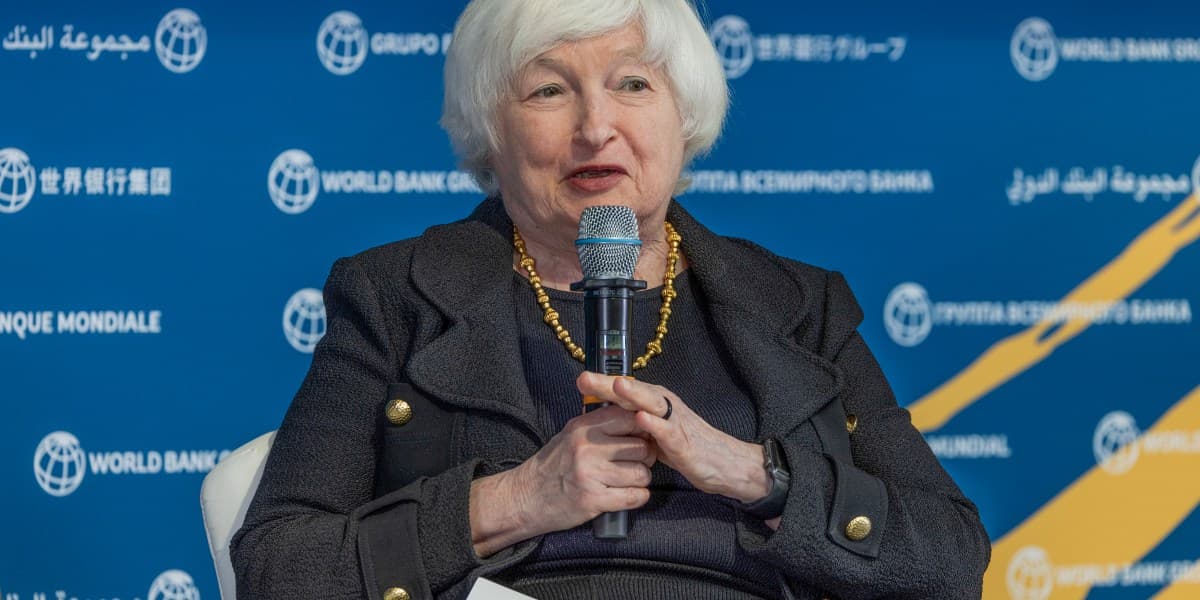
American · Politics
Janet Yellen
August 13, 1946 – present
Early Life and Background
Janet Louise Yellen was born on August 13, 1946, in Brooklyn, New York, into a Jewish family rooted in the professional middle class.[3][5][9] Her father, Julius Yellen, was a family physician, and her mother, Anna (Blumenthal) Yellen, had worked as an elementary school teacher before focusing on raising their children.[5][12] Growing up in the Bay Ridge neighborhood, Yellen experienced the post–World War II economic expansion and the social change of mid‑century New York, contexts that later shaped her interest in the forces driving employment, income, and inequality.
Yellen attended local public schools and showed strong academic promise from an early age. She matriculated at Brown University, then the women’s college Pembroke College, where she majored in economics and graduated summa cum laude in 1967.[1][9][11] At Brown she developed a deep interest in macroeconomics and labor markets and studied under influential teachers who encouraged her to pursue graduate work at a time when relatively few women entered economics.
She continued her studies at Yale University, enrolling in the Ph.D. program in economics. Yellen completed her doctorate in 1971, writing a dissertation under prominent economists such as James Tobin and joining a cohort of future leading macroeconomists.[1][9] She was reportedly the only woman among 24 Ph.D. graduates in economics that year, highlighting the gender imbalance in the field and foreshadowing the pathbreaking character of her later career.[1][11]
Academic Career Beginnings
After earning her Ph.D., Yellen began her academic career at Harvard University, where she served as an assistant professor of economics from 1971 to 1976.[5][9] At Harvard she taught courses and conducted research on macroeconomic theory, labor markets, and unemployment, contributing to the emerging literature on the causes and consequences of joblessness. Her early academic work examined how wage rigidity and imperfect information could lead to involuntary unemployment, themes that would recur throughout her scholarly and policy writings.
In 1977, Yellen joined the Board of Governors of the Federal Reserve System as a staff economist, working there until 1978.[5][9] In this role she specialized in issues of international trade and finance, including the stabilization of currency exchange rates following the breakdown of the Bretton Woods system.[9] The experience provided her with firsthand exposure to central banking and international monetary policy, deepening her understanding of how macroeconomic decisions affected both domestic employment and global economic relations.
Yellen moved to the University of California, Berkeley, in 1980, where she joined the Haas School of Business and the Department of Economics.[6][9] At Berkeley she rose through the ranks to become the Bernard T. Rocca, Jr. Professor of International Business and Trade and later the Eugene E. and Catherine M. Trefethen Professor of Business Administration.[6][9] Her teaching and research focused on macroeconomics, unemployment, and international economics. She also served on the Panel of Economic Advisers for the Congressional Budget Office and as a senior adviser to the Brookings Panel on Economic Activity, underscoring her combination of academic and policy expertise.[9]
Research Contributions and Economic Views
Throughout her academic career, Yellen developed a reputation as a careful, empirically oriented macroeconomist. She co‑authored influential work with her husband, Nobel laureate George Akerlof, including research on efficiency wage theory—the idea that firms may pay wages above the market‑clearing level to improve worker productivity and reduce turnover, with implications for persistent unemployment.[9][11] Her scholarship examined the mechanisms behind labor market frictions, wage setting, and the social costs of job loss.
Yellen was known for her emphasis on the human dimension of macroeconomic outcomes. She argued that policymakers should take the real consequences of unemployment seriously and balance inflation concerns with the need for broad‑based employment. This focus on labor markets and inclusive growth later shaped her leadership at the Federal Reserve and the Treasury.
Entry into National Economic Policy: Federal Reserve Governor and CEA Chair
Yellen’s transition from academia to high‑level economic policymaking began in the 1990s. In February 1994, President Bill Clinton appointed her as a member of the Board of Governors of the Federal Reserve System.[9] As a governor, she participated in monetary policy decisions and regulatory oversight at a time marked by debates over inflation, globalization, and financial stability.
On February 18, 1997, after Senate confirmation, she was sworn in as Chair of the Council of Economic Advisers (CEA) in the Clinton administration.[9] In this role, which she held until 1999, Yellen advised the president on macroeconomic policy, labor markets, and international economic issues. She helped shape economic strategies during a period of strong growth, low unemployment, and fiscal consolidation, including discussions about the federal budget and the economic implications of trade liberalization.[9]
Her tenure as CEA Chair also saw her involvement in public communication about economic conditions and policy rationales, further enhancing her profile as a bridge between technical economics and practical governance.
Leadership at the Federal Reserve Bank of San Francisco
In the early 2000s, Yellen returned more directly to central banking. She became President and Chief Executive Officer of the Federal Reserve Bank of San Francisco, assuming office on June 14, 2004.[3][6] The San Francisco Fed oversees a large and economically significant district that includes nine western states, among them California and Washington.
As president, Yellen was responsible for supervising regional banks and financial institutions, analyzing economic conditions across the district, and contributing to the deliberations of the Federal Open Market Committee (FOMC), the body that sets U.S. monetary policy. She was widely noted for her rigorous analysis and her concern for financial stability and labor‑market health.
Crucially, Yellen’s tenure in San Francisco coincided with the build‑up to the 2008 global financial crisis. She was among those who warned about potential risks associated with the housing market and rising leverage in the financial system.[12] Although the crisis still unfolded with severe consequences, her early caution and subsequent focus on recovery further established her reputation as a thoughtful, risk‑aware central banker.
Yellen’s presidency at the San Francisco Fed made her the first woman to serve as president and CEO of that Reserve Bank, marking an important step forward for women in central banking leadership.[6][1] She continued in the role until 2010, when she was elevated to the Federal Reserve Board’s vice chairmanship.[1][6]
Vice Chair and Chair of the Federal Reserve
In 2010, Yellen became Vice Chair of the Board of Governors of the Federal Reserve System, serving in that capacity until 2014.[6] Her appointment to the vice chair post further cemented her influence on U.S. monetary policy during the aftermath of the financial crisis, a period characterized by slow recovery, unconventional monetary tools, and intense scrutiny of the Fed’s role in stabilizing the economy.
On February 3, 2014, Yellen was sworn in as Chair of the Federal Reserve, succeeding Ben Bernanke.[3][2][12] She thus became the first woman to lead the U.S. central bank and, effectively, one of the first women to head a major global central bank.[2][1] Her four‑year term ran until early 2018.[3][2]
As Fed Chair, Yellen presided over the careful unwinding of the crisis‑era policies implemented under Bernanke. She oversaw the gradual reduction of asset purchases (quantitative easing) and the eventual increase of interest rates from near‑zero levels. Her approach emphasized data‑driven decision‑making, transparency, and clear communication, contributing to what observers described as a relatively smooth normalization of monetary policy despite market sensitivities.
Yellen also continued to highlight the importance of labor‑market indicators beyond headline unemployment, such as participation rates and underemployment, arguing that these measures should guide decisions about tightening monetary policy.[1][11] Under her leadership, the Fed began to place somewhat greater emphasis on employment outcomes in its public framing of policy trade‑offs.
Her term as chair ended in 2018, after which she left the Federal Reserve and returned to academic and policy commentary, including work with think tanks and public speaking on economic issues.[3][6]
Secretary of the Treasury and Historic Triple Leadership
Yellen’s most widely recognized barrier‑breaking achievement came with her appointment as United States Secretary of the Treasury. On January 25, 2021, the U.S. Senate confirmed her as the 78th Treasury Secretary by a vote of 84–15, making her the first woman ever to hold the office.[5][1] She was sworn in the following day, January 26, 2021, under President Joe Biden.[3][10]
As Treasury Secretary, Yellen played a central role in the federal government’s response to the COVID‑19 pandemic and its economic fallout. She helped design and oversee the implementation of major fiscal stimulus packages aimed at supporting households, businesses, and state and local governments, including measures to expand unemployment benefits and direct relief payments. She also engaged extensively in international economic diplomacy, working with global partners through the G7 and G20 forums on issues such as global recovery, debt relief, and international tax cooperation.[1][2]
Yellen’s tenure extended from January 2021 to January 2025, aligning with the first term of the Biden administration.[2][6][8] During this period she also oversaw Treasury’s regulatory responsibilities, including oversight of the Financial Stability Oversight Council and interaction with other financial regulators on systemic‑risk issues.
Her appointment completed a historic trifecta: Yellen became the first person in American history to have led all three major economic policy institutions of the federal government—the Council of Economic Advisers, the Federal Reserve, and the Department of the Treasury.[1][2][6] This unique combination of roles gave her an unparalleled perspective on the interaction of fiscal and monetary policy and the institutional architecture of U.S. economic governance.
Awards, Honors, and Public Recognition
Yellen’s trailblazing career has garnered numerous honors and widespread recognition. In the scholarly realm, she has been acknowledged for her contributions to macroeconomic theory and labor‑market analysis, including her work on efficiency wages and unemployment.[9][11] Her influence is reflected in textbooks, research citations, and the ongoing use of her ideas in policy debates.
Beyond academia, Yellen has become a symbol of women’s leadership in economics and finance. On September 18, 2017, she was featured on the cover of Time magazine’s "Firsts" issue, which celebrated women who had achieved historic breakthroughs across various fields.[13] The magazine highlighted her role as the first woman to serve as Chair of the Federal Reserve and her impact on central banking and economic policy.
In June 2026, the National Women’s Hall of Fame announced Yellen’s induction as part of its 2026 class, formally honoring her as the first woman Fed Chair and first female Treasury Secretary, and as the only person to lead the three top U.S. economic policy institutions.[6] The Hall of Fame, located in Seneca Falls, New York, recognizes women whose achievements have significantly advanced society; Yellen’s inclusion underscores the importance of economic leadership in the broader story of women’s rights and opportunities.
Various biographical works have further cemented her legacy, including detailed biographies and analyses of her career and policymaking style. For example, book‑length studies—such as those discussed in reviews from the Wharton Initiative on Financial Policy and Regulation—examine her steady ascent and her navigation of political and economic upheaval.[13][14]
Personal Life
Janet Yellen married George Akerlof, an eminent economist and future Nobel Prize laureate, in 1978
Yellen and Akerlof have one son, Robert, born in the late 1970s; he was noted in a 1990s biographical sketch as being a student at St. Albans School in Washington, D.C.[9] Yellen has occasionally referenced her family life in interviews, emphasizing the importance of balancing personal and professional commitments. Despite her high‑profile roles, Yellen has generally maintained a low‑key personal style, avoiding the trappings of celebrity and focusing on analytic work and public service. Biographical accounts describe her as meticulous, soft‑spoken, and deeply committed to evidence‑based policy.[12][13] Janet Yellen’s historical significance rests on both her substantive contributions to economic policy and her role as a barrier‑breaking woman in fields long dominated by men. As an economist, she helped shape the understanding of unemployment, wage setting, and macroeconomic stabilization. Her policy work across multiple administrations and institutions influenced how the United States responded to economic shocks, from the post‑Cold War transitions to the 2008 financial crisis and the COVID‑19 downturn. As a trailblazer, Yellen has served as the first woman to hold two of the most powerful economic positions in the United States: Chair of the Federal Reserve and Secretary of the Treasury.[1][2][6] She also stands as the first person ever to lead the CEA, the Fed, and the Treasury, giving her a singular place in American economic history.[1][2] These milestones have been widely cited as glass‑ceiling breakthroughs for women in economics, finance, and public administration. Her leadership style—emphasizing careful analysis, collegial deliberation, and attention to labor‑market conditions—has influenced debates about the goals and tools of central banking. Under Yellen, the Federal Reserve’s communication and policy framing increasingly highlighted employment outcomes and the lived experiences of workers, not only abstract price stability.[1][11] Yellen’s career also illustrates how women’s participation in economics has evolved since the mid‑twentieth century. From being the only woman among Yale’s economics Ph.D. graduates in 1971 to leading the world’s most prominent central bank and the U.S. Treasury, her trajectory reflects both individual accomplishment and the broader, still incomplete opening of elite economic roles to women. Her induction into institutional honors such as the National Women’s Hall of Fame demonstrates that economic policymaking is now recognized as a vital arena of women’s history, alongside suffrage, civil rights, and social reform. For students and early‑career economists, Yellen stands as a powerful example that rigorous scholarship combined with public service can transform both policy and perceptions of who belongs in positions of economic authority. After concluding her term as Secretary of the Treasury in January 2025, Yellen has remained an influential voice in economic debates through writing, speaking engagements, and advisory roles.[2][6][8] As Professor Emeritus at UC Berkeley’s Haas School of Business, she continues to be associated with academic life, although her primary public role has shifted to that of elder stateswoman and commentator on monetary and fiscal policy.[6] As of mid‑2026, Yellen is alive and active, frequently cited in discussions about central bank independence, inflation management, labor markets, and international economic cooperation.[6][13] Her ongoing contributions extend her legacy beyond her official tenures, reinforcing her status as one of the most important economists and economic policymakers of her generation.Legacy and Historical Impact
Later Life
Dated achievements
8 indexed.
- Aug131946Politics
Birth of Janet Louise Yellen
Janet Louise Yellen was born in Brooklyn, New York, beginning the life of a future trailblazing American economist and public servant.
View details Janet Yellen - Wikipedia - Feb181997Politics
Sworn in as Chair of the Council of Economic Advisers
Janet Yellen was sworn in as Chair of the White House Council of Economic Advisers under President Bill Clinton.