← All women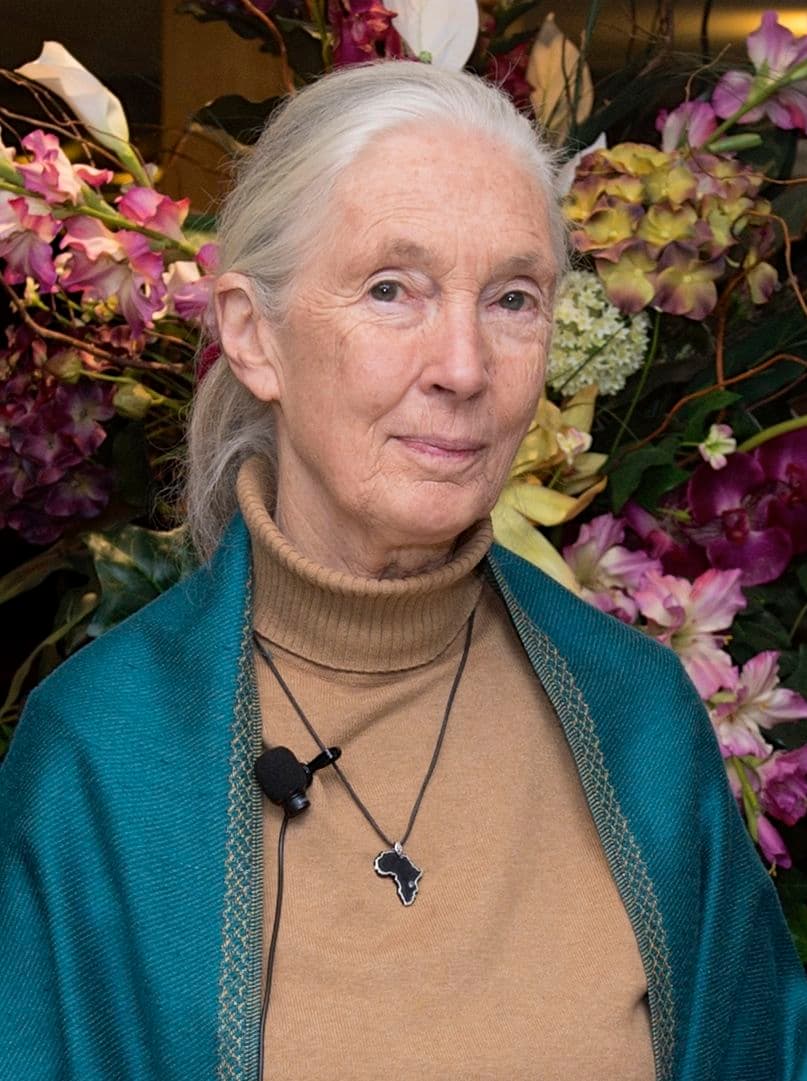
British · Science · Activism
Jane Goodall
April 3, 1934 – present
Early Life and Formative Influences
Valerie Jane Goodall was born on April 3, 1934, in London, England, to Mortimer Herbert Morris-Goodall, a businessman and race car driver, and Margaret Myfanwe Joseph, a novelist who wrote under the name Vanne Morris-Goodall. As a young child, Jane was given a lifelike stuffed chimpanzee toy named Jubilee by her father, which she credits with sparking her lifelong fascination with animals rather than frightening her, as some relatives feared it might. She grew up largely in Bournemouth, on the south coast of England, raised primarily by her mother after her parents separated during World War II.
From early childhood, Jane displayed an intense curiosity about the natural world. A famous family anecdote recounts a four-year-old Jane hiding for hours in a henhouse to observe how a hen laid an egg, an early demonstration of the patient, observational temperament that would define her scientific career. She devoured books about animals and Africa, particularly The Story of Doctor Dolittle and Tarzan of the Apes, and dreamed from a young age of traveling to Africa to live among wild animals—an extraordinary ambition for a girl of modest means in mid-20th-century England, when few women pursued careers in field science.
Goodall's family could not afford to send her to university, so after completing secondary school she trained as a secretary at a business college in London and took jobs including work at a documentary film company. She continued to nurture her dream of Africa, and in 1957, at the invitation of a school friend whose family had relocated to Kenya, she saved money working as a waitress to pay for the ocean voyage.
Arrival in Africa and Meeting Louis Leakey
Upon arriving in Kenya in 1957, Goodall sought out the renowned paleoanthropologist and archaeologist Louis Leakey, then curator of the Coryndon Museum in Nairobi, hoping for advice on working with animals. Leakey, impressed by her enthusiasm and depth of self-taught knowledge despite her lack of formal scientific training, hired her as his secretary and soon invited her to participate in fossil-hunting expeditions at Olduvai Gorge in Tanzania. Leakey believed that a researcher without preconceived academic biases about animal behavior might make keener, less prejudiced observations of great apes in the wild, and he specifically sought women for this type of long-term fieldwork, believing them to be more patient observers. Goodall became the first of what would later be called "The Trimates" or "Leakey's Angels"—along with Dian Fossey (gorillas) and Biruté Galdikas (orangutans)—a trio of women Leakey mentored to study humankind's closest living relatives.
Leakey arranged funding, and on July 14, 1960, Goodall arrived at what is now Gombe Stream National Park on the shores of Lake Tanganyika in Tanzania (then Tanganyika) to begin observing wild chimpanzees—an unprecedented undertaking, as no long-term scientific study of chimpanzees in their natural habitat had ever been attempted. British colonial authorities, unwilling to allow a young unmarried woman to live alone in the bush, required that she be accompanied; her mother Vanne joined her for the first several months.
Breakthrough Discoveries at Gombe
Goodall's early months at Gombe were marked by extreme difficulty, as the chimpanzees fled at the sight of her. Her patience eventually paid off: over time, one chimpanzee she named David Greybeard lost his fear of her and allowed her to observe him closely. In late 1960, Goodall witnessed David Greybeard stripping leaves from a twig and using it to "fish" termites out of a mound, and on another occasion using a stick to pry open a termite nest—the first documented instance of tool use and tool making by a non-human animal. This discovery was seismic: it upended the long-standing scientific definition of humans as the only tool-making species (famously prompting Leakey's remark, "Now we must redefine tool, redefine man, or accept chimpanzees as human"). She also observed chimpanzees eating meat, hunting cooperatively, and displaying complex social behaviors, dominance hierarchies, and long-term mother-offspring bonds—overturning the prevailing view of chimpanzees as strict herbivores and simple-minded animals.
Goodall's methodology also broke with scientific convention: rather than assigning numbers to research subjects, she gave the chimpanzees names—Flo, Fifi, Goliath, Mike, and others—and described their apparent emotions and individual personalities, a practice initially criticized by the scientific establishment as anthropomorphic and unscientific but later vindicated and widely adopted as it revealed the depth of chimpanzee cognitive and emotional life.
Lacking an undergraduate degree, Goodall was nonetheless admitted directly to a PhD program at Cambridge University in 1962 at Leakey's urging—an exceptionally rare occurrence. She earned her Ph.D. in ethology from Cambridge in 1965, becoming only the eighth person allowed to study for a doctorate there without first obtaining a bachelor's degree. Her dissertation drew on her first five years of observations at Gombe.
Institution-Building and Later Research
In 1965, Goodall established the Gombe Stream Research Centre to continue and expand long-term study of the chimpanzee community, which remains, decades later, one of the longest continuous wildlife studies in history. In 1977 she founded the Jane Goodall Institute (JGI) to support ongoing research at Gombe and to broaden conservation and community-based initiatives across Africa. Her observations during the 1970s also documented a darker side of chimpanzee behavior, including a four-year intercommunity conflict known as the Gombe Chimpanzee War (1974–1978), during which she documented organized violence, infanticide, and even cannibalism among chimpanzees—findings that further complicated the picture of chimpanzees as gentle, peaceful creatures and provided controversial insight into the possible evolutionary roots of human violence and warfare.
Her popular 1971 book, In the Shadow of Man, brought her research to a global audience and remains a landmark work of popular science writing. She published extensively thereafter, including the more technical The Chimpanzees of Gombe: Patterns of Behavior (1986), a comprehensive scientific summary of her decades of data.
Transition to Conservation and Activism
Following a 1986 conference in Chicago that revealed the scale of habitat destruction and the bushmeat trade threatening chimpanzees across Africa, Goodall shifted her focus from active field research to full-time conservation advocacy and public education. In 1991, she founded Roots & Shoots, a global youth-led community action and environmental education program that began with a small group of Tanzanian students and grew into a network active in over 60 countries, emphasizing hands-on projects to benefit people, animals, and the environment.
Goodall has since spent much of each year traveling roughly 300 days annually (prior to the COVID-19 pandemic) to lecture, meet with policymakers, and advocate for wildlife conservation, sustainable development, and animal welfare. She has campaigned against the use of chimpanzees in biomedical research and entertainment, championed sanctuaries for orphaned and rescued apes, and spoken widely on climate change and environmental sustainability.
Awards and Honors
Goodall's contributions have been recognized with numerous honors, including:
- Appointment as a Dame Commander of the Order of the British Empire (DBE) in 2004
- The Kyoto Prize in Basic Sciences (1990)
- The Benjamin Franklin Medal in Life Science (2003)
- Designation as a United Nations Messenger of Peace, beginning in 2002
- The Templeton Prize (2021)
- Numerous honorary doctorates from universities worldwide
- Fellowship and honors from National Geographic Society, whose grants funded her early research and whose films and magazine features brought her work to worldwide audiences
Personal Life
Goodall married twice. Her first husband was Dutch wildlife photographer and filmmaker Baron Hugo van Lawick, whom she married in 1964; their collaboration produced some of the earliest and most famous photographic and film documentation of her Gombe research, including celebrated National Geographic features. The couple had one son, Hugo Eric Louis van Lawick, nicknamed "Grub," born in 1967. The marriage ended in divorce in 1974. Later that year, Goodall married Derek Bryceson, a member of the Tanzanian parliament and director of Tanzania's national parks, who helped protect the Gombe research site from regional political instability; he died of cancer in 1980.
Legacy and Impact
Jane Goodall is widely regarded as the world's foremost authority on chimpanzees and one of the most influential scientists and conservationists of the 20th and 21st centuries. Her insistence on documenting individual personality, emotion, and social complexity in animals reshaped ethology, primatology, and comparative psychology, and her tool-use discovery remains a foundational moment in the modern understanding of animal cognition and human evolutionary origins. Beyond science, her decades-long advocacy work through the Jane Goodall Institute and Roots & Shoots has inspired generations of conservationists, scientists, and young activists worldwide. She continues, into her nineties, to serve as a global voice for wildlife protection, habitat conservation, and environmental stewardship, and remains an enduringly recognizable public figure through documentaries, books, and lectures.
Dated achievements
2 indexed.
- Apr031934Science
Birth of Jane Goodall
Valerie Jane Goodall was born in London, England, on April 3, 1934.
View details Jane Goodall - Wikipedia - Jul141960Science
Arrival at Gombe Stream to begin chimpanzee research
Goodall arrived at Gombe Stream in Tanganyika (Tanzania) to begin the first long-term study of wild chimpanzees.