← All women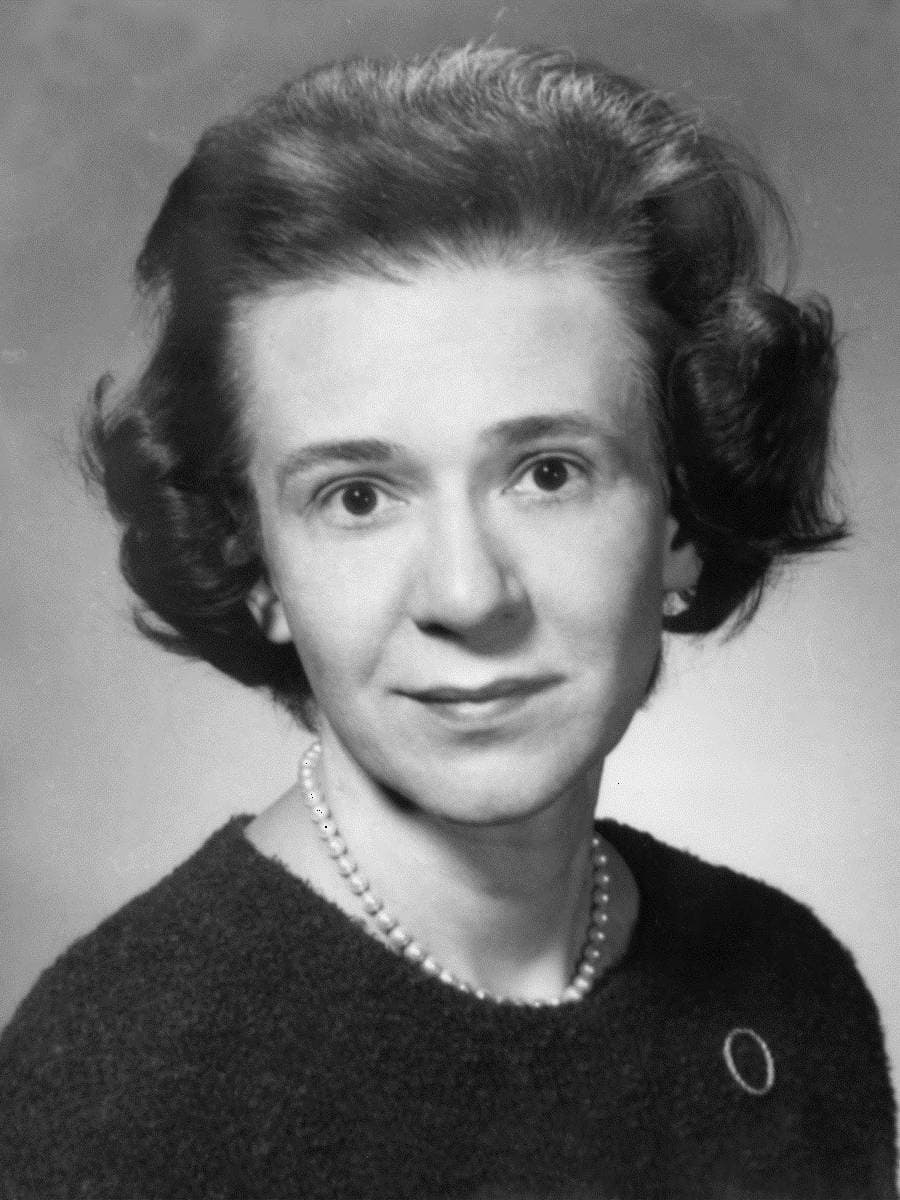
American · Science
Irene Stegun
February 9, 1919 – January 27, 2008
Early Life and Background
Irene Ann Stegun was born on 9 February 1919 in Yonkers, New York, United States, the daughter of Richard Stegun and Regina Skakandi Stegun. Both parents were immigrants from Central Europe, placing her within the broader story of early twentieth‑century immigrant families seeking economic security and educational opportunity in the United States.[1][2] Growing up in Yonkers, a working‑ and middle‑class suburb north of New York City, she came of age during the interwar period, when opportunities for women in advanced scientific fields were limited.
Details of her early schooling are sparse in the historical record, but biographical accounts agree that she demonstrated strong mathematical ability from an early age and initially trained as a teacher.[1][3] This route—moving from school teaching into applied mathematics—was relatively common for women of her generation, who often entered professional mathematics through education rather than through research fellowships or elite university posts.
Education and Formative Influences
After her initial teacher training, Stegun pursued further study in mathematics, ultimately completing a master's degree in mathematics at Columbia University in New York.[1][2][3] While exact dates for her graduate studies are not specified in available sources, they occurred during her employment in the Mathematical Tables Project, indicating that she combined full‑time technical work with advanced study.
One of the most important formative influences on her career was Gertrude Blanch, a Polish‑born mathematician who led the Planning Committee of the Mathematical Tables Project under the U.S. Works Progress Administration (WPA).[2][3] After a brief period teaching mathematics at a Catholic school in New York City, Stegun joined this committee. Under Blanch’s supervision she learned the basics of numerical analysis and large‑scale computation—skills that would later underpin her work at the National Bureau of Standards (NBS).[1][2][3]
The Mathematical Tables Project itself was a major New Deal initiative, designed to provide employment for mathematically trained workers while producing extensive tables of functions and constants for use by scientists, engineers, and the military. Participation in this project gave Stegun early exposure to collaborative computation, rigorous checking procedures, and the culture of government‑sponsored scientific work.
Early Career: The Mathematical Tables Project
Stegun’s mathematical career began during the Second World War.[1][2] The Mathematical Tables Project had by then become deeply involved in war‑related calculations, including ballistics, navigation, and other applications requiring high‑precision numerical tables. In this environment, Stegun advanced from a schoolteacher to a professional mathematical worker.
Sources note that while working on the project she completed her master’s degree at Columbia University, further solidifying her theoretical foundation in mathematics while she applied numerical methods in practice.[2][3] Under Blanch’s mentorship, she specialized in numerical analysis, learning techniques for approximating special functions and organizing teams of human “computers” who carried out calculations by hand or with mechanical aids.
The project accustomed Stegun to the demands of large collaborative efforts, where the accuracy of published tables depended on meticulous cross‑checking and editorial oversight. These experiences would prove essential when she later became co‑editor—and eventually sole editor—of one of the most influential mathematical handbooks of the twentieth century.
Transition to the National Bureau of Standards
In 1948, as the Mathematical Tables Project wound down, Stegun and several of her colleagues moved to Washington, D.C., where they helped establish the Computation Laboratory of the National Bureau of Standards (NBS).[2] This laboratory later became part of what is today the National Institute of Standards and Technology (NIST).[1][2]
At NBS, Stegun worked within the emerging Applied Mathematics Division, which focused on numerical methods, mathematical tables, and computational standards for federal agencies and the wider scientific community.[1] She was among the founding members of the division and was closely associated with Milton Abramowitz, a mathematician who would become her principal collaborator on the Handbook of Mathematical Functions.
Over time, Stegun rose in responsibility, eventually serving as assistant chief of the Computation Laboratory and later acting director (interim director) in the mid‑1960s.[2] These roles made her one of the relatively few women in senior positions within a major federal scientific laboratory, a fact that underscores both her technical credibility and her organizational skills in an era when management roles in science were overwhelmingly held by men.
Major Work: The Handbook of Mathematical Functions
Stegun’s most significant and enduring contribution to mathematics was her co‑editorship of A Handbook of Mathematical Functions with Formulas, Graphs, and Mathematical Tables, published by NBS in 1964 as Applied Mathematics Series 55 and universally known as “Abramowitz and Stegun”.[1] The handbook brought together an enormous range of information on elementary and special functions, including definitions, relations, approximations, and extensive numerical tables.
Initially, the project was led jointly by Milton Abramowitz and Irene Stegun. After Abramowitz’s death from a heart attack in 1958, Stegun assumed responsibility for managing the project and completing the volume.[2] She worked under the direction of Philip J. Davis, then Chief of Numerical Analysis at NBS, who also contributed to the book, but the day‑to‑day editorial coordination fell heavily on Stegun.
The handbook was conceived as a definitive reference for scientists and engineers needing reliable values and representations of functions used in physical models, engineering design, and statistical analysis. It included:
- Formulas and identities for trigonometric, exponential, logarithmic, and hyperbolic functions;
- Extensive coverage of special functions such as Bessel functions, Legendre functions, and elliptic integrals;
- Graphs illustrating qualitative behavior;
- Numerical tables enabling users to look up function values prior to the widespread availability of digital computers.
Published in 1964 (exact day not specified), the handbook quickly became one of the most frequently cited mathematical references in scientific and engineering literature.[1] For decades it was standard equipment in laboratories, universities, and industrial research departments worldwide.
Editorial Leadership and Technical Contributions
While the handbook is often associated with both Abramowitz and Stegun, historical analyses emphasize Stegun’s editorial leadership after 1958.[2] She organized contributions from numerous experts, coordinated typesetting and proofreading, and instituted rigorous checking procedures to minimize errors in tables that would be used for critical engineering applications.
Stegun’s role illustrates a broader phenomenon in mid‑twentieth‑century science: the central importance of editorial and organizational labor in large technical compilations. Such work often fell to individuals whose contributions were undervalued compared to those of theoretical authors. In Stegun’s case, however, her name on the cover and on subsequent reprints ensured that her role in shaping the handbook’s structure and reliability would be remembered.
Beyond the handbook, bibliographic databases list around 15 publications associated with Irene A. Stegun, including work on mathematical tables and special functions.[4] Her research contributions, though less widely publicized than the handbook, helped refine numerical methods and tables that were essential to practitioners before the routine use of electronic computation.
Awards, Honors, and Recognition
Stegun’s most prominent formal recognition was the Gold Medal of the United States Department of Commerce, awarded in 1965 for her role in completing the Handbook of Mathematical Functions.[2] The Gold Medal is the department’s highest honor, recognizing outstanding contributions with significant impact on the agency’s mission and on national scientific or economic interests.
Receiving this medal placed Stegun among a select group of scientists and engineers whose work was considered nationally important. It confirmed that the federal government regarded the handbook not merely as an internal technical report, but as a foundational resource for the broader scientific community.
In addition to the medal, Stegun’s handbook continues to be recognized by institutions such as NIST, which host digital versions and historical notes on its origins.[1] Timelines of women in science cite the 1964 completion and publication of the handbook as a major milestone, emphasizing that it was one of the few major scientific projects of its era led by a woman.[1]
Positions and Responsibilities at NBS/NIST
Within the National Bureau of Standards, Stegun’s career advanced beyond that of a typical staff mathematician. She served as assistant chief of the Computation Laboratory, and in the mid‑1960s she became acting director (sometimes described as interim director) of the laboratory.[2] These positions placed her in charge of managing personnel, overseeing computational projects, and liaising with other divisions and external agencies.
Her leadership roles coincided with a period when the Computation Laboratory was transitioning from manual and mechanical computation to electronic computing technologies. Managing this transition required both technical insight and organizational skill, as the laboratory had to integrate new machines, software systems, and numerical methods while continuing to provide accurate tables and standards.
Stegun’s ability to navigate these changes, while maintaining the quality of high‑profile publications such as the handbook, underscores her importance in shaping the computational infrastructure of NBS/NIST.
Personal Life
Public sources on Irene Stegun focus primarily on her professional achievements, and only limited information is available about her personal life. Her obituary notes that she lived for many years in Westchester County, New York, and later in Danbury, Connecticut, but does not detail marital status or children.[7] In keeping with the norms of mid‑century scientific culture, where women’s careers were often documented separately from their family lives, historical records emphasize her role as a mathematician and editor rather than her domestic arrangements.
This relative absence of personal detail has itself become noteworthy in the historiography of women in science, highlighting how the archival record can obscure aspects of women’s lives even when their professional contributions are well documented. Researchers must therefore rely mainly on institutional records, obituaries, and brief biographical notes rather than on extensive personal correspondence or memoirs.
Later Life and Retirement
After the success of the Handbook of Mathematical Functions and her service in leadership roles at NBS, Stegun gradually withdrew from active federal service. Sources do not specify the exact dates of her retirement, but by the late twentieth century she was no longer prominently involved in new NBS/NIST publications.[1][2]
She remained associated with the legacy of the handbook, which continued to be reprinted and distributed globally. As digital computation became dominant, the handbook’s tables were increasingly incorporated into software libraries and online databases, yet researchers and practitioners continued to cite "Abramowitz and Stegun" directly in scientific papers.
Stegun spent her later years in Connecticut, where she died in Danbury on 27 January 2008 at the age of 88.[1][7] Her obituary remembers her as a mathematician whose work touched many fields of science and engineering, even if her name was not widely recognized outside specialist circles.[7]
Death
On 27 January 2008, Irene Stegun died in Danbury, Connecticut.[1][7] She was 88 years old. The obituary published in a Westchester County newspaper notes her ties to the region and mentions her career at the National Bureau of Standards, underscoring the significance of her federal scientific service.[7]
Her death marked the end of a career that had spanned from the manual computation era of the 1940s to the age of digital computation. By then, the handbook she co‑edited had been in continuous use for more than four decades, and digital copies were beginning to reach new audiences online.
Legacy and Historical Impact
Irene Ann Stegun’s legacy rests primarily on the Handbook of Mathematical Functions, which has remained a cornerstone reference in applied mathematics and engineering since its 1964 publication.[1] Even in the twenty‑first century, when high‑precision computation is readily available, scientists and engineers continue to reference "Abramowitz and Stegun" for definitions, identities, and canonical tables.
From a historical perspective, the handbook symbolizes the culmination of decades of work in mathematical table production, beginning with the WPA Mathematical Tables Project and continuing through NBS’s Applied Mathematics Division. Stegun’s editorial role connects these phases, demonstrating how women contributed not only as "computers" but also as leaders who shaped large technical projects.
In the history of women in science, Stegun is frequently cited as an example of a woman who achieved prominence in a field—numerical analysis and mathematical tables—that was central to mid‑century scientific practice but often undervalued compared to pure theoretical research.[1] Her Gold Medal from the Department of Commerce underscores that federal institutions could, at times, recognize women’s technical leadership, even if broader cultural visibility remained limited.[2]
Institutional histories of NIST and scholarly timelines of women in science now include Stegun among the figures whose work underpinned the infrastructure of modern science. Her career illustrates the importance of editorial and organizational labor, and her life story provides a lens through which to examine the gendered division of labor in twentieth‑century mathematics.
In sum, Irene Ann Stegun stands as a key figure in the tradition of mathematical handbooks and tables. Her work continues to shape how generations of scientists and engineers access and apply mathematical functions, ensuring her place in both the technical and gender history of modern science.
Dated achievements
4 indexed.
- Feb091919Science
Birth of Irene Ann Stegun
Irene Ann Stegun was born on this day in Yonkers, New York.
View details Wikipedia: Irene Stegun - Jun011964Science
Publication of Handbook of Mathematical Functions
The influential Handbook of Mathematical Functions was published, co-edited by Stegun.
View details