← All women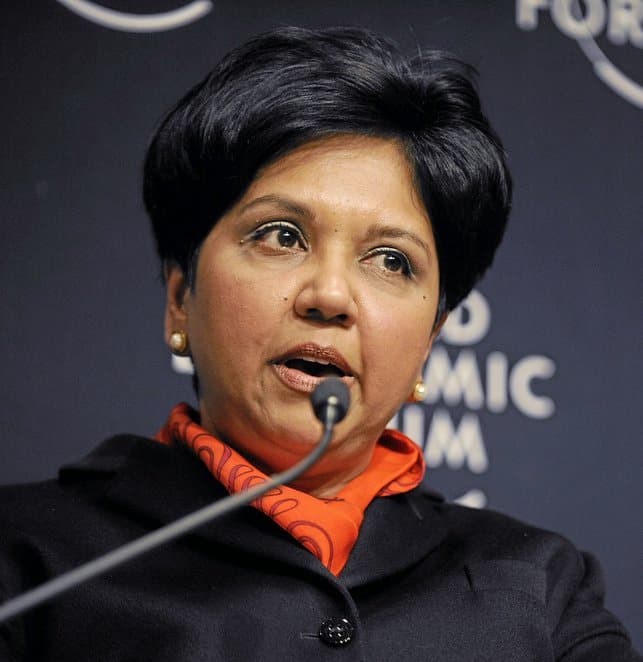
Indian, American · Politics
Indra Nooyi
October 28, 1955 – present
Early life and education
Indra Krishnamurthy Nooyi was born on 28 October 1955 in Madras, India, now Chennai.[1][2] She grew up in a Tamil-speaking family and later described her upbringing as one that emphasized discipline, ambition, and intellectual seriousness.[7][11] Sources describe her as academically gifted from an early age, and her education would become a defining feature of her career path.[9][11]
Nooyi studied at Madras Christian College, where she earned a bachelor’s degree in science, and then completed an MBA at the Indian Institute of Management Calcutta.[1][11] She later moved to the United States and earned a master’s degree in public and private management from the Yale School of Management in 1980.[1][11] This combination of Indian and American education helped prepare her for a career that would bridge markets, cultures, and management traditions.
Before becoming a globally known executive, Nooyi worked in India in product management roles and then continued her career in the United States. Her educational and professional path reflected both the limited options available to ambitious women of her generation and the growing possibilities created by transnational higher education and corporate globalization.[11]
Career beginnings
Nooyi’s early career included work in India and later in the United States, where she held positions at firms such as Boston Consulting Group, Motorola, and Asea Brown Boveri before joining PepsiCo.[11][9] Those roles gave her experience in strategy, operations, and finance, and they helped establish the reputation for analytical rigor that later made her a compelling candidate for senior leadership.
She joined PepsiCo in 1994 as senior vice president of corporate strategy and development.[1][2][7] Although the exact day of her start is not consistently documented in the supplied sources, her arrival marked the beginning of a career at PepsiCo that would last nearly a quarter century.[1][7] During the 1990s, she became associated with major strategic decisions, including restructuring and diversification efforts that helped shape the company’s portfolio.[1][9][11]
Secondary reporting also links Nooyi to PepsiCo’s major acquisitions and strategic shifts in the late 1990s and early 2000s, including transactions involving Tricon and Tropicana and the later Quaker Oats deal.[8][9][11] While the exact dates for those milestones are not fully verified in the supplied sources, they illustrate the breadth of her influence inside the company before she reached the top job.
Rise to the top of PepsiCo
In 2001, Nooyi was named president and chief financial officer of PepsiCo.[1][7] That promotion placed her at the center of the company’s financial and strategic leadership and set the stage for her eventual succession as chief executive.[1][2] Her work during this period reinforced her reputation as a long-range strategist with a strong grasp of capital allocation, portfolio management, and international expansion.
On 14 August 2006, Nooyi was named chief executive officer of PepsiCo.[1][5][7] This was a landmark appointment: she became the company’s first woman CEO and, as widely noted, the first woman of color and first immigrant to head a Fortune 50 company.[5][7][10] The appointment was historically significant because it broke multiple barriers at once in an industry and era where women remained dramatically underrepresented at the top of large global corporations.
Nooyi became chair of the board in 2007 and remained CEO until 2018.[1][2] Her tenure is closely associated with PepsiCo’s strategic framing around “Performance with Purpose,” a philosophy emphasizing financial success alongside environmental sustainability, healthier products, and social responsibility.[4][12] Under her leadership, the company expanded its focus beyond carbonated soft drinks and increasingly positioned itself as a diversified food-and-beverage enterprise.[1][5][11]
Leadership style and business impact
Nooyi’s leadership at PepsiCo was widely praised for balancing profitability with long-term strategic adaptation.[5][11] Women’s History sources note that during her 12-year tenure as CEO, the company’s annual net profit rose substantially, and its environmental and product-health initiatives became more prominent.[5] This approach made her a prominent example of a chief executive who sought to align corporate purpose with shareholder value rather than treating them as opposing goals.
Her management of PepsiCo also had a symbolic dimension. As one of the most visible women in global business, she frequently appeared in discussions about gender, leadership, work-life balance, and the challenges faced by immigrants in elite professional environments.[5][7][10] She became a reference point for debates over how corporations identify talent and for whether leadership pipelines adequately include women and minorities.
Nooyi’s public image combined authority with accessibility. She was often cited for her analytical style and her insistence on the importance of both business performance and social context.[4][12] These traits helped make her one of the most recognizable female executives of the 21st century.
Awards and honors
Nooyi received extensive recognition for her leadership. In 2006, Fortune ranked her number one on its list of Most Powerful Women in business, reflecting the scale of her influence even before her CEO tenure was fully underway.[9] In 2007, India awarded her the Padma Bhushan.[2]
She also received honorary degrees and honors from institutions including Babson College, New York University, Duke University, and Barnard College.[2] The supplied sources do not consistently document exact presentation dates for these honors, so they are best understood as year-level achievements rather than exact-date milestones. Their cumulative importance lies in the breadth of recognition she received from both business and academic institutions.
Nooyi also became a major philanthropist. Women’s History notes that her donation to Yale School of Management made her the school’s largest alumni donor and the first woman to endow a chair at a top business school.[5] This philanthropic legacy extended her influence beyond PepsiCo and into higher education and women’s leadership development.
Personal life
Nooyi is married to Raj K. Nooyi, and they have two daughters.[2] Her family life became part of the broader public discussion surrounding her career, especially because she later wrote and spoke about the difficulty of balancing professional ambition with caregiving and domestic responsibilities.[4][10] Her memoir, My Life in Full: Work, Family, and Our Future, explicitly frames those tensions as a social issue rather than a private one.[4][10]
In public remarks and in her book, Nooyi has emphasized that women’s advancement cannot be understood only as an individual challenge; it is also shaped by workplace design, social expectations, and access to support systems.[4][10] That perspective made her an important voice in debates about gender equity in management and the future of work.
Later career and legacy
Nooyi announced in August 2018 that she would step down as PepsiCo CEO later that year, ending a 24-year career at the company.[1][7] Her departure marked the close of an era, but her influence continued through board service, philanthropy, writing, and public commentary.[4][12] She later became a director at Amazon, according to German-language biographical coverage, though the supplied sources do not provide a detailed chronology of that post-PepsiCo role.[6]
Her memoir and public speaking have extended her impact into a broader conversation about leadership, family policy, and the representation of women at the highest levels of business.[4][10] She is widely remembered as a strategic thinker who reshaped PepsiCo while also redefining what a global corporate leader could look like.
Historically, Nooyi’s importance rests on several linked legacies: she was a barrier-breaking executive, a high-profile Indian American woman in a male-dominated field, and a proponent of a more socially conscious model of corporate leadership.[1][5][7] Her career is now frequently used to illustrate both the persistence of glass ceilings and the significance of those who break them.
Dated achievements
5 indexed.
- Oct281955Politics
Birth of Indra Krishnamurthy Nooyi
Indra Krishnamurthy Nooyi was born on October 28, 1955, in Madras, India (now Chennai).
View details Encyclopedia Britannica: Indra Nooyi - Aug172001Politics
Quaker Oats Acquisition Announced
Quaker Oats acquisition was announced on August 17, 2001, a strategic win for PepsiCo under Nooyi.