← All women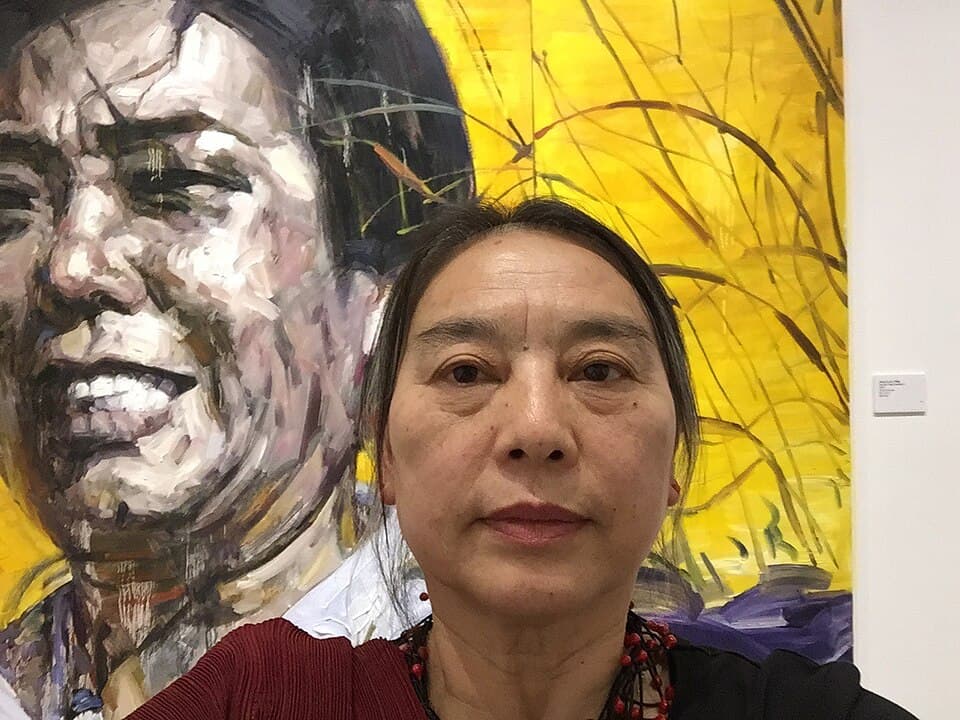
Chinese, American · Arts
Hung Liu
February 17, 1948 – August 7, 2021
Early Life and Background
Hung Liu (劉虹) was born in Changchun, Jilin Province, China, on 17 February 1948, two years after the start of the Chinese Communist Revolution and one year before the founding of the People’s Republic of China.[1][4][14] Her childhood unfolded under the emerging Maoist regime, whose political upheavals and campaigns against perceived class enemies shaped both her family’s fate and her later artistic concerns.[4][10][15]
Liu’s father, an officer in the Nationalist army, was arrested when the family crossed into Communist-held territory in search of food, an absence that left a lasting emotional mark.[4][10] Growing up amid scarcity and ideological pressure, Liu experienced the Great Leap Forward and, as a young adult, Mao Zedong’s Cultural Revolution (1966–1976). During this period, she was sent to the countryside for four years of agrarian "proletariat reeducation," laboring in rice and wheat fields alongside peasants.[3][10][12][16] This forced labor, combined with strict ideological monitoring, exposed her to the lives of rural workers whose stories she would later amplify in her paintings.
Despite these constraints, Liu pursued art education. She studied painting in the Soviet-influenced tradition of socialist realism, a style that demanded heroic, idealized depictions of workers, soldiers, and party leaders.[3][4][5][14] In the 1970s she completed degrees in art and education and began teaching, while quietly experimenting with more personal modes of expression. She produced hundreds of small landscape paintings in secret, describing the work as "having a dialogue with the wider world" beyond the rigid doctrine of socialist realism.[4] Only a fraction of these clandestine works survived, but they signaled her early resistance to artistic orthodoxy.
Artistic Training in Beijing
After her period of reeducation, Liu continued formal studies at the Central Academy of Fine Arts in Beijing, one of China’s premier art institutions.[5][6][14] There she specialized in mural painting and refined the technical skills that would later underpin her large-scale canvases and installations. Training at the Academy required her to master state-approved visual language, yet it also exposed her to broader art historical traditions, including European realism and monumental mural practices.
Within the intersecting pressures of political surveillance and academic discipline, Liu began to develop a personal visual vocabulary. She absorbed the detailed observation of realist painting but became increasingly interested in ambiguity, memory, and the emotional lives of ordinary people—concerns largely absent from official propaganda imagery. These tensions between state-sanctioned clarity and lived complexity would later inform her signature practice of layering, dripping, and partially obscuring images drawn from historical photographs.
Emigration to the United States and Graduate Study
In 1984, at the age of thirty-six, Hung Liu emigrated from the People’s Republic of China to the United States to pursue a Master of Fine Arts degree at the University of California, San Diego.[3][10][12][14] She was among the first artists from mainland China of her generation to study abroad and build an art career in the U.S., moving at a time when such exchanges were still relatively rare and logistically difficult.[12][14]
At UC San Diego, Liu encountered an experimental, conceptually driven art environment profoundly different from the orthodox realism of her Beijing training. She studied under performance artist Allan Kaprow, originator of "Happenings," and feminist art historian Moira Roth, both of whom encouraged boundary-pushing and critical reflection.[4][6][12][14] Kaprow famously led students to a junkyard and asked them to create art from found materials—a moment Liu later recalled as transformative, making her realize "there were no rules" and that she could make any kind of art she wished.[4]
This shift liberated Liu from the stylistic and ideological restrictions of her earlier training. In California she encountered conceptual art, performance, installation, and feminist critique, all of which informed the evolution of her practice. She earned her MFA in 1984 and remained in the United States, eventually settling in northern California, where she would live and work for the rest of her life.[2][7][14]
Career Beginnings in the United States
During the mid-1980s and early 1990s, Liu began to merge her technical mastery of realist painting with experimental strategies learned in San Diego. She relocated to the Bay Area and, in 1990, joined the faculty of Mills College in Oakland, where she taught for twenty-two years and was eventually named Professor Emerita.[5][6][12][14] Her teaching career allowed her to mentor generations of students, including many women and artists of color, and positioned her within a vibrant network of West Coast artists and institutions.
Liu’s early U.S. works explored personal and political themes of migration, identity, and memory. She began using photography as source material—initially family snapshots and documentary images—translating them into large-scale paintings that incorporated dripped linseed oil, layered washes of color, and symbolic motifs. This technique, later described as "weeping realism", fused the apparent objectivity of photographic documentation with the emotional and temporal instability suggested by paint that appears to dissolve or erode the image.[5]
Major Works and Conceptual Breakthroughs
One of Liu’s breakthrough works was "Resident Alien" (1988), created shortly after her arrival in the United States.[1][2] This large-scale painting appropriates the format of her U.S. "green card," enlarging it to monumental proportions and altering key details. Most notably, she replaced her legal name with the word "Fortune Cookie," a sharp commentary on stereotypes, exoticization, and the reduction of Asian identities to clichés in American culture.[1][2] By monumentalizing an administrative document, Liu highlighted the bureaucratic framing of immigrants’ lives while asserting her agency in reimagining that framing.
In 1994, Liu produced "Jiu Jin Shan (Old Gold Mountain)", a major installation work comprising a mound of approximately 200,000 fortune cookies piled atop intersecting railroad tracks.[2][7] The title references the nickname Chinese migrants gave to San Francisco during the Gold Rush era, and the installation addresses the history of Chinese laborers who built the transcontinental railroad and faced exploitation, racism, and legal exclusion. By using fortune cookies—a product often mistaken as Chinese but actually invented in California—Liu layered commentary on cultural misunderstanding, commodification, and the fragility of migrant dreams.
Throughout the 1990s, Liu deepened her engagement with historical photography. During travels back to China, she encountered 19th-century and early 20th-century photographs, including images of courtesans and other women whose lives were largely absent from official narratives.[13] These photographs became the foundation of many subsequent paintings, in which Liu reimagined anonymous figures with color, pattern, symbolic animals, and calligraphic marks, often embedding motifs from traditional Chinese art such as cranes, dragons, and decorative borders.[1][9][13]
In 2006, she completed "Going Away, Coming Home", a massive public installation at the Oakland International Airport depicting a flock of cranes.[7] Suspended overhead, the birds evoke migration, travel, and trans-Pacific movement, while referencing traditional Chinese symbolism in which cranes signify longevity and transcendence. The installation cemented Liu’s reputation as a significant public artist and introduced her work to thousands of travelers passing through the airport each day.
Signature Style and Thematic Concerns
Liu’s mature style is characterized by layered, drip-laden portraits based on historical photographs, often of people who were poor, marginalized, or forgotten: prostitutes, refugees, street performers, soldiers, laborers, prisoners, women soldiers, and orphaned children.[1][4][9][10] She typically began with a drawn or painted translation of the photograph, then applied washes of color mixed with linseed oil, allowing vertical drips to partially obscure the image. These drips, combined with stenciled patterns, Chinese characters, and recurring motifs (such as circles, animals, and halos), give her paintings a sense of temporal erosion and spiritual resonance.
Critics have described this technique as "weeping realism," suggesting that the image itself appears to cry or dissolve under the weight of history.[5] For Liu, the drips referenced both the passage of time and the instability of memory, challenging the idea of photographs as neutral records. By reworking archival images, she insisted on the emotional and ethical dimensions of looking at the past, especially when that past involves violence, displacement, and gendered vulnerability.
Liu’s work consistently addresses migration and diaspora. Many of her subjects are in motion—boats of refugees, workers on trains, women crossing barren landscapes—echoing her own experiences of exile and relocation. She also engaged with American histories of slavery, segregation, and immigrant labor, particularly in works that foreground Chinese railroad workers and other communities rendered invisible in mainstream narratives.[2][7][9]
Awards, Honors, and Institutional Recognition
Over the course of her career, Hung Liu received significant recognition from major institutions. She was a two-time recipient of Visual Arts Fellowships from the National Endowment for the Arts (NEA), underscoring national acknowledgment of her contributions to contemporary painting.[5][12] In 2011, the Southern Graphics Council International honored her with a Lifetime Achievement Award in Printmaking, reflecting her parallel practice in works on paper and her influence in the field of printmaking.[5]
Museums across the United States collected her work, including the Oakland Museum of California, San Francisco Museum of Modern Art, the Whitney Museum of American Art, the Metropolitan Museum of Art, the National Gallery of Art in Washington, D.C., the Asian Art Museum of San Francisco, and the Los Angeles County Museum of Art, among others.[5][9] These acquisitions positioned her not only as a key figure in Asian American art but also as a central contributor to the broader narrative of contemporary American painting.
In 2012, the NEA featured her in "Art Talk with Hung Liu," an interview highlighting her journey from forced labor in the Chinese countryside to international art recognition and exploring her practice of reworking historic photographs into haunting paintings and mixed-media pieces.[12] This profile further solidified her status as a nationally recognized artist whose work operated at the intersection of personal memory and public history.
Teaching, Mentorship, and Personal Life
Hung Liu’s long tenure at Mills College in Oakland was central to her impact. Beginning in 1990, she taught painting and drawing, eventually becoming Professor Emerita.[5][6][14] In this role, she mentored many young artists, encouraging them to explore their own histories and confront social and political issues through visual means. Her presence as a Chinese-born woman artist in a predominantly white, Western art academy was itself significant; she offered students a living example of transnational artistic practice and resilience.
Public sources focus more on Liu’s artistic and political life than on her private relationships. She lived in Oakland at the time of her death and balanced a demanding exhibition schedule with teaching and studio work.[2][6][7] She spoke frequently about her early experiences of forced labor, the disappearance of her father, and the dislocations of migration, suggesting that these personal histories were inseparable from her artistic production.[4][10][12] While detailed information about her family life, marriage, or children is not widely documented in major museum and press sources, her work itself reveals deep investment in the experiences of women and children affected by war, revolution, and poverty.
Later Career: Making History and Living Memory
In the 2000s and 2010s, Liu’s reputation continued to grow, and museums organized significant exhibitions of her work. The National Museum of Women in the Arts (NMWA) highlighted her art’s capacity to transform canvases and paper surfaces into "memorial sites" for women and children, emphasizing her role in representing individuals who risked being forgotten in death as in life.[9][13] Exhibitions such as "Hung Liu: Making History" and later "Hung Liu: Living Memory" at the Nasher Museum of Art at Duke University presented her as an artist who continually reinterpreted historical narratives through portraiture and symbolism.[9][15]
NMWA’s "Artist Spotlight" and "5 Fast Facts" features underscored key aspects of her practice: her use of drip-laden portraits, her reliance on historical photographs, and her focus on subjects such as prostitutes, refugees, laborers, and soldiers.[4][9][13] These profiles also traced her life story, linking her childhood under Mao, her four years of forced field labor, and her subsequent training and emigration to the themes that dominate her work. They framed Liu as an artist whose personal history dovetailed with major geopolitical shifts in China and whose work speaks to broader Asian American experiences of exile and cultural displacement.[3][10][15]
National Portrait Gallery Retrospective and Posthumous Recognition
Liu’s late-career recognition culminated in the Smithsonian National Portrait Gallery exhibition "Hung Liu: Portraits of Promised Lands", which opened on 27 August 2021.[8][13][16] The show surveyed fifty years of her portraiture, focusing on migrants, refugees, workers, and marginalized figures from both Chinese and American contexts, and it was notable as the first solo retrospective by an Asian American woman at the National Portrait Gallery.[8][13]
The exhibition’s curatorial framing emphasized Liu’s revolutionary approach to portraiture. By basing her paintings on archival photographs and then transforming them through color, drips, and layered symbolism, she challenged conventional notions of portraiture as a straightforward likeness of an individual.[1][13][19] Instead, her works became meditations on memory, trauma, and collective history. The show’s title, "Portraits of Promised Lands," referenced both the hopes and betrayals associated with migration and national narratives of opportunity.
Because the exhibition opened just weeks after Liu’s death, it also functioned as a memorial. Press coverage from NPR, KQED, and Smithsonian-affiliated outlets highlighted the poignancy of her absence and the significance of the museum’s recognition of an Asian American woman artist who had spent decades foregrounding marginalized lives.[8][10][13] The retrospective intensified posthumous attention to her work, prompting new essays, acquisitions, and educational materials that situate her among the most important portraitists of the late 20th and early 21st centuries.
Later Life and Death
In her final years, Hung Liu remained active as both an artist and teacher, continuing to live in Oakland, California, and working on ambitious projects that further explored themes of displacement, historical memory, and cross-cultural exchange.[2][6][7] She maintained close ties with institutions such as NMWA, the National Portrait Gallery, and Bay Area museums, and she participated in interviews and public programs that reflected on her journey from Maoist China to the U.S. art world.[9][12][16]
Liu was diagnosed with late-stage pancreatic cancer in 2021.[8] On 7 August 2021, she died in Oakland at the age of seventy-three, only weeks after her diagnosis and shortly before the opening of "Portraits of Promised Lands" in Washington, D.C.[1][2][8] Obituaries in outlets such as Artforum, NPR, KQED, CNN, and gallery statements described her as a "groundbreaking" and "revolutionary" artist whose work memorialized those "invisible" in conventional historical narratives.[1][2][8]
Legacy and Historical Impact
Hung Liu’s legacy is multifaceted. As a Chinese-born American artist, she bridged histories of Maoist China and the United States, using painting and installation to interrogate power, ideology, and the lived experiences of ordinary people.[1][3][10] Her practice foregrounded women, children, laborers, and migrants, insisting that their stories belong at the center of visual culture. By adopting and transforming historical photographs—often of anonymous subjects—she created a powerful language for reflecting on memory, loss, and survival.
She is widely recognized as one of the first artists from China to establish a sustained career in the U.S. art world, and her success opened space for subsequent generations of Chinese and Asian American artists.[1][12][14] Her conceptual work "Resident Alien" remains an iconic exploration of immigration and identity, frequently cited in discussions of diaspora art, while installations such as "Jiu Jin Shan (Old Gold Mountain)" and "Going Away, Coming Home" embody her commitment to public memory and the acknowledgment of historically marginalized labor.[2][7]
Liu’s impact is especially significant in the realm of women’s history. Institutions like the National Museum of Women in the Arts and the Smithsonian’s American Women’s History Initiative have emphasized how her art "keeps history close" by creating memorial sites for women and children affected by war, revolution, and poverty.[9][10] Her drip-laden portraits challenge viewers to confront both the beauty and the pain embedded in historical images, reconfiguring portraiture as a site of ethical engagement.
The National Portrait Gallery’s 2021 retrospective, the first of its kind for an Asian American woman, stands as a formal recognition of her role in reshaping American portraiture, and it serves as a landmark in the ongoing diversification of museum canons.[8][13] As scholars, curators, and artists continue to explore transnational histories and the politics of representation, Hung Liu’s work remains a vital touchstone—an enduring testament to how art can transform overlooked archives into powerful, empathetic narratives.
Dated achievements
2 indexed.
- Aug072021Science
Death in Oakland, California
Hung Liu died at age 73 in Oakland, California, of pancreatic cancer, weeks before her Smithsonian retrospective opened.
View details Artforum: Hung Liu (1948–2021) - Aug272021Science
First solo retrospective by an Asian American woman at the National Portrait Gallery
The Smithsonian's National Portrait Gallery opened 'Portraits of Promised Lands,' its first-ever solo retrospective by an Asian American woman.