← All women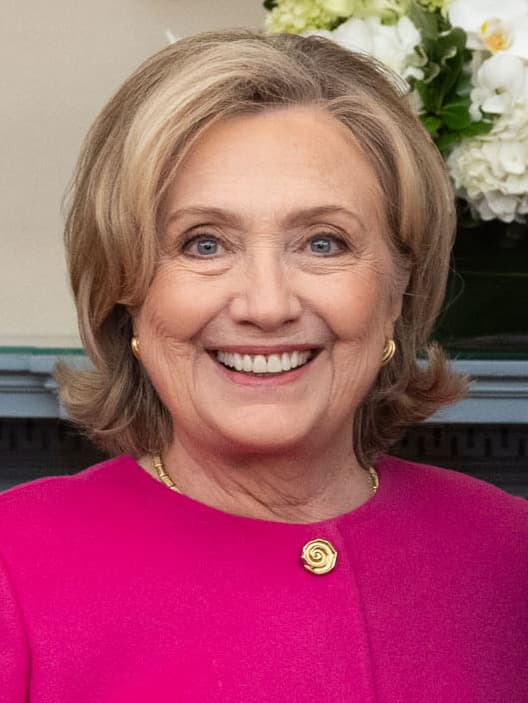
American · Politics · Law · Activism
Hillary Long
October 26, 1947 – present
Early Life and Background
Hillary Diane Rodham Clinton (née Rodham) was born on October 26, 1947, in Chicago, Illinois, the eldest of three children of Hugh Ellsworth Rodham and Dorothy Emma Howell Rodham.[14][13] She grew up in the suburban community of Park Ridge, Illinois, in a middle‑class household that emphasized education, hard work, and civic responsibility.[12][16] Her father ran a small textile business, while her mother’s difficult childhood and commitment to her children deeply shaped Hillary’s sensitivity to issues of neglect, opportunity, and resilience.[12][16]
Rodham attended public schools in Park Ridge, where she was an excellent student and active in youth organizations. She participated in the local Methodist church, joined the youth minister’s discussion group, and became involved with the Girl Scouts.[12][16] As a teenager in the early 1960s, she was initially aligned with the Republican Party, admiring figures such as Barry Goldwater, but the civil rights movement, the Vietnam War, and campus activism gradually shifted her views toward a more liberal outlook.[14][16]
In 1965, she enrolled at Wellesley College, an elite women’s liberal arts institution in Massachusetts.[14][13] At Wellesley, Rodham majored in political science and became deeply engaged in campus politics and social issues. She served in student government and worked with the Wellesley chapter of the League of Women Voters.[16] In 1969, she delivered Wellesley’s first student commencement address, a widely noted speech that criticized complacency and called for engaged citizenship, and she graduated with high honors in political science.[14][13] The speech brought national attention, foreshadowing her future as a prominent public voice.
Education and Career Beginnings
After Wellesley, Rodham entered Yale Law School, one of the most prestigious law faculties in the United States.[14][13] At Yale she worked on child advocacy issues, including research with the Yale Child Study Center and internships that exposed her to legal strategies for protecting vulnerable children.[12][16] She also met fellow law student Bill Clinton, beginning a partnership that would become central to late‑20th‑century American politics.[12][16]
Rodham earned her J.D. degree in 19731974, she joined the staff of the House Judiciary Committee’s impeachment inquiry during the Watergate investigation into President Richard Nixon.[13][18] Her work, along with that of other lawyers, helped develop the legal arguments underpinning the committee’s consideration of presidential misconduct, though Nixon resigned before the House voted on articles of impeachment.
After Watergate, Rodham moved to Arkansas, where Bill Clinton had begun teaching law and engaging in state politics.[12][16] She joined the University of Arkansas School of Law faculty in Fayetteville and soon became affiliated with the Rose Law Firm in Little Rock, one of Arkansas’s most prominent firms.[12][14] In 1975, she married Bill Clinton in Fayetteville, choosing to retain her surname, Rodham, in professional life—a notable decision in an era when political wives were expected to adopt and use their husbands’ names.[14][12]
In 1978, Rodham became the first woman partner at the Rose Law Firm, marking a significant advance for women in the legal profession in Arkansas.[12][13] She developed a practice representing corporations and nonprofits, while maintaining a strong focus on public-interest work. In 1979, she co‑founded Arkansas Advocates for Children and Families, an organization dedicated to improving policies affecting children’s health, education, and welfare.[12][16] These roles established her as both a corporate lawyer and a dedicated advocate for social justice.
First Lady of Arkansas and Policy Work
Bill Clinton was elected governor of Arkansas in 1978, making Hillary Rodham First Lady of Arkansas for most of the period from 1979 to 1992.[14][12] In this role, she balanced law practice with extensive civic engagement. She chaired the Arkansas Educational Standards Committee, helping to redesign the state’s public school curriculum and standards.[12][16] Her efforts contributed to major education reforms that tied school funding and teacher pay to performance and standards, an approach that attracted national attention.
Rodham also introduced the Home Instruction Program for Preschool Youth (HIPPY) to Arkansas, promoting home‑based early childhood education to support low‑income families.[12] She served on boards of organizations such as the Legal Services Corporation and the Children’s Defense Fund, reinforcing her reputation as a lawyer deeply committed to children’s rights and educational opportunity.[16][18]
Her professional success and public service led to recognition as Arkansas Woman of the Year in 1984, among other honors.[12] Throughout the 1980s, she navigated the challenges of being both a working mother—her daughter Chelsea Victoria Clinton was born in 1980—and a political spouse in a conservative southern state. She faced criticism over her use of her own surname and her high‑profile career, pressures that would later intensify on the national stage.[14][16]
Rise to National Prominence: First Lady of the United States
Bill Clinton’s election as president in 1992 elevated Hillary Rodham Clinton to national prominence. On January 20, 1993, she became First Lady of the United States when he was inaugurated as the 42nd president.[14][13][20] Unlike many of her predecessors, she took on an explicitly policy‑oriented role, maintaining a West Wing office and engaging directly with legislative issues.
On January 25, 1993, President Clinton appointed her to chair the Task Force on National Health Care Reform, giving her formal responsibility for developing a comprehensive plan to expand coverage, control costs, and improve quality.[14][12][16] The ambitious proposal, often dubbed "Hillarycare," sought to create a universal health insurance system, but it faced intense opposition from business groups, Republicans, and some Democrats. The plan ultimately failed to pass Congress, and the episode contributed to the Democratic Party’s losses in the 1994 midterm elections.[13][20]
Despite this setback, Hillary Clinton continued to shape policy as First Lady. She championed initiatives that led to the Children’s Health Insurance Program (CHIP), offering coverage to millions of low‑income children.[8][9] She supported reforms in adoption and foster care, including the Adoption and Safe Families Act of 1997, and worked to reduce teen pregnancy through community‑based programs.[8][12] Her advocacy extended globally; in 1995, she delivered a widely cited speech at the United Nations Fourth World Conference on Women in Beijing, declaring that "women’s rights are human rights," a phrase that became emblematic of international women’s rights discourse.[16][18]
Her time as First Lady was also marked by significant controversy, including scrutiny of the Whitewater land deal, questions about law firm billing records, and criticism of her role in policy making. Nonetheless, she remained one of the most recognizable and polarizing figures in American politics, simultaneously admired for her intelligence and work ethic and denounced by opponents who saw her as overreaching the traditional bounds of the First Lady role.[13][20]
Transition to Elected Office: U.S. Senator from New York
Following President Clinton’s second term, Hillary Rodham Clinton sought elected office in her own right. Relocating to New York, she announced her candidacy for the U.S. Senate seat being vacated by Daniel Patrick Moynihan.[14][13] On November 7, 2000, she was elected senator from New York, becoming the first former First Lady of the United States to be elected to public office.[14][13][18] Her victory overcame accusations of "carpetbagging" and demonstrated that a woman could successfully transition from the unelected role of First Lady to a major statewide elected position.
On January 3, 2001, she was sworn in as a senator, making her the first former First Lady to serve in the U.S. Congress and the first woman senator from New York.[14][18] In the Senate, Clinton focused on issues including national security, health care, and economic development. Serving on committees such as Armed Services, Environment and Public Works, and Budget, she cultivated a reputation for detailed policy work and cross‑party collaboration, especially in the aftermath of the September 11, 2001 terrorist attacks.[13][18]
Clinton worked to secure federal funds for New York’s recovery, health monitoring for first responders, and economic support for affected communities.[13] She co‑sponsored legislation on prescription drug benefits, technology infrastructure, and support for veterans. On November 7, 2006, she was re‑elected to the Senate, winning her second term with a substantial margin.[14][13] By the mid‑2000s, she had become one of the most visible and influential members of the Democratic caucus, frequently mentioned as a potential presidential candidate.
Presidential Campaigns and National Leadership
In 2007, Hillary Clinton formally launched her campaign for the 2008 Democratic presidential nomination.[14][13] Widely considered the early frontrunner, she faced a strong challenge from Senator Barack Obama. The race highlighted tensions within the party over experience versus change and raised new questions about sexism in political media. After a long primary season, Clinton conceded the nomination to Obama in June 2008 and endorsed him, urging her supporters to back the party’s nominee.[13][18]
Following Obama’s victory, he nominated Clinton as Secretary of State. The Senate confirmed her with broad bipartisan support, and on January 21, 2009, she was sworn in as the 67th U.S. Secretary of State.[14][13] In this role, she oversaw American diplomacy during a period marked by the global financial crisis, wars in Iraq and Afghanistan, the "reset" in relations with Russia, and the Arab Spring uprisings.[13][18]
Clinton advanced the concept of "smart power," integrating military strength with diplomacy, development, and support for civil society.[13] She emphasized the importance of women’s empowerment in global stability, launching initiatives such as the Global Women’s Issues office and championing programs to combat gender‑based violence and promote girls’ education.[18] She also focused on internet freedom, climate change, and global health, including efforts against HIV/AIDS.
Her tenure was not without controversy. The 2012 attacks on U.S. facilities in Benghazi, Libya, prompted prolonged congressional investigations into security decisions and her role as secretary of state, which later intersected with scrutiny of her use of a private email server for official communications.[13][18] On February 1, 2013, Clinton left office as Secretary of State, having visited more countries than any previous holder of the position up to that time and solidifying her status as a key figure in U.S. foreign policy.[14][13]
After leaving government, she published the memoir Hard Choices in 2014, reflecting on decisions made during her diplomatic tenure.[13][18] In 2015, she declared her candidacy for the 2016 Democratic presidential nomination.[14] Running on a platform that included expanding health care, addressing income inequality, and advancing women’s rights, she faced Senator Bernie Sanders in a competitive primary.
On July 26, 2016, the Democratic National Convention formally nominated Hillary Clinton as the party’s presidential candidate, making her the first woman to secure a major U.S. political party’s presidential nomination.[14][18] Her nomination was widely heralded as a historic breakthrough nearly a century after women gained the right to vote.
In the general election, Clinton ran against Republican nominee Donald Trump. The campaign was intensely polarized and unprecedented in its rhetoric, with strong debates over immigration, trade, national security, and political norms. On November 8, 2016, Clinton won the national popular vote by nearly three million ballots but lost the Electoral College, becoming the first woman in U.S. history to win the popular vote in a presidential election without winning the presidency.[14] The result sparked ongoing discussions about the Electoral College, media treatment of female candidates, and Russian interference in the election.
Awards, Honors, and Later Roles
Across her career, Hillary Rodham Clinton has received numerous awards and honorary degrees recognizing her work in law, children’s advocacy, public service, and diplomacy. As First Lady, she served as honorary president of the Girl Scouts of the USA and was frequently recognized by advocacy organizations for her work on health care and children’s issues.[12][8]
In subsequent years, she continued to write and speak. She authored the memoir What Happened (2017), analyzing the 2016 campaign and broader structural challenges in American democracy, and co‑wrote The Book of Gutsy Women with her daughter Chelsea, highlighting the stories of notable women throughout history.[13][17] She remained active in the Clinton Foundation, supporting initiatives in global health, economic development, and climate resilience.[17]
On November 22, 2022, President Joe Biden awarded Clinton the Presidential Medal of Freedom, the nation’s highest civilian honor, in recognition of her decades of public service and leadership.[13] On June 16, 2023, she was installed as Chancellor of Queen’s University Belfast, a ceremonial position that reflects her longstanding engagement with Northern Ireland and the peace process.[13] She is the first woman to hold this role at the university, underscoring her international stature and ongoing influence in educational and civic spheres.
Personal Life
Hillary Rodham married Bill Clinton on October 11, 1975, in a small ceremony at their home in Fayetteville, Arkansas.[14][12] Their daughter, Chelsea Victoria Clinton, was born in 1980.[12][15] Throughout Bill Clinton’s political career—from Arkansas governor to U.S. president—Hillary maintained her own professional work while serving as a central advisor and public partner.
The couple’s marriage has been subject to intense public scrutiny, particularly during the 1990s when revelations about President Clinton’s infidelities led to impeachment proceedings and global media coverage. Hillary Clinton’s decisions to remain in the marriage and continue in public life became part of broader debates about feminism, forgiveness, and the personal costs of political careers.[13][20] Chelsea Clinton has likewise entered public life as an author and foundation executive, often collaborating with her mother on philanthropic and advocacy projects.
Legacy and Historical Impact
Hillary Rodham Clinton’s legacy in women’s history and American politics is multifaceted. She has been a pioneer in multiple roles: the first former First Lady elected to public office, the first former First Lady to serve in Congress, the first woman senator from New York, and the first woman to receive a major U.S. party’s presidential nomination and to win the national popular vote in a presidential election.[14][18]
Her career has expanded the scope of what is considered possible for women in public life. As First Lady, she redefined the position as one that could include formal policy leadership, especially on health care and children’s issues. As senator and secretary of state, she demonstrated that women could be central figures in national security and global diplomacy, managing complex crises and negotiating with foreign leaders.[13][18]
Clinton has also been a catalyst for conversations about gender, power, and media. The intense scrutiny of her appearance, voice, ambition, and decisions has illuminated persistent biases faced by women leaders. At the same time, her resilience and continued engagement have inspired countless women to pursue careers in law, politics, and public service. Her Beijing declaration that "women’s rights are human rights" remains a touchstone in global feminist discourse.[16][18]
In electoral politics, her 2016 campaign stands as both a milestone and a cautionary tale about structural and cultural barriers. The fact that she gained more votes than any previous presidential candidate except Barack Obama, while still losing the Electoral College, highlights the complex interplay of institutions, geography, and gender in American democracy.[14] The wave of female candidates and activists who emerged in subsequent election cycles often cite her campaign as a motivating example.
Later Life and Continuing Influence
Since leaving the State Department and elective office, Hillary Rodham Clinton has remained an influential voice in national and international debates. She continues to speak on topics such as democracy, women’s rights, and global security; teaches and hosts programs in academic settings; and participates in philanthropic initiatives through the Clinton Foundation and other organizations.[17][13]
Her role as Chancellor of Queen’s University Belfast and recipient of the Presidential Medal of Freedom reflect an ongoing recognition of her contributions outside formal office. As of the mid‑2020s, she is widely regarded as one of the most significant American women in modern political history, whose career encapsulates both the remarkable advances and persistent challenges facing women in leadership.[13][18]
Hillary Rodham Clinton remains alive and active in public life, continuing to shape discussions about governance, gender equality, and the future of democratic institutions in the United States and beyond.[14][17]
Dated achievements
13 indexed.
- Oct261947Politics
Birth of Hillary Diane Rodham
Hillary Diane Rodham was born in Chicago, Illinois, to Hugh and Dorothy Rodham.
View details Wikipedia - Oct111975Law
Marriage to Bill Clinton
Hillary Rodham married Bill Clinton in Fayetteville, Arkansas, in a small ceremony.
View details