← All women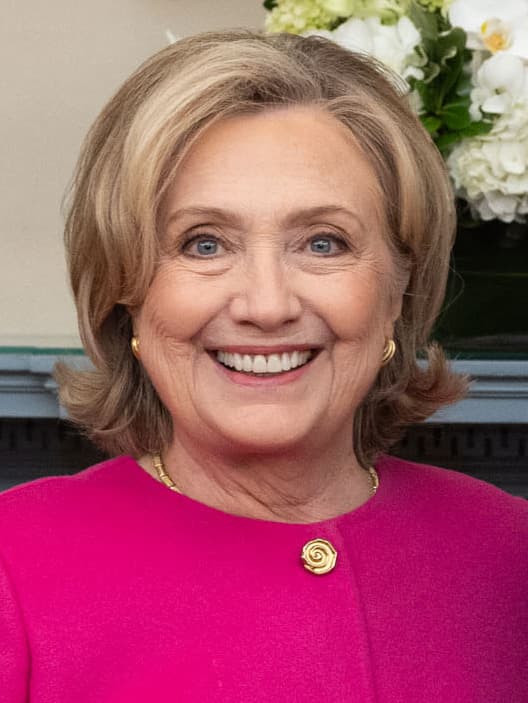
American · Politics · Activism · Law
Hillary Clinton
October 26, 1947 – present
Early Life and Background
Hillary Diane Rodham Clinton was born on October 26, 1947, in Chicago, Illinois, and raised in the nearby suburb of Park Ridge. Her father, Hugh Rodham, was a small business owner in the textile industry, and her mother, Dorothy Howell Rodham, had a difficult childhood that informed Hillary’s lifelong concern for vulnerable children. The family upbringing combined Republican political leanings with Methodist religious teachings emphasizing personal responsibility and social justice.
As a child, Hillary was an excellent student and active in youth organizations, including the Girl Scouts and Methodist youth groups. She attended Maine East High School and later Maine South High School, where she excelled academically and participated in student government. The political and social upheavals of the 1960s shaped her emerging worldview, exposing her to the civil rights movement, the Vietnam War, and early second-wave feminism.
In 1965, she enrolled at Wellesley College, an elite women’s liberal arts college in Massachusetts. Initially a Republican, she campaigned for Barry Goldwater in 1964, but her views shifted as she engaged with antiwar activism and critiques of poverty and racism. At Wellesley she majored in political science, served in student leadership, and became known for her analytical skill and commitment to public service.
Her national debut came in 1969, when she delivered the student commencement address at Wellesley College. The speech gained wide attention after its publication in Life magazine, presenting her as a thoughtful critic of political complacency and an articulate representative of her generation.
After Wellesley, Rodham entered Yale Law School, one of the country’s most prestigious legal institutions. At Yale she worked with the Yale Child Study Center and volunteered for legal services, focusing on children and low-income families. She also interned with civil rights lawyer Marian Wright Edelman’s Children’s Defense Fund. During this time she met fellow law student Bill Clinton, beginning a partnership that would become central to her life and to American politics.
Career Beginnings and Development
Following law school, Rodham deepened her engagement with public interest law. She contributed to research for the Watergate impeachment inquiry staff in Washington, D.C., examining constitutional and ethical questions around presidential power. Rather than remain in the capital, she chose to move to Arkansas, where Bill Clinton had begun teaching at the University of Arkansas School of Law.
In Arkansas, Hillary joined the University of Arkansas law faculty, teaching criminal law and other subjects. She soon transitioned into private practice, becoming an attorney at the Rose Law Firm in Little Rock, one of the oldest and most influential firms west of the Mississippi River. In 1977, she became the firm’s first female partner, an important professional milestone in a male-dominated legal culture.
Beyond her legal work, Rodham took on significant public roles. That same year, President Jimmy Carter appointed her to the board of directors of the Legal Services Corporation, the federally funded entity supporting civil legal aid for low-income Americans. She later chaired the board, and sources note that she was the first woman to serve in that capacity, helping oversee expansion and defense of legal services during a period of political challenge.
In Arkansas she also chaired the Arkansas Education Standards Committee, advocating for reforms to improve public schools, and served on boards related to children, health, and economic development. These positions established her reputation as a policy-focused lawyer and civic leader in her own right, independent of her husband’s political career.
Hillary Rodham and Bill Clinton married on October 11, 1975, in Fayetteville. When Bill was elected governor of Arkansas in 1978, she became the state’s First Lady. In this role she continued her legal practice while championing education reform and child welfare initiatives. She balanced professional work and public responsibilities in ways that challenged traditional expectations of political spouses, signaling a new model of dual-career political partnership.
First Lady of the United States
Bill Clinton’s election to the presidency in 1992 brought Hillary to national prominence as First Lady of the United States. When he was inaugurated on January 20, 1993, she became the first First Lady with a law degree, a credential that helped define her unusually active and substantive role in the administration.
Early in the Clinton presidency she was appointed to chair the President’s Task Force on Health Care Reform, charged with designing a comprehensive overhaul of the U.S. health system. Although the effort ultimately failed in Congress, the initiative underscored her willingness to tackle complex policy problems and revealed the limits of unelected influence in a polarized political environment.
As First Lady she focused on issues affecting children and families. She helped create the Department of Justice’s Office on Violence Against Women, an institutional response to domestic and sexual violence. She played a major role in shaping and promoting the Adoption and Safe Families Act, which aimed to move children more swiftly out of unsafe foster-care situations into permanent homes. She also supported the development and rollout of the State Children’s Health Insurance Program (SCHIP), enacted in 1997, which expanded health coverage for children in low-income families.
Her policy work often involved bipartisan cooperation, particularly on adoption, foster care, and children’s health, demonstrating her capacity to work across party lines even as she remained a polarizing figure for some critics. She also convened conferences at the White House on early childhood development, school violence, and Latino children and youth, using the First Lady’s platform to highlight social issues that long-term advocates considered urgent.
Global Advocacy and the Beijing Speech
In addition to domestic policy, Clinton used her position to advance women’s rights internationally. She traveled widely, visiting more than 80 countries and meeting with activists, officials, and civil society leaders. Her most famous intervention came at the Fourth World Conference on Women in Beijing in 1995.
On September 5, 1995, she delivered a keynote address insisting that "women’s rights are human rights, and human rights are women’s rights." The speech criticized practices such as domestic violence, forced sterilization, and political repression, and urged governments to treat abuses against women as violations of fundamental human rights rather than private or cultural matters.
The Beijing speech is widely regarded as a turning point in the international human-rights framework, helping mainstream gender-based violence and discrimination in global policy and advocacy. It also cemented Clinton’s reputation as a leading voice for women and girls, linking her domestic work to a broader transnational feminist movement.
U.S. Senator from New York
As the Clinton administration neared its end, Hillary Clinton pursued elective office. Despite being a relative newcomer to New York, she launched a campaign for the U.S. Senate seat being vacated by Daniel Patrick Moynihan. Facing both skepticism about her residency and intense media scrutiny, she conducted an extensive listening tour and built a broad coalition.
On November 7, 2000, she was elected U.S. Senator from New York. This made her the first former First Lady elected to the U.S. Senate and the first woman elected to statewide office in New York. She was sworn in on January 3, 2001, beginning a tenure that would last until she resigned to become Secretary of State in 2009.
In the Senate, Clinton served on committees including Armed Services and Environment and Public Works. She focused on health care, economic development, and national security. After the September 11, 2001 terrorist attacks, she played a prominent role in securing assistance for New York City and state, advocating for federal funding to rebuild infrastructure and for health monitoring and treatment of first responders suffering from exposure at Ground Zero.
Her most controversial Senate vote came on October 11, 2002, when she supported the Authorization for Use of Military Force Against Iraq. The vote, intended by some to strengthen diplomatic leverage, later became a focal point for criticism after the U.S.-led invasion and the failure to find weapons of mass destruction. Clinton defended her decision for years but later described her vote as a mistake, a stance that influenced perceptions of her foreign-policy judgment in subsequent presidential campaigns.
2008 Presidential Campaign
In 2007, Clinton announced her candidacy for the Democratic presidential nomination for the 2008 election. She entered as a frontrunner, drawing on her national recognition and Senate record. The campaign raised substantial funds and built a large organizational network, marking one of the most serious bids for the presidency by a woman in U.S. history.
Her primary contest with Senator Barack Obama was intense and closely watched. Clinton won several large states and millions of votes, and her candidacy shattered previous expectations about women’s viability at the presidential level. Although she ultimately fell short of the nomination, in 2008 she suspended her campaign and endorsed Obama, becoming the first former First Lady to be a major-party presidential contender. Her performance demonstrated that a woman could compete at the highest electoral level, even if systemic and strategic factors still posed obstacles to victory.
Secretary of State
After his election, President Obama nominated Clinton to be Secretary of State, a move that reflected both reconciliation after the primary and recognition of her capabilities. She was confirmed by the Senate and on January 21, 2009, she was sworn in as the 67th U.S. Secretary of State, becoming the first former First Lady to serve in a cabinet-level position.
As Secretary of State, Clinton advanced the concept of "smart power," combining military strength with diplomacy, development, and the promotion of values such as human rights and the rule of law. She prioritized rebuilding alliances strained in earlier years and emphasized multilateral cooperation.
Her tenure encompassed major foreign-policy challenges. She supported the "reset" with Russia, worked toward the New START treaty on nuclear arms control, and helped build international support for sanctions on Iran, an effort that laid groundwork for later agreements on Iran’s nuclear program. She was involved in decisions leading to the NATO intervention in Libya and navigated complex dynamics during the Arab Spring, including uprisings in Egypt, Tunisia, and other countries.
Clinton also made women’s rights, LGBT rights, and civil society central themes of U.S. foreign policy. She launched initiatives to support women’s political and economic participation globally and spoke out against discriminatory laws and practices. In 2012 she helped negotiate a ceasefire between Israel and Hamas during fighting in Gaza, a diplomatic effort often cited as a significant achievement.
Her tenure was not without controversy. The 2012 attack on U.S. facilities in Benghazi, Libya, resulting in the deaths of Ambassador J. Christopher Stevens and three other Americans, led to extensive investigations and congressional hearings. Critics questioned security decisions and information management, while Clinton defended the State Department’s efforts and accepted responsibility as the leader of the department.
On February 1, 2013, Clinton stepped down as Secretary of State, concluding four years in the role. Her service left a complex legacy of diplomatic initiatives, institutional reforms, and contentious episodes that would remain central to debates over her record.
Awards, Honors, and Recognition
Over the course of her career, Hillary Clinton received numerous awards and honors. A particularly notable recognition came on November 20, 2013, when President Barack Obama awarded her the Presidential Medal of Freedom, the nation’s highest civilian honor. The award acknowledged her decades of service as First Lady, senator, and Secretary of State, as well as her advocacy for children, families, and human rights.
Clinton has also received honorary degrees from various universities and has been frequently listed among the world’s most influential people in media rankings, reflecting her impact on politics and global affairs. Her writings, including the memoirs Living History and Hard Choices, have been widely read and contribute to public understanding of the eras in which she served.
2016 Presidential Campaign and Historic Nomination
In 2015, Clinton announced a second campaign for the presidency, seeking the Democratic nomination for the 2016 election. This time she faced major opposition from Senator Bernie Sanders, whose candidacy energized progressive and younger voters. Clinton’s campaign emphasized experience, incremental reform, and continuity with many Obama-era policies, alongside proposals on health care, college affordability, and criminal justice.
Across the primary season she won a majority of pledged delegates and votes, while securing strong support among party leaders. By June 6, 2016, she had accumulated enough delegates, including superdelegates, to be widely recognized as the presumptive Democratic nominee, making her the first woman in U.S. history to lead a major party’s presidential ticket.
At the Democratic National Convention in Philadelphia, Clinton was formally nominated and on July 26, 2016 she accepted the Democratic nomination for president. This made her the first woman ever nominated for president by a major American political party. Her nomination was seen by many as a culmination of decades of struggle for women’s political representation, occurring nearly a century after the ratification of the Nineteenth Amendment granting women the right to vote.
In the general election, Clinton ran against Republican nominee Donald Trump. She won the popular vote by nearly three million ballots but lost the Electoral College due to narrow defeats in several key states. The outcome prompted extensive analysis of factors ranging from economic discontent and racial polarization to gender dynamics and media coverage. For women’s history, her campaign demonstrated both the progress achieved and the obstacles remaining in efforts to elect a woman to the presidency.
Personal Life
Hillary and Bill Clinton’s marriage, begun in 1975, has been intensely scrutinized due to his political career and personal controversies. The couple has one child, Chelsea Victoria Clinton, born in 1980, who grew up in the public eye during her father’s presidency and has since taken on roles in philanthropy, academia, and media.
The Clintons’ relationship endured public crises, most notably the revelation of President Clinton’s affair with Monica Lewinsky, a White House intern, and the subsequent impeachment proceedings in the late 1990s. Hillary’s decision to maintain the marriage drew both criticism and admiration and has been interpreted variously as a personal choice, a political calculation, or a complex mix of both. Throughout, she continued her public work, illustrating the interplay between private life and political responsibility for high-profile women.
Religiously, Clinton has remained connected to the Methodist tradition, often referencing her faith as a source of moral guidance, particularly regarding social justice and care for the vulnerable. Her religious identity has informed her rhetoric and some policy priorities but has not dominated her public image.
Legacy and Historical Impact
Hillary Clinton’s legacy is multifaceted and contested, but certain themes stand out in historical analysis. She is widely recognized as one of the most influential women in modern American politics, having held a unique combination of roles: First Lady of Arkansas, First Lady of the United States, U.S. Senator, Secretary of State, and major-party presidential nominee.
Her career has expanded the boundaries of what women can do in public life. As the first First Lady with a law degree and an active policy portfolio, she helped redefine that role away from purely ceremonial duties. As the first former First Lady elected to the Senate and the first woman elected statewide in New York, she demonstrated that political spouses could transition into independent elected leadership. As the first former First Lady to serve in a cabinet-level role, she showed that women could occupy the highest ranks of foreign-policy decision-making.
Her 2016 nomination as the first woman presidential nominee of a major American party stands as a major milestone, symbolizing the culmination of decades of feminist and civil-rights struggle. Millions of women and girls watched her candidacy as evidence that the highest office was at least theoretically open to them.
At the same time, Clinton’s career highlights persistent structural and cultural barriers. She has faced intense partisan hostility, gendered criticism, and scrutiny of her appearance, voice, and personal choices at levels often exceeding that directed at male counterparts. Debates over her Iraq War vote, her management of the State Department, and issues such as the use of a private email server have been central to discussions of accountability, trust, and power in contemporary politics.
Scholars of women’s history and political science frequently use Clinton as a case study in the evolution of female leadership, the double standards women face, and the role of networks, experience, and resilience in achieving high office. Her impact extends beyond formal positions to include symbolic and inspirational effects, particularly in encouraging women’s political participation and candidacies at all levels.
Later Life and Continuing Work
After leaving the State Department and the 2016 campaign, Clinton remained active in public life. She has delivered speeches, written books, and engaged in philanthropic initiatives through the Clinton Foundation, focusing on global health, economic development, and climate change. She has also supported efforts to increase women’s participation in politics and public leadership.
Clinton’s post-government career includes teaching, commentary, and involvement with academic and policy institutions. Her work continues to influence debates over foreign policy, democracy, and women’s rights. While she has not sought office again after 2016, her presence remains significant within the Democratic Party and in broader discussions about the direction of American politics and global governance.
As a living figure, assessments of her legacy continue to evolve. New scholarship, memoirs, and archival materials are likely to deepen understanding of her role in late twentieth- and early twenty-first-century history. For women’s-history researchers, Hillary Clinton offers a rich subject whose life intersects with major developments in gender, law, policy, and international relations.
Dated achievements
13 indexed.
- Oct261947Politics
Birth of Hillary Diane Rodham
Hillary Diane Rodham (later Hillary Rodham Clinton) was born in Chicago, Illinois, United States.
View details Hillary Clinton Fast Facts - CNN - May311969Politics
Wellesley commencement address gains attention
Hillary delivered the student commencement address at Wellesley College, making national headlines.