← All women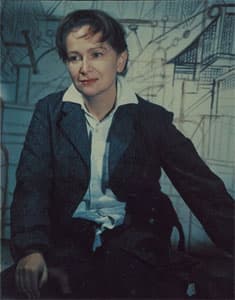
Romanian, American · Arts
Hedda Sterne
August 4, 1910 – April 8, 2011
Early Life and Background
Hedda Sterne was born as Hedwig Lindenberg in Bucharest, Romania, on August 4, 1910. She showed an early interest in art and pursued her studies in Vienna and Bucharest, eventually continuing her education at the Academy of Arts in Bucharest. Her father was a linguist and her mother was an accomplished pianist, both of whom encouraged her artistic pursuits. Sterne was profoundly influenced by the cultural milieu of interwar Europe, absorbing influences from varied art movements such as Dadaism and Surrealism.
Career Beginnings and Development
Sterne began her career in Bucharest, where she first exhibited her works in 1932. However, it was not until she emigrated to the United States in 1941, escaping the perils of World War II, that her artistry truly flourished. In New York, she connected with key figures in the American art scene, including Peggy Guggenheim and Marcel Duchamp, which facilitated her integration into the avant-garde circles of the city. Sterne became associated with the Abstract Expressionist movement, although her style remained distinct and eclectic.
Major Works and Accomplishments
Sterne's works are characterized by their technical versatility and innovative use of forms. A signature piece is her series of "Machine" paintings, developed during the 1940s and inspired by the technological transformations occurring in America. Her piece NYC Transit, from this series, exemplifies her ability to translate urban landscapes into dynamic, abstract forms. In 1950, Sterne was the only woman included in the famous "Irascibles" photograph by Nina Leen for Life magazine, which featured leading Abstract Expressionists, securing her place in art history.
Awards, Honors, and Recognition
Throughout her career, Sterne was lauded for her contributions to modern art, earning numerous accolades. Her works have been featured in prestigious institutions such as the Museum of Modern Art and the Metropolitan Museum of Art. Despite her achievements, she often felt overlooked, overshadowed by her male contemporaries, yet her resilience shone through in her continued evolution and prolific output.
Personal Life
Sterne married influential Surrealist painter Frederic Sterne in 1932; however, their marriage ended, and she later married Saul Steinberg in 1944, a Romanian-born American artist distinguished for his work as a cartoonist in The New Yorker. The couple remained married until 1960. Although they did not have children, their marriage was a notable partnership rooted in mutual respect and creativity.
Legacy and Historical Impact
Hedda Sterne's legacy is marked by her role as a pioneering female artist in a predominantly male domain. Her resistance to being defined by a singular style and refusal to be categorized encapsulate her lasting impact on art. In recent years, her contribution to modern art has garnered renewed interest, celebrated in retrospectives and scholarly work that seek to reposition her influence within 20th-century art history.
Later Life and Death
Hedda Sterne continued to create art well into her nineties, residing in New York City. She stayed intellectually active, revisiting earlier themes and exploring new formats. Her death on April 8, 2011, at the age of 100, marked the end of an era for an artist who had witnessed and influenced dramatic changes in the art world.
Dated achievements
2 indexed.
- Aug041910Arts
Birth of Hedda Sterne
Hedda Sterne was born on August 4, 1910, in Bucharest, Romania.
View details Tate Biography - Apr082011Arts
Death of Hedda Sterne
Hedda Sterne passed away on April 8, 2011, in New York City, at the age of 100.
View details