← All women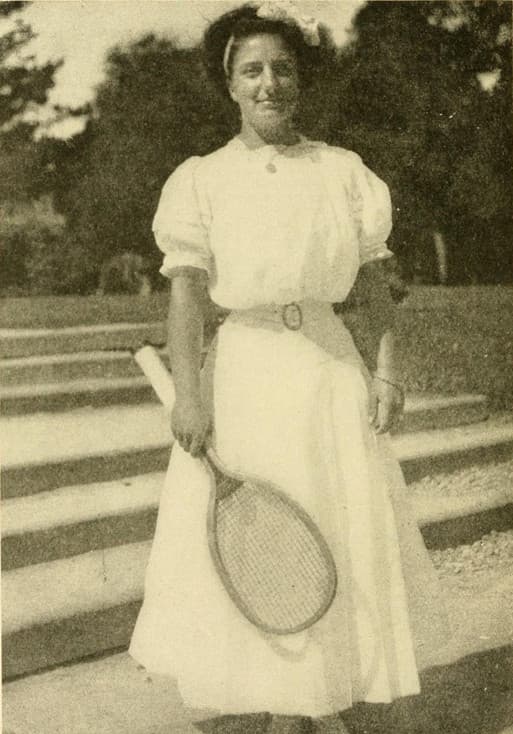
American · Sports
Hazel Wrightman
December 20, 1886 – December 5, 1974
Early Life and Background
Hazel Virginia Hotchkiss Wightman was born on 20 December 1886 in Healdsburg, a small town in Sonoma County, Northern California.[4][5][11] She was the daughter of William Joseph Hotchkiss, a banker, and Emma Lucretia (Grove) Hotchkiss
Hazel’s early education took place in California, and she later enrolled at the University of California, Berkeley
Hazel Hotchkiss began playing tennis in California around 1902, at a time when the sport was relatively new and socially constrained for women.[1][8] Tennis was considered a genteel pastime appropriate for upper‑middle‑class women, but the conventional style emphasized modesty and baseline rallies rather than aggressive athleticism. By 1903, in San Francisco, Hazel had already started experimenting with a more attacking style, introducing aggressive volley and net play into women’s tennis.[7] This tactical departure from the prevailing baseline game foreshadowed her later influence on the sport. Her early competitive experiences reflected both talent and innovation. Hazel developed a right‑handed game characterized by strong serves, quick footwork, and an eagerness to rush the net—traits that would become her signature.[4][9] As she refined her skills on California courts, she also absorbed the strategic lessons of playing multiple racket sports, including squash and table tennis, which complemented her tennis instincts.[14] Hazel’s move to major national tournaments came in the late 1900s, when she entered the U.S. National Championships (the forerunner of today’s U.S. Open) at the Philadelphia Cricket Club.[3][4] Arriving as a relatively unknown college player, she quickly established herself as a formidable competitor. Her tactical daring, mental resilience, and willingness to challenge expectations for women’s play distinguished her from contemporaries and set her on a path to national dominance. Hazel Hotchkiss Wightman’s breakthrough came in 1909, when she won the U.S. National Championships women’s singles title.[1][2][4] That year, she achieved a historic sweep by securing the singles, women’s doubles, and mixed doubles crowns, becoming the first woman to win all three national titles in the same year.[1][4] Her achievement on 28 August 1909 has been widely recognized as a watershed moment in women’s tennis, demonstrating comprehensive mastery of multiple events. Hazel did not merely repeat this success; she entrenched her dominance. In 1910, she again won the singles, doubles, and mixed doubles titles at the U.S. National Championships, and she completed a third consecutive sweep in 1911
Her influence extended beyond outdoor events. Over her career, Hazel amassed 45 U.S. titles, spanning singles, doubles, and mixed doubles, both outdoors and indoors.[4][9][11][14] By 1943, she had secured a combined total of 17 United States Indoor Championships titles in singles, doubles, and mixed doubles.[1] Between 1948 and 1954, she added 11 United States Grasscourt Senior Doubles Championships, demonstrating remarkable longevity in competitive tennis.[1][9] Dutch and Spanish sources note that she won 45 tournaments in the United States, including her last national title at an advanced age, reflecting an active competitive span of several decades.[5][9] Hazel also maintained her singles prowess over a long period. She won U.S. national singles titles between 1909 and 1928, including a notable singles victory in 1928
Hazel Hotchkiss Wightman’s impact was not confined to the United States. In 1924, she won the Wimbledon doubles championship, adding a prestigious international crown to her collection.[1][4][6] Her success on grass at Wimbledon underscored her capacity to adapt to different surfaces and competitive environments. The pinnacle of her international career came at the 1924 Olympic Games in Paris. Tennis at these Games was played on clay courts at Stade Olympique de Colombes. Hazel, then 37 years old, competed in multiple events and emerged with two gold medals.[4][6][7] These Olympic successes were particularly significant because tennis would soon disappear from the Olympic program for many decades. Hazel’s medals thus belong to an early era of Olympic tennis and stand as rare examples of female tennis excellence on the Olympic stage.[6][7][8] Her performance also challenged assumptions about age and athletic peak, showing that women could win at the highest level well into their thirties. Hazel Wightman’s most enduring institutional contribution was the creation of the Wightman Cup. In 1923, she donated a trophy and spearheaded the establishment of an annual international team competition for women between the United States and Great Britain.[1][2][4] The inaugural Wightman Cup tie was held that year, with Hazel both providing the cup and playing on the U.S. team. The Cup was conceived as a female parallel to the Davis Cup, which had long served as the premier international team event for men’s tennis. By creating a comparable structure for women, Hazel directly addressed the absence of institutionalized international opportunities for female players. The Wightman Cup offered regular transatlantic rivalry, national representation, and media attention, helping to legitimize women’s tennis as a serious competitive sport.[2][4][8] Over the following decades, the Wightman Cup became a fixture of women’s tennis, producing memorable matches and giving younger players a platform to gain international experience. It also contributed to strengthening Anglo‑American ties in tennis and helped integrate women into the narrative of global team competition. Hazel’s role as donor and namesake ensured that her contribution would be remembered as foundational to the sport’s international structure.[1][4][8][12] Though best known for tennis, Hazel Wightman excelled in other racket sports. Sources note that she won the United States women’s squash singles championship, with some accounts placing the victory around 1930.[1][14] The New York Times obituary further records that she triumphed in a Massachusetts ping‑pong (table tennis) championship and reached the national doubles finals in minton, a precursor of modern badminton.[14] These achievements illustrate her broad athletic ability and her willingness to experiment across disciplines. Her success in multiple racket sports reinforced the idea that women could excel in a variety of athletic contexts, not just the select pursuits deemed suitable by early‑20th‑century social norms. It also reflected the underlying skills—hand‑eye coordination, anticipation, and strategic thinking—that made her tennis play so influential. Over her lifetime and posthumously, Hazel Hotchkiss Wightman received numerous honors. These honors reflect both national and international recognition. The CBE and the Wightman Cup underscore her importance to British tennis; American halls of fame and stamps emphasize her central role in U.S. tennis history; and collegiate recognition places her within the story of women’s university athletics. On 1 June 1912, Hazel Hotchkiss married George Wightman, a Boston dentist who later became president of the United States Lawn Tennis Association.[7][12] Following her marriage, she was widely known as Hazel Hotchkiss Wightman or simply Hazel Wightman
Hazel and George had three children, and Hazel continued to compete while raising her family. Biographical sources emphasize that she maintained a demanding schedule of training, competition, and travel despite domestic responsibilities, challenging the prevailing notion that marriage and motherhood should end a woman’s athletic career.[11][12] George’s later leadership role in the USLTA placed the family at the heart of American tennis administration, linking Hazel’s ideas and experiences to institutional decision‑making. In her later years, Hazel was known as a mentor and teacher to younger players. She gave lessons, advised promising juniors, and remained a visible figure at tournaments. Her personal relationships within the tennis world extended across generations, reinforcing her reputation as the "Queen Mother" who nurtured the sport’s growth as much through guidance as through her own competitive record.[11][14] Hazel Wightman continued to play competitive tennis into her fifties and beyond. Accounts note that she won her last national tennis title in doubles in the early 1940s at about age 56, demonstrating extraordinary longevity.[1][8] Dutch sources highlight that she claimed her final U.S. tournament victory at age 68, underscoring her lasting presence on the court.[9] In the early 1970s, she remained a respected elder in the tennis community. In 1973, she received the honorary CBE from Queen Elizabeth II, a capstone international honor that recognized both her Wightman Cup legacy and her broader contributions to Anglo‑American tennis cooperation.[4][12] Hazel Virginia Hotchkiss Wightman died on 5 December 1974 at her home in Chestnut Hill, Massachusetts, near Boston, at age 87.[2][4][7][8][11][14] The New York Times obituary described her as a "legendary figure in American tennis" and recorded that she had won 45 national titles over 45 years
Hazel Hotchkiss Wightman’s legacy is multifaceted, encompassing tactical innovation, competitive excellence, institutional leadership, and mentorship. On the court, she transformed women’s tennis by demonstrating the effectiveness and excitement of aggressive net play. Her serve‑and‑volley style, introduced in California in the early 1900s and refined at national tournaments, broke with the predominantly defensive baseline game and helped establish a more dynamic brand of women’s tennis.[4][7][11] Her multiple U.S. championship sweeps and international victories provided compelling evidence that women could play with the same tactical daring and physical intensity as men. Her founding of the Wightman Cup in 1923 created a structural platform for women’s international team competition, parallel to the Davis Cup.[1][2][4][8] This innovation was crucial in normalizing the idea that women deserved institutionalized opportunities to represent their countries, compete regularly abroad, and become part of a global sporting narrative. The Cup influenced later developments in women’s team events and contributed to the broader movement toward equality in sports structures. Hazel’s long career and visibility also helped shift social attitudes. She competed at a high level while married and raising children, won titles into middle age and beyond, and remained active as a mentor. Her story contrasted sharply with stereotypes of women as limited or fragile athletes. By the mid‑20th century, she was widely known as the "Queen Mother of American Tennis," a title used by encyclopedias and biographies to signal her maternal but authoritative role in the sport’s development.[2][11][14] Institutional recognition—Hall of Fame inductions, the CBE, and commemorative stamps—has reinforced her historical status. The U.S. Postal Service’s 25‑cent stamp featuring Hazel as part of its "Women on Stamps" series in 1990 placed her alongside other notable women whose achievements reshaped American life.[8][12] The ITA Hall of Fame induction in 1995 further embedded her in the history of collegiate athletics, linking early female pioneers to modern university sports.[9] For women’s history, Hazel Wightman stands as a central figure in the professionalization and internationalization of women’s sport. Her career illustrates how one woman, starting from a small town in California and a college tennis team, could revolutionize playing styles, secure unprecedented titles, create international institutions, and mentor generations of athletes. Her life story is a key chapter in understanding the evolution of gender roles in sport and the gradual recognition of women as full participants in competitive athletics.Career Beginnings and Development
Rise to Dominance: U.S. National Championships
International Achievements and Olympic Success
The Wightman Cup and Organizational Leadership
Other Sporting Endeavors
Awards, Honors, and Recognition
Personal Life
Later Life and Death
Legacy and Historical Impact
Dated achievements
9 indexed.
- Dec201886Science
Birth of Hazel Virginia Hotchkiss
Hazel Virginia Hotchkiss was born in Healdsburg, Sonoma County, California, later becoming a foundational figure in women's tennis.
View details Hazel Hotchkiss Wightman - Wikipedia - Aug281909Science
First woman to win U.S. singles, doubles, and mixed doubles titles in same year
Hazel Hotchkiss became the first woman to sweep the U.S. National Championships singles, doubles, and mixed doubles titles in a single year.