← All women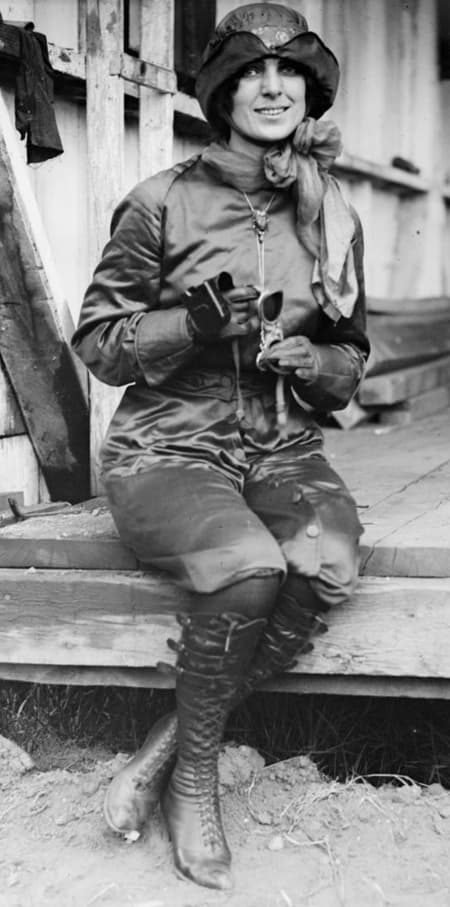
American · Aviation · Arts
Harriet Quimby
May 11, 1875 – July 1, 1912
Early Life and Background
Harriet Quimby was born on May 11, 1875, near Coldwater, Michigan, to William Quimby, an itinerant salesman and sometime farmer, and Ursula (Cook) Quimby.[2][9] Many references describe her birthplace simply as "near" or "around" Coldwater, reflecting limited documentation of the exact farm location.[9] Britannica notes an alternative and uncertain birth date of May 1, 1875, probably near Coldwater,[3] but the May 11 date is widely used by biographical sources and adopted in most modern accounts.[2][9][11]
Quimby grew up in a rural, working-class family in the late nineteenth-century Midwest, a context in which educational and professional opportunities for girls were limited. Around 1884, when Harriet was still a child, the family moved to California, seeking better prospects.[9] In California she helped in the family business packaging herbal remedies, work that biographers view as an early exposure to entrepreneurship and practical organization.[9] Although detailed records of her formal schooling are sparse, later accounts emphasize that she was intelligent, ambitious, and drawn to writing and the theater, interests that would shape her first career.[8][9]
Her relocation from Michigan to California coincided with broader patterns of westward migration and urbanization in the United States. Growing up during a period of rapid technological change, including the advent of the telephone, electricity, and later the automobile, Quimby matured in an environment where modern machines were transforming daily life. This background helps explain, though cannot fully account for, her eventual attraction to aviation—a new technology that symbolized modernity and daring.[2][9]
Career Beginnings in Journalism and Screenwriting
By 1901, Quimby had begun a professional journalism career in San Francisco, working as a reporter for various newspapers and periodicals.[9] Women reporters were still relatively rare, and those who did work in the field often covered "women’s" topics such as society news or household advice. Quimby, however, developed a broader portfolio, writing feature stories that reflected her curiosity about travel, drama, and spectacle.[9]
In 1903 she moved to New York City, then the publishing capital of the United States, to join Leslie’s Illustrated Weekly as a drama critic and feature writer.[8][9] At Leslie’s she quickly established herself as a prominent journalist known for her vivid style and interest in international themes. Her assignments included theater reviews, travel pieces, and coverage of emerging trends. These experiences expanded her contacts in media and exposed her to the world of public entertainment and technological displays, including air meets.
During her years in New York, Quimby also wrote scenarios for early silent films. She is credited with screenplays for at least a handful of short motion pictures produced by the Biograph Company, though many exact titles are difficult to document today.[2][13] In this work she experimented with narrative structure and visual storytelling at a time when cinema itself was a new medium. Her dual roles as journalist and screenwriter show her as a creative professional engaged with cutting-edge forms of communication.[2][9]
Journalism was critically important in Quimby’s path to aviation. In 1910 she traveled to Los Angeles to cover an air meet, the first such event held in the United States, for Leslie’s.[11] Watching pioneering pilots like Louis Paulhan and Glenn Curtiss perform aerial maneuvers over the field, she became fascinated with flight. Articles she wrote on the spectacle introduced readers to aviation while deepening her own interest in participating rather than merely observing.[11]
Transition to Aviation and Training
Quimby’s transition from reporter to aviator began in earnest in 1911. Inspired by what she had seen at air meets and encouraged by her friend Matilde Moisant—sister of famed pilot John Moisant—she decided to pursue flight training.[4][11] That year she enrolled at the Moisant School of Aviation on Hempstead Plains, Long Island, one of the earliest and most prominent aviation schools in the United States.[2][4][17]
The Moisant School trained students on French-built Blériot monoplanes. Instruction included ground lessons in mechanics and aerodynamics, as well as flight practice in taking off, maneuvering, and landing. On June 13, 1911, contemporary newspaper coverage recorded that Quimby began learning to fly a monoplane at the school, marking the documented start of her brief flying career.[17] At a time when most pilots were men and aviation was widely considered dangerous, her presence at Hempstead drew attention.
Quimby quickly mastered the basics of piloting. Within weeks she was performing solo flights and refining the maneuvers required for official certification. Journalists noted her composed demeanor and precise handling of the aircraft, qualities that countered stereotypes that women were too nervous or physically weak for flying.[4][11] Her training alongside Matilde Moisant also highlighted the emergence of a small but determined cohort of women aviators in the United States.
First American Woman to Earn a Pilot’s License
On August 1, 1911, Quimby took the Aero Club of America’s pilot tests at the Moisant School and successfully met all requirements for certification.[14][17] The exams, modeled on standards of the Fédération Aéronautique Internationale (FAI), required candidates to demonstrate competence in controlled figure‑eights, altitude and distance management, and safe landings in front of club officials.
Upon passing, she was issued FAI certificate no. 37 by the Aero Club of America, becoming the first woman in the United States, and the first American woman anywhere, to earn an official pilot’s license.[2][3][9][14][17] She was the second woman in the world to achieve a pilot’s license, following French aviator Raymonde de Laroche, who had been certified in 1910.[2][10][14]
This was a landmark in both aviation and women’s history. At the time, the Aero Club and similar organizations were dominated by male elites, and some questioned whether women should be allowed to sit for the same tests. Quimby’s success demonstrated that a woman could meet the identical technical standards imposed on male pilots. It also conferred formal recognition of her skills, enabling her to participate in public exhibitions and races as a professional aviator rather than a mere curiosity.[2][9][11]
Newspapers and magazines reported the event, frequently illustrating her in her tailored flying outfit and emphasizing her poise under pressure.[14][17] Her achievement inspired other women to consider aviation training, helping to inaugurate a small but growing international community of female pilots. The Michigan Women’s Hall of Fame and the National Aviation Hall of Fame later cited this licensing milestone as a principal reason for honoring Quimby posthumously.[8][11]
Exhibition Flying and Races
After obtaining her license, Quimby rapidly entered the world of public exhibition flying. In 1911, within weeks of certification, she won her first cross‑country air race in the United States, though available sources do not consistently record the exact date.[6][7][11] This victory affirmed her capabilities in distance and navigation beyond simple field circuits.
On September 24, 1911, she participated in an aviation race in adverse weather where newspapers noted that she was the only woman competitor, emphasizing her courage and determination.[17] Flying in poor conditions with fragile early aircraft involved considerable risk; her willingness to take off when some male pilots hesitated reinforced her reputation for daring.
Quimby became known for her theatrical and practical flying costume: a plum‑colored satin suit tailored with trousers and a close‑fitting jacket, worn with high boots and a helmet.[2][4][8] The outfit was not merely decorative; trousers and fitted clothing reduced the risk of fabric catching on controls and provided freedom of movement in the cockpit. Nevertheless, the striking color and cut contributed to her public image as "America’s First Lady of the Air" and drew media attention.
Some sources credit Quimby as the first woman to fly an aeroplane at night, earning a substantial fee for a seven‑minute night flight in 1911.[11][14] However, while this feat is widely mentioned, primary documentation with a precise date remains scarce in the materials surveyed, and at least one secondary source gives an impossible date after her death, indicating textual error.[9][13][14] Even without a secure date, the claim illustrates the boundary‑pushing nature of her exhibition work.
First Woman to Fly Solo Across the English Channel
Quimby’s most famous achievement came less than a year after she earned her license. On April 16, 1912, she piloted a Blériot monoplane from Whitfield near Dover, England, across the English Channel to the French coast, landing on a beach near Hardelot or Équihen‑Plage in Pas‑de‑Calais.[2][3][7][8][12][17] The flight took approximately 59 minutes.[2][8][16]
The English Channel had become a symbolic route in aviation after Louis Blériot’s historic crossing in 1909. For Quimby, completing the journey as a solo pilot meant confronting the risks of open‑water flight with rudimentary instrumentation. She relied primarily on a small hand compass and visual judgment to maintain course, flying at modest altitudes to reduce exposure to strong winds.[14][5]
This crossing made Quimby the first woman to fly an aircraft solo across the English Channel, a fact reported in European and American newspapers.[2][3][7][8][10][17] Her success demonstrated that women could tackle the same demanding international routes as male pilots, reinforcing the idea that aviation skill was not inherently gendered.
Quimby’s flight was somewhat overshadowed in immediate news cycles by the sinking of the RMS Titanic on April 15, 1912, the day before her crossing.[5] Nevertheless, her Channel achievement soon gained recognition as a milestone for women in aviation. Later historians and institutions, including the Michigan Women’s Hall of Fame, the National Aviation Hall of Fame, and educational programs, have highlighted the crossing as a defining moment in the struggle for women’s acceptance in technical and adventurous pursuits.[8][11][14]
Public Image, Writing on Aviation, and Advocacy
Quimby used her skills as a writer to shape public understanding of aviation and women’s roles within it. On May 26, 1912, she gave a detailed newspaper interview in which she discussed her flying experiences, technical aspects of piloting, and her distinctive costume.[17] In the interview she sought to demystify aviation, explaining how pilots navigated, managed engines, and thought about safety.
She also addressed public curiosity about her attire, describing how her suit helped reconcile the practical needs of flying with contemporary expectations about feminine appearance.[2][4] By speaking directly to readers, Quimby framed herself as a professional and knowledgeable aviator, not simply an entertainer.
Beyond interviews, she wrote articles about aviation that combined reportage and advocacy. She argued that flying required serious training and discipline and that women who undertook such preparation could succeed. Her writings and public comments thus contributed to broader debates over women’s capabilities and appropriate roles in modern technological culture.[2][9]
In 1912, she was reportedly preparing to become the first woman to carry United States mail by airplane, a pioneering role that would have linked aviation to everyday infrastructure.[9] Plans were cut short by her death, but the initiative shows how she envisioned aviation as a practical, civic service rather than only a spectacle.
Awards, Honors, and Posthumous Recognition
During her lifetime, Quimby’s honors consisted largely of public acclaim, monetary prizes for exhibition flights, and extensive media coverage. After her death, she became an iconic figure in women’s aviation history.
In the late twentieth century she was enshrined in the National Aviation Hall of Fame in Dayton, Ohio, recognized for being the first American woman to earn a pilot’s license, the first woman to fly solo across the English Channel, and one of the earliest female exhibition pilots.[11] She was also inducted into the Michigan Women’s Hall of Fame, which celebrates her as a pathbreaking Michigan-born aviator and journalist.[8] The specific induction dates are not consistently documented in the sources consulted, but both institutions highlight her achievements as central to their commemorations.
In the 1980s, the United States Postal Service honored Quimby with a 50‑cent airmail stamp in its "Pioneers of Aviation" series, depicting her and a Blériot monoplane to commemorate her pioneering role as a woman pilot.[14] The stamp introduced her story to a broad public and reinforced her status as a national aviation figure.
Museums and educational organizations continue to feature Quimby. The Smithsonian National Air and Space Museum presents her as one of the most popular women aviators, emphasizing her dual firsts and her influence on perceptions of women in flight.[6] The Cradle of Aviation Museum on Long Island, the Mystic Seaport Museum’s planetarium program on women pioneers of the air, and Civil Air Patrol lesson materials all use Quimby’s life to teach about early aviation history and gender barriers.[1][6][14][20]
Personal Life
Compared to her public career, Quimby’s personal life is sparsely documented. Sources agree that she never married and had no children.[9] Biographical sketches describe her as independent, career-focused, and socially connected through journalism and theater circles, but they do not provide detailed accounts of romantic relationships or domestic arrangements.
Her friendships within the aviation community were important. She maintained close ties to the Moisant family, particularly Matilde Moisant, who became the second American woman to earn a pilot’s license shortly after Quimby.[4][11][16] Other associations included fellow pilots and journalists she met at air meets and in New York’s media environment.
Quimby’s choice to remain unmarried and to dedicate herself to journalism and aviation reflected broader patterns among some professional women of the early twentieth century, who found that marriage could restrict their ability to pursue demanding careers. Her life thus offers insight into the personal trade‑offs faced by women who sought visibility and authority in male-dominated fields.[9]
Later Life and Death
Following her Channel crossing in April 1912, Quimby continued to fly exhibitions and planned further ambitious flights. She appeared at air meets and was in demand as a star attraction due to her fame and distinctive persona.[4][6]
On July 1, 1912, she flew at the Third Annual Boston Aviation Meet, also referred to as the Harvard‑Boston Air Meet, held over Dorchester Bay, part of Boston Harbor, near Squantum, Massachusetts.[2][3][6][9] Piloting a new two‑seat Blériot monoplane, she took William Willard, the event’s organizer, as a passenger.
After completing a flight over Boston Light and the harbor, Quimby’s aircraft suddenly pitched forward. Willard was thrown from his seat, followed by Quimby, and both fell to their deaths in the shallow waters below.[2][3][6][9][13] The plane itself reportedly crashed relatively intact, leading observers to speculate about the causes of the sudden nose‑down attitude and the role of weight distribution or turbulence.
At the time, early aircraft rarely had seat belts, and pilots as well as passengers were vulnerable to ejection during abrupt maneuvers. Quimby’s death at age 37 vividly illustrated the hazards of exhibition flying and contributed to subsequent discussions of aviation safety. Newspapers lamented the loss of a pioneering woman aviator so soon after her Channel triumph, and obituaries praised her courage and skill.[4][6][9]
Legacy and Historical Impact
Despite a flying career that lasted only about eleven months, Quimby occupies a central place in the history of women in aviation. She combined technical accomplishment with media savvy, using her talents as a journalist and screenwriter to shape public narratives about flight.[2][8][9]
Her status as the first American woman to earn a pilot’s license and the first woman to fly solo across the English Channel provided powerful examples that women could meet the same standards, tackle the same routes, and confront the same risks as male aviators.[2][3][7][9][11][14] These feats undermined widely held assumptions about women’s physical and emotional limitations and helped to expand the imagined possibilities for women’s work.
Later female pilots and aviation figures, including Amelia Earhart, Ruth Law, and Bessie Coleman, navigated a path that Quimby helped to chart, though direct lines of influence are difficult to document in detail. Educational materials and museum exhibits frequently present her as an early forerunner who, by stepping into the cockpit and into the public eye, made it easier for others to follow.[6][8][14]
Quimby’s life also sheds light on the intersections of media, technology, and gender in the early twentieth century. As a journalist covering air meets, she initially encountered aviation as spectacle to be written about; as a pilot, she became part of that spectacle, using costume and performance to attract attention while insisting on serious recognition of her skills.[2][4][8] Her ability to work across multiple domains—press, cinema, and flight—illustrates how women participated in, and helped shape, the modern public sphere.
Today, Quimby is commemorated in halls of fame, on postage stamps, in museum collections, and in scholarly and popular histories of aviation. The Smithsonian, Michigan Women Forward, the National Aviation Hall of Fame, and Civil Air Patrol all highlight her as a role model and a gateway figure for discussions about women’s contributions to science and technology.[6][8][11][14] Her legacy endures as an emblem of both the possibilities and the perils faced by early women pioneers who dared to leave the ground.
Dated achievements
7 indexed.
- May111875Aviation
Birth near Coldwater, Michigan
Harriet Quimby is born near Coldwater, Michigan, on May 11, 1875 (some sources cite May 1).
View details Harriet Quimby - Wikipedia - Jun131911Aviation
Begins flight training at the Moisant School of Aviation
Quimby begins learning to fly a monoplane at the Moisant School of Aviation in Hempstead, Long Island.