← All women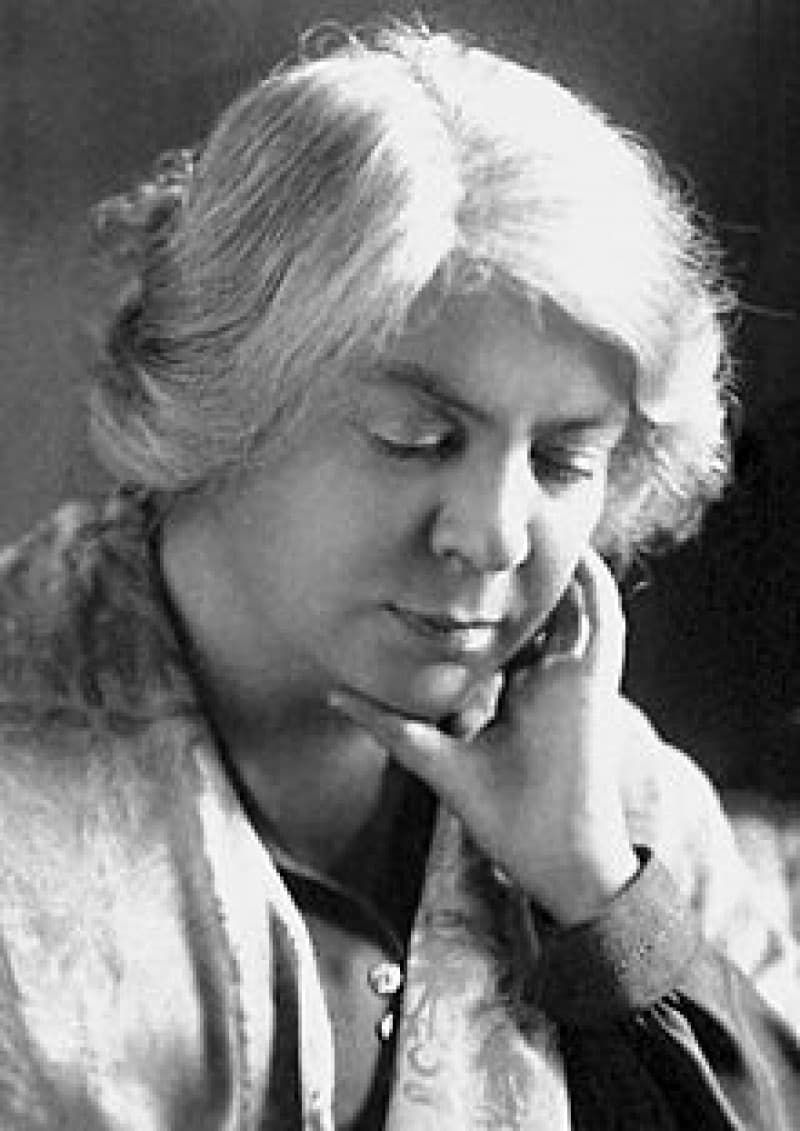
Italian · Literature
Grazia Deledda
September 27, 1871 – August 15, 1936
Early Life and Background
Grazia Maria Cosima Damiana Deledda was born on 27 September 1871 in Nuoro, a small town in the mountainous interior of Sardinia, then part of the Kingdom of Italy.[1][5][6][7][18] She was the fourth of seven children of Giovanni Antonio (Totoni) Deledda, a landowner and businessman engaged in agriculture and commerce, and Francesca Cambosu, noted for her strict morals and religiosity.[7][16][18] The family belonged to the respectable local bourgeoisie, but their environment remained deeply traditional, shaped by rural customs, Catholic devotion, and the hierarchical social structures of a recently unified Italy.[13][16]
Nuoro’s isolation and conservative culture profoundly marked Deledda’s imagination. As a girl, she attended formal school only to about age eleven; after that, her parents, reflecting prevailing norms about girls’ education, withdrew her from school, expecting her to focus on domestic duties.[1][5][16][18] Deledda nonetheless pursued learning on her own. She read widely, studied grammar and French with a private tutor, and began writing secretly, in defiance of local expectations that a respectable woman should not publish fiction.[1][7][16]
The tension between Deledda’s aspirations and her community’s values became a central theme in her later work. Many of her novels depict the clash between individual desire and communal codes of honour, religious scruple, and patriarchal authority, drawing directly on the psychological and social atmosphere of her youth in Nuoro.[1][5][16][17] The landscapes, dialects, and folk traditions of Sardinia supplied the material that she would transform into literary art.
Career Beginnings and Development
Deledda’s literary career began remarkably early. As a teenager, she submitted short stories to newspapers and magazines on the Italian mainland, often under pseudonyms to avoid scandal in Nuoro.[1][16][18] Per biographical summaries, her first short story was published in 1886, when she was about fifteen.[16] The local reaction was hostile; her writing was considered improper, and relatives and townspeople pressured her to stop.[7][16][18] Despite this, she continued, motivated by a strong sense of vocation and supported by a few sympathetic correspondents.
In 1892, Deledda saw the publication of her first novel, marking her transition from occasional contributor to professional author.[16] Around the same period, her father died, a loss that intensified the themes of grief, duty, and moral struggle in her fiction.[16] Her early novels and stories—often serialized—were influenced by the Italian school of verismo (realism), which sought to depict everyday life and social conditions with unsentimental clarity.[5][16] She applied this realist approach to Sardinian peasants, shepherds, and townspeople, portraying poverty, honour, vendettas, and religious anxiety with an eye for psychological complexity.
Seeking broader horizons, Deledda left Nuoro. She went first to Cagliari, the capital of Sardinia, around 1899, and in 1900 she moved to Rome, which was rapidly consolidating its status as the political and cultural centre of unified Italy.[1][16][18] Rome offered her access to major publishing houses, journals, and literary circles. Although she never fully integrated into avant‑garde movements, she established herself as a respected novelist whose works were widely translated and disseminated.[1][5][16]
Through the early 20th century, Deledda wrote at a remarkable pace. The Nobel Prize facts page emphasises that she produced a "large collection of novels, short stories, articles, stage plays, and poems," illustrating both her productivity and her range.[6] Her reputation grew steadily, especially after several key novels highlighted her distinctive Sardinian settings and moral themes.
Major Works and Literary Themes
Deledda’s best‑known works explore the intersection of Sardinian life, religious belief, and existential questions. Among her early successes was "Elias Portolu" (published 1903), a novel about a young man torn between desire and religious duty, set against the backdrop of Sardinian pastoral society.[1][5][16] It exemplifies her interest in guilt, redemption, and the burdens of tradition.
Another important work is "Cenere" (Ashes), a novel that examines the consequences of social stigma and maternal sacrifice. Its significance was underscored when it was adapted into a film in 1916, bringing Deledda’s stories to new audiences in the era of silent cinema.[16] Her protagonists often face tragic dilemmas, their lives shaped by rigid social codes and harsh natural environments.
In the 1910s and 1920s, Deledda’s writing matured toward more pronounced psychological introspection. Biographical entries note a "shifted writing themes from Sardinia to psychological introspection" around 1921, as she began to foreground inner conflicts alongside regional realism.[16] Her novel "La madre" (The Mother), published in Italian earlier in the decade, appeared in English in 1922 with an introduction by D.H. Lawrence, signalling international recognition and engagement with contemporary literary debates.[16]
Throughout her oeuvre, characteristic themes recur:
- Fate and fatalism: Characters often experience life as governed by an inescapable destiny, reflecting both traditional beliefs and Deledda’s own pessimistic view of the human condition.[16]
- Sin, guilt, and redemption: Religious and moral transgression, followed by remorse and the search for forgiveness, structure many narratives, mirroring the deeply Catholic culture of Nuoro.[1][5][16]
- Conflict between individual desire and communal norms: Her novels repeatedly stage clashes between personal love or ambition and the strict codes of honour and propriety enforced by rural society.[1][16][17]
- Landscape as moral force: Sardinia’s mountains, plains, and villages are not merely backdrops but shaping forces in the psychological lives of her characters.[1][17][18]
Stylistically, critics have noted her blend of verismo with symbolic and sometimes mystical elements, as well as her "plastic clarity" in depicting scenes and emotions—phrasing later echoed in the Nobel citation.[5][6][17]
Awards, Honours, and Nobel Prize
By the 1920s, Deledda was widely regarded as one of Italy’s leading novelists. In 1926, the Swedish Academy decided to award her the Nobel Prize in Literature, citing "her idealistically inspired writings which with plastic clarity picture the life on her native island and with depth and sympathy deal with human problems in general."[1][5][6][12][17][18] This decision made her only the second woman ever to receive the literary Nobel, after Selma Lagerlöf’s 1909 award.[1][6][16][18]
The Nobel Prize in Literature is dated 1926, but according to the Nobel Prize official facts page, Deledda "received her Nobel Prize one year later, in 1927," at the formal award ceremony.[6] On 10 December 1927 she was presented with the prize in Stockholm, an event that symbolised her international recognition.[6][9][17][18] At that ceremony she became the first Italian woman and the second woman worldwide to win the Nobel Prize in Literature.[6][9][16][18] She remains, as several biographical sources emphasise, the only Italian woman and the only Sardinian ever to receive this distinction.[9][17][18]
The award produced both celebration and controversy. Some contemporaries suggested that she had been chosen partly for political reasons over another Italian woman writer, Matilde Serao, reflecting debates about the role of nationalism and gender in prize selections.[7][14] Nonetheless, the Nobel solidified Deledda’s status as a major European novelist. Her works were translated into multiple languages, and she became a reference point in discussions of regionalism, women’s writing, and Italian modernism.[1][5][16][18]
Beyond the Nobel, Deledda received ongoing critical attention through reprints, translations, and film adaptations, though the Nobel remains the central formal honour of her career.[1][6][16]
Personal Life
Deledda’s personal life intertwined with her literary career in ways typical of women writers of her generation. In 1900, after moving to Rome, she married Palmiro Madesani
Despite living in Rome, Deledda maintained strong emotional ties to Sardinia. She returned to Nuoro periodically and continued to set many stories and novels in Sardinian villages and countryside, even as she gained national and international readership.[1][5][16][17] Her marriage appears in biographical accounts as supportive; Madesani is described as encouraging her writing, which was crucial in a society where female authorship could still provoke criticism.[16][18] Accounts of her personality emphasise her modesty and reserve. She generally avoided the more flamboyant literary salons and modernist circles that flourished in early‑20th‑century Rome, choosing instead a quieter life of sustained work. Several sources note that she continued to write intensively even after serious illness began to affect her health, attesting to her dedication to literature.[2][6][18] Deledda’s legacy operates on several interconnected levels: national, regional, literary, and feminist. Nationally, she is recognised as one of the foremost Italian novelists of the early 20th century, alongside writers such as Giovanni Verga and Luigi Pirandello, though her style and themes are distinct.[1][5][16] Her Nobel Prize remains a point of pride for Italian literature, particularly because she is still the only Italian woman laureate in the category.[6][9][18] Regionally, Deledda is celebrated as the voice of Sardinia, a phrase highlighted by the Nobel Prize’s own interpretive essay on her work.[17] She brought Sardinian landscapes, customs, and dialect‑coloured speech into international literature, challenging the marginalisation of island and rural cultures within national narratives. In Nuoro and wider Sardinia, her memory is institutionalised through museums, cultural programmes, and municipal biographies underscoring how her writing "crosses the sea" and Italy’s borders to reach a global audience.[9][17] In literary terms, scholars underline her contribution to the evolution of realism and psychological fiction. Her novels often combine detailed ethnographic observation with explorations of conscience, passion, and metaphysical anxiety, prefiguring later 20th‑century interest in interiority and moral ambiguity.[1][5][14][16] Her focus on marginal characters—women, peasants, socially stigmatized individuals—expanded the range of Italian fiction beyond urban bourgeois settings. From the perspective of women’s history, Deledda’s career is emblematic of the barriers faced and overcome by women writers in the late 19th and early 20th centuries. She wrote from a region where girls’ education was curtailed and female authorship could damage a family’s respectability.[1][7][16][18] Nevertheless, she persisted, publishing against local disapproval, relocating to cities to pursue her craft, and ultimately securing the highest international literary honour available. Her status as the second woman Nobel laureate in literature and first Italian woman laureate highlights both her exceptional achievements and the structural exclusion of women from such recognition.[1][6][16][18] Contemporary feminist and literary scholars, as well as public history projects, increasingly foreground Deledda in discussions of women’s cultural contributions. Articles and biographies emphasise the "pessimistic" yet profound vision of the human condition that emerges from her work, arguing that her focus on guilt, suffering, and destiny reflects both personal experience and broader social constraints imposed on women in patriarchal societies.[13][16] After receiving the Nobel Prize, Deledda did not retreat from literary activity. The Nobel Prize biographical note observes that she "continued to write extensively after she received the Nobel Prize," producing further novels and stories into the 1930s.[2][6][18] Her later works deepened her exploration of moral and psychological themes, though they did not always receive the same international attention as her earlier classics. In her final years, Deledda lived in Rome, where she balanced family life with ongoing writing despite worsening health. Multiple sources describe her death as resulting from cancer, commonly specified as breast cancer.[7][9][13][18] She died on 15 August 1936 in Rome at the age of 64.[1][5][6][18] Some reference works, such as one Encyclopedia.com entry, list the date as 16 August, indicating a minor discrepancy in the record, but major authorities including Britannica, the Nobel Prize facts page, and most biographical summaries agree on 15 August.[1][5][6][16][18] Deledda’s passing prompted reflections on the trajectory from her youth in Nuoro to international acclaim. Posthumous scholarship and criticism have reassessed her place within Italian and European literature, often arguing that earlier dismissals of her as merely a regional or "folk" novelist underestimated the philosophical and psychological depth of her work.[1][5][14][16][18] Today, Deledda’s life story—self‑education in a conservative town, early scandal, migration to the capital, sustained artistic labour, and Nobel recognition—serves as a powerful narrative in women’s history. It illustrates how a woman from a peripheral region could reshape literary canons and public perceptions of women’s intellectual capacities, even as many structural barriers remained. Her birth in 1871 and death in 1936 bracket a period of intense change in Italy and Europe; her novels capture the ethical and emotional complexities of individuals navigating that transformation.Legacy and Historical Impact
Later Life and Death
Dated achievements
4 indexed.
- Sep271871Literature
Birth in Nuoro, Sardinia
Grazia Maria Cosima Damiana Deledda was born in Nuoro, Sardinia, Italy, into a middle-class family in the provincial town that would deeply shape her literary work.
View details Nobel Prize Facts: Grazia Deledda - Dec101927Literature
Receives Nobel Prize in Literature for 1926
Grazia Deledda formally received the Nobel Prize in Literature for 1926 at the Nobel Prize Award Ceremony held in Stockholm on 10 December 1927.