← All women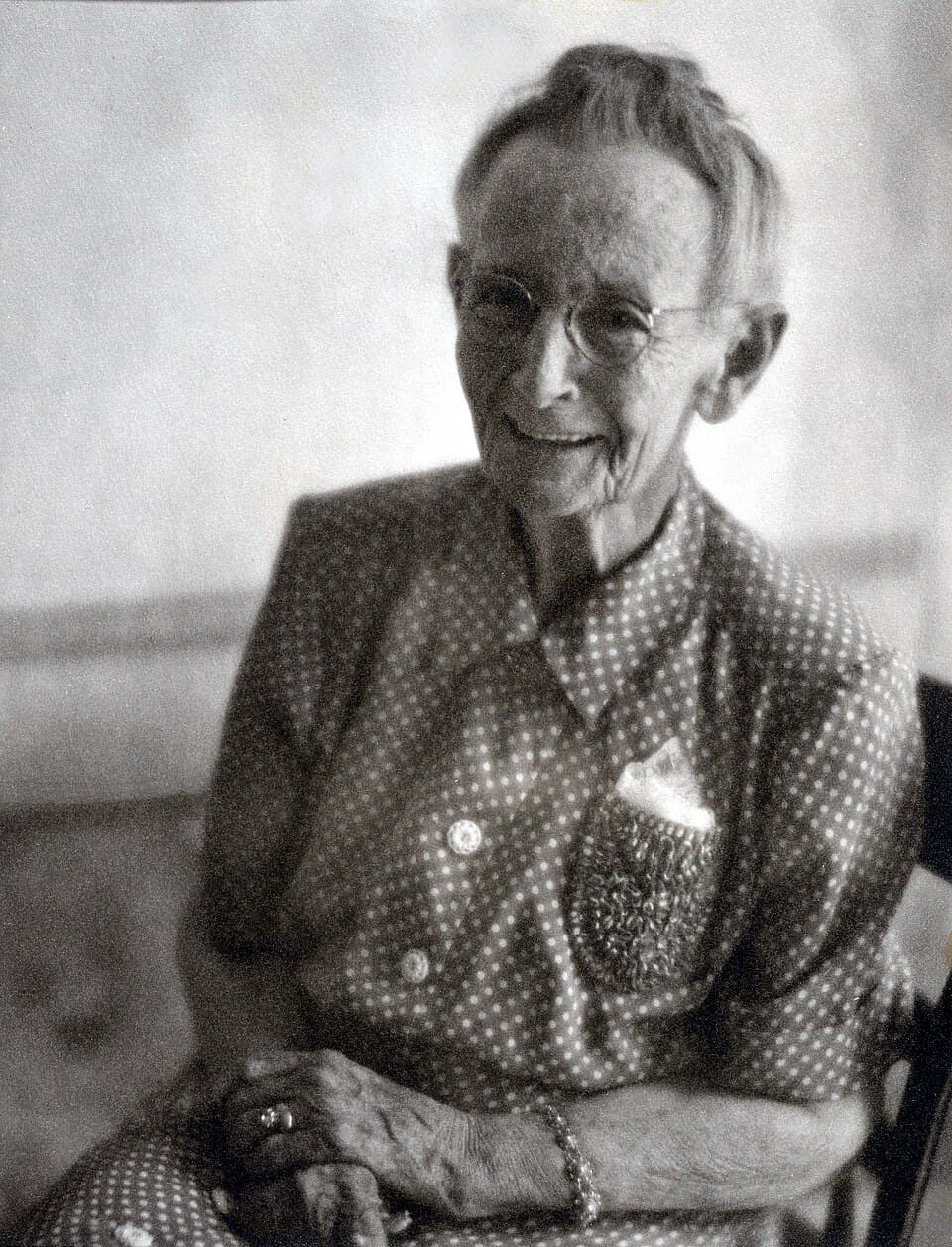
American · Arts
Grandma Moses
September 7, 1860 – December 13, 1961
Early Life and Background
Anna Mary Robertson Moses, universally known as Grandma Moses, was born on September 7, 1860, near Greenwich, Washington County, New YorkRussell King Robertson, a farmer and sometime inventor, and Margaret (Shick/Shanahan) Robertson, the daughter of Irish immigrants.[2][11] The family lived in rural upstate New York, an environment of farms, small villages, and seasonal cycles of agricultural work that would later become the enduring subject matter of her paintings.
Moses’s childhood was shaped by both economic necessity and limited educational opportunities. She attended local country schools sporadically, gaining only a basic formal education.[11] Like many farm girls of the era, she was expected to contribute to household labor from a young age. Her father encouraged creativity by bringing home large sheets of paper on which the children could draw, and Anna enjoyed making images and patterns. This early informal drawing experience, though modest, nurtured her visual imagination.[5][11]
At about twelve years old, Moses left her parental home to work as a “hired girl” on a neighboring farm.[3][12] This position involved domestic tasks such as cooking, cleaning, and child care, as well as assisting with farm chores, reflecting the gendered division of labor on rural farms. The demanding work underscored the constraints placed on girls and women in 19th‑century rural America, even as it familiarized her with the routines and social life that later appeared in her paintings—quilting bees, barn raisings, and seasonal festivals.
Marriage, Family, and Farm Life
On November 6, 1887, Anna Mary Robertson married Thomas Salmon Moses, a hired farm worker.[1][11] The marriage transformed her into Anna Mary Robertson Moses and set the course for the domestic and agricultural life that defined most of her adulthood. The couple worked as tenant farmers, initially in the Shenandoah Valley of Virginia and later back in upstate New York. They eventually acquired a farm near Eagle Bridge, New York, around 1907, though sources specify only the year.[1][4][11]
Moses bore ten children, five of whom survived infancy, reflecting the high child mortality rates in rural America at the time.[3][11] Her daily life was dominated by the demands of childrearing, household management, and farm labor. She helped support the family by selling homemade butter, potato chips, and preserves, along with crafts such as needlework and quilts.[3][11] These domestic enterprises were typical strategies by which farm women contributed to household income.
Although she had enjoyed drawing in childhood, Moses’s creative outlet during her middle years was primarily needlework pictures and quilting. She disliked some forms of sewing but began making embroidered scenes of farm life for her own enjoyment and as gifts for friends.[3][11] This work honed the compositional skills and narrative approach she would later transfer to painting: arrangements of small figures within expansive landscapes, careful attention to seasonal detail, and an emphasis on collective activity.
In 1918, after Thomas Moses’s death, Anna moved in with her son and his family near Eagle Bridge.[1][4] Widowed and aging, she continued to manage household responsibilities but also began to shift her creative focus. Arthritis made fine needlework increasingly painful, and this physical limitation would turn out to be a pivotal factor in her transition from embroidery to painting.
Transition to Painting and Career Beginnings
Moses’s turn to painting occurred in her seventies, a fact repeatedly noted in biographical accounts as central to her legend.[2][5][8] Precise dates for her first paintings are not documented, but scholars agree that she began painting seriously in the late 1930s, after arthritis impeded her ability to embroider.[1][4][15] She used whatever materials were at hand—house paint, leftover boards, and simple brushes—and drew heavily on memory rather than direct observation, recreating scenes of rural life from decades earlier.[3][14]
Her earliest paintings focused on familiar motifs: farmhouses, fields, rivers, and hills rendered in bright colors with an even, often frontal perspective. Figures were stylized and small, engaged in activities such as plowing, harvesting, sleigh riding, and attending community events. Her style has been described as Primitivism or naïve art, a branch of folk art characterized by simplified forms, flattened space, and emphasis on narrative rather than strict realism.[2][5]
Moses initially sold her paintings locally, sometimes for modest sums or in exchange for goods. A turning point occurred in 1938 when New York art collector Louis J. Caldor noticed her works displayed in the window of the W.D. Thomas pharmacy in Hoosick Falls, New York.[1][4][12] Impressed by their charm and originality, Caldor purchased several paintings and brought them to New York City, showing them to gallery owner Otto Kallir of Galerie St. Etienne.
In 1939, Kallir organized her first New York gallery exhibition, titled "What a Farm Wife Painted", at Galerie St. Etienne.[1][4] Though sources disagree on the exact opening date, they agree that the show introduced Moses to the New York art world, framing her as an authentic farm wife whose paintings offered unschooled yet compelling visions of rural America. Reviews were generally enthusiastic, and the show established the groundwork for her rapid rise in visibility.
Institutional Recognition and Major Exhibitions
A crucial milestone came on November 15, 1940, when the Museum of Modern Art in New York opened "Contemporary Unknown American Painters", an exhibition that included works by Grandma Moses.[1] The show’s premise—to spotlight "unknown" American artists—underscored her status outside academic and professional networks, yet MoMA’s endorsement significantly raised her profile and validated her work within modern art discourse.
During this period, a reviewer for the New York Herald Tribune noted that her neighbors called her "Grandma Moses," a nickname that quickly became her public and professional identity.[3][10] The moniker reinforced her image as a kindly, elderly rural grandmother and contrasted sharply with the typically male, urban, and formally trained artists who dominated critical attention.
Throughout the 1940s and 1950s, Moses’s paintings were exhibited widely in the United States and abroad. Galerie St. Etienne continued to champion her, organizing shows that traveled to major cities. Museums and private collectors amassed her works, and her paintings of snow‑covered villages, harvest fields, and community gatherings became popular with audiences seeking nostalgic visions during and after World War II.[2][16]
On September 7, 1955, her ninety‑fifth birthday, a major retrospective opened at Gallery St. Etienne in New York.[1][4] The show surveyed her career, presenting early and recent works together and confirming her status as a significant figure in American art rather than a passing curiosity. By then she had produced hundreds of paintings, and estimates at her death ranged from roughly 1,600 to about 2,000 works.[5][15]
Style, Themes, and Major Works
Grandma Moses’s paintings are best known for their depiction of rural American life in the late 19th and early 20th centuries. Her landscapes are populated with small figures engaged in farming, traveling, celebrating holidays, or simply going about their daily routines. She frequently painted seasonal scenes, particularly winter settings with sleighs, ice skating, and snow‑covered fields.[2][5][16]
Her works have been described as combining "narrative clarity" and "rhythmic composition," with clusters of activity arranged across rolling hills and winding roads.[14] She often used bright, flat colors and limited shadowing, producing an effect that echoes the patterns of cross‑stitching and embroidery she had practiced for decades.[15] Rather than capturing exact topographical detail, she synthesized memories from different times and places into composite scenes that recreated the emotional texture of rural community life.
Moses sometimes employed unconventional materials, such as sprinkling glitter over snow in her winter landscapes to evoke the shimmer of sunlight.[10] Critics occasionally disparaged these choices as amateurish, but she defended them as truthful to her visual experience. Her paintings were typically given descriptive titles referencing activities or locations—such as "Sugaring Off" (depicting maple syrup making) or "Hoosick Falls"—and many became iconic images through reproduction on greeting cards, textiles, and dinnerware.[10][16]
While specific "masterpieces" are difficult to single out in a body of work so focused on thematic continuity, art historians have emphasized the importance of her seasonal series and village panoramas. These works not only commemorate a rural world in transition but also document the social fabric of small‑town life, including the labor of women and children, community gatherings, and religious observances.[2][5]
Public Image and Mass Reproduction
Grandma Moses’s rise to fame was closely tied to mass media and commercial reproduction. In 1946, her public image reached a new level when she appeared on the cover of TIME magazine on November 3, portrayed as a national folk‑art celebrity.[1] The cover story framed her as an embodiment of American rural virtues and postwar nostalgia, bringing her name and face to millions of readers beyond the art world.
Her paintings were widely licensed for commercial use. Hallmark Cards, for example, reproduced her images on greeting cards, selling an estimated 16 million cards featuring her paintings in 1947 alone.[10] Fabrics, plates, and other household items also bore her imagery, integrating her depictions of rural life into everyday domestic spaces.
On June 9, 1949, the film "Grandma Moses" premiered in New York City, dramatizing her life story.[1] The movie presented her biography—farm girl, farm wife, grandmother, and late‑blooming artist—as a uniquely American tale of perseverance and creativity. It reinforced the sentimental aspects of her public image, emphasizing her age and rural simplicity while celebrating her success.
While some critics dismissed her work as "storybook" or overly nostalgic, others appreciated its compositional sophistication and cultural value. Her popularity with the general public sometimes placed her at odds with avant‑garde tastes, but it also ensured that her art reached audiences who rarely visited museums or galleries.[13][16]
Awards, Honors, and Autobiographical Writing
Moses received numerous honors in recognition of her contribution to American art and culture. On October 16, 1947, U.S. President Harry S. Truman personally presented her with the Women’s National Press Club Award.[1] The ceremony highlighted the role of women journalists in championing her work and brought presidential prestige to a self‑taught woman artist.
In addition to such awards, she received honorary degrees from institutions including Russell Sage College and was honored by various cultural organizations, though many of these recognitions are documented by year rather than specific dates.[5][11] Her paintings were acquired by major museums, and the Bennington Museum in Vermont eventually assembled the largest public collection of her works.[16]
On February 10, 1952, her ninety‑second birthday, New York Governor Nelson A. Rockefeller proclaimed "Grandma Moses Day" in New York State, officially acknowledging her significance as a cultural figure.[1][10] This proclamation was rare for an artist and particularly notable for a woman who had begun her professional career so late in life.
Moses also documented her own life in writing. Her autobiographical text "My Life’s History" was first published in Art in America in 1944, and she later issued an expanded autobiography in 1952, at age ninety‑two.[1][7][10] In these writings, she reflected on her childhood, marriage, farm work, and artistic development, and she commented on the gender constraints she had faced. In one often‑quoted passage, she wrote: "Many a time I had to rock the cradle; I liked it, but I had rather been outdoors with my brothers," encapsulating her awareness of how domestic duties limited her freedom as a girl.[10]
Personal Life and Gendered Experience
Throughout her life, Moses navigated the expectations placed on rural women: marriage, motherhood, and domestic labor as primary identities. She combined these roles with a growing artistic practice only in old age, when domestic demands lessened and physical limitations forced her to abandon fine needlework for painting.[3][11]
She had nine grandchildren and more than thirty great‑grandchildren, a large extended family that reinforced her public persona as "Grandma Moses."[10] Sources note that when she first exhibited her work she was referred to as "Mrs. Moses," and the "Grandma" title emerged from journalistic and critical commentary rather than self‑branding.[3][10] The nickname both celebrated and constrained her, emphasizing her age and domestic identity even as it helped secure her appeal.
Moses’s reflections on gender in her autobiography reveal a subtle critique of the limitations imposed on women. Her desire to be outdoors with her brothers rather than confined to childcare underscores the broader pattern of female restriction in 19th‑century rural society.[10] Her eventual success as an artist did not erase these experiences but rather transformed them into material for her work: the scenes of women participating in farm labor and community events make visible the often overlooked contributions of rural women.
Legacy and Historical Impact
Grandma Moses’s legacy is multifaceted, encompassing art history, cultural memory, and women’s history. As a self‑taught folk artist who began painting seriously in her seventies, she became a powerful symbol of lifelong creativity and the potential for late‑life reinvention.[2][5][8] Her success challenged assumptions about the necessity of formal training, urban residence, and youth for artistic recognition.
In art historical terms, she is a central figure in American naïve and folk art. Her works are frequently cited in discussions of vernacular visual culture, and her emphasis on narrative, memory, and communal life has informed scholarly understandings of how non‑professional artists document social worlds.[2][5][16] Institutions such as the Bennington Museum and Galerie St. Etienne have played key roles in preserving and interpreting her oeuvre, ensuring that her paintings remain available for research and public viewing.[1][16]
Culturally, Moses’s depictions of rural America have become part of the collective imagination of the United States. Created during decades of rapid industrialization, urbanization, and geopolitical upheaval, her paintings offered viewers comforting visions of small‑town and farm life, framed as an "idyllic bygone America."[16] Their popularity in greeting cards and household items disseminated these images widely, influencing how Americans pictured their own past.
For women’s history, Moses is significant as an example of a woman whose artistic career emerged from—and was shaped by—domestic and agricultural labor. Her story illustrates the ways in which women’s creative capacities can be constrained by gendered expectations yet later find expression through forms that revalue those experiences. Her honors, including the Women’s National Press Club Award and "Grandma Moses Day," highlight the growing mid‑20th‑century recognition of women’s cultural contributions.[1][2][10]
Her life also intersects with broader historical narratives: born just before the Civil War, she lived through Reconstruction, industrialization, the two World Wars, and the beginnings of the civil rights movement.[6][12] Her paintings do not directly address these political events, but they chronicle everyday rural life across the same period, offering a parallel record of social continuity amid change.
Later Life and Death
In her later decades, Moses continued to paint prolifically, often producing works based on childhood memories and earlier sketches. She remained active into her late nineties, adapting her working habits to her physical capacities and relying on assistants for some practical tasks while maintaining creative control over her imagery.[3][5]
Her hundredth birthday in 1960 was marked by widespread celebrations and media tributes, though sources generally describe these commemorations by year rather than by specific dates.[5][9] She was frequently interviewed and photographed, and her status as a centenarian artist further strengthened her symbolic role as an embodiment of resilience and enduring creativity.
On December 13, 1961, Grandma Moses died in Hoosick Falls, New York, at age 101.[1][2][8][11] She had painted until a few months before her death, leaving an extensive body of work. Obituaries emphasized not only her artistic achievements but also the extraordinary span of her life—from the era of Abraham Lincoln’s presidency to that of John F. Kennedy.[2][6]
After her death, her paintings continued to be collected, exhibited, and reproduced. Scholars and curators have examined her work in relation to folk traditions, gender, age, and the politics of nostalgia. The sustained interest in her art underscores the enduring relevance of the questions her life raises: who is recognized as an artist, how everyday experiences become cultural memory, and how women’s labor and creativity are recorded in history.
Grandma Moses remains a key figure in both American art and women’s history, her paintings serving as visual testimony to a rural world and a reminder that artistic innovation can emerge from unexpected places and late in life.
Dated achievements
9 indexed.
- Sep071860Arts
Birth of Anna Mary Robertson (Grandma Moses)
Anna Mary Robertson was born on this day in Greenwich, New York.
View details Wikipedia - Grandma Moses - Nov061887Arts
Marriage to Thomas Salmon Moses
Anna Mary Robertson married Thomas Salmon Moses on this day.
View details