← All women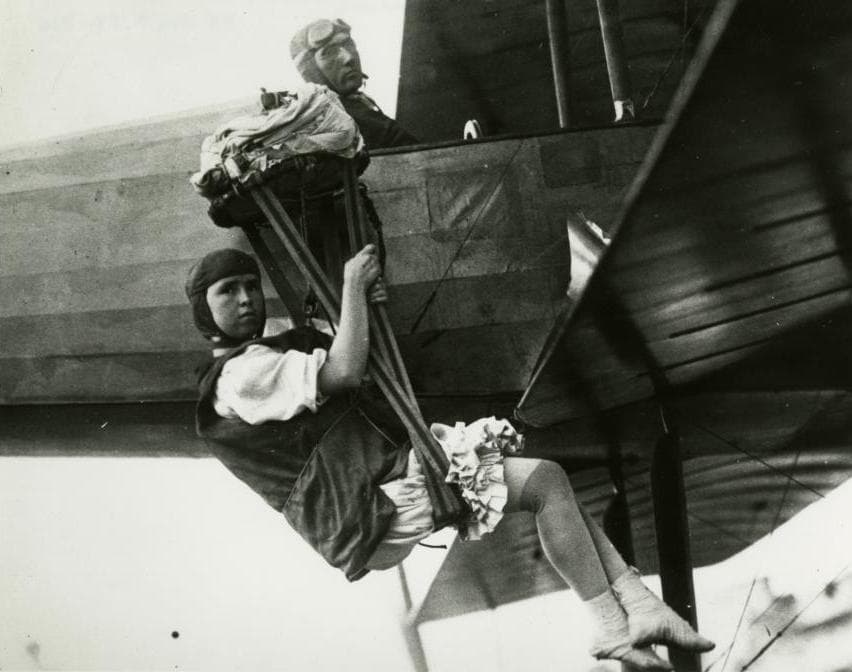
American · Aviation · Exploration
Georgia "Tiny" Broadwick
April 8, 1893 – August 25, 1978
Early Life and Background
Georgia Ann Thompson, later known as Georgia "Tiny" Broadwick, was born on April 8, 1893, in Oxford, North Carolina. She was called "Tiny" because of her small stature, standing just over four feet tall and weighing less than 100 pounds. This petite frame would ironically become one of her greatest assets in the field of parachuting.
Raised in a rural setting, Broadwick's early life was marked by modest conditions and limited opportunities. However, her adventurous spirit led her into the nascent world of aviation, a field largely dominated by men and still in its infancy when she began her career.
Career Beginnings and Development
Broadwick's introduction to parachuting came through a fortuitous encounter with Charles Broadwick, an inventor and parachute enthusiast. Charles immediately recognized "Tiny"'s potential for parachuting due to her size and physique, allowing her to safely descend with lighter equipment. She joined his exhibition team, performing jumps at fairs and air shows across the country.
It was during this time that she adopted the professional surname "Broadwick," continuing to work closely with Charles, who had developed an early form of the modern parachute. Her performances quickly gained popularity, captivating audiences and positioning her as a novelty act in a burgeoning entertainment industry centered on aviation.
Major Works, Discoveries, and Accomplishments
On June 21, 1913, in Los Angeles, Georgia Broadwick became the first woman to jump from an airplane. This event was not merely a spectacle; it demonstrated the potential for parachutes in aviation safety. She further distinguished herself on June 21, 1914, when she performed the first free-fall jump. Broadwick's risky yet controlled descents showcased the practical applications of parachuting, directly influencing the safety measures adopted by the military and civilian aviation sectors alike.
In later jumps, she innovated parachute technology by using a ripcord for deployment, a crucial improvement that would become a standard feature in parachutes.
Awards, Honors, and Recognition
Though formal recognition was limited during her lifetime due to the gender biases of the era, Broadwick's contributions were acknowledged posthumously. Her pioneering efforts in aviation are celebrated in institutions such as the Smithsonian's National Air and Space Museum, solidifying her legacy within the annals of early flight history.
Personal Life
Broadwick's personal life was deeply interwoven with her professional pursuits. She married once, but much of her later life remained private. She continued to share her passion for flying, working with military personnel to enhance parachute deployment training and improve safety standards.
Legacy and Historical Impact
Georgia "Tiny" Broadwick's legacy is monumental not only in the story of aviation but also in the history of women's advancements in male-dominated fields. Her fearless dedication demonstrated that technical aptitude and bravery were not confined by gender. Her contributions laid the groundwork for future developments in parachute technology, influencing both military and civilian parachuting.
Later Life and Death
Broadwick retired from active parachuting in the mid-1920s but remained involved in aviation circles. She passed away on August 25, 1978. Her life and career continue to inspire countless aviators and skydivers, reminding us of the importance of courage and innovation in the face of adversity.
Dated achievements
3 indexed.
- Apr081893Aviation
Born in Oxford, North Carolina
Georgia Broadwick was born on April 8, 1893, in Oxford, North Carolina.
View details North Carolina Department of Natural and Cultural Resources - Jun211913Aviation
First woman to parachute from an airplane
On June 21, 1913, Georgia Broadwick became the first woman to jump from an airplane.