← All women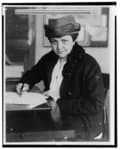
American · Politics · Activism · Law
Frances Perkins
April 10, 1880 – May 14, 1965
Early life and education
Frances Perkins was born on April 10, 1880, in Boston, Massachusetts, and was baptized Fannie Coralie Perkins. She grew up in a family of New England roots that valued education, self-discipline, and public responsibility. Biographical sources describe her upbringing as shaped by both middle-class stability and an inherited sense of civic obligation, traits that later informed her approach to reform and public service.
Perkins attended school in Worcester before entering Mount Holyoke College, where she graduated in 1902. Her years at Mount Holyoke were formative. The college’s strong emphasis on intellectual seriousness, women’s education, and social purpose helped deepen her commitment to public life. While studying, she became increasingly attentive to industrial conditions, poverty, and the relationship between work and human dignity. She later studied economics and sociology further, including work at Columbia University, and trained for reform-oriented work that would define her career.
After college, Perkins taught school and worked in settlement houses, including Hull House in Chicago and settlement work in Philadelphia. These experiences brought her into direct contact with the lives of working families, immigrants, and the urban poor. The settlements exposed her to low wages, dangerous factories, poor housing, and the daily hardships created by industrial capitalism. They also introduced her to a practical reform tradition that sought to improve conditions through investigation, advocacy, and public policy rather than charity alone.
Formative reform years
A decisive moment in Perkins’s development came in 1911, when she witnessed the Triangle Shirtwaist Factory fire in New York City. The disaster, which killed 146 workers, most of them young immigrant women, shocked the nation and exposed the deadly consequences of lax industrial safety standards. Perkins’s reaction was not temporary grief but lifelong political commitment. The fire became one of the most powerful moral reference points in her career, driving her insistence that government had a duty to regulate workplaces and protect laborers.
In the years that followed, Perkins worked with labor reform organizations and consumer advocacy groups. She became head of the New York Consumers’ League in 1910, using that role to press for shorter hours, safer conditions, and protections for women and children in the workplace. In this period, women activists often faced skepticism about their authority, especially when they sought influence over industrial policy. Perkins nevertheless built credibility through research, coalition-building, and practical policy work.
Her reform efforts helped secure passage of New York’s 54-hour bill in 1912, which limited the weekly hours women and children could work. She then moved into state government service, where she held increasingly significant positions in industrial regulation. In 1918, she became the first executive director of the New York Committee on Safety and the first woman appointed to the New York State Industrial Commission. These posts placed her at the center of efforts to improve industrial safety, labor standards, and enforcement mechanisms in one of the nation’s most important industrial states.
Rise in New York State government
Perkins’s state service demonstrated her ability to combine reform ideals with administrative competence. She worked under governors who recognized the growing political importance of labor issues during the Progressive Era and after World War I. In 1929, Governor Franklin D. Roosevelt appointed her New York State Industrial Commissioner, making her the first woman to hold that office. The appointment elevated her profile nationally and gave her valuable experience in labor administration, mediation, and enforcement.
By the time Roosevelt became president, Perkins had already established herself as one of the country’s most capable labor reformers. Her record in New York showed that she could navigate politics, negotiate with employers and unions, and translate reform principles into enforceable rules. Those skills would prove crucial in Washington during the Depression.
Secretary of Labor and the New Deal
On March 4, 1933, Roosevelt appointed Perkins Secretary of Labor, making her the first woman to serve in a U.S. presidential Cabinet. She would hold the office until 1945 and become the longest-serving Secretary of Labor in American history. Her appointment was historically unprecedented, but her tenure was defined not by symbolism alone. She helped design and implement major components of the New Deal, working to give federal government a new role in economic security.
As Secretary of Labor, Perkins helped shape policies that addressed unemployment, minimum wages, maximum hours, child labor, and workers’ rights. She was a central figure in the creation of the Social Security Act of 1935, which established old-age pensions, unemployment insurance, and related protections. She also played an essential role in the National Labor Relations Act, which protected workers’ rights to organize and bargain collectively. In addition, she was a major force behind the Fair Labor Standards Act of 1938, which created the first federal minimum wage, established a maximum workweek, and restricted child labor.
Perkins’s influence extended beyond legislation to the broader machinery of New Deal administration. She supported labor standards enforcement and oversaw programs and agencies designed to mitigate mass unemployment and stabilize the labor market. Her work contributed to the development of the modern American welfare state, especially by embedding the principle that government should help ensure a basic measure of economic security. During a period of enormous distress and political contention, she had to overcome not only administrative challenges but also gender prejudice in a federal government dominated by men.
Her leadership style combined persistence, discretion, and strategic pragmatism. She was often portrayed as a behind-the-scenes negotiator rather than a dramatic public orator, but her influence was substantial. Contemporary and later assessments have credited her with helping make the New Deal coherent and durable, especially on questions of labor policy and social insurance. Her role in turning reform ideas into law made her one of the most consequential cabinet officers of the twentieth century.
Later government service and teaching
Perkins left the Cabinet in 1945 after Roosevelt’s death and the end of his long presidency. Her public service did not end there. President Harry Truman asked her to serve on the U.S. Civil Service Commission, a post she held until 1952. That appointment extended her federal career and reflected the continuing respect she commanded across administrations.
After leaving government service, Perkins remained active as a lecturer and teacher, including work at the New York State School of Industrial and Labor Relations at Cornell University. In this phase of her life, she continued to interpret the New Deal for new audiences and to advocate for labor standards and social insurance. Her later writings and talks reinforced her reputation as both a policymaker and a public intellectual who helped explain why labor protections mattered in a democratic society.
She also authored books, including People at Work (1934) and The Roosevelt I Knew (1946). These works helped document her thinking on labor policy and her experience inside the Roosevelt administration. Through them, she contributed to the historical record of the New Deal from an insider’s perspective.
Personal life
Perkins married economist Paul Caldwell Wilson in 1913, and they had one daughter. Her marriage was complicated by Wilson’s long struggles with mental illness, a burden that influenced her domestic life and required significant personal resilience. Despite these private challenges, she sustained a demanding public career. Her ability to maintain that balance has often been noted by historians as part of what made her life unusual for a woman of her generation.
Her personal experiences did not remove her from the public sphere; rather, they deepened her understanding of economic insecurity, family responsibility, and the social supports working people needed. That perspective gave added force to her policy work on wages, unemployment, and retirement security.
Honors, recognition, and institutional legacy
Perkins received substantial posthumous recognition for her contributions. The U.S. Department of Labor later named its headquarters after her, and she was inducted into the Labor Hall of Fame. Museums, historical associations, and women’s-history institutions have continued to highlight her as a foundational figure in social policy and women’s political history. Her work is also commemorated by the Frances Perkins Center and by numerous archival and educational collections devoted to labor history and the New Deal.
Her legacy rests on both substance and symbolism. Substantively, she helped establish the federal commitment to old-age security, unemployment insurance, labor rights, and wage-and-hour regulation. Symbolically, she demonstrated that a woman could not only enter the highest levels of government but also shape the nation’s policy architecture. At a time when women’s political authority was still contested, Perkins proved that expertise, persistence, and moral seriousness could overcome institutional barriers.
Historical impact
Frances Perkins is widely regarded as one of the most important public officials of the Roosevelt era and one of the central architects of the modern American welfare state. Her reform career bridged the Progressive Era and the New Deal, linking early industrial safety activism to a broader vision of federal responsibility for economic justice. The Triangle fire, the labor struggles of the early twentieth century, and the catastrophe of the Great Depression all shaped her sense that the state had to protect workers from market failures and unsafe conditions.
Her importance also lies in the precedent she set for women in public life. As the first woman in a U.S. presidential Cabinet, she expanded the realm of conceivable political leadership for future generations. Yet she also insisted that competence, not novelty alone, should define her work. That combination of barrier-breaking achievement and policy substance makes her a landmark figure in American women’s history, labor history, and the history of social reform.
Perkins died in New York City on May 14, 1965, but the institutions she helped build remained central to American life. Social Security, wage and hour regulation, and collective bargaining rights continue to reflect the policy framework she advanced. Her life stands as a model of reform sustained over decades, and of the power of government used in service of social protection and dignity.
Dated achievements
3 indexed.
- Apr101880Science
Birth of Frances Perkins
Frances Perkins (born Fannie Coralie Perkins) was born in Boston, Massachusetts.
View details Frances Perkins - Wikipedia - Mar041933Politics
First woman appointed to a U.S. presidential Cabinet as Secretary of Labor
Sworn in as U.S. Secretary of Labor under FDR, Perkins became the first woman to serve in a presidential Cabinet in American history.