← All women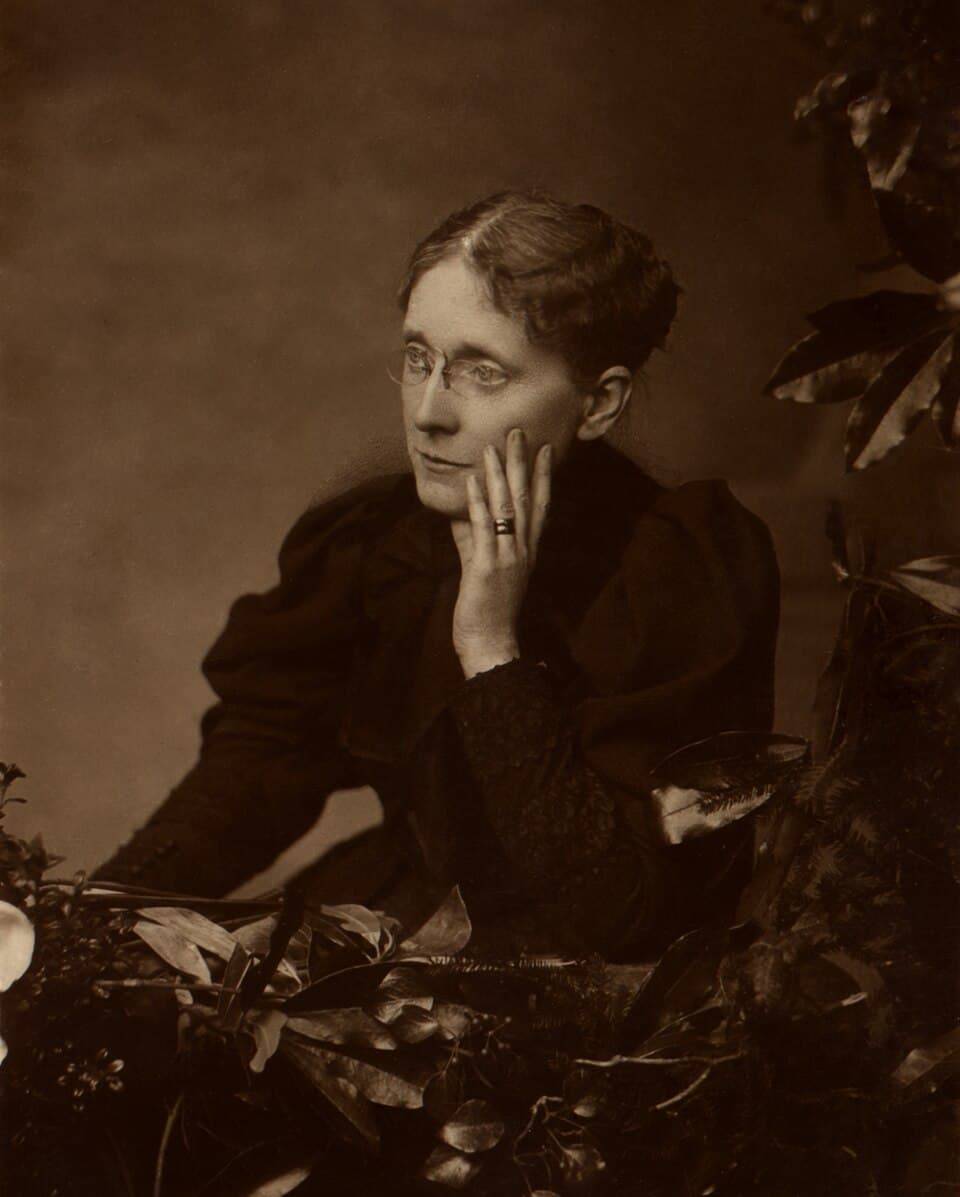
American · Activism · Politics
Frances E. Willard
September 28, 1839 – February 17, 1898
Early Life and Background
Frances Elizabeth Caroline Willard was born on September 28, 1839, in Churchville, near Rochester, New York, the second of three children of Josiah Willard and Mary Hill Willard.[6][7] Her father was a farmer and businessman, and her mother a former teacher, combining practical enterprise with a strong commitment to education and religious life. This family environment, especially her mother’s intellectual and moral influence, played a decisive role in shaping Frances Willard’s values and ambitions.[7][14]
In the early 1840s and 1850s, the Willard family joined the broader westward movement of Americans, relocating first to Ohio and later to the frontier of Wisconsin.[4][14] Willard spent much of her childhood in Janesville, Wisconsin, where she was exposed to the rigors of frontier life, evangelical Protestantism, and the emerging culture of reform. These experiences cultivated in her a sense of resilience, a strong work ethic, and a belief that Christianity demanded engagement in social improvement.[14]
Willard received early schooling from her mother and local institutions, showing a voracious appetite for reading and a precocious interest in moral and philosophical questions.[7][11] As a young woman she developed a deep Methodist piety and a belief in personal conversion, yet increasingly connected her faith to public concerns such as slavery, intemperance, and the status of women. The combination of religious conviction and frontier pragmatism laid the groundwork for her later role as a leader in mass movements.
Education and Formative Influences
In 1858, Willard moved to Evanston, Illinois, a suburb north of Chicago, to attend North Western Female College, one of the region’s leading institutions for women’s higher education.[10][14] She graduated in 1859, serving as valedictorian of her class.[10][13] Her studies included literature, rhetoric, and moral philosophy, fields that sharpened her talents as a writer and orator.
The Evanston environment was crucial for Willard’s intellectual development. The town was strongly influenced by the Methodist Episcopal Church and by reform-minded educators associated with Northwestern University. In college she encountered ideas about coeducation, women’s intellectual equality, and the moral responsibilities of educated Christians.[10][14] These formative influences encouraged her to view teaching not merely as a respectable female occupation, but as a platform for social transformation.
Shortly after graduation, Willard joined the Methodist Episcopal Church, confirming her allegiance to an evangelical tradition that would remain central to her identity.[10] Methodism’s emphasis on personal holiness, social concern, and organized lay activity offered her both spiritual grounding and a practical framework for the collective action she later championed.
Career Beginnings in Education
In the early 1860s, Willard embarked on a teaching career that took her to schools in Illinois, Pennsylvania, and New York.[1][2][7] Over roughly sixteen years she held various posts as a teacher and administrator, gaining a reputation for competence and innovation in education. She promoted comprehensive curricula for girls, including literature, science, and moral instruction, and she advocated coeducation as a means of recognizing women’s intellectual equality.[13]
Her experiences in the classroom exposed her to the constraints faced by women educators—limited authority, low pay, and cultural skepticism about women’s leadership—and cultivated in her a desire to reshape educational institutions.[7] Willard’s pedagogical work also honed her skills in discipline, persuasion, and public speaking, all of which would later serve her in organizational leadership.
By the early 1870s, Willard’s educational career had brought her back to Evanston. In 1871 she was appointed president of Evanston College for Ladies, a newly formed institution designed to provide degree-level education for women in affiliation with Northwestern University.[1][13] She is widely described as the first woman president of a U.S. college granting degrees to women, a barrier‑breaking appointment that placed her at the forefront of women’s higher education.[1][6]
Evanston College for Ladies and Dean of Women at Northwestern
As president of Evanston College for Ladies, Willard oversaw curriculum development, faculty hiring, and student life, promoting rigorous academic standards and an environment of moral seriousness.[1][13] She saw the college as a laboratory for demonstrating that women could meet and exceed the intellectual expectations applied to male students.
Within a few years, Evanston College for Ladies merged with Northwestern University. Following the merger, Willard was appointed Northwestern’s first dean of women and professor of English and aesthetics.[10][13] In this role, she advocated for women’s access to university resources, supervised their welfare, and worked to ensure that coeducation would be both academically serious and morally protective.
Despite her accomplishments, Willard’s tenure at Northwestern was marked by tensions with university president Charles Fowler and other administrators over governance and the scope of women’s authority. These conflicts contributed to her decision to resign her post and turn toward full-time reform work.[6][12] The episode revealed how deeply institutional structures resisted women’s leadership even when their competence was widely acknowledged.
Entry into Temperance and Women’s Organizing
In the early 1870s, the emerging women’s temperance crusade in the Midwest drew Willard into new forms of public activism. Inspired by women who prayed in saloons and sought to persuade proprietors to stop selling alcohol, she saw temperance as both a moral issue and a path to expanding women’s public role.[6][12]
Willard became involved in local temperance efforts and quickly rose to prominence. By 1873 she was among the women who helped organize what would become the Woman’s Christian Temperance Union (WCTU), initially a loose federation of local groups concerned with the social harms of alcohol.[6][18] Temperance activism resonated with her belief that alcohol abuse undermined families, harmed women and children, and reflected broader social injustices.
Her earlier experience working with evangelist Dwight L. Moody, organizing women’s meetings and evangelistic campaigns, had already taught her how to mobilize large crowds and coordinate volunteers.[10] These skills proved invaluable as she turned from educational administration to the building of a national reform organization.
Founding Leadership in the National WCTU
The turning point in Willard’s temperance career came in November 1874, when delegates convened in Cleveland, Ohio, to create a national organization. At this founding convention of the National Woman’s Christian Temperance Union, Willard was elected the first corresponding secretary.[1][6] This position placed her in charge of communication, enabling her to build networks across states and denominations.
As corresponding secretary, Willard traveled widely, organized new local unions, and produced literature that articulated temperance as part of a broader Christian duty to protect home and society.[6][7] She quickly became one of the WCTU’s most visible voices, emphasizing the connection between alcohol, domestic violence, poverty, and women’s lack of legal and political power.
In 1878, Willard became president of the Illinois WCTU and led campaigns promoting the "home protection ballot", an early formulation of women’s suffrage grounded in the argument that women needed political power to defend their homes against liquor-related harms.[7] This concept helped make suffrage more acceptable to conservative and religious constituencies by framing it as an extension of women’s domestic responsibilities.
National Presidency and the "Do Everything" Policy
At the WCTU’s national convention in Indianapolis in 1879, Willard was elected national president.[6][10] She held this office until her death in 1898, guiding the WCTU through a period of extraordinary growth and diversification. Under her leadership, membership expanded dramatically and the organization established departments devoted to a wide array of reform initiatives.
Willard was best known for her strategic vision, encapsulated in the slogan "Do Everything".[6][19][20] Rather than restricting the WCTU to temperance alone, she encouraged it to engage in issues including:
- Women’s suffrage and civic education
- Labor reforms, notably advocacy for the eight-hour workday
- Protection of women and children in the workplace
- Prison reform and appointment of female jail matrons
- Social purity and campaigns against prostitution
- Scientific temperance instruction in public schools
- Kindergarten promotion and teacher training
- Advocacy for uniform marriage and divorce laws[6][13][19]
Her "Do Everything" policy transformed the WCTU from a single-issue moral crusade into a broad social reform coalition that served as a political education for countless women. Through committee work, petition drives, lobbying, and public speaking, WCTU members learned organizational, rhetorical, and political skills that they later carried into other movements.
International Organizing and the World’s WCTU
Willard’s vision extended beyond national boundaries. In 1883, she helped found the World’s Woman’s Christian Temperance Union, an international federation of women’s temperance organizations.[10][17] As founder and leader, she promoted transnational cooperation and sought to mobilize Christian women globally against alcohol and other social evils.
One of her most notable international initiatives was the Polyglot Petition, a document circulated worldwide urging governments to restrict the liquor and opium trades and to support moral and social reforms.[6][19] The petition was printed in numerous languages and collected signatures from across continents, symbolizing the emerging global reach of women’s activism.
Through the World’s WCTU, Willard traveled and lectured abroad, gaining an international reputation for her oratory and organizational skills.[9][10] She forged connections with reformers in Britain, Europe, and Asia, helping to disseminate the model of women’s temperance unions and encouraging local adaptations.
Political Engagement and the Prohibition Party
Although Willard never held public office, she engaged deeply with party politics. In 1882, she played a leading role in organizing and promoting the Prohibition Party, a minor but symbolically important political party centered on banning the manufacture and sale of alcohol.[5][17] She saw partisan engagement as a necessary complement to moral suasion, arguing that temperance reform required legislative action.
As a leader of the Prohibition Party, Willard advocated for candidates who supported prohibition and broader social reforms, and she worked to persuade WCTU members to see political participation—including voting where possible—as an extension of Christian duty.[17] Her involvement was controversial among some temperance advocates who preferred nonpartisan approaches, but it exemplified her view that women could not remain outside formal politics if they hoped to change law and policy.
Willard’s party work also intersected with her advocacy for women’s suffrage. She argued that women’s votes were essential to the success of prohibition and other reforms, helping to link suffrage to a mainstream moral cause and thereby move it beyond its earlier association primarily with radical abolitionist circles.[12][19]
Major Writings and Intellectual Contributions
Willard was a prolific writer whose books, pamphlets, and speeches articulated the philosophy behind her activism. Among her best-known works is Women and Temperance (1883), in which she argued that temperance provided a gateway for women to enter public life and exercise moral leadership.[5][6] She framed women as "home guardians" whose responsibilities required influence over laws and social norms.
Her writings blended evangelical theology, republican ideals of citizenship, and emerging feminist arguments. She insisted that Christian faith demanded concern for social justice, particularly for the vulnerable, and she criticized structures that left women economically dependent and politically powerless.[19]
Willard’s speeches—including her 1891 "Address to the National Council of Women"—explored themes of Christian social responsibility, the duty of organized womanhood, and the interconnectedness of reforms.[12][19] She was widely regarded as an excellent orator, capable of captivating audiences and translating complex issues into persuasive moral narratives.[17]
National Council of Women and Women’s Club Movement
In addition to her temperance work, Willard helped to lay the foundation for broader women’s organizational structures. In the late 1880s and around 1890, she was a central figure in creating the National Council of Women of the United States, and she served as its first president.[4][10] The Council was designed as an umbrella organization uniting groups such as the WCTU, women’s suffrage associations, and the General Federation of Women’s Clubs.
Through the Council, Willard promoted cooperation rather than competition among women’s organizations, emphasizing that different groups could pursue complementary aspects of a shared reform agenda.[12] Her leadership at the Council’s first triennial meeting in 1891 showcased her role as a strategist in the broader infrastructure of first-wave feminism and Progressive reform.
Willard also encouraged the growth of the women’s club movement, which provided middle‑class women with venues for self‑education, civic engagement, and community service.[10][19] She saw clubs and councils as essential training grounds for public leadership, offering women organizational experience and collective identity at a time when they remained excluded from many formal institutions.
Social Reform Agenda and Specific Achievements
Under Willard’s leadership, the WCTU and allied organizations pursued an ambitious agenda of social reforms. Among the accomplishments attributed to her and the WCTU are:
- Significant contributions to raising the age of consent in many U.S. states, shifting legal standards toward greater protection of girls.[6]
- Advocacy for the eight-hour workday and other labor protections, connecting temperance to broader concerns about industrial exploitation.[6][19]
- Promotion of scientific temperance instruction in schools, encouraging curricula that taught the physiological effects of alcohol and the moral implications of intemperance.[6]
- Support for establishing kindergartens, improving early childhood education, and endorsing federally funded teacher training.[13]
- Campaigns for appointing female jail matrons to oversee women prisoners, addressing concerns about abuse and moral rehabilitation.[6]
- Work toward more uniform marriage and divorce laws, aimed at protecting women’s rights within the family.[6]
These reforms reflected Willard’s conviction that social problems were interconnected. By placing temperance within a web of issues—labor, education, sexuality, family law—she helped expand the scope of women’s activism and demonstrated that "women’s issues" encompassed the entire social order.
Personal Life and Relationships
Frances Willard never married and had no children, a fact that shaped both her personal and professional life. Remaining single freed her from some of the domestic responsibilities expected of women in her era, enabling her to devote herself fully to public work.[7][11] At the same time, she maintained close emotional and working relationships with several women, notably her longtime companion and collaborator Anna Gordon.
Gordon served as Willard’s private secretary and, later, as a leading figure in the WCTU. She accompanied Willard on travels, assisted with correspondence and writing, and continued Willard’s work after her death.[6][9] Their relationship exemplified the intense partnerships that often underpinned women’s reform careers, providing emotional support and organizational continuity.
Willard’s personal life was steeped in evangelical practice—daily prayer, Bible study, and participation in church life—and she viewed her activism as an outgrowth of spiritual calling.[10][14] She also experienced periods of poor health and exhaustion, reflecting the physical toll of relentless travel and leadership.
Later Life and Death
In the 1890s, Willard continued to travel extensively, lecture, and guide the WCTU and World’s WCTU, even as her health began to decline. She remained a central figure in debates over temperance, suffrage, social purity, and labor reform, and her words carried significant weight in both religious and secular circles.[6][19]
Willard died in New York City on February 17, 1898, at age 58, reportedly from pernicious anemia
Her death prompted widespread mourning within the WCTU and among reform circles. Memorial services emphasized her role as a "Christian statesman" of sorts, a woman who had fused religious conviction, organizational skill, and an expansive vision of social justice.[14][19] Frances Willard’s legacy in American and international history is extensive. She is commonly regarded as one of the most influential women of the nineteenth century, particularly in the domains of temperance, suffrage, and Christian social reform.[14][15] Her leadership helped shift women’s activism from localized moral suasion to organized, national and global campaigns that engaged law, policy, and public opinion. Willard’s strategic framing of suffrage as "home protection" and her integration of feminist concerns into a broadly evangelical discourse contributed to the mainstreaming of women’s rights among conservative and religious communities.[12][19] Historians credit her with helping to move suffrage from the margins of radical abolitionist circles into the mainstream reform agenda of the 1880s and 1890s.[12] Her influence persisted after her death. In 1905, a statue of Frances Willard representing Illinois was placed in the National Statuary Hall Collection in the U.S. Capitol, making her the first woman to be honored in that space.[9] This recognition symbolized her stature among "America’s greatest leaders" and marked a milestone in public commemoration of women’s contributions. In 1940, the U.S. Post Office issued a stamp featuring Frances Willard as part of its "Famous Americans" series, which included only a small number of women among thirty‑five honorees.[13] The stamp portrayed her as an educator and reformer, reflecting her enduring national significance and the growing public awareness of women’s historical roles. Willard’s home in Evanston, Illinois, where she lived for many years, became one of the earliest house museums in the United States dedicated to a woman reformer, and it now operates as the Frances Willard House Museum and Archives.[9][14] The site preserves artifacts, papers, and interpretive exhibits that illuminate her life and the wider history of women’s activism. She has been inducted into the National Women’s Hall of Fame, and her work continues to be studied by scholars of women’s history, religious history, and social movements.[1][15] Contemporary analyses emphasize both her remarkable achievements and the limitations of her perspective, including tensions around race and her relationship to African American activists such as Ida B. Wells. These discussions highlight the complexity of late nineteenth‑century reform and the ways in which even pioneering figures were shaped by the racial and cultural assumptions of their era. Overall, Frances Willard’s life demonstrates how a woman grounded in evangelical faith and frontier experience could become a central architect of broad campaigns for social change. Her synthesis of temperance, feminism, labor reform, and Christian ethics helped lay the intellectual and organizational foundations for major twentieth‑century reforms, including national prohibition and woman suffrage.[6][13][20]Legacy and Historical Impact
Dated achievements
9 indexed.
- Sep281839Activism
Birth of Frances E. Willard
Frances Elizabeth Caroline Willard was born in Churchville, New York.
View details Wikipedia - Sep051871Activism
Becomes first woman president of Evanston College for Ladies
Frances E. Willard becomes the first female college president at Evanston College for Ladies.