← All women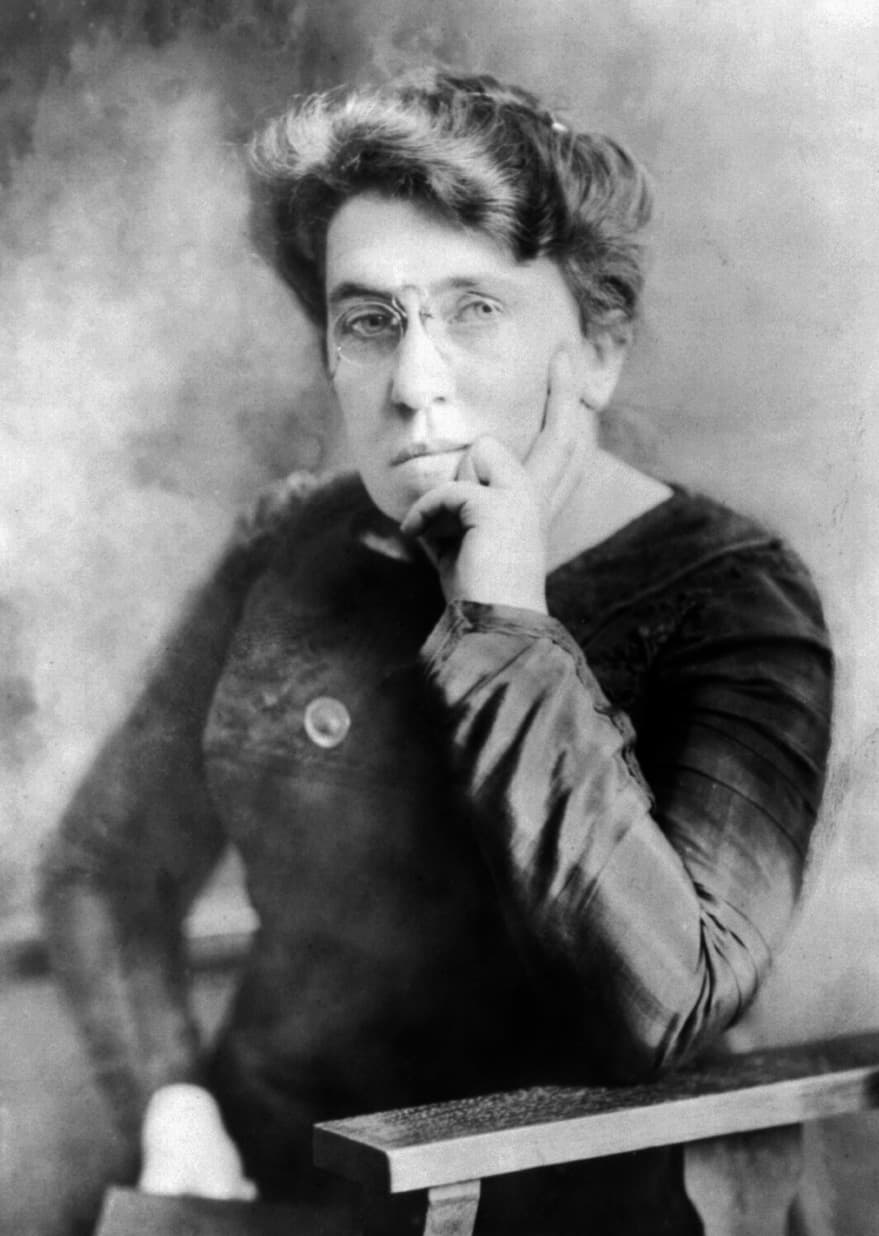
American, Lithuanian · Activism · Politics · Literature
Emma Goldman
June 27, 1869 – May 14, 1940
Early life and background
Emma Goldman was born on June 27, 1869, in Kovno in the Russian Empire, now Kaunas, Lithuania, to a Jewish family.[1][2] She grew up in a household marked by poverty, authoritarian family relations, and the pressures facing Jews in imperial Russia. Later biographical accounts describe her family as struggling economically and socially, and Goldman herself would repeatedly connect oppression in private life with oppression in public life.[2][4][11]
As a child and adolescent, Goldman received limited formal schooling. The constraints of family finances, antisemitism, and gender expectations narrowed her educational options, but she developed a lifelong appetite for reading and debate. The social order into which she was born offered few paths for a young Jewish woman beyond marriage, domestic labor, or low-paid work. Those barriers profoundly shaped her politics. Her later insistence on women’s independence, sexual freedom, and social rebellion emerged from experience rather than abstraction.[2][3][12]
In 1885, at the age of sixteen, Goldman emigrated to the United States, arriving in New York on December 29 and then joining family in Rochester, New York.[1][11] Like many eastern European Jewish immigrants of her generation, she entered industrial labor quickly and first worked in a clothing factory as a seamstress.[3] In 1886 she married Jacob Kersner, but the union was unhappy and soon ended in separation; her later life and writing consistently rejected the conventional marriage she had been expected to embrace.[3][11]
Entry into radical politics
Goldman moved to New York City in 1889, where she entered anarchist circles and met Alexander Berkman, who became both a political collaborator and a central personal relationship.[3][11] The late nineteenth-century city exposed her to the harsh realities of industrial capitalism, wage exploitation, and police repression. The Haymarket affair and the broader labor conflicts of the era shaped her developing political outlook, leading her toward anarchism, anti-capitalism, and opposition to coercive institutions.[11][12]
Her first years as a public radical were marked by surveillance, arrests, and attempts to suppress her speech. After the 1892 Henry Clay Frick shooting during the Homestead strike, Goldman was publicly associated with political violence because of Berkman’s role in the affair and later faced police attention.[1][11] On August 21, 1893, she was arrested in New York for inciting to riot after urging unemployed workers to take food if they were starving, and she was sentenced to one year on Blackwell’s Island.[1][11][20] That imprisonment made her better known nationally and confirmed a pattern that would define much of her career: she used public speech to challenge inequality, and authorities responded with criminal prosecution.
Goldman continued to lecture, organize, and write despite repeated harassment. In 1897 she was arrested in New Haven on a Frick-related warrant and released when evidence failed to materialize.[1][11] After President William McKinley’s assassination in 1901, she was detained as a suspected associate of Leon Czolgosz and interrogated before being cleared; the episode reflected a wider public panic in which anarchists and immigrants were portrayed as enemies of the nation.[1][11][12] These experiences helped make Goldman a symbol of repressed dissent in Progressive Era America.
Writer, editor, and organizer
Goldman was not only a street speaker and political agitator; she was also a prolific writer and editor. In 1906 she launched Mother Earth, an anarchist monthly that quickly became one of the most influential radical periodicals in the United States.[1][4][11] The magazine carried essays on labor, free thought, anti-militarism, literature, censorship, women’s emancipation, and sexual freedom. It gave Goldman a lasting platform and helped shape the intellectual culture of the American left.
Her published works expanded her influence far beyond the lecture hall. In 1910 she published Anarchism and Other Essays, a collection that helped establish her as a leading anarchist theorist.[3][11] She also became an early and prominent advocate of birth control, an issue that brought her into direct conflict with the law. On February 9, 1916, she was arrested in New York for distributing contraception information in violation of the Comstock laws.[1][11][20] At a time when women’s reproductive knowledge was policed as obscenity, Goldman’s activism connected anarchism to bodily autonomy and feminist politics.
Goldman also wrote on drama, politics, and social life, arguing that culture could be a site of liberation as well as critique. Her essays and speeches emphasized free expression, workers’ rights, women’s equality, and the right to personal independence. She rejected both state power and traditional social authority, including the institution of marriage when imposed as a limit on women’s freedom.[3][11][12]
War, repression, and deportation
World War I intensified the conflict between Goldman and the U.S. state. In 1914 she founded the Anti-Militarist League, and in 1917 she helped organize the No-Conscription League against the draft.[11] On June 15, 1917, Goldman and Berkman were arrested under the Espionage Act, and on July 9 she was convicted in federal court in New York of conspiring to obstruct the draft.[1][11][20] She was sentenced to two years in prison and a substantial fine, and on September 11, 1917, she entered the federal penitentiary in Jefferson City, Missouri.[11][13]
The wartime case against Goldman became one of the most famous examples of suppression of dissent in the United States. It showed how antiwar speech could be criminalized as a threat to national security. On December 1, 1919, the Supreme Court issued Goldman v. United States, upholding her conviction.[20] Weeks later, on December 21, 1919, she was deported aboard the Buford, the ship popularly known as the “Soviet Ark.”[11][13] Goldman described herself as the first political agitator deported from the United States, and that self-description captured the symbolic force of the moment, even as historians debate the broader claim.[13]
Russia, disillusionment, and international activism
Goldman initially hoped that the Russian Revolution might fulfill revolutionary promises, but she soon became disenchanted with Bolshevik rule. On December 5, 1921, she left Soviet Russia for Riga, and in 1922 she published My Disillusionment in Russia, a critical account of the new regime.[1][11] The book was followed by My Further Disillusionment in Russia in 1924, and together the works established her as one of the most forceful early anti-authoritarian critics of Bolshevism.[3][11]
During the 1920s and 1930s Goldman continued to lecture internationally on anarchism, free speech, and the dangers of dictatorship. She returned to the United States under a limited visa in 1931 for a lecture tour, drawing large audiences despite her deported status.[1][4][11] Her visibility showed that she remained a formidable public intellectual even after decades of exclusion. In 1933 she published her autobiography, Living My Life, one of the most important first-person accounts of radical politics in the twentieth century.[3][11][15]
Goldman also became increasingly involved in the struggle against fascism. In 1936 she arrived in Barcelona to support anarchists during the Spanish Civil War and to speak internationally on behalf of the anti-fascist cause.[1][11] Her Spanish activism connected the old labor and anarchist traditions of the nineteenth century to the global crises of the 1930s. It also reflected her continuing commitment to transnational solidarity at a time when authoritarian movements were rising across Europe.
Personal life
Goldman’s personal life was closely intertwined with her politics. Her marriage to Jacob Kersner in 1886 quickly proved unhappy, and she later rejected the idea that marriage should define women’s lives.[3][11] Her relationship with Alexander Berkman was one of the most important in her life: they were lovers, collaborators, and comrades in anarchist organizing, and they shared prison, persecution, and exile.[1][11] Goldman did not have children, and her political writing often treated motherhood, sexuality, and intimate life as subjects that women should be able to control rather than duties imposed by law or custom.[3][12]
Her identity as a Jewish immigrant woman also remained central to her public voice. She lived much of her adult life among working-class communities and radicals, and she repeatedly returned in her writing to the experience of exclusion, poverty, and state violence. Those experiences gave her criticism of authority a personal and historical depth that resonated beyond anarchist circles.
Legacy and historical impact
Goldman’s legacy rests on the breadth of the issues she insisted were connected: labor rights, antiwar activism, free speech, women’s emancipation, birth control, and opposition to authoritarian government.[2][4][12] She helped define what political dissent could look like in modern America, especially for women and immigrants who were expected to remain politically silent. Her repeated arrests, prosecutions, imprisonment, and deportation made her one of the most visible targets of state repression in the Progressive Era and World War I period.[1][11][20]
She also left a substantial literary and intellectual legacy. Through Mother Earth, Anarchism and Other Essays, My Disillusionment in Russia, and Living My Life, she created a body of work that still shapes scholarship on anarchism, feminism, and civil liberties.[3][11][15] Later generations have remembered her both as a political radical and as a pioneering feminist voice who argued that women should control their bodies, labor, and intimate lives. Her life illustrates the costs of dissent in an age of repression and the long-term influence of women who refused to accept the limits placed on their speech and public action.
Later life and death
After her stroke in Toronto on February 17, 1940, Goldman became partially paralyzed and her public activities ended.[11] She died in Toronto on May 14, 1940, at the age of 70.[1][2] She was later buried in Forest Park, Illinois, near the graves of the Haymarket anarchists, linking her memory to the labor martyrs and radical traditions that had shaped her political life.[3]
Goldman’s life remains a touchstone in histories of anarchism, feminism, civil liberties, and immigrant activism. She was repeatedly criminalized for ideas that later became central to broader democratic debates, and her career shows how women could transform political marginality into lasting public influence.
Dated achievements
22 indexed.
- Jun271869Activism
Birth of Emma Goldman
Emma Goldman is born in Kovno (now Kaunas), Lithuania, then part of the Russian Empire, to Jewish parents.
View details Emma Goldman - Britannica - Dec291885Activism
Arrival in the United States
Emma Goldman arrives in New York, joining her sister after emigrating from Russia.
View details