← All women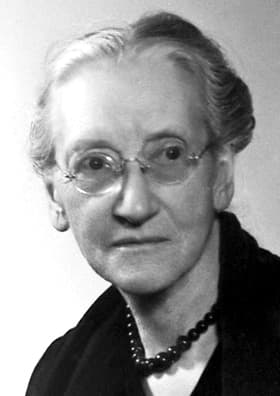
American · Activism · Politics · Science
Emily Greene Balch
January 8, 1867 – January 9, 1961
Early life and family background
Emily Greene Balch was born on January 8, 1867, in Jamaica Plain, Massachusetts, then a part of Boston. She came from a well-educated New England family: her father, Francis Vergnies Balch, was an attorney, and her mother, Ellen Noyes Balch, had been a schoolteacher. That family setting helped shape Balch’s later intellectual seriousness and social conscience. She grew up in a milieu that valued learning, civic responsibility, and moral reform, all of which would become central to her adult life.
Balch entered adulthood during a period when women were still fighting for meaningful access to higher education and professional life. Her generation witnessed the opening of new educational opportunities for women, but those opportunities remained limited and often socially contested. Balch’s path into scholarship and reform therefore required both personal determination and the ability to work within institutions that had not been built to include women as intellectual authorities.
She later studied at Bryn Mawr College, graduating in 1889, and continued her studies at the Sorbonne in Paris. These experiences widened her intellectual horizons and brought her into contact with European academic traditions. They also helped prepare her for a career that would join economics, sociology, and social reform to a broader international vision.
Education and early professional formation
Balch’s education was central to her development as a scholar. At a time when women’s higher education was still relatively new, Bryn Mawr offered a rigorous academic environment that allowed her to pursue serious intellectual work. Her studies in Paris further deepened her engagement with political economy and social questions. The combination of American and European training gave her an unusually broad perspective for a woman of her generation.
She became interested in the conditions of urban labor, poverty, and immigration, subjects that would later define much of her scholarly and activist work. Rather than treating economics as an abstract discipline, Balch used it to study real social conditions. This approach connected her to reform movements that sought to understand industrial society not only through markets but through the lives of workers, immigrants, and the urban poor.
Balch also helped found Denison House, Boston’s first settlement house, reflecting the era’s growing interest in social settlement work. Settlement houses combined research, education, and community service, and they became important centers for Progressive Era reform. Her involvement with this movement showed an early commitment to practical social improvement as well as to scholarly analysis.
Academic career at Wellesley College
Balch taught economics and sociology at Wellesley College for about twenty years. In the classroom, she brought together theoretical learning and social observation, teaching subjects that were still developing as formal academic disciplines. Her work at Wellesley placed her among the relatively small number of women professors in the United States at the turn of the twentieth century, when women in higher education often faced limited status, restricted authority, and unequal compensation.
Her academic career was shaped by her growing public engagement with labor, immigration, and peace. Balch was not a detached scholar; she used her expertise to address urgent political and social problems. That combination of scholarship and activism became one of her defining traits. Her writings and teaching reflected a belief that economics and sociology should illuminate the conditions of democratic life and the responsibilities of citizenship.
Balch’s pacifist commitments increasingly influenced her public identity. During World War I, she became an outspoken critic of war and nationalism. Her antiwar position was costly in an era of intense patriotic pressure. In 1918, her views contributed to the end of her position at Wellesley, illustrating the professional risks faced by dissenters, especially women reformers whose public influence depended on institutions that could also exclude them.
Peace work and international organizing
Balch’s most enduring legacy lies in her peace activism. She was a founder of the Women’s International League for Peace and Freedom (WILPF), an organization that became one of the most important international women’s peace networks of the twentieth century. She later served as a leading figure in the organization, helping to shape its approach to disarmament, international cooperation, and women’s political participation.
Her peace work developed in the aftermath of World War I, when many activists believed that international institutions had to replace militarism and competition among nations. Balch argued that peace required more than treaties; it required a transformation in how nations imagined themselves and their relationship to one another. She therefore became associated with a cosmopolitan ideal often summarized in her belief in global citizenship.
Balch also worked on issues of nationalism, immigration, and minority rights. Her scholarship and activism were connected: she studied social conflict not as an abstract problem, but as something rooted in inequality, fear, and the politics of exclusion. In this sense, her work anticipated later human-rights and transnational feminist approaches to peace.
Nobel Peace Prize and international recognition
In 1946, Balch received the Nobel Peace Prize, shared with John R. Mott, for her lifelong work for the cause of peace. The award brought international recognition to a woman whose ideas had long circulated most powerfully within reform and peace networks rather than mainstream political life. It also marked her as the second American woman to receive the Nobel Peace Prize.
The recognition was especially significant because Balch’s antiwar advocacy had once made her a target of suspicion. According to Nobel sources, the official United States government had long regarded her as a radical. The prize therefore functioned not only as a personal honor, but also as a public vindication of her long commitment to disarmament and international understanding. Her Nobel lecture, delivered later in Oslo in 1948 because she was too ill to attend the 1946 ceremonies, extended her reflections on human unity beyond nationalism.
Balch donated much of her prize money to peace work, reinforcing the practical dimension of her idealism. That act of generosity reflected a career in which personal recognition mattered less than institutional and moral change. Her Nobel Prize helped ensure that WILPF and related peace efforts would remain visible in the history of women’s activism.
Personal life
Balch never married and had no children. Her life was instead structured around intellectual work, reform communities, and transnational activism. That fact is historically meaningful in itself, since many educated women of her era had to balance or negotiate public ambitions with expectations of domestic life. Balch chose a path centered on public service, scholarship, and movement organizing.
She developed important professional and political relationships with other reformers, including Jane Addams and fellow peace advocates in the United States and Europe. These alliances helped define her career and connected her to a broad network of social reformers who believed that women could play a distinctive role in building a more peaceful world. Her friendships and collaborations were part of the infrastructure of her activism.
Later life and death
Even after the Nobel Prize, Balch remained committed to the ideas that had shaped her career: disarmament, cooperation, and international peace. As she aged, she continued to be recognized as a moral authority within peace circles. Her life spanned an era of extraordinary upheaval, including two world wars, the rise of mass international institutions, and the steady expansion of women’s public participation.
Balch died on January 9, 1961, in Cambridge, Massachusetts, at the age of 94. Her death came just one day after her birthday, a poignant close to a life that had been long and consequential. By then, her reputation had grown beyond her original academic specialty to encompass a much broader historical significance as a feminist reformer, economist, sociologist, and peace activist.
Legacy
Emily Greene Balch’s legacy rests on the combination of scholarship and action. She demonstrated that economics and sociology could inform public reform, and that women could shape international politics even when excluded from formal centers of power. Her leadership in WILPF made her a key figure in twentieth-century peace history, while her Nobel Prize fixed her place among the most important women honored for work in peace and international cooperation.
Balch also stands as an example of the costs borne by women who challenged militarism and nationalism in the early twentieth century. She lost professional standing because of her convictions, yet her ideas outlived the institutions that tried to marginalize her. Today she is remembered as a pioneer of internationalism, a defender of peace, and a woman whose life connected academic rigor to public conscience.
Dated achievements
3 indexed.
- Jan081867Science
Birth of Emily Greene Balch
Emily Greene Balch was born in Jamaica Plain, Massachusetts, later becoming an economist, sociologist, and Nobel Peace Prize-winning activist.
View details Emily Greene Balch – Biographical, Nobel Prize - Nov141946Science
Awarded the Nobel Peace Prize
Balch was awarded the 1946 Nobel Peace Prize for her lifelong work for disarmament and international peace, becoming the second American woman so honored.