← All women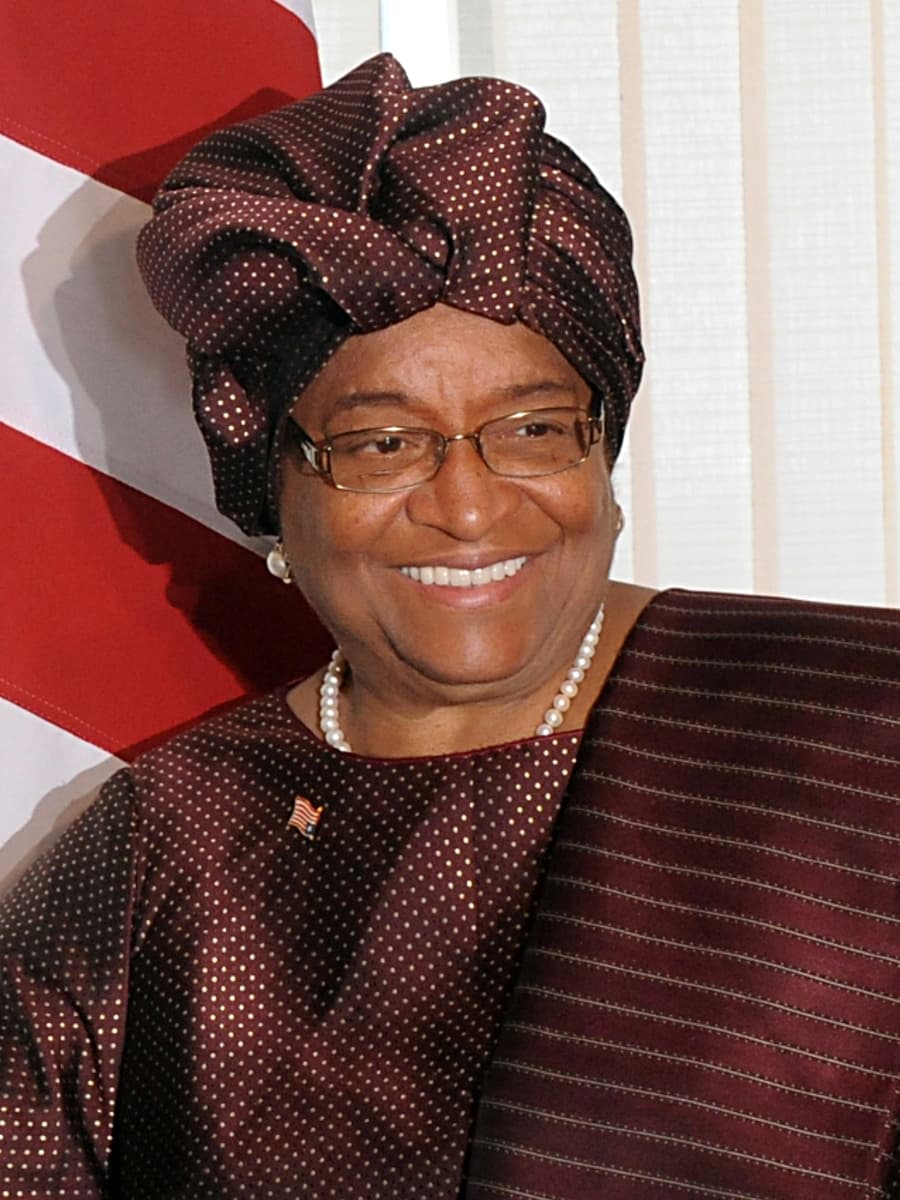
Liberian · Politics
Ellen Johnson Sirleaf
October 29, 1938 – present
Early life and education
Ellen Johnson Sirleaf was born on October 29, 1938, in Monrovia, Liberia. She grew up in the Liberian capital in a family and political environment that later shaped her understanding of public service, state institutions, and the social limits placed on women’s ambitions. Liberia’s political class in the mid-twentieth century was overwhelmingly male, and Sirleaf’s later rise into senior government office would challenge those norms in conspicuous ways.
She married young and had four sons, a family life that she later balanced with an increasingly demanding public career. Her early years included education in Liberia and, eventually, study in the United States. According to biographical sources, she earned an accounting degree from Madison College of Business in Wisconsin and later completed a Master of Public Administration at Harvard University’s Kennedy School of Government. Those credentials became central to her public identity: she combined technical economic training with political ambition at a time when few women from West Africa were entering elite policy networks abroad.
Sirleaf’s educational path also reflected broader barriers overcome by women of her generation. Access to advanced study, especially in economics and public administration, was limited for African women during the colonial and early postcolonial period. Her professional formation in finance and management gave her the tools to work inside government and international institutions, and it positioned her for a career that would span banking, civil service, diplomacy, opposition politics, imprisonment, exile, and eventually the presidency.
Entry into public life
Sirleaf first emerged prominently in national political life in 1972, when she delivered a commencement address at her former high school that sharply criticized the Liberian government. The speech is widely treated as her political debut because it signaled a willingness to challenge authority publicly. In a political culture that expected deference, particularly from women, her criticism demonstrated both courage and an early commitment to reform.
She entered government service in the 1960s and 1970s, including work in the Treasury Department and later in economic and financial administration. Her technical background and administrative reputation helped her move through the state bureaucracy. This career trajectory culminated in her appointment on July 26, 1979, as Minister of Finance of Liberia. That appointment made her the first woman to hold the office, a landmark in a country where finance was one of the most powerful and male-dominated portfolios in government.
As finance minister, Sirleaf became associated with reformist economic management, but her tenure was short-lived amid political upheaval. Liberia’s political order destabilized after the 1980 military coup led by Samuel Doe. Sirleaf was imprisoned following the coup and later faced further political persecution, including a 1985 prison sentence after her opposition to the regime. These experiences cemented her reputation as a principled dissenter and made clear the personal risks of challenging authoritarian rule.
Exile, international service, and return to Liberia
After periods of detention and pressure in Liberia, Sirleaf spent years abroad, where she built an international career in banking and development. She worked in financial institutions and later at multilateral organizations, including the United Nations Development Programme, where she served in senior leadership roles. That work expanded her global profile and gave her deeper experience in governance, development policy, and international finance.
Her time outside Liberia was also politically formative. It provided distance from domestic repression while preserving her ties to national politics. Like many African opposition leaders in exile, she remained an important voice in debates about democracy, accountability, and postcolonial governance. Her international work strengthened her credibility as someone who could manage not only symbolic politics but also the practical demands of public administration.
Sirleaf returned to Liberian politics in the 1990s. In 1997, she contested the presidential election against Charles Taylor. She did not win, but the campaign kept her visible as a major opposition figure and demonstrated her persistence in a political environment shaped by war and intimidation. Even in defeat, she remained a leader to watch, and her profile continued to rise as Liberia moved, slowly and unevenly, toward peace.
Presidency and postwar reconstruction
Sirleaf won the presidency in the 2005 election cycle and was inaugurated on January 16, 2006. Her victory made her the first elected female head of state in Africa and the first woman to lead a modern African nation through the ballot box. She assumed office at the end of a devastating civil war that had shattered Liberia’s institutions, economy, and social fabric. The scale of the challenge was enormous: she had to restore basic governance while helping a traumatized nation recover from years of violence.
During her presidency, Sirleaf was closely associated with reconciliation, debt relief, economic stabilization, institutional rebuilding, and the reestablishment of public confidence in the state. She emphasized women’s empowerment, democratic rule, and public-sector reform. Her government faced criticism and serious constraints, but it also oversaw Liberia’s emergence from postwar fragility toward greater stability. International observers frequently described her as a crucial figure in the country’s recovery.
Her leadership also had a powerful symbolic dimension. In much of Africa, women had long been active in civil society, peace movements, and local organizing, but they were rarely elevated to the presidency. Sirleaf’s presidency challenged that pattern. Her tenure demonstrated that women could govern in situations of extraordinary difficulty, and that women’s leadership was not merely auxiliary to formal politics but central to rebuilding a state after conflict.
Nobel Prize and global recognition
Sirleaf’s international standing reached a new level in 2011, when she was jointly awarded the Nobel Peace Prize with Leymah Gbowee and Tawakkol Karman. The prize announcement on October 7, 2011, praised their nonviolent struggle for the safety of women and for women’s participation in peace-building. The award ceremony followed on December 10, 2011, in Oslo. For Sirleaf, the prize recognized both her presidency and her broader commitment to democratic inclusion and women’s rights.
The Nobel committee’s decision was especially significant because it linked a sitting African head of state with a women’s rights activist and a Yemeni democratic activist. That framing emphasized that peace was not only the absence of war, but also the presence of political participation, especially for women. Sirleaf’s inclusion in the trio underscored how state power and grassroots activism could be mutually reinforcing rather than opposed.
Over time, Sirleaf became widely known as Africa’s “Iron Lady,” a label that reflected her toughness in politics and the perseverance required to navigate patriarchal institutions, war, and exile. The Nobel Prize helped consolidate her image as a global advocate for peace, justice, and democratic rule.
Later presidency, regional leadership, and retirement from office
Sirleaf was re-elected and served two terms, leaving office on January 22, 2018, when George Weah was inaugurated as her successor. Her departure was notable because Liberia experienced a peaceful transfer of power, a rare and important achievement in its modern political history. The transition reinforced one of the central themes of her presidency: that democratic institutions could survive and normalize after conflict.
Before leaving office, she had also taken on regional responsibilities. On June 4, 2016, she was elected Chairperson of ECOWAS, becoming the first woman to hold that post. The role extended her influence across West Africa and reflected the respect she had earned among regional leaders. Her chairmanship connected Liberia’s national recovery to broader questions of regional security, cooperation, and democratic governance.
After leaving the presidency, Sirleaf continued to receive major honors. On February 12, 2018, she was announced as the winner of the Ibrahim Prize for Achievement in African Leadership. On March 29, 2019, she received the International Four Freedoms Award. These recognitions confirmed her place among the most distinguished African leaders of her generation and underlined the international resonance of her career.
Personal life and family
Sirleaf married and had four sons. Her family life has often been noted in biographies because it unfolded alongside intense political and professional responsibilities. Like many women leaders, she had to navigate expectations about marriage and motherhood in addition to the demands of public service. Her public career made her an exception in the political culture of her time, but she remained grounded in family relationships that were part of her personal story and public image.
Her life also included long periods of pressure, separation, and uncertainty, especially during years of imprisonment, political persecution, and exile. These experiences shaped both her political outlook and the way she was remembered by supporters and critics alike. Her biography is inseparable from the broader history of Liberian conflict, and her personal resilience became part of her public legacy.
Legacy
Ellen Johnson Sirleaf’s legacy rests on several interconnected achievements. She was the first woman to hold Liberia’s finance ministry, the first democratically elected female head of state in Africa, a Nobel Peace Prize laureate, and a central figure in Liberia’s postwar reconstruction. Each of these milestones mattered on its own, but together they transformed her into a symbol of women’s political possibility on the African continent.
Her importance also lies in the fact that she succeeded in a setting marked by violent upheaval and entrenched gender hierarchy. She did not rise in a stable system designed to promote women’s leadership; she rose in spite of one. Her career demonstrated that expertise, persistence, and political courage could open doors even in institutions resistant to change. For historians of women’s leadership, she represents both breakthrough and precedent.
Her papers, archives, and leadership record continue to attract scholarly attention. In 2023, Harvard Library announced a partnership with her presidential center to preserve and make accessible her materials, reinforcing the view that her life is not only politically significant but also a matter of historical memory. Sirleaf’s story remains central to discussions of women in governance, post-conflict reconstruction, and the democratic transformation of African politics.
Dated achievements
10 indexed.
- Oct291938Politics
Birth in Monrovia, Liberia
Ellen Johnson Sirleaf was born in Monrovia, Liberia, on October 29, 1938.
View details Britannica: Ellen Johnson Sirleaf Profile - Jul261979Politics
First female Minister of Finance of Liberia
In 1979, Ellen Johnson Sirleaf became Liberia's first female Minister of Finance.