← All women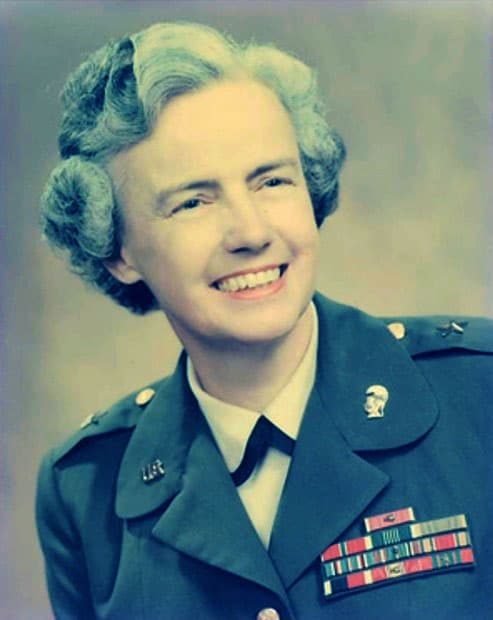
American · Politics
Elizabeth P Hoisington
November 3, 1918 – August 21, 2007
Early Life and Background
Elizabeth Paschel Hoisington was born on November 3, 1918, in Newton, Harvey County, Kansas.[1][3][4][6] She grew up in a family with deep military roots. Her grandfather helped found the Kansas Army National Guard, and her father was an Army colonel and an expert marksman, serving multiple tours at Fort Leavenworth, Kansas.[2][3] This environment exposed her early to the culture of the U.S. Army and the expectations of discipline, duty, and public service.
Hoisington attended local schools before enrolling at the College of Notre Dame of Maryland (now Notre Dame of Maryland University) in Baltimore. She graduated in 1940 with a degree in chemistry.[1][2][3][6] Her choice of a scientific field and her attendance at a Catholic women’s college reflected both her academic interests and the limited but growing opportunities for women in higher education during the interwar period. The college would later honor her by naming a distinguished alumna award after her.[7]
Despite her family’s military tradition, Hoisington initially encountered resistance at home when she sought to join the newly formed Women’s Army Auxiliary Corps (WAAC) during World War II. According to biographical accounts, she overcame this opposition within six months of the WAAC’s authorization, demonstrating the determination that would characterize her career.[2]
Career Beginnings in the Women’s Army Auxiliary Corps
Shortly after the United States entered World War II, Congress authorized the Women’s Army Auxiliary Corps in 1942.[2][3] That same year, Hoisington enlisted, beginning her military career in a pioneering organization designed to allow women to serve in noncombat roles supporting the Army.[1][2][3] The WAAC was not initially part of the regular Army; its members held auxiliary status, with fewer benefits and protections than male soldiers.
Hoisington quickly demonstrated leadership ability. In 1943, she completed WAAC Officer Candidate School and received her commission, transitioning from enlisted status to officer.[2] She served briefly in California after commissioning, gaining experience in the administrative and organizational tasks that would define much of her later work.
As the war progressed, the WAAC transitioned into the Women’s Army Corps (WAC), which integrated women more fully into the Army structure. Hoisington’s early experience with the WAAC positioned her to take on greater responsibility as the WAC grew in size and scope. Her formative years in the auxiliary corps taught her how to navigate an institution that was still adjusting to the idea of women in uniform, and she developed a reputation as a capable, organized, and well‑liked officer.[2][3]
World War II Service and the European Theater
After her stint in California, Hoisington was assigned to the European Theater of Operations. She served in London as the executive officer of the WAC Detachment at Headquarters, European Theater of Operations, a role that placed her at the center of Allied administrative and personnel operations.[2] Her responsibilities included coordinating the work of WAC personnel who handled communications, clerical tasks, logistics, and staff support—functions critical to the functioning of theater headquarters.
On June 14, 1944, only days after the D‑Day landings, Hoisington went ashore at Normandy as part of the early WAC contingent deployed to support Allied forces in France.[2] Operating close to a major combat zone, she helped establish the administrative infrastructure necessary for sustained operations on the continent. At a time when women’s presence near the front was still controversial, her deployment reflected both the Army’s need for skilled staff officers and Hoisington’s willingness to serve where she was most needed.
Later that summer, she participated in one of the most symbolically charged moments of the war. On August 25, 1944, during the liberation of Paris, Hoisington became the first member of the Women’s Army Corps to enter liberated Paris.[2][5] She was among the first six WACs to arrive in the city, where they helped set up headquarters operations and coordinate personnel functions for Allied command. Her presence in newly freed Paris underscored the increasingly visible role of American military women in the European theater.
Hoisington’s performance in these demanding assignments did not go unnoticed. On November 10, 1944, she became the first WAC in the European theater to receive the Bronze Star Medal, awarded for meritorious service in a combat zone.[2][5] The honor recognized her work as executive officer of the WAC Detachment and symbolized institutional acknowledgment that women’s contributions could meet the same standards of merit as those of male officers. During the latter part of the war, she also supported high‑level events, including staff duties connected to President Truman’s attendance at the Potsdam Conference and personnel roles with Army formations in Europe.[2][9]
Her World War II service established Hoisington as one of the WAC’s most respected officers. She demonstrated that women could perform effectively in demanding staff roles, close to the front lines, and under the pressure of large‑scale operations. This experience laid the foundation for her postwar career.
Postwar Service and Rising Responsibility
Following World War II, Hoisington remained in the Army as the service reevaluated the role of women in its ranks. The WAC continued as a separate corps, and Hoisington advanced through a series of personnel and command positions. She served in assignments connected to the Korean War and later the Vietnam era, though her work remained primarily in administrative and leadership roles rather than direct combat.[6]
By the 1950s and early 1960s, she had accumulated extensive experience in managing WAC units and overseeing personnel policy. Biographical summaries indicate that she held key posts at the Women’s Army Corps Center and other training and administrative installations, where she influenced recruitment, training, and the integration of women into Army structures.[2] These assignments required her to balance traditional expectations about women’s roles with emerging demands for greater equality and opportunity.
Her steady advancement reflected both her competence and the Army’s growing reliance on experienced female officers to manage the WAC. Hoisington’s ability to navigate institutional politics and to represent the corps effectively to senior male leadership made her a logical choice for higher command.
Director of the Women’s Army Corps
In 1966, Hoisington became Director of the Women’s Army Corps, the highest leadership position within the WAC.[1][2][3] She assumed command during a period of significant social and military change. The Civil Rights Movement, the early women’s liberation movement, and the escalation of the Vietnam War all shaped debates about who should serve in the military and under what conditions.
As director, Hoisington was responsible for all aspects of WAC policy, including recruitment, training, assignments, and welfare. She made routine trips to Vietnam, visiting WAC personnel and assessing their working and living conditions.[2] Her leadership focused on professionalizing the corps and expanding both the number of women and the range of roles available to them.
Under her tenure, the number of women in the WAC rose from fewer than 10,000 to almost 13,000.[3] She worked to broaden occupational specialties for women, encouraging expanded participation in fields beyond traditional clerical and nursing roles. At the same time, she had to operate within the constraints of existing regulations, which still barred women from many combat and combat‑support positions.
Hoisington’s directorship coincided with increasing public scrutiny of the military’s treatment of women. She often served as the public face of the WAC, speaking to civic groups, military audiences, and the media about the corps’ contributions and the importance of women’s service. In these forums, she emphasized professionalism and readiness, arguing that women should be judged by their performance and the needs of the Army.
Promotion to Brigadier General and Historic Firsts
Hoisington’s leadership of the WAC culminated in a series of historic milestones. On May 15, 1970, President Richard Nixon announced that she and Colonel Anna Mae Hays of the Army Nurse Corps had been selected for promotion to brigadier general, making them the first women nominated to become general officers in U.S. military history.[1][5] The announcement signaled a major shift in longstanding policies that had kept women out of the flag‑officer ranks.
Less than a month later, on June 11, 1970, Hoisington and Hays were formally promoted to brigadier general at a Pentagon ceremony.[1][2][3][5] They became the first two women to wear general officer rank in the U.S. Army and the first women generals in the U.S. armed forces. Some accounts note that Hays’ promotion order was processed minutes earlier, technically making Hoisington the second woman to be promoted, but historically they are recognized together as breaking the general‑officer barrier.[4]
The promotion was widely covered in the press and was seen as a landmark in the broader movement for women’s equality. For Hoisington, the general’s star represented recognition of nearly three decades of service and leadership. For the Army, it demonstrated that women could hold positions of significant authority and responsibility within the institution.
Awards, Honors, and Recognition
Throughout her career, Hoisington received numerous military decorations. Her awards included the Distinguished Service Medal, two awards of the Legion of Merit, the Bronze Star Medal, and the Army Commendation MedalCroix de Guerre from France, reflecting her contributions in the European theater.[6]
When she retired in 1971, Hoisington became only the third WAC to receive the Distinguished Service Medal, underscoring the exceptional nature of her career.[3] Her decorations testified not only to her personal merit but also to the growing acknowledgment of women’s importance in military operations.
After her death, the College of Notre Dame of Maryland honored her legacy by dedicating the Elizabeth P. Hoisington ’40 Distinguished Alumna Award in 2007–2008, with the 2008 award being the first given under the new name.[7] The award recognizes alumnae who demonstrate distinguished service and leadership in the spirit of Hoisington’s career, further cementing her status as a role model for women leaders.
Personal Life and Character
Public sources focus primarily on Hoisington’s professional achievements and offer limited detail about her private life. Biographical profiles emphasize her identity as a career officer from a military family and do not prominently mention marriage or children.[1][2][3][4] This suggests that her principal public role was as a military leader and advocate for women’s service.
Accounts describe her as organized, efficient, and well liked by colleagues and subordinates.[2][3] She was known for her professionalism and for maintaining high standards within the WAC. As director, she balanced advocacy for women’s opportunities with loyalty to the Army’s mission and traditions.
Her continuing service on boards and as a trustee after retirement indicates a strong commitment to institutional stewardship and mentorship. She remained connected to military and educational communities, shaping policies and supporting younger generations of soldiers and students.[2]
Later Life, Retirement, and Ongoing Service
Hoisington retired from the U.S. Army in August 1971, concluding nearly 29 years of service.[1][2][3] At the time of her retirement, she had led the WAC through a period of expansion and gradual policy change, positioning the corps for eventual integration into the regular Army.
In retirement, she became a popular speaker, addressing audiences about women in the military, leadership, and public service.[2] She served on the Board of Visitors of Virginia Military Institute, the Board of Directors of the Army and Air Force Mutual Aid Association, and as a trustee of Notre Dame of Maryland University.[2] These roles allowed her to influence military education, financial support systems for service members, and the direction of her alma mater.
Hoisington also played a role in establishing the Army Women’s Museum, dedicated to preserving and interpreting the history of women in the Army.[2] Her involvement helped ensure that the experiences of women soldiers—from the WAAC era through Vietnam—would be documented and shared with future generations.
Death and Commemoration
On August 21, 2007, Elizabeth P. Hoisington died of congestive heart failure at age 88 at an assisted‑living facility in Springfield, Virginia.[1][3][4][6] Obituaries, including those in major newspapers such as the Los Angeles Times, highlighted her role as one of the first two women generals in U.S. military history and as the leader of the WAC during a time of dramatic change.[3]
Hoisington was buried in Arlington National Cemetery, in Section 6, grave 9239‑A‑B, reflecting national recognition of her service.[2][6] Her burial at Arlington placed her among other distinguished military figures, symbolizing her contribution to the nation’s defense.
In 2008, Notre Dame of Maryland University formally renamed its distinguished alumna award in her honor, creating the Elizabeth P. Hoisington ’40 Distinguished Alumna Award.[7] This posthumous recognition linked her military leadership to broader ideals of women’s achievement in education and public life.
Legacy and Historical Impact
Elizabeth P. Hoisington’s legacy rests on her role as a trailblazer for women in the U.S. Army and the armed forces more broadly. As one of the first two women to attain the rank of brigadier general, she helped break a barrier that had stood since the founding of the American military.[1][2][3][5] Her promotion demonstrated that women could hold high command and manage complex institutional responsibilities.
Her leadership of the Women’s Army Corps during the 1960s and early 1970s contributed to the gradual integration and professionalization of women’s military service. She advocated for increased numbers of women in uniform and for expanded occupational opportunities, laying groundwork for later reforms that would open more career fields and ranks to women.[2][3]
Hoisington’s World War II record—going ashore at Normandy, being the first WAC to enter liberated Paris, and receiving the first Bronze Star awarded to a WAC in the European theater—demonstrated that women could serve close to the front and perform effectively in high‑pressure environments.[2][5] These experiences helped challenge stereotypes that confined women to purely domestic or background roles in wartime.
Institutionally, her work on boards, her role in establishing the Army Women’s Museum, and the alumna award named in her honor ensured that the history of women’s military service would be remembered and celebrated.[2][7] Her career is frequently cited in scholarly and popular histories of women in the military, including articles and reference entries that document the first two women generals in U.S. military history.[1][3][5]
Hoisington’s impact extends beyond the specific policies she implemented. She served as a visible example of female leadership within a traditionally male institution, encouraging younger women to consider military careers and demonstrating that perseverance, competence, and dedication could overcome structural barriers. Her life story encapsulates the broader twentieth‑century transformation of women’s roles in the U.S. armed forces—from auxiliary support to integral, recognized leadership.
Dated achievements
8 indexed.
- Nov031918Politics
Birth of Elizabeth P. Hoisington
Elizabeth Paschel Hoisington was born in Newton, Kansas, later becoming one of the first two women U.S. Army generals.
View details Elizabeth P. Hoisington - Wikipedia - Jun141944Politics
Goes ashore at Normandy with the WAC
Hoisington went ashore at Normandy on June 14, 1944, as part of the initial Women's Army Corps contingent supporting Allied operations in France.