← All women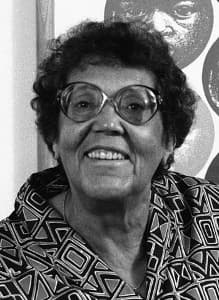
American, Mexican · Arts · Activism
Elizabeth Catlett
April 15, 1915 – April 2, 2012
Early Life and Background
Elizabeth Alice Catlett, later known as Elizabeth Catlett Mora, was born on April 15, 1915, at Freedmen’s Hospital in Washington, D.C.[1][3] She was the youngest of three children in a middle-class African American family whose history was profoundly shaped by slavery and Reconstruction. Both her maternal and paternal grandparents had been enslaved, a legacy that deeply informed her awareness of racial injustice and the dignity of Black labor.[1][3][12]
Her father, John Catlett, was a mathematics professor at Tuskegee Institute, and her mother, Mary Carson Catlett, worked as a truant officer in Washington’s public schools.[3][7][12] The family valued education and discipline, and Catlett grew up in an environment where intellectual achievement was expected and social responsibility emphasized. She attended Lucretia Mott Elementary School and then Dunbar High School, a renowned institution that educated many Black professionals and intellectuals.[2]
From a young age, Catlett wanted to be an artist.[1] She won a scholarship to the Carnegie Institute of Technology in Pittsburgh, but the offer was rescinded when the school discovered she was Black.[1][10] This early experience of segregation and exclusion left a lasting mark and reinforced her determination to pursue art in the face of racism.
Denied entry to Carnegie, she enrolled instead at Howard University, then the leading historically Black university in the United States for higher education in the arts and humanities. At Howard, she studied with influential Black artists and intellectuals including Lois Mailou Jones, James Herring, and philosopher Alain Locke, whose advocacy of the "New Negro" in art encouraged Black artists to depict African American life with pride and realism.[1][2][12] Catlett completed her Bachelor of Science degree in art, graduating cum laude in 1936.[2][3]
Advanced Study and Early Career
After Howard, Catlett sought further training and enrolled at the University of Iowa, where she studied under regionalist painter Grant Wood.[4][10][12] Wood encouraged his students to depict the lives of ordinary people in their own communities, advice that resonated strongly with Catlett’s commitment to representing Black workers and women. She concentrated on sculpture, and her thesis project was the limestone work Mother and Child, portraying a Black mother and child with tenderness and strength.[4][6][12]
On June 5, 1940, the University of Iowa’s Board of Regents formally awarded Catlett a Master of Fine Arts degree in sculpture, making her the first person at the university to receive an MFA in that discipline.[2][6] This was a significant milestone for a Black woman artist at a predominantly white Midwestern institution, and the degree helped establish her professional credentials in sculpture.
In the early 1940s, Catlett pursued further study in art. She took ceramics courses at the Art Institute of Chicago and studied lithography at the Art Students League in New York.[2][7] At the same time, she began receiving recognition for her work. Her sculpture Mother and Child won first prize for sculpture at the American Negro Exposition in Chicago, with the award reported in the Chicago Defender on July 4, 1940.[6] The following year, press coverage dated August 7, 1941 documented that she had received first prize in sculpture at the Golden Jubilee National Exposition in Chicago.[6] These honors, awarded by Black cultural institutions, affirmed the importance of her focus on African American subjects and helped propel her career.
Catlett also began teaching early. She held positions at Dunbar High School and later at Dillard University, a historically Black college in New Orleans.[4][12] In 1941, as chair of Dillard’s art department, she confronted segregation directly. City Park’s racist rules prevented African Americans from entering the grounds, and therefore barred her students from the Delgado Art Museum. Catlett organized a bus trip that drove her students straight to the museum entrance to see a major Pablo Picasso retrospective, circumventing the restrictions and insisting that her students deserved access to world-class art.[1][6] This episode illustrated her view that art education and civil rights activism were inseparable.
Julius Rosenwald Fellowship and Turn to Political Art
In the early 1940s, Catlett received a Julius Rosenwald Foundation grant that allowed her to travel in the American South to research and portray the lives of Black women and sharecroppers.[6][11] Although the precise dates of the fellowship are documented only by year, this period was crucial. She created sculptures, prints, and paintings that depicted women working, bearing children, and enduring poverty, building a visual language that emphasized the dignity and strength of Black women.
Through the Rosenwald fellowship she developed a seminal series titled I Am a Negro Woman, completed by the late 1940s. The series combined sculpture and prints with inscribed texts, celebrating multiple roles of Black women—as workers, mothers, activists, and intellectuals.[2][11] The works toured Black women’s colleges in the South, reaching audiences largely excluded from mainstream museums and modeling a form of art explicitly directed toward Black women’s self-recognition and empowerment.
Her art from this period showed increasing political commitment. She portrayed sharecroppers and domestic workers with solemn, monumental forms, aligning her work with both social realism and African American protest traditions.[3][12][7] These themes would endure throughout her career, shaping later signature works such as the print Sharecropper (1952), which depicts an older Black woman in a straw hat, etched with lines of hardship and resilience.[10][3]
Move to Mexico and Taller de Gráfica Popular
In 1946, Catlett moved to Mexico, a decision that became a defining turning point in her life and career.[2][3][12] She accepted an invitation to work with the Taller de Gráfica Popular (TGP), a radical printmaking collective in Mexico City dedicated to producing politically engaged posters, leaflets, and prints for workers’ movements, anti-fascist campaigns, and educational projects.[2][12]
At TGP, Catlett collaborated with Mexican and international artists who believed that art should be accessible to ordinary people rather than confined to galleries. She produced linocuts and woodcuts that addressed racism, labor exploitation, and women’s struggles, translating her commitment to African American subjects into a broader solidarity with workers and peasants across the Americas.[12][13] Her style evolved under the influence of Mexican muralism and the bold graphic language of TGP, incorporating simplified forms, strong contrasts, and clear political symbolism.
Mexico offered Catlett both artistic freedom and relative relief from U.S. racism. Over time she made her home there, marrying Mexican artist and printmaker Francisco Mora and raising three sons.[4][12] In 1962, she became a Mexican citizen, though she maintained strong ties to African American communities and civil rights struggles through her art.[3][13]
Academic Career at UNAM and Major Sculptural Works
Catlett’s stature in Mexico grew steadily, and in 1958 she achieved a major institutional milestone. On September 1, 1958, she began teaching as a professor of sculpture at the National School of Fine Arts of the National Autonomous University of Mexico (UNAM), becoming the first woman professor of sculpture in the school’s history.[6][12] She eventually became head of the sculpture department, a position she held until her retirement on June 30, 1976.[6]
At UNAM, Catlett trained generations of students in stone, wood, and bronze, emphasizing both technical mastery and social responsibility. She drew inspiration from African sculpture, European modernists like Barbara Hepworth and Käthe Kollwitz, and Mexican muralist traditions.[12][13] Her teaching reinforced the idea that sculptural form could be a vehicle for political and cultural affirmation, particularly for marginalized communities.
Catlett’s own sculptural work flourished during these decades. She produced monumental and medium-scale works that celebrated Black and Mexican women, workers, and historical figures. Her sculptures often used simplified, rounded forms to convey physical and maternal strength. She created portraits and monuments of figures such as Harriet Tubman, Malcolm X, and other freedom fighters, situating her work within global liberation movements.[6][13]
In 1983, she created the sculpture Survivor, later the subject of a detailed educational dossier by the Chazen Museum of Art.[6] The work, depicting a woman who has endured violence or oppression, encapsulates Catlett’s ongoing concern with resilience and the demands of justice. It exemplifies her mature style—combining modernist abstraction with emotionally charged, representational content.
Political Prints and Involvement with Civil Rights Movements
While teaching and sculpting, Catlett continued to make politically engaged prints. In the 1970s, she produced some of her most widely reproduced images, supporting Black liberation movements and honoring contemporary activists.[11][14][15] Among these were prints that depicted Angela Davis, whose imprisonment and activism became a focal point for international solidarity campaigns.
Catlett’s prints circulated across activist networks, student movements, and cultural organizations in the United States, Mexico, and beyond.[11][13] Their bold graphic language, influenced by her experience at TGP, made them effective tools of communication as well as works of art. She also maintained a connection to African American art scenes; in 1968, her work appeared in the controversial exhibition Harlem on My Mind at the Metropolitan Museum of Art, which, despite criticism for its limited inclusion of Black artists, expanded visibility for Black cultural production.[11][12]
Catlett’s art engaged themes of race, gender, and class. She portrayed domestic workers, farmers, and mothers not as victims but as active subjects whose labor sustained communities.[3][7][12] Her emphasis on Black and Indigenous women challenged prevailing art historical narratives that marginalized women of color, and her work provided imagery for broader feminist and anti-racist struggles.
Awards, Honors, and Recognition
Over her long career, Catlett received numerous awards and forms of recognition. Early honors included first prizes at the American Negro Exposition and Golden Jubilee National Exposition in Chicago in 1940 and 1941, respectively.[6] She twice won second prize in sculpture at the Atlanta University Annual in 1946 and 1956, affirming her continued prominence among Black artists in the mid‑twentieth century.[6]
From the 1990s through the 2000s, Catlett’s work received growing institutional recognition in the United States. Major museums such as the National Gallery of Art, the Whitney Museum of American Art, and the Brooklyn Museum acquired her sculptures and prints and organized exhibitions that repositioned her as a central figure in twentieth-century art.[8][10][13] The National Museum of Women in the Arts, Wadsworth Atheneum, and other institutions featured her in exhibitions and interpretive materials that underscored her importance as a Black woman artist and activist.[6][1]
Scholars and curators increasingly emphasized both her formal achievements—her command of bronze, wood, and linocut—and her role in advancing socially committed art. She became the subject of oral histories, documentaries, and lectures, including major presentations at the Brooklyn Museum and other venues that framed her as a "black revolutionary artist" whose practice embodied feminist and anti-racist commitments.[11][13]
Personal Life
Catlett’s personal life intertwined closely with her artistic and political commitments. In the 1940s she married the American artist Charles White, a leading figure in social realist painting and drawing, though the marriage later ended.[7][12] Her move to Mexico in 1946 eventually led to her marriage to Mexican painter and printmaker Francisco Mora.[4][12]
With Mora she had three sons. The family made their home primarily in Mexico City and later in Cuernavaca, though Catlett maintained ties to New York and other U.S. cities. Her bicultural family life reflected her broader transnational identity: an African American woman who became a Mexican citizen while continuing to engage with Black liberation struggles in the United States.[3][12]
Despite periods of political tension—her leftist activities and association with TGP drew scrutiny from U.S. authorities during the Cold War—Catlett remained committed to her causes. She experienced difficulties traveling to the United States at certain moments, but over time much of the hostility subsided, and in later decades she frequently visited for exhibitions and educational events.[13][12]
Legacy and Historical Impact
Elizabeth Catlett is widely regarded as one of the most important Black woman artists of the twentieth century.[9][13] Her legacy rests on several intertwined contributions:
- Centering Black and Mexican women: Catlett devoted much of her art to depicting women of African and Indigenous descent—workers, mothers, activists—thereby challenging the invisibility of women of color in both fine art and public representation.[3][6][12]
- Fusing modernism with social justice: She combined modernist sculptural forms and print techniques with direct political themes, showing that experimental aesthetics could coexist with activism and community-oriented art.[9][13]
- Educational leadership: As the first woman professor of sculpture at UNAM and long-time head of its sculpture department, she reshaped Mexican art education and mentored generations of artists to view their work as socially engaged.[6][12]
- Transnational activism: Catlett’s life and work bridged U.S. and Mexican contexts, creating a visual language of solidarity among Black, Indigenous, and working-class people across borders.[12][13]
Her images—such as Sharecropper, Survivor, and prints of Angela Davis—have become icons in both art history and activist culture. They circulate in museums, classrooms, and social movements as symbols of resilience and the demand for justice.[3][6][11]
In recent years, major retrospectives and scholarly publications have further solidified her place in the canon. The Brooklyn Museum’s exhibition and related programs foregrounded her as a "black revolutionary artist" whose work transformed beauty into direct action.[9][13] Institutions such as the National Museum of African American History and Culture and the National Museum of Women in the Arts have produced educational resources that situate Catlett at the intersection of African American, Latinx, feminist, and labor histories.[1][6]
Later Life and Death
In the later decades of her life, Catlett continued to work actively in both sculpture and printmaking. From the mid‑1970s onward she divided her time between Cuernavaca, Mexico and New York City, maintaining studios and participating in exhibitions in both places.[10][12] Her later works retained the themes of earlier years while exploring new materials and commissions, including large-scale public sculptures.
She remained engaged with contemporary politics, following civil rights, Black liberation, and feminist movements closely and responding to them in her art. Even as institutional recognition increased, she consistently emphasized that her primary audience was ordinary workers and community members whose lives she sought to honor.[9][13]
On April 2, 2012, Catlett died peacefully in her sleep at her home in Cuernavaca at the age of ninety‑six.[3][4][12] Her death marked the end of a nearly seventy-year career as an artist and activist. Obituaries and memorials in both Mexico and the United States celebrated her as a pioneering sculptor and printmaker, a devoted teacher, and a lifelong advocate for social justice.
Since her death, interest in her work has only grown. Museums have organized retrospectives, scholars have produced monographs and essays, and activists have continued to use her imagery in campaigns. Elizabeth Catlett’s life and art offer a powerful example of how a Black woman artist navigated and reshaped the worlds of modernism, academia, and political activism, leaving a legacy that continues to influence artists, educators, and movements across the Americas.[9][13][6]
Dated achievements
8 indexed.
- Apr151915Arts
Birth of Elizabeth Catlett
Elizabeth Catlett was born in Washington, D.C., on April 15, 1915.
View details Whitney Museum of American Art - Jun051940Arts
First MFA in sculpture awarded by the University of Iowa
First MFA in sculpture by the University of Iowa awarded to Elizabeth Catlett.
View details