← All women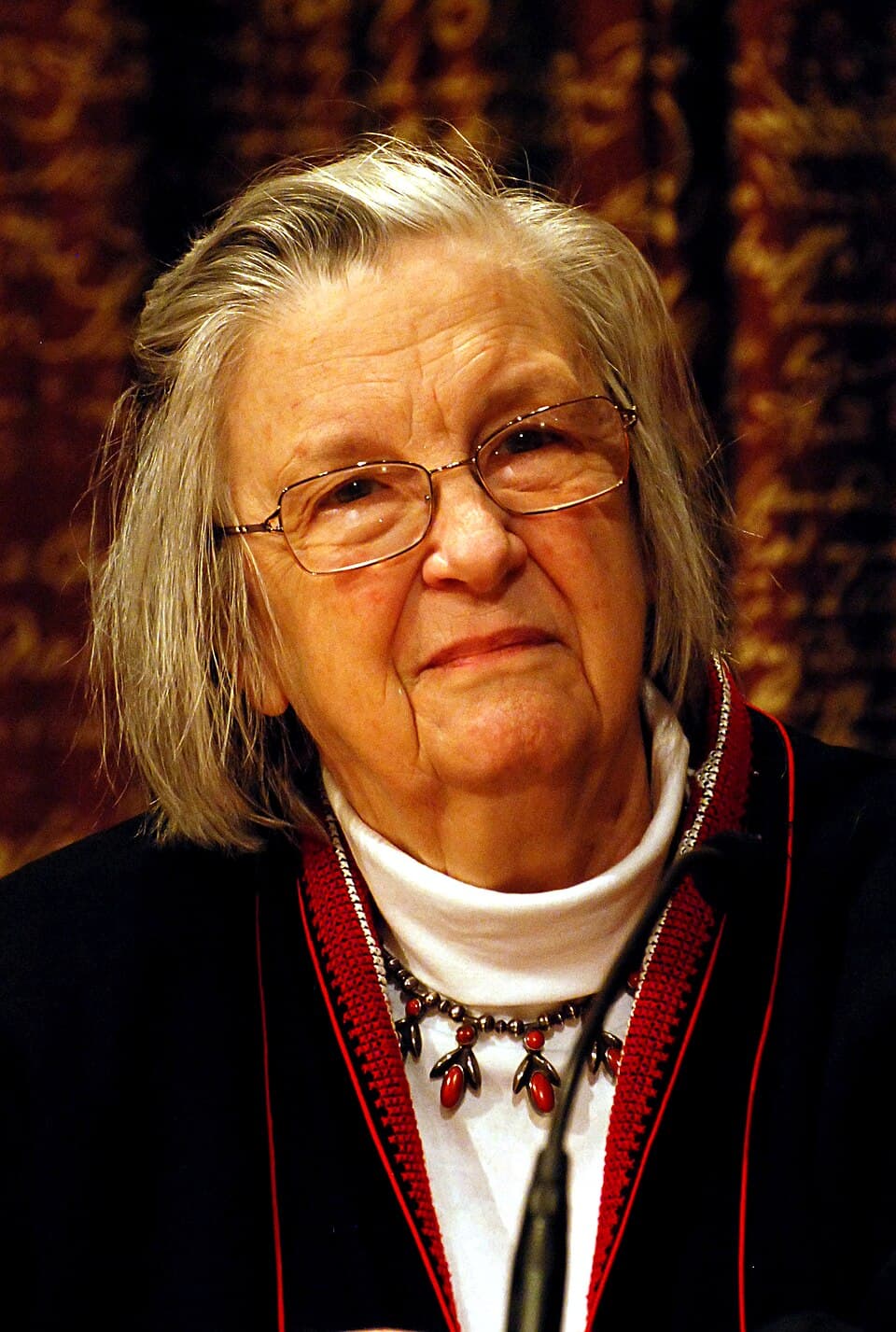
American · Science · Politics
Elinor Ostrom
August 7, 1933 – June 12, 2012
Early Life and Background
Elinor Claire "Lin" Ostrom (née Awan) was born on 7 August 1933 in Los Angeles, California, during the Great Depression. Her parents divorced when she was young, and she was raised primarily by her mother, who worked as a secretary and later as an artist.[1][2][3] Growing up in a working-class household shaped Ostrom’s awareness of economic hardship and the importance of community resilience.
Ostrom attended Beverly Hills High School, where she distinguished herself in debate but confronted gender discrimination in mathematics education. She later recalled that she was kept out of advanced math courses because she was a girl, an exclusion that reflected broader social expectations about women’s intellectual capacities in mid-20th-century America.[1][17] These early experiences of structural bias would inform her later insistence that analytical rigor does not depend solely on formal mathematical training.
After high school, Ostrom enrolled at the University of California, Los Angeles (UCLA), initially majoring in political science despite limited encouragement for women in the field.[1][3] She worked various jobs to support her studies, including employment in the university’s library and as a clerk, illustrating the economic precarity often faced by women pursuing higher education at the time. She completed her B.A. in political science in 1954, a significant accomplishment given that few women earned degrees in the discipline in that era.[1]
Personal Life and Marriage
On 11 June 1954, shortly after completing her undergraduate degree, Elinor Awan married Vincent Ostrom in Los Angeles.[1] Vincent, a political scientist interested in public administration and federalism, became both a life partner and key intellectual collaborator. Their marriage defied prevailing norms that often positioned women’s academic careers as secondary to domestic responsibilities. Instead, the Ostroms built a household oriented around shared research, teaching, and mentoring.
Elinor Ostrom’s personal life was deeply intertwined with her scholarly work. She and Vincent did not have children, a choice that enabled them to devote substantial time to fieldwork, data collection, and institution building. They traveled widely for research and conferences, and their partnership became emblematic of joint intellectual inquiry in the social sciences.[1][3]
Graduate Studies and Dissertation Research
After working for several years, Ostrom returned to UCLA for graduate study in political science. She completed an M.A. and then pursued a Ph.D., overcoming skepticism from some faculty members who doubted that a woman could succeed in the program.[1][3] Her doctoral work drew her into the emerging field of public choice and institutional analysis.
Ostrom’s dissertation focused on groundwater management in the Los Angeles Basin, a region facing acute water scarcity and complex overlapping jurisdictions.[1] She examined how local users—cities, water districts, and private actors—developed rule systems to stabilize pumping, allocate costs, and prevent resource depletion. The study required extensive archival research and engagement with legal and hydrological data, reflecting her commitment to empirical, problem-centered analysis.
On 1 May 1965, at UCLA’s commencement, Ostrom formally received her Ph.D. in political science.[1] Earning a doctorate in a male-dominated discipline during the mid-1960s was itself historically notable, marking her entry into the small cadre of women with advanced degrees in political science and related areas of economics and public policy.
Career Beginnings at Indiana University
In 1965, Ostrom joined the faculty of Indiana University Bloomington in the Department of Political Science.[1][6] At a time when leading research universities employed few women in tenure-track positions in political science, her appointment represented a significant breach in gender barriers. She quickly established herself as a rigorous teacher and researcher, emphasizing the connection between theoretical concepts and real-world governance challenges.
Ostrom’s early work at Indiana University expanded her interest in collective action, public service provision, and local governance. She engaged in field studies of policing, municipal services, and water management, often in collaboration with Vincent and other colleagues.[1][6] These projects explored how different institutional arrangements affected efficiency, equity, and citizen participation, foreshadowing her later emphasis on institutional diversity.
The Workshop in Political Theory and Policy Analysis
In 1973, Elinor and Vincent Ostrom co-founded the Workshop in Political Theory and Policy Analysis at Indiana University.[1][5] The Workshop became a pioneering interdisciplinary research center dedicated to studying how institutions shape collective action, public services, and resource governance. Its organizational design reflected Ostrom’s belief in polycentric, collaborative inquiry: faculty, students, and visiting scholars worked in a shared space, exchanging ideas across disciplinary boundaries.
The Workshop’s research agenda included studies of policing, metropolitan governance, common-pool resources, and development policy. It emphasized field-based data, comparative analysis, and the systematic study of institutional rules. Ostrom cultivated a vibrant intellectual community that trained generations of scholars from around the world. The Workshop later became known simply as the Ostrom Workshop, underscoring its association with her intellectual leadership.[5][6]
Major Works and Theoretical Contributions
Ostrom’s most widely celebrated book, "Governing the Commons: The Evolution of Institutions for Collective Action", was published in 1990.[1][3] In this work, she challenged the prevailing "tragedy of the commons" narrative that framed shared resources as inevitably doomed to overuse unless privatized or tightly regulated by central authorities. Drawing on case studies of irrigation systems, grazing lands, fisheries, and forests, she demonstrated that resource users frequently develop effective, self-governing institutions.
"Governing the Commons" introduced a set of design principles associated with successful governance of common-pool resources, including clearly defined boundaries, congruence between rules and local conditions, collective-choice arrangements, monitoring by accountable actors, graduated sanctions, conflict-resolution mechanisms, recognition of the right to organize, and nested enterprises for larger systems.[1][3] These principles became foundational in environmental governance, development studies, and institutional economics.
Beyond this book, Ostrom produced an extensive body of work on institutional analysis and development (IAD), a framework she helped create to systematically study how rules, norms, and strategies shape human interactions and outcomes.[1][6] The IAD framework provided a common language for analyzing diverse settings, from local irrigation associations to global climate regimes.
In later years, Ostrom applied her insights to global environmental challenges, arguing for polycentric governance in climate policy—multiple centers of decision-making at local, regional, national, and international levels. She maintained that relying solely on centralized, top-down solutions was insufficient, and that local initiatives and experimental governance arrangements were essential to effective climate action.[14]
Awards, Honors, and Recognition
Ostrom’s scholarly achievements garnered numerous honors. In 1991, she was elected to the American Academy of Arts and Sciences, recognizing her contributions to political science and institutional analysis.[12] In 1999, she became a member of the National Academy of Sciences, one of the highest honors for a scientist in the United States.[12] She received the Johan Skytte Prize in Political Science in 1999 and the John J. Carty Award in 2004, among other distinctions.[1][3]
In 2004, Indiana University named her a Distinguished Professor and Arthur F. Bentley Professor of Political Science, formalizing her status as one of the institution’s most eminent scholars.[12] She also served as President of the American Political Science Association in 1994, reflecting her leadership within the discipline.[1]
Her most celebrated honor came in 2009, when she was awarded the Sveriges Riksbank Prize in Economic Sciences in Memory of Alfred Nobel, shared with Oliver E. Williamson. The Royal Swedish Academy of Sciences cited her “analysis of economic governance, especially the commons,” and highlighted her demonstration that common property can be successfully managed by groups of users.[2][5][10]
The Nobel Prize in Economic Sciences
On 12 October 2009, the Royal Swedish Academy of Sciences announced that Ostrom had been awarded the Nobel Prize in Economic Sciences, making her the first woman ever to receive the prize.[2][5][10] She shared the prize with Oliver E. Williamson, who was recognized for his analysis of economic governance and the boundaries of the firm.
The Academy emphasized that Ostrom’s work showed how local property can be successfully managed by user associations without necessarily requiring privatization or state control.[2][10][18] This recognition brought unprecedented visibility to her research on common-pool resources and institutional diversity, as well as to the interdisciplinary field of political economy.
On 10 December 2009, Ostrom received the Nobel medal and diploma at the award ceremony in Stockholm and delivered her Nobel lecture.[2] In the lecture, she synthesized decades of fieldwork and theoretical development, arguing against simplistic policy prescriptions and emphasizing the need to understand the complexity of self-governing systems. She advocated for a nuanced approach to resource management, grounded in empirical evidence and respect for local knowledge.[2]
Ostrom donated her share of the Nobel monetary award to the Workshop in Political Theory and Policy Analysis, continuing a pattern of reinvesting prize funds into collective research endeavors.[14] This act reflected her deep commitment to institution-building and to supporting future generations of scholars.
Approach to Research and Methodology
Ostrom’s research was distinguished by its empirical grounding and methodological pluralism. She combined fieldwork, case studies, archival research, surveys, and experimental methods, resisting pressure to conform to any single methodological orthodoxy.[1][6] Her work often involved collaboration with economists, anthropologists, ecologists, and legal scholars, embodying a genuinely interdisciplinary approach.
Central to her methodology was the belief that ordinary people are capable of designing sophisticated institutions to manage shared resources. She emphasized listening to resource users, understanding the specific context of each case, and analyzing the rules-in-use rather than relying solely on formal legal frameworks.[6][14] This orientation challenged top-down, technocratic solutions that ignored local knowledge and institutional diversity.
Ostrom also invested heavily in teaching and mentorship. She supervised numerous graduate students from around the world, many of whom carried her frameworks into research on forests, fisheries, irrigation systems, and urban governance. The Ostrom Workshop became a hub for international collaboration, training scholars who adapted her insights to new regions and challenges.[5][6]
Later Life and Continued Work
In her later years, Ostrom extended her analysis of common-pool resources to global issues, particularly climate change. She argued that polycentric, multi-level governance offers more resilient and adaptable responses than single, centralized regimes.[14] Her work influenced debates within organizations such as the World Bank and the United Nations, as well as academic discussions in environmental economics and political science.
Despite health challenges, Ostrom remained intellectually active into the 2010s. She continued to publish articles, deliver lectures, and participate in research networks. Her colleagues frequently remarked on her energy, curiosity, and willingness to engage with new ideas and data.[14]
On 12 June 2012, Ostrom died of pancreatic cancer in Bloomington, Indiana, after an illness of about six months.[2][14] She was 78. Her death prompted tributes from scholars across disciplines, who highlighted her generosity, intellectual independence, and transformative impact on the study of governance and collective action.
Legacy and Historical Impact
Elinor Ostrom’s legacy is multifaceted. Substantively, she altered how scholars and policymakers think about the commons and collective action. Her research provided robust evidence that communities can, under appropriate institutional conditions, manage shared resources sustainably without relying solely on privatization or centralized state control.[1][3][6] Her design principles and IAD framework are now standard references in environmental governance, development policy, and institutional economics.
Her work has influenced a wide array of fields, including environmental studies, sustainability science, public administration, law, anthropology, and economics. It has been applied to forests in Nepal, irrigation systems in Spain, fisheries in the Philippines, and urban service provision in the United States, among many other contexts.[6][14] Scholars have extended her insights to digital commons and knowledge-sharing institutions, illustrating the broad applicability of her approach.
Historically, Ostrom stands out as a barrier-breaking woman in economics and political science. She was the first woman to receive the Nobel Prize in Economic Sciences, and remains, to date, the only woman laureate in that category.[2][5][13][14] Her recognition challenged gendered expectations about leadership in economic thought and demonstrated that major theoretical advances can emerge from empirical, interdisciplinary research.
Ostrom also reshaped understandings of academic authority. Trained as a political scientist rather than an economist, she nonetheless profoundly influenced economic science. Her career underscores the value of crossing disciplinary boundaries and of grounding theory in detailed observation of real institutions.
Institutionally, her impact persists through the Ostrom Workshop at Indiana University, which continues to support research on governance, commons, and collective action.[5][6] Many of her students and collaborators have taken leadership roles in universities and policy organizations worldwide, propagating her frameworks and commitment to empirical rigor.
Elinor Ostrom’s historical significance lies not only in her groundbreaking Nobel Prize but also in her demonstration that communities can be trusted to solve complex problems when they are empowered to design and adapt their own institutions. Her life and work offer a powerful counterpoint to pessimistic narratives about human cooperation and remain central to contemporary debates on sustainability and democratic governance.
Dated achievements
6 indexed.
- Aug071933Science
Birth of Elinor Ostrom
Elinor Claire Awan (later Ostrom) was born in Los Angeles, California, USA.
View details Nobel Prize Facts - Elinor Ostrom - Jun111954Science
Marriage to Vincent Ostrom
Elinor Awan married Vincent Ostrom in Los Angeles, California.
View details