← All women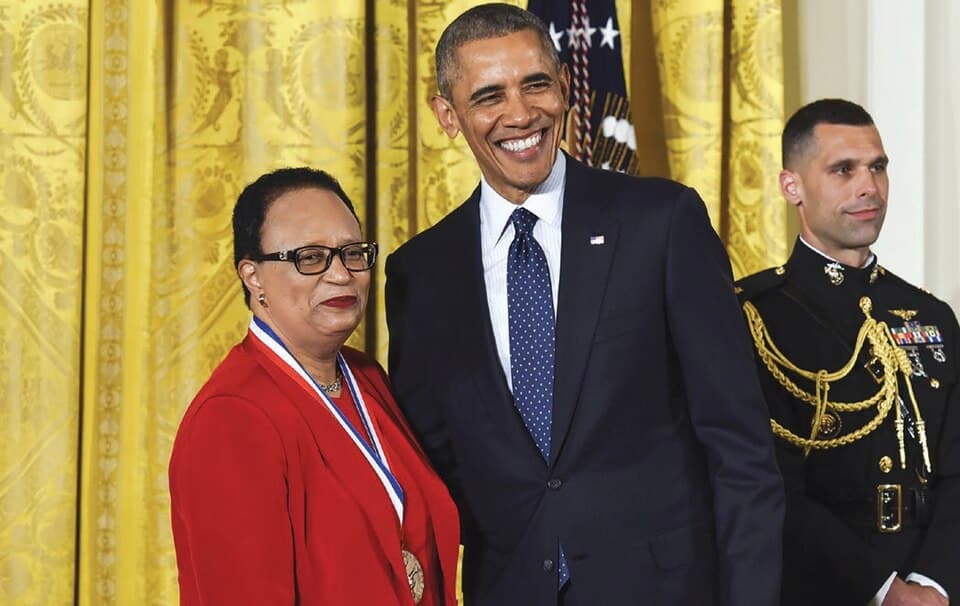
American · Science · Activism
Dr. Shirley Jackson
August 5, 1946 – present
Early Life and Background
Shirley Ann Jackson was born on August 5, 1946, in Washington, D.C., to George Hiter Jackson and Beatrice Cosby Jackson.[6][12] She grew up in the city’s northwest section, in a family that valued education and fostered her curiosity about the natural world. Her father, who had a strong interest in science and tinkering, encouraged her to solve problems and explore how things worked; her mother supported her academic ambitions and stressed the importance of persistence.[6][12] These influences helped cultivate Jackson’s early aptitude in mathematics and science.
As a child and teenager, Jackson attended segregated public schools in Washington, D.C., at a time when opportunities for African American students—especially girls—in advanced science and mathematics were limited.[12] She excelled academically, undertaking independent science projects and advanced coursework when available. Jackson later recalled building her own science experiments and being motivated by the dawn of the space age, including the launch of Sputnik, to take mathematics and physics seriously.[6]
Jackson attended Theodore Roosevelt High School, where she distinguished herself both academically and in leadership. She graduated as valedictorian of her class, an achievement that reflected her mastery of rigorous coursework and her determination to succeed despite structural barriers related to race and gender.[3][12] Her high‑school success, combined with encouragement from teachers and family, set the stage for her entry into one of the most demanding technical universities in the world.
Education at MIT and Academic Formation
In the mid‑1960s, Jackson enrolled at the Massachusetts Institute of Technology (MIT) to study physics.[3][5][10] She was among the very few Black students on campus and one of the earliest Black women undergraduates at MIT, entering an environment where she faced both academic intensity and pronounced social isolation. Accounts from Jackson and later biographical profiles describe peer hostility and avoidance: fellow students would sometimes refuse to sit with her in dining halls or told her to "go away," reflecting the racial tensions of the era.[3]
Despite these challenges, Jackson pursued her studies in theoretical physics. She completed her B.S. in physics in 1968, demonstrating academic excellence in demanding courses and research experiences.[3][5][10] Her persistence at MIT during a period marked by civil‑rights struggles and campus unrest underscores the intersection of her scientific training with broader social movements for racial equality.
Jackson chose to remain at MIT for graduate study, focusing on nuclear and particle physics. She completed her Ph.D. in theoretical elementary particle physics in 1973, becoming the first African American woman to earn a doctorate from MIT in any discipline and one of the first two Black American women to receive a Ph.D. in physics in the United States.[1][5][10][11][12] Her doctoral work involved advanced mathematical analyses of subatomic particles and their interactions, contributing to the growing theoretical framework of particle physics.
After earning her Ph.D., Jackson undertook postdoctoral research at major international facilities, including Fermi National Accelerator Laboratory (Fermilab) in Batavia, Illinois, and the European Center for Nuclear Research (CERN) in Geneva, Switzerland.[12] These appointments placed her within leading global collaborations in high‑energy physics, deepening her expertise and exposing her to cutting‑edge experimental work.
Career Beginnings: Bell Laboratories and Theoretical Physics
In 1976, Jackson joined AT&T Bell Laboratories in Murray Hill, New Jersey, as a condensed matter theorist and research physicist.[6][12] Bell Labs was one of the world’s premier industrial research centers, known for innovations in telecommunications, materials science, and information theory. Jackson’s work there focused on the behavior of electrons in solids, surfaces, and thin films, including the interaction of electrons on liquid helium films and surface excitations treated as a polaron problem—a complex many‑body phenomenon in condensed matter physics.[1][11]
Her research contributed to the theoretical foundations underlying a range of telecommunications technologies. Accounts from institutional and popular sources credit Jackson’s work at Bell Labs as part of the intellectual environment that advanced technologies such as fiber optic cables, solar cells, portable fax machines, and telephone services like touch‑tone dialing, caller ID, and call waiting.[6][7] While Jackson is not individually listed as the inventor on specific patents, these innovations relied on the kind of solid‑state and materials physics to which her research contributed.
Jackson spent approximately fifteen years at Bell Labs, from 1976 to 1991, dividing her time between theoretical research and consulting work in semiconductor theory.[12] Her publications and internal reports enhanced understanding of electron transport and surface phenomena, helping industry engineers design more reliable and efficient communication systems.
Transition to Academia: Rutgers University
In the early 1990s, Jackson moved from industrial research to academia. She joined Rutgers University in New Brunswick, New Jersey, as a professor of theoretical physics around 1991
Jackson’s presence at Rutgers expanded opportunities for students to engage with cutting‑edge theoretical work and brought to the department a faculty member with leading experience at Bell Labs and major research facilities. Her role also had symbolic significance: as a Black woman physicist in a major public research university, she provided representation and mentoring that were rare in the physics discipline.[11][12] During this period, Jackson’s scholarly achievements were recognized by the broader physics community. In 1991, she was elected a Fellow of the American Physical Society (APS) for her research on the interaction of electrons on liquid helium films with surface excitations treated as a polaron problem.[1][11] Fellowship in APS signaled her standing as a scientist whose work had made substantial contributions to the field. Jackson’s scientific and leadership abilities drew the attention of policy makers. In 1995, President Bill Clinton selected her for a senior federal role in nuclear regulation. She became the first African American to serve as a commissioner of the U.S. Nuclear Regulatory Commission (NRC) and, shortly thereafter, the first woman and first African American to chair the agency.[1][11][12] On May 9, 1995, Clinton announced his intention to appoint Jackson as NRC Chairman, marking an unprecedented step in diversifying leadership in U.S. nuclear policy.[1][5] She was sworn in on June 29, 1995, formally assuming office as chairman.[5] As the principal executive officer and official spokesperson of the NRC, Jackson oversaw regulatory frameworks for commercial nuclear power plants, medical and industrial uses of nuclear materials, and the management of nuclear waste, all with a focus on protecting public health and safety.[1] Jackson chaired the NRC until 1999. Her tenure was characterized by an emphasis on risk‑informed, performance‑based regulation and heightened attention to transparency and public communication. In May 1997, she spearheaded the formation of the International Nuclear Regulators Association (INRA), a forum for the heads of nuclear regulatory authorities in several major nuclear‑power countries, and was elected as INRA’s first chairman.[1] Through INRA, Jackson worked to strengthen international cooperation on nuclear safety, sharing lessons from events such as Chernobyl and promoting best practices in regulatory oversight. Her leadership at the NRC reaffirmed the agency’s commitment to public health and safety and demonstrated that expert scientists from underrepresented backgrounds could effectively lead complex technical agencies. Jackson’s work in this period also contributed to broader debates about energy policy, environmental protection, and technological risk. After leaving the NRC, Jackson entered a new phase of institutional leadership. On July 1, 1999, she became the 18th president of Rensselaer Polytechnic Institute (RPI), based in Troy, New York.[1][2][5] Her appointment made her the first woman and the first African American to lead the oldest technological university in the United States and is widely recognized as making her the first Black American woman to lead a national, top‑ranked research university.[1][11] At RPI, Jackson launched an ambitious institutional strategy known as the Rensselaer Plan, which sought to transform the university into a more prominent research institution with expanded interdisciplinary programs and modern facilities.[1][2] Under her leadership, RPI invested in areas such as biotechnology, information technology, nanotechnology, and advanced materials. She oversaw major capital projects, including new research centers and campus infrastructure, and worked to increase research expenditures and graduate enrollment. Jackson’s presidency emphasized the integration of basic science, engineering, and societal needs. She encouraged research addressing global challenges such as water and food security, climate change, energy systems, and human health.[2][7] Her administration also focused on student experiences, diversity, and outreach, seeking to position RPI graduates as leaders in technology‑driven industries. Beyond RPI, Jackson continued to serve on national and international advisory boards. She has been involved with the President’s Intelligence Advisory Board, the U.S. Department of Energy advisory structures, and research councils of the National Academy of SciencesNational Academy of Engineering (NAE) in 2001, becoming the first Black American woman elected to the NAE.[8][11] Jackson’s scientific contributions lie primarily in theoretical and condensed matter physics. Her work on electron behavior in solids, surfaces, and thin films has explored phenomena critical to the understanding of transport and excitations in materials. The specific problem of electrons on liquid helium films interacting with surface excitations, treated as a polaron system, earned her election as a Fellow of the American Physical Society.[1][11] Through her research at Bell Labs and in academia, Jackson contributed to a body of knowledge that enabled advances in semiconductor technology and telecommunications. While industrial innovation is inherently collaborative and she is not named as the individual inventor on key patents, institutional biographies point to her work as part of the intellectual infrastructure behind technologies such as fiber optic communications, solar energy devices, and modern telephone systems that use touch‑tone signaling and digital caller‑identification services.[6][7] Jackson has authored and co‑authored scientific papers and technical reports, and has been widely recognized for her ability to bridge theory, experiment, and policy. Her expertise in nuclear and particle physics also informed her leadership at the NRC and her participation in advisory councils concerned with nuclear energy and safety. Over the course of her career, Jackson has received numerous honors recognizing both her scientific achievements and her leadership. Jackson has also been described by Time Magazine as "perhaps the ultimate role model for women in science," a phrase widely quoted in institutional and media profiles.[2] She has served in leadership roles for the National Science Board, chaired major advisory committees, and participated in governance for organizations such as The Nature Conservancy, where she has been listed as Global Board Secretary.[2] Public‑education and media materials dating to September 13, 2016 have highlighted her as a National Medal of Science honoree, reinforcing her status as a leading figure in American science and a prominent advocate for STEM education.[5][7] Shirley Ann Jackson has managed a demanding professional life alongside family responsibilities. She is married to Morris A. Washington, himself a physicist, and they have one son, Alan.[12] Her marriage to a fellow scientist has often been noted in biographies that emphasize the shared intellectual environment surrounding her work and family. While Jackson has maintained a relatively private personal profile compared to her public professional roles, she has spoken in interviews about the importance of family support, mentorship, and community. These elements, combined with her own experiences of isolation and discrimination in early academic settings, have informed her advocacy for inclusive campus climates and supportive networks for students from underrepresented backgrounds.[6][7] Jackson’s legacy is multifaceted, encompassing scientific research, federal regulatory leadership, and transformative university administration. As the first Black woman to earn any doctorate from MIT, she broke through one of the most formidable institutional barriers in American higher education, demonstrating that Black women could thrive in elite scientific environments despite entrenched racial and gender biases.[1][5][10][11] Her subsequent career at Bell Labs and Rutgers showed how a theoretical physicist could move between industrial research and academia, contributing to both fundamental science and applied technologies. As NRC chairman, Jackson helped recalibrate nuclear regulation for a post‑Chernobyl world and strengthened international collaboration through the founding of the International Nuclear Regulators Association.[1] At RPI, Jackson’s long presidency reshaped a historic technological university, expanding its research profile and infrastructure and promoting interdisciplinary approaches to global challenges. Her leadership in the National Academy of Engineering, the National Science Board, and other advisory roles has influenced national science and technology policy across multiple administrations.[2][8][11][12] In women’s and African American history, Jackson stands as a key figure in the narrative of Black women’s entry into high‑level STEM roles. Her career demonstrates how structural barriers can be confronted through excellence, persistence, and institutional change. She has served as a mentor and role model for generations of students, and her life story is frequently used in STEM‑education programs to encourage girls and underrepresented minorities to pursue science and engineering.[2][3][7] As of the mid‑2020s, Shirley Ann Jackson remains an influential voice in science, engineering, and higher education. After more than two decades leading RPI, she was recognized as president emerita and continues to be involved in advisory, governance, and public‑engagement roles.[2] She has participated in boards for organizations such as The Nature Conservancy and has remained active in discussions about climate change, sustainability, national security, and technological innovation.[2][7] Jackson continues to speak about the importance of diversity in STEM, the necessity of strong science and engineering education for addressing global challenges, and the need for robust public trust in scientific institutions. Public interviews and profiles highlight her reflections on her own path—from segregated schools in Washington, D.C., through MIT, Bell Labs, the NRC, and RPI—as a lens for understanding progress and continuing obstacles in American science.[2][6][7] Her life story, documented in institutional archives, encyclopedias, and women’s‑history projects, remains a critical resource for scholars, educators, and students seeking to understand how Black women have shaped modern physics, nuclear regulation, and technological universities. Jackson’s continuing influence ensures that her pioneering achievements will inform debates and decisions in science and policy for years to come.Federal Service: Commissioner and Chair of the U.S. Nuclear Regulatory Commission
Presidency of Rensselaer Polytechnic Institute
Major Works, Discoveries, and Scientific Contributions
Awards, Honors, and Recognition
Personal Life
Legacy and Historical Impact
Later Life and Continuing Influence
Dated achievements
6 indexed.
- Aug051946Science
Birth in Washington, D.C.
Shirley Ann Jackson was born in Washington, D.C.
View details Encyclopedia Britannica - May091995Science
Named first woman and first African American Chairman of the U.S. NRC
Shirley Ann Jackson was appointed the first woman and African American chair of the NRC.