← All women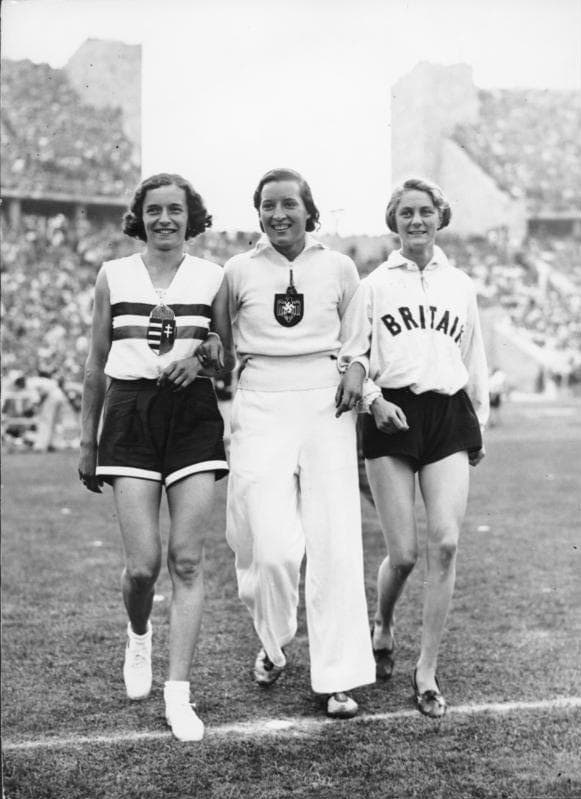
British · Sports
Dorothy Tyler
March 14, 1920 – September 25, 2014
Early life and background
Dorothy Jennifer Beatrice Odam was born on 14 March 1920 in Stockwell, London, and later became known as Dorothy Tyler after marriage. She grew up in south London in an era when women’s competitive athletics was still developing and when opportunities for girls in elite sport were far more limited than they are today. Her emergence as a world-class high jumper is therefore inseparable from the broader history of women’s sport in interwar Britain, where female athletes often had to prove the legitimacy of their ambitions as well as their physical ability.
Little of her early family life is recorded in the main public sources, but the outline of her upbringing is clear enough to place her within a generation of athletes who came of age before the Second World War. She entered athletics young and quickly showed unusual promise in the high jump, an event that required not only speed and coordination but also technical adaptability. By the time she was a teenager, she had already become one of Britain’s most remarkable sporting prospects.
Her childhood and adolescence unfolded against the social constraints of the 1920s and 1930s, when serious women’s athletics still fought for respectability and coverage. That context matters because Tyler’s later successes were not simply personal triumphs; they were also evidence that women could excel in events previously treated as marginal to mainstream sport.
Rise to international prominence
Tyler’s breakthrough came astonishingly early. At the 1936 Berlin Olympic Games, competing as Dorothy Odam, she won the silver medal in the women’s high jump at just 16 years old. This made her the first British woman to win an individual Olympic medal in athletics, a milestone that ensured her place in the history of British women’s sport. The result was all the more striking because it came in Berlin, at the politically charged Olympics staged under Nazi rule, where British and other foreign athletes competed in an atmosphere shaped by propaganda, pageantry, and international tension.
The Berlin competition revealed both Tyler’s technical quality and the limitations of the rules of the time. She was the highest jumper in the event and would have won under modern countback procedures, but the 1936 rulebook led to a jump-off that she lost. Even so, the silver medal was a breakthrough of enduring significance. It showed that a teenage British woman could reach the Olympic podium in a technically demanding event and helped redefine expectations for female athletes in Britain.
Two years later, Tyler confirmed her elite status by winning the high jump gold medal at the 1938 British Empire Games in Sydney. That title showed that her Olympic success was not an isolated performance but part of a sustained international career. In 1939, at Brentwood, Essex, she cleared 1.66 metres, an outstanding leap that was later recognized as a world record. Because official record-keeping for women’s sport was still less secure and less consistent than modern systems, the performance initially lacked the immediate status it merited. Its later recognition only underscored how far ahead of the formal record she had been.
War, marriage, and return to competition
Tyler’s career, like the careers of many athletes of her generation, was interrupted by the Second World War. She married fellow athlete Dick Tyler, and during the war years she worked in a lorry-driving role at the RAF base associated with 617 Squadron, the Dambusters, according to later biographical accounts. The war transformed the lives of athletes across Europe, shutting down normal international competition and forcing many sportswomen to combine work, service, and family life with the uncertainty of wartime conditions.
After the war, Tyler returned to athletics with extraordinary effectiveness. At the 1948 London Olympic Games, now competing as Dorothy Tyler, she won silver again in the women’s high jump. That made her the only woman to win Olympic athletics medals both before and after the Second World War, a distinction that remains one of the most important in Olympic history. The London Games were especially symbolic because they represented the reawakening of international sport after years of devastation, rationing, and loss. Tyler’s medal connected the pre-war world of Berlin to the post-war world of London in a single athletic career.
She continued at elite level after 1948. In 1950, she won another high jump gold medal at the British Empire Games in Auckland, reinforcing the idea that she remained among the world’s best over a remarkably long span. She went on to compete for Great Britain at the 1952 Helsinki Olympics, where she placed seventh, and at the 1956 Melbourne Olympics, where she placed twelfth. After Melbourne she retired from international competition. Her Olympic record—four Games spread over two decades—made her one of the most durable figures in British athletics.
Technique, coaching, and later athletic service
Tyler’s career is also notable for technical adaptation. Biographical accounts note that she changed her style from the scissors technique to the western roll in 1951, reflecting the evolution of high-jump methods in mid-century athletics. Such adjustments were essential in an event where innovation could affect outcomes dramatically. Her willingness to adapt helped explain the longevity of her competitive career.
After retiring from competition, Tyler remained active in the sport as a coach, official, and British team manager. She became especially important as a barrier-breaking figure in coaching: sources describe her as the first British woman qualified to coach male athletes in the 1950s. That achievement mattered because coaching credentials were another area in which women had long faced exclusion or skepticism. Tyler’s progression from athlete to coach helped open a professional pathway for later women in British sport.
Her continuing engagement with athletics was visible well into old age. In 2012, she served as the official starter for the London Marathon, a symbolic role that linked the sport’s modern mass-participation culture with one of its earliest British female stars. The appearance reflected both her standing in the athletic community and the lasting relevance of her name.
Honors and recognition
Tyler’s Olympic and Empire Games results brought her lasting public recognition, and her name became closely associated with women’s sporting firsts in Britain. Later life tributes emphasized not only her competitive record but also her extraordinary place in Olympic memory. She was repeatedly cited as the first British woman to win an individual Olympic athletics medal and as the only woman to medal in Olympic athletics on both sides of the Second World War.
Her 1939 high jump was ultimately recognized as a world record, giving formal status to a performance that had long been historically important. That delayed recognition is part of her legacy because it reveals the uneven way women’s achievements were sometimes recorded and rewarded. Tyler’s career helped correct the historical record by demonstrating that women’s athletic excellence deserved full and timely acknowledgment.
In 2009, she was made a Member of the Order of the British Empire, according to later summaries, further confirming her place in the national sporting memory. The honor acknowledged a life that had combined high-level competition, coaching, and the promotion of athletics across generations.
Personal life
Tyler married fellow athlete Dick Tyler, and biographical notices state that they had two sons. She lived much of her life in the Croydon area of south London. Her personal story is inseparable from the world of sport, but it also reflects the broader experience of twentieth-century women who balanced elite public achievement with family life and wartime disruption.
Because the surviving public record focuses primarily on her athletics, fewer details of her private life are widely documented than for some modern sports figures. Even so, the available evidence shows a woman whose life remained rooted in London and who maintained strong ties to the sporting community long after her competitive peak.
Legacy and historical impact
Dorothy Tyler’s legacy lies in several overlapping achievements. She was a teenage Olympic medallist in 1936, a double Empire Games champion, an athlete whose pre-war world record was later recognized, and a post-war Olympian who remained elite across extraordinary historical change. Most importantly, she helped change what British observers thought women could accomplish in athletics.
Her career also reveals the asymmetry of recognition in women’s sport. She achieved major results in an era when women often competed with fewer resources and less attention than men, and some of her accomplishments—such as her 1939 record—took years to be fully validated. Yet her reputation endured, in part because her story connected sporting excellence to larger historical experiences: the rise of women’s Olympic competition, the disruptions of war, and the gradual professionalization of women’s coaching roles.
In the history of British athletics, Tyler stands as a foundational figure. Later generations of high jumpers and women athletes inherited a landscape in which Olympic success by women was far more imaginable because figures like Tyler had already done it. She died on 25 September 2014 in Sanderstead, Surrey, aged 94, after a long illness, leaving behind a record that remains central to any account of British women’s sporting history.
Dated achievements
11 indexed.
- Mar141920Sports
Birth of Dorothy Jennifer Beatrice Odam
Dorothy Jennifer Beatrice Odam was born in Stockwell, London, England.
View details Wikipedia - Aug091936Sports
First British woman to win an Olympic athletics medal
Dorothy Odam won a silver medal in high jump at 1936 Berlin Olympics, first for a British woman.
View details