← All women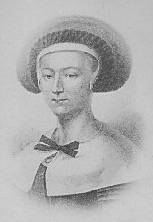
Norwegian · Literature
Dorothe Engelbretsdatter
January 16, 1634 – February 19, 1716
Early Life and Background
Dorothe Engelbretsdatter was born on January 16, 1634, in Bergen, Norway. Her father was Engelbrecht Jørgensen, a priest, and her mother was Anna Wrangel. Growing up in a religious household, Dorothe was deeply influenced by Lutheran teachings, which later permeated her literary work. She was well-educated for a woman of her time, receiving a comprehensive education that would set the stage for her future endeavors in literature.
Career Beginnings and Development
Engelbretsdatter's literary career took off at a time when women's writing was not commonly published. Her first publication, "Siu saligh Sange," appeared in 1678, marking her as the first woman in Norway to publish a book. This collection of hymns and religious songs reflected her deep religious convictions and her mastery in the Baroque style, which characterized her work with intricate metaphors and allegories.
Major Works and Accomplishments
Dorothe's subsequent publication, "Taare-Offer," or "The Offering of Tears," came out in 1685. This work is often regarded as her masterpiece, reflecting on themes of loss, repentance, and religious devotion. Her ability to blend personal grief with divine acceptance struck a chord with readers across Norway and beyond.
Awards, Honors, and Recognition
Despite the limited opportunities for women during her lifetime, Engelbretsdatter gained considerable recognition. Her works were admired by her contemporaries and influenced later Norwegian writers, thereby helping pave the way for women in literature. Although formal accolades in the modern sense were scarce, her pioneering status as a female author was a significant acknowledgment in itself.
Personal Life
In 1652, Dorothe married Ambrosius Hardenbeck, a young clergyman. The marriage produced eight children, though many did not survive childhood, a common tragedy during the era. Her personal struggles often permeated her work, giving it a profound depth and poignant resonance.
Legacy and Historical Impact
Dorothe Engelbretsdatter is remembered as a trailblazer for women in literature, both in Norway and internationally. Her writings offered a rare and authentic female perspective in a male-dominated literary world, providing insights into the religious and societal norms of her time while shaping Norwegian literary history.
Later Life and Death
After the death of her husband in 1683, Dorothe continued to write and manage her household and children. Her later years were marked by financial difficulty and health challenges, yet she continued to influence others through her writings until her death on February 19, 1716, in Bergen. Her burial in Bergen's Korskirken stands as a testament to her enduring presence in Norwegian culture.
Dated achievements
2 indexed.
- Jan161634Literature
Birth of Dorothe Engelbretsdatter
Dorothe Engelbretsdatter was born on January 16, 1634, in Bergen, Norway.
View details Store norske leksikon - Feb191716Literature
Death of Dorothe Engelbretsdatter
Dorothe Engelbretsdatter passed away on February 19, 1716, in Bergen, Norway.