← All women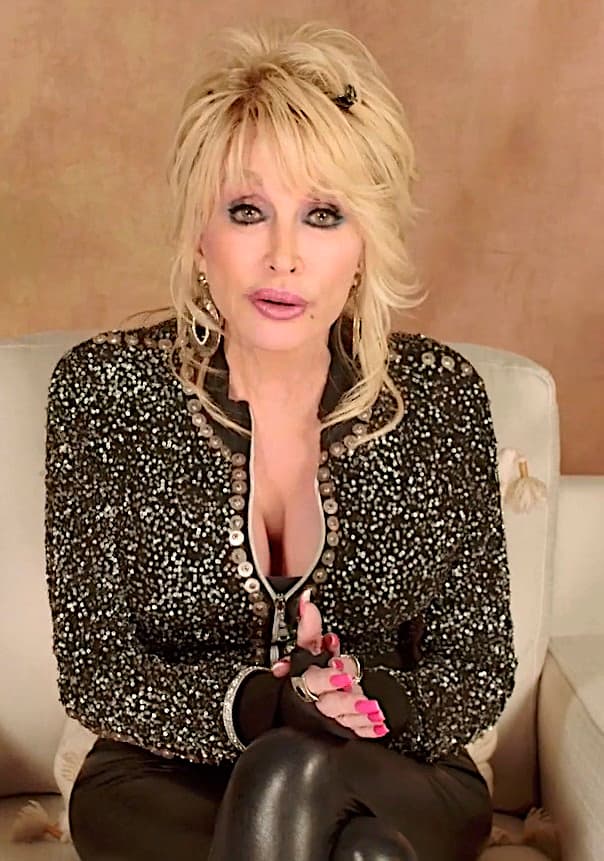
American · Arts · Literature · Activism
Dolly Parton
January 19, 1946 – present
Early life and family background
Dolly Rebecca Parton was born on January 19, 1946, near Sevierville, Tennessee, in the Great Smoky Mountains region.[1][3][14] She was the fourth of twelve children born to Robert Lee Parton and Avie Lee Owens Parton, and she grew up in a family that lived in poverty but was rich in music, oral storytelling, and religious devotion.[7][10][13] The Partons’ rural Appalachian environment shaped her sense of identity and later became a central part of her artistic persona.
Parton has often described her childhood as difficult but creatively formative. Her family’s economic hardship meant that she learned early how to entertain herself and others through imagination, songs, and homemade instruments. The local church, family singing, and mountain ballads formed her earliest musical education. Later biographical accounts note that she wrote her first song as a child and performed publicly while still young, showing an early instinct for both composition and performance.[5][13]
She attended local schools in East Tennessee, but music quickly became her chief ambition. As a teenager, she was already performing on radio and television in Knoxville and around the region, gaining experience in professional settings before finishing adolescence.[13] Her upbringing in a large family, combined with the practical discipline required by rural life, would remain visible throughout her career in her work ethic, entrepreneurial style, and public emphasis on resilience.
Career beginnings
Parton’s first commercial recording came in 1957 with “Puppy Love”, recorded for Goldband Records and co-written with her uncle Bill Owens.[1][5] In 1959, she made her debut at the Grand Ole Opry, a landmark appearance that connected the young singer to the center of country music performance culture.[1][2][8] These early experiences helped establish her as a precocious talent and also exposed her to the professional demands of the music business at an unusually young age.
In 1967, Parton released her debut country single, “Dumb Blonde”, which reached the country charts and introduced a public style that was already unmistakably her own.[4][6] That same year, her debut album, Hello, I’m Dolly, began a recording career that would eventually span decades.[1] Her early hits demonstrated that she could write and perform songs that were both commercially viable and emotionally memorable, even as the country industry remained strongly shaped by male executives and established stars.
During the late 1960s, Parton worked closely with singer Porter Wagoner, appearing on his television show and recording with him. The partnership gave her national exposure and helped sharpen her performance style, but it also highlighted the tension many women faced in country music: success often depended on working within structures controlled by male collaborators.[1][3][4] Parton’s ability to navigate that environment while building her own identity would prove decisive.
Breakthrough as a solo star
Parton’s first major solo breakthrough came on March 6, 1971, when “Joshua” became her first solo No. 1 country hit.[1][4] The song established her as more than a duet partner or supporting performer; it confirmed that audiences would embrace her as a singular artist. In the years that followed, she scored a series of major successes that made her one of country music’s defining figures.
In 1974, Parton released “Jolene” and “I Will Always Love You”, two songs that became permanent fixtures in American popular music.[1][3][4][15] “Jolene” showcased her gift for narrative tension and emotional ambiguity, while “I Will Always Love You” reflected her professional separation from Porter Wagoner and her determination to pursue independence. That same year she left The Porter Wagoner Show, a move that symbolized her assertion of creative and business autonomy.[1][3][4]
Parton’s solo career gained further momentum in the mid-1970s, when she was voted Country Music Association Female Vocalist of the Year in consecutive years, 1975 and 1976.[8] Her 1977 album Here You Come Again became her first to reach the Top 20 on the Billboard 200, helping her cross into the pop mainstream while retaining a country foundation.[7] By the late 1970s, Parton had become one of the most recognizable female entertainers in America.
Film, crossover success, and business expansion
In 1980, Parton starred in the film 9 to 5 and wrote and performed its title song, which became a major hit across country, pop, and adult contemporary formats.[4][7][8] The song earned multiple Grammy Awards and an Academy Award nomination, while the film itself made Parton a bona fide screen presence. The project also broadened her audience and linked her name to one of the era’s most visible depictions of working women in popular culture.
Parton’s business ventures expanded in parallel with her entertainment career. In 1986, she helped establish Dollywood in Pigeon Forge, Tennessee, turning a regional amusement attraction into a branded cultural destination under her ownership and creative guidance.[4][16][19] The park’s opening reflected her ability to build an enduring enterprise around her public image, while also stimulating tourism and local economic development in East Tennessee.
That same year, she also co-founded Sandollar Productions, extending her work into film and television production.[4] In 1988, she launched the Dollywood Foundation, initially to support scholarships for local students and later to house literacy initiatives, including the Imagination Library.[4][19] These ventures show that Parton’s brand was never limited to performance alone; she used fame as a platform for ownership, production, and public service.
Literacy, philanthropy, and cultural influence
One of Parton’s most enduring achievements began on September 21, 1995, when the Dollywood Foundation launched Dolly Parton’s Imagination Library in Sevier County.[7][16] The program was designed to mail free books to young children and grew into an international literacy initiative. It became a landmark example of celebrity philanthropy because it was practical, replicable, and deeply connected to Parton’s own experience of childhood scarcity.
In 1992, Parton licensed “I Will Always Love You” for Whitney Houston’s recording in The Bodyguard, allowing one of her most famous compositions to reach a new global audience.[4][10] Houston’s version became one of the best-selling singles by a female artist in history, amplifying Parton’s reputation as one of the most successful songwriters of the modern era. The song’s enduring success also demonstrated the unusual longevity of her catalog.
Parton continued to receive major institutional recognition. On April 14, 2004, she received the Library of Congress Living Legend Medal, and on February 13, 2011, she was awarded the Grammy Lifetime Achievement Award.[1][14] These honors reflected not only her chart success but her long-term importance to American arts and culture.
In 2018, Guinness World Records recognized her for having the most hits on the U.S. Hot Country Songs chart by a female artist and for spanning six decades with a Top 20 hit on that chart, underscoring the longevity and breadth of her commercial success.[5] By the 2010s, she had accumulated a record-setting number of No. 1 country songs and Top 10 country albums for a female artist, along with a reputation as one of the most prolific songwriters in the genre.[14]
Awards, honors, and later recognition
Parton has received some of the highest honors available in popular music, including multiple Grammy Awards, Emmy Awards, and other industry recognitions.[1][4] She was also honored as MusiCares Person of the Year on February 8, 2019, becoming the first country artist to receive that distinction.[14] That recognition paired her artistic legacy with her philanthropic leadership and placed her among the music industry’s most respected humanitarians.
Her influence has also been recognized beyond music awards. Parton has become a symbol of Appalachian pride, female entrepreneurship, and the power of self-authored fame. Her image—often playful, glamorous, and self-aware—has allowed her to resist the narrow categories often assigned to women in country music. Instead, she developed a public identity that merged performance, business, humor, and generosity into a uniquely durable cultural brand.
Personal life
Parton married Carl Dean in May 1966, and their marriage became one of the longest-running relationships in popular entertainment.[4] Dean largely stayed out of the spotlight, allowing Parton to maintain a public career while keeping her private life relatively separate from her professional persona. The couple did not have children, a fact that Parton has discussed as part of her life story and personal choices.
Parton’s life has often been framed through the contrast between private constancy and public exuberance. Her marriage, business partnerships, and philanthropic work show a pattern of careful control over her image and her institutions. That control has been central to her longevity: she has repeatedly adapted to new entertainment markets without surrendering the identity that made her distinctive in the first place.
Legacy
Dolly Parton stands as one of the most consequential women in the history of country music and American popular culture. She helped redefine the role of the female country artist by combining songwriting authority, vocal individuality, crossover appeal, business ownership, and philanthropy. At a time when women in the genre often had to work within narrow expectations, Parton built a career that made autonomy part of the performance itself.
Her legacy extends beyond recordings and awards. Through Dollywood, the Dollywood Foundation, and the Imagination Library, she transformed celebrity into lasting institutions. Through songs such as “Jolene,” “I Will Always Love You,” and “9 to 5,” she created a catalog that remains central to American music. And through decades of public reinvention, she became a model of how a woman from a poor rural background could shape national culture on her own terms.
Parton’s historical significance lies in the combination of artistic excellence and social imagination. She is at once a country music icon, an entrepreneur, a philanthropist, and a symbol of cultural mobility. Few artists have translated personal biography into public meaning as successfully, or as enduringly, as Dolly Parton.
Dated achievements
8 indexed.
- Jan191946Science
Birth of Dolly Parton
Dolly Rebecca Parton is born in Locust Ridge near Sevierville, Tennessee, to Robert Lee Parton and Avie Lee Parton.
View details Dolly Parton - Wikipedia - Mar061971Science
"Joshua" becomes Dolly Parton's first solo No. 1 country hit
Parton's single "Joshua" reaches No. 1 on Billboard's Hot Country Songs chart, her first solo No. 1 country hit.