← All women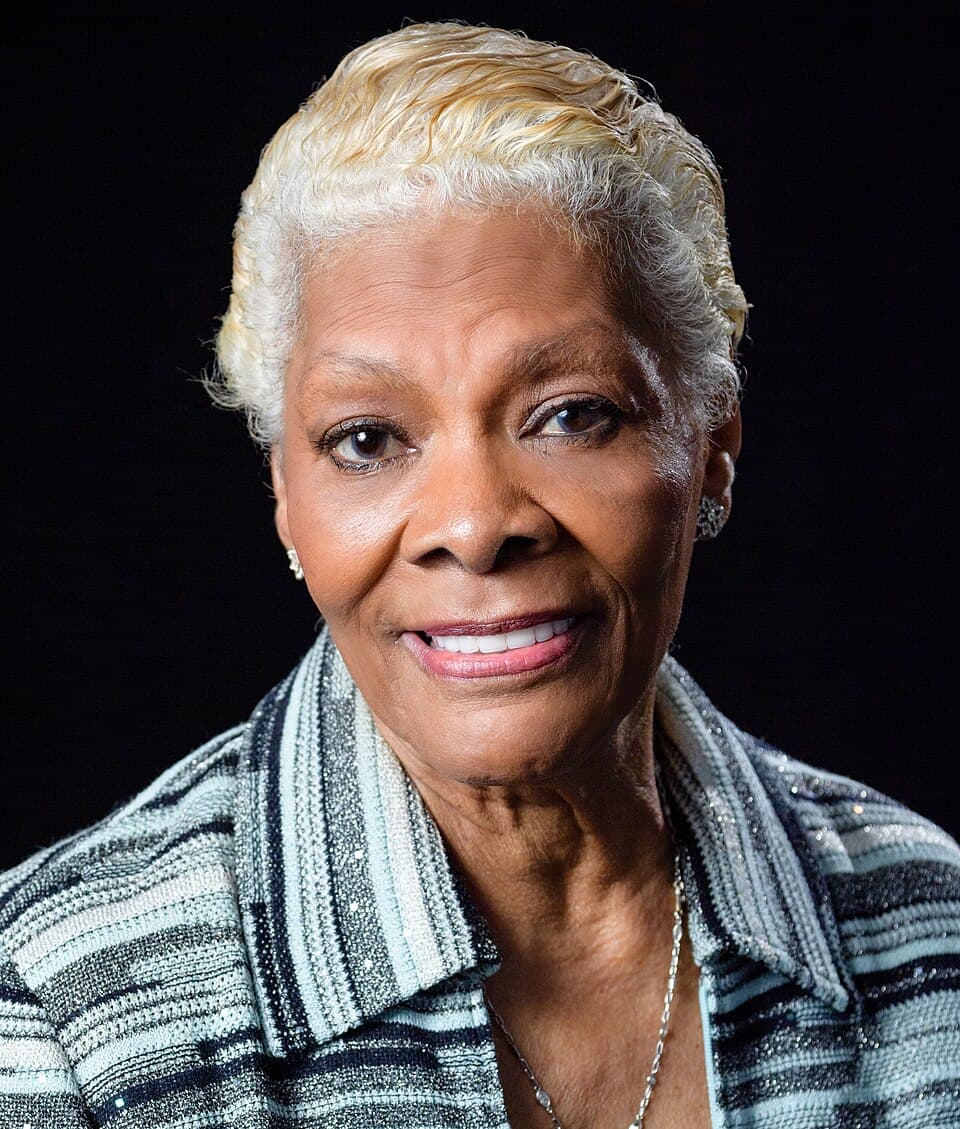
American · Arts · Activism
Dionne Warwick
December 12, 1940 – present
Early Life and Background
Marie Dionne Warwick was born on December 12, 1940, in East Orange, New Jersey, United States.[2][6][12][14] She grew up in a closely knit, deeply religious African‑American family with strong musical roots. Her mother, Lee Drinkard, was a member of the Drinkard Singers, a well‑known gospel group, and her father, Mancel Warrick, worked as a Pullman porter, chef, and record promoter.[6][12] Warwick was the eldest of three siblings, including her sister, the singer Dee Dee Warwick, and brother Mancel Jr.[6][15]
Immersed in church life and gospel music from childhood, Warwick sang in the family’s gospel group and local churches, developing the disciplined vocal technique and expressive phrasing that would later distinguish her commercial recordings.[6][8][12] She attended East Orange High School and showed early interest in formal musical training. After graduation, she enrolled at the Hartt College of Music (now The Hartt School at the University of Hartford) in Connecticut, where she studied music and continued performing.[8]
While at Hartt and commuting between Connecticut and New York, Warwick began working as a session singer. She formed a vocal group called the Gospelaires, which provided background vocals for recording sessions and television appearances. These early professional experiences placed her within the New York music scene and brought her into contact with producers and songwriters who were looking for versatile vocalists.[1][6]
Career Beginnings and Development
Warwick’s professional breakthrough came when she was singing background on a recording session for the Drifters in the early 1960s. Songwriter and composer Burt Bacharach noticed her voice and stage presence and began using her on demos of songs he and lyricist Hal David were writing.[1][2][9] Impressed by her interpretive skill, Bacharach and David helped secure her a recording contract with Scepter Records in 1962.[6][8]
Her debut single for Scepter, “Don’t Make Me Over”, written by Bacharach and David, was released in October 1962 and became her first major hit, charting on the Billboard Hot 100 and R&B charts.[6][8][13] The song introduced Warwick’s clear, controlled vocal style and her ability to navigate Bacharach’s complex melodies and shifting time signatures. It established her as a promising new artist at a time when the U.S. music industry was still deeply segregated and few Black female vocalists enjoyed sustained crossover success.
Following “Don’t Make Me Over,” Warwick released a series of singles and albums that solidified her reputation. Her first album, Presenting Dionne Warwick, appeared in 1963.[1][15] Over the next several years she became one of the premier interpreters of Bacharach–David compositions. Key early hits included “Anyone Who Had a Heart” (1963), “Walk On By” (1964), “You’ll Never Get to Heaven (If You Break My Heart)” (1964), and “Alfie” (1967).[1][2][10][12]
Between 1963 and 1966, Warwick achieved notable chart success, becoming widely recognized as one of the first African‑American female recording artists to accumulate approximately a dozen consecutive Top 100 singles on the Billboard charts, a significant crossover achievement.[6][9][14] Her music combined gospel‑trained vocal precision with sophisticated arrangements that appealed to adult pop audiences as well as R&B listeners.
Warwick’s career also expanded internationally during this period. Her performances in Europe, including a notable engagement at the Olympia Theater in Paris in 1963, helped establish her as an international star.[6] She became particularly popular in the United Kingdom and continental Europe, where Bacharach–David compositions found a receptive audience.
Major Works and Artistic Accomplishments
Throughout the 1960s, Warwick’s collaborations with Bacharach and David produced a long string of influential recordings. Songs such as “Walk On By”, “I Say a Little Prayer” (1967), “(Theme from) Valley of the Dolls” (1967), and “Do You Know the Way to San Jose” (1968) became pop standards and remain closely associated with her voice.[1][2][10][12] These works showcased her ability to deliver complex, rhythmically unusual melodies with conversational clarity and emotional restraint.
Warwick also expanded into acting. In 1968, she made her film debut in the movie Slaves, playing a major role that marked one of the first times since Lena Horne that a contemporary African‑American female recording artist took on such a role in a feature film.[6] This step into cinema reflected her broader cultural presence as a prominent Black woman in entertainment.
Her partnership with Bacharach and David eventually came under strain in the early 1970s, particularly around the dissolution of their songwriting team.[1][12] Nevertheless, Warwick continued to record and perform, signing with Warner Bros. Records and releasing albums that explored new musical directions. In 1974 she scored a No. 1 pop hit with “Then Came You”, recorded with the Spinners, demonstrating her continuing chart power outside the Scepter context.[1][10]
Warwick’s career experienced a resurgence at the end of the 1970s. Her 1979 album Dionne, produced by Barry Manilow for Arista Records, sold strongly and introduced new hits such as “I’ll Never Love This Way Again” and “Déjà Vu.”[1][12][10] These songs updated her sound for contemporary pop and R&B audiences while retaining the elegance and emotional clarity that characterized her earlier work.
In the early 1980s, Warwick continued to chart with singles including “Heartbreaker” (1982), written by the Bee Gees, and “Love Power” (1987), a duet with Jeffrey Osborne.[1][10] She also became known to television audiences as the host of the music‑variety series Solid Gold, which she led for multiple seasons, further embedding her in popular culture.[1][8]
Awards, Honors, and Recognition
Warwick’s achievements have been recognized with numerous awards. On March 10, 1968, she won her first Grammy Award, receiving Best Contemporary Female Vocal Performance for “Do You Know the Way to San Jose.”[6][9] She is cited as the first African‑American solo female artist of her generation to win this category, a significant barrier‑breaking moment for Black women in mainstream pop.[6][9]
At the 12th Annual Grammy Awards on March 11, 1970, Warwick received a second Grammy Award, reflecting industry recognition of her continuing impact.[6] By that time she had recorded dozens of hit singles and nearly twenty best‑selling albums.[6]
One of Warwick’s most celebrated milestones occurred at the 22nd Annual Grammy Awards on February 27, 1980, when she won Best Pop Vocal Performance, Female for “I’ll Never Love This Way Again” and Best R&B Vocal Performance, Female for “Déjà Vu.”[3][9][13] She is described in multiple sources as the first woman, and specifically the first female solo artist, to win Grammys in both pop and R&B categories in the same year.[3][6][13]
In addition to competitive Grammys, Warwick has been honored with lifetime‑achievement and hall‑of‑fame recognitions. She has been inducted into the Hollywood Walk of Fame, the Grammy Hall of Fame, the National Rhythm & Blues Hall of Fame, the Rock and Roll Hall of Fame, and the Apollo Theater Walk of Fame, acknowledging her influence across genres and eras.[1][9] In 2019, she received the Grammy Lifetime Achievement Award, formally recognizing her decades of contributions to recorded music.[1][15]
In June 2003, the Rhythm & Blues Foundation presented Warwick with a lifetime achievement award, and she was named one of the 2003 Top Faces of Black History, highlighting her significance in Black cultural history.[6] These honors, along with continued tributes from institutions and media, underscore her status as one of the most important female vocalists in modern popular music.
Activism, Humanitarian Work, and Public Roles
Beyond music, Warwick has engaged in notable philanthropic and humanitarian activities. In 1985, she became a central figure in music‑industry responses to the AIDS crisis. The charity single “That’s What Friends Are For”, recorded with Elton John, Stevie Wonder, and Gladys Knight under the name Dionne & Friends, was released in October 1985 and became a worldwide hit.[9][10] Proceeds were donated to AIDS research and support, and the project is widely regarded as one of the earliest major artist‑led efforts in popular music to raise funds and awareness for AIDS.[9][14]
Warwick’s willingness to foreground AIDS advocacy at a time of intense stigma was significant. She helped normalize public discussion of the disease and encouraged other prominent artists to participate in charitable initiatives.
Her humanitarian work expanded further when, on October 16, 2002, she was appointed a global Ambassador for the United Nations Food and Agriculture Organization (FAO) in Rome.[6] In this role, Warwick supported campaigns addressing hunger and food security, reflecting a commitment to global social issues beyond the music industry.
Warwick has also been associated with other charitable undertakings, including work with children’s causes and literacy. In 2008, she published a children’s book titled Say a Little Prayer, inspired by her classic song, extending her influence into children’s literature and reinforcing themes of empathy and reflection.[13]
Personal Life
In her personal life, Warwick has experienced the challenges and changes common to long careers in entertainment. She married actor and drummer William Elliott in 1966
Warwick has spoken publicly about the demands of balancing family life with touring, recording, and television commitments. Despite these pressures, she maintained close relationships with her extended musical family, including her cousin Whitney Houston, whose career she supported and occasionally collaborated with.[1] Her personal faith and church upbringing continued to inform her outlook, even as she navigated secular pop stardom. Various interviews and biographical accounts note her emphasis on professionalism, discipline, and respect for the craft of singing as guiding principles throughout her life.[6][12] Dionne Warwick’s legacy is multifaceted. Commercially, she is among the most charted female vocalists in history, with sources citing more than 75 charted hit songs and over 100 million records sold worldwide.[9] Artistically, she is celebrated as the primary interpreter of the Bacharach–David catalog, helping to define a distinctive strain of sophisticated, orchestrated pop in the 1960s. Historically, Warwick was one of the first Black recording artists to reach a mainstream pop audience that “knew no racial or ethnic barriers,” as one encyclopedia notes, particularly in the late 1960s when she sold millions of albums and placed numerous singles in the Top Ten.[14] Her sustained presence on the charts from 1963 onward and her crossover appeal contributed to breaking down racial divisions in pop radio and record marketing. For women’s history, Warwick’s career is significant because she exemplified a model of Black female success rooted in vocal subtlety, interpretive intelligence, and adult‑oriented material, rather than the more stereotyped roles often assigned to Black women in entertainment. Her barrier‑breaking Grammys, Royal Command Performance before Queen Elizabeth II, and international tours demonstrated that a Black woman could occupy spaces of prestige and high cultural visibility long dominated by white performers. Warwick also influenced subsequent generations of singers who drew on her approach to phrasing and emotional control. Artists across soul, pop, and jazz have cited her recordings as touchstones. Her ability to move between genres—gospel, pop, R&B, adult contemporary—and between recording studios, television, and live performance helped define the modern template for a multi‑platform music career. Her activism, particularly around AIDS and global hunger, further extends her legacy. By putting her name and reputation behind controversial or difficult causes, Warwick demonstrated how entertainers can participate in public life as advocates and philanthropists. These efforts have become part of the broader story of how women in the arts have used their platforms to push for social change. Into the 1990s and 2000s, Warwick continued to record, tour, and make guest appearances, maintaining a presence in the music world even as tastes and industry structures evolved. She released albums revisiting standards and collaborating with contemporary artists, and she remained a regular performer on concert stages in the United States and abroad.[1][9] She has been frequently profiled in media retrospectives, television specials, and interviews that highlight her reflections on her career, collaborations, and the evolution of the music business. In recent years, Warwick has attracted renewed public attention through social media engagement and candid commentary on the music industry, introducing her work to younger audiences and reinforcing her reputation for wit and directness.[1] Warwick’s later‑life honors, including the Grammy Lifetime Achievement Award in 2019 and various hall‑of‑fame inductions, have continued to affirm her historical importance.[1][9] As of the latest sources, she remains alive and active, occasionally performing and participating in cultural events that celebrate her contributions. Taken together, Dionne Warwick’s life and career offer a rich case study in the intersection of Black history, women’s history, and popular music. From her beginnings in East Orange church choirs to global stages and humanitarian roles, she has helped shape the soundscape and social possibilities of modern entertainment, leaving an enduring imprint on both music and public culture.Legacy and Historical Impact
Later Life and Continuing Career
Dated achievements
9 indexed.
- Dec121940Science
Birth of Dionne Warwick
Marie Dionne Warwick born in East Orange, New Jersey, beginning the life of the future Grammy-winning pop and R&B icon.
View details Britannica: Dionne Warwick - Oct011962Science
Release of debut hit single "Don't Make Me Over"
Warwick's debut single, written by Bacharach and David, became her first major hit and launched her solo career.