← All women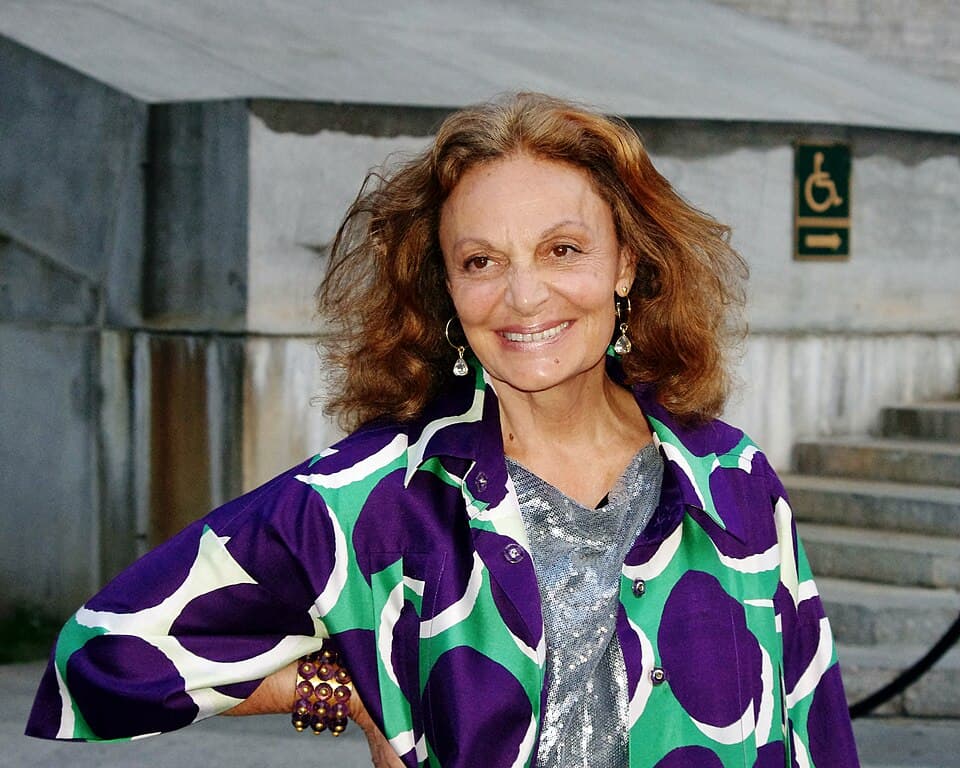
Belgian · Arts
Diane von Furstenberg
December 31, 1946 – present
Early life and background
Diane von Furstenberg was born Diane Simone Michele Halfin on 31 December 1946 in Brussels, Belgium. She was raised in a family shaped by migration, wartime trauma, and cultural mixing: her mother was a Holocaust survivor, and her father was of Romanian Jewish origin. That background gave her an early understanding of resilience and reinvention, themes that would later become central to both her personal story and her public image.
She spent part of her education in boarding schools outside Belgium and later studied economics, first in Madrid and then at the University of Geneva. This training gave her a practical grounding that complemented her instinct for style, commerce, and self-presentation. Before she became a global fashion name, she was already learning how to move between countries, languages, and social worlds—an ability that would serve her well in business and in the international fashion industry.
Marriage, identity, and early adulthood
In 1969, she married Prince Egon von Fürstenberg, entering the German princely House of Fürstenberg and becoming widely known as a princess. The marriage gave her a highly visible public identity, but it did not define her career; instead, she used the visibility and access of that period to build an independent professional life. She and Egon had two children, Alexandre and Tatiana, both of whom remained part of her public story later in life.
After moving to the United States, she began to establish herself in New York, where the fashion industry was expanding rapidly and where new ideas about women’s dress and women’s roles were taking hold. Her later biography would repeatedly connect this period with the creation of a business identity that stood apart from aristocratic title and family name.
Career beginnings and the rise of DVF
Diane von Furstenberg entered the fashion world in the early 1970s with a keen sense that women wanted clothes that were both elegant and wearable. By 1970, she had launched her eponymous label. In the years that followed, she developed designs that combined softness, confidence, and practicality, helping to define a new kind of day-to-night dressing for professional women.
Her most famous design, the wrap dress, emerged in the mid-1970s and quickly became the garment most associated with her name. The dress was simple in construction but powerful in effect: it wrapped across the body, tied at the waist, and created a flattering silhouette without the rigidity of many contemporary fashions. It fit the era’s changing social landscape, in which more women were working, traveling, and seeking clothes that reflected independence rather than constraint.
By 1976, the wrap dress had sold in large numbers and had become a cultural phenomenon. It was celebrated not only as a commercial success but as a design that spoke to changing ideas about femininity, sexuality, and authority. In the language of fashion history, the dress became a symbol of the modern working woman, and von Furstenberg herself became one of the most visible female designers of her generation.
Business development and reinvention
Von Furstenberg’s career was not a single uninterrupted ascent. After her initial wave of success, she stepped back from fashion, later returning with a strategically important relaunch in 1997. That comeback demonstrated a skill that would define her career as much as design talent: the ability to read the market, revive her brand, and connect her name to a broader luxury lifestyle identity.
Over time, the DVF label expanded beyond dresses into ready-to-wear, accessories, handbags, luggage, and other categories. The brand became an international business, sold in many countries and sustained by both heritage and reinvention. Her business reputation also depended on her willingness to adapt the label to new consumer expectations while preserving the core idea that had made it famous: stylish clothing designed to empower women.
The trademark history associated with the DIANE VON FURSTENBERG mark documents the commercial development of this identity. Even when specific product launches are not fully dateable from available records, the trademark trail shows the building of a fashion house that moved from a single iconic garment to a durable global brand.
Leadership in fashion and public recognition
Von Furstenberg’s reputation extended beyond design into institutional leadership. In 2005, she received the Council of Fashion Designers of America’s Lifetime Achievement Award, a recognition that placed her among the most important figures in American fashion. She later served as chair of the CFDA, helping shape the organization and influence the broader industry.
She also became a prominent public advocate for women’s leadership and empowerment. Her philanthropic work included support for women’s causes and the creation of the DVF Awards in 2010 through the Diller-von Furstenberg Family Foundation. Those awards were designed to honor women who showed leadership, strength, and courage in service to their communities and causes, extending her brand of empowerment beyond clothing into civic and philanthropic life.
Her prominence was recognized in other honors as well. In 2015, she was named one of TIME’s most influential people, and in 2019 she was inducted into the National Women’s Hall of Fame. In the early 2020s, European states also acknowledged her contributions: France awarded her the Chevalier de la Légion d’Honneur in 2020, and Belgium named her a Commandeur of the Order of the Crown in 2021. These recognitions reflected not only her success as a designer, but also her status as a cultural figure with transatlantic significance.
Writing, philanthropy, and public voice
Von Furstenberg expanded her influence through books and public speaking. Her memoirs and self-help titles, including The Woman I Wanted to Be and Own It: The Secret to Life, continued the themes of self-invention and resilience that had defined her career. In these works, she presented herself not just as a designer, but as a businesswoman who understood the emotional and practical dimensions of women’s ambition.
Her public persona has often emphasized autonomy, confidence, and the power of choosing one’s own identity. That message resonated because it was rooted in her own life story: a woman who moved from postwar Europe to the center of American fashion and made her name into both a company and a cultural symbol.
Personal life
Her marriage to Prince Egon von Fürstenberg ended in divorce in 1983. She later married media executive Barry Diller in 2001. Through these relationships, she remained a highly visible figure in international social and business circles, but her own achievements increasingly stood apart from the prestige of marriage and title.
Her children, Alexandre and Tatiana, have also remained part of her family narrative. The family’s public visibility has often been connected to her status as a designer, patron, and philanthropist rather than merely as a celebrity spouse.
Legacy and historical impact
Diane von Furstenberg’s lasting historical significance lies in the way she helped redefine what women’s fashion could represent. The wrap dress was not merely a garment; it became a visual shorthand for independence, mobility, and self-possession in the 1970s. Its success also demonstrated that a woman designer could build a powerful, recognizable, globally marketed brand around the needs and aspirations of women customers.
Her career is especially important in the history of women’s entrepreneurship. She built an international business under her own name at a time when women founders were still underrepresented at the top levels of fashion and luxury retail. Her continued relevance across decades shows a rare combination of design instinct, commercial resilience, and public leadership.
Von Furstenberg’s legacy is therefore dual: she is both a fashion innovator and a model of female reinvention. Her story remains a touchstone for discussions of women’s leadership in creative industries, the politics of dressing, and the long afterlife of an iconic design.
Later life
In later decades, she continued to serve as a public face for her brand and as an advocate for women’s advancement. She remained involved in fashion leadership, charitable work, and cultural institutions, sustaining a career that bridged design, business, authorship, and philanthropy. Her ongoing visibility has helped keep her associated not only with a single famous dress, but with a broader legacy of style and empowerment.
Dated achievements
2 indexed.
- Dec311946Arts
Birth of Diane von Furstenberg in Brussels
Diane von Furstenberg was born in Brussels, Belgium, on December 31, 1946, to a Holocaust survivor mother and Greek-Jewish father.
View details Britannica: Diane von Furstenberg - Mar141974Arts
Trademark record establishes 1974 first use of the Diane von Furstenberg brand name
The DVF trademark record documents 1974 as the first use in commerce of the 'Diane von Furstenberg' mark, cementing her name as a business brand.