← All women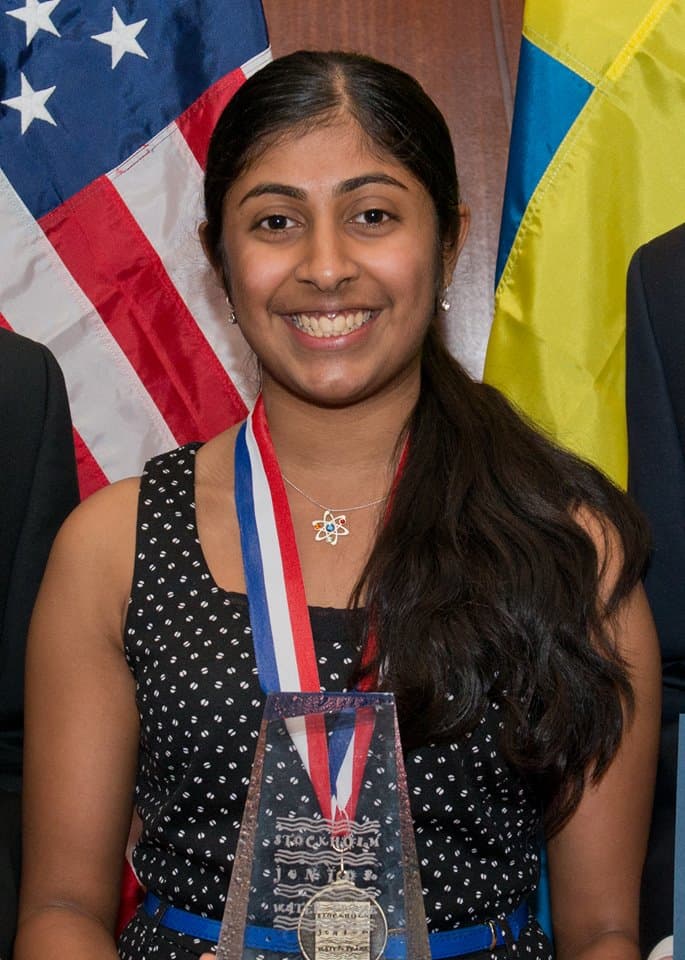
American · Science · Activism
Deepika Kurup
April 12, 1998 – present
Early Life and Background
Deepika Kurup was born on 12 April 1998 in Nashua, New Hampshire, United States.[1][2][3] She is the daughter of Indian immigrants Pradeep Kurup and Meena Kurup
These visits had a profound influence on her worldview. During one trip in her early teens, Kurup observed children near her grandparents’ home in India collecting and drinking water that was visibly contaminated and "too dirty even to touch."[6][8] Learning about the scale of the global water crisis—affecting hundreds of millions of people who lack access to safe drinking water—she resolved to become an advocate for clean water and to find a practical technological solution that could be deployed in low-resource settings.[6][7][8] At home in New Hampshire, Kurup’s parents encouraged her interest in science. Her father supported her by allowing her to establish a small laboratory in the family garage to experiment with water purification methods, and the family kitchen also served as an early workspace.[6][8] This combination of personal exposure to water insecurity abroad and strong mentoring at home laid the foundation for her later achievements as an inventor and clean water advocate. Kurup attended school in Nashua, New Hampshire, where she became deeply involved in science and mathematics during her middle and high school years.[1][11] By ninth grade she was already undertaking independent research projects in chemistry and environmental science, leading to her participation in national science competitions.[1][4][11] After her highly visible successes as a teenage scientist, Kurup pursued higher education in neuroscience. According to interviews and profiles, she studied neuroscience at Harvard University, completing her undergraduate degree before beginning medical training.[4][6] The TED speaker biography and CNN profile describe her as a scientist, speaker, social entrepreneur, and student at Harvard University, later preparing to start a medical program at Stanford.[4][6] Her educational trajectory reflects a dual commitment: continuing to work on scientific solutions to water contamination while training in medicine to address health impacts related to environmental conditions. As of the mid‑2020s, her LinkedIn profile identifies her as a resident doctor at Boston Children’s Hospital, indicating that she has advanced into clinical practice while retaining her identity as a scientist and advocate.[10] Kurup’s scientific career began in earnest when she was about fourteen years old. Motivated by the conditions she had witnessed in India, she set out to develop a method for purifying water that would be affordable, efficient, and suitable for communities without access to complex infrastructure.[6][7][8] Working largely in her home garage and kitchen, she undertook experiments with photocatalytic materials—substances that can accelerate chemical reactions when activated by light—to disinfect contaminated water.[5][7] Her early prototypes involved using metal oxides such as titanium dioxide and zinc oxide, which, when exposed to sunlight, generate hydroxyl radicals capable of destroying bacteria.[11] She sought to combine photocatalysis with filtration, designing systems in which the photocatalyst is embedded in a medium that water passes through. This dual approach aimed to remove particulates while simultaneously inactivating microorganisms.[5][9] Kurup entered the Discovery Education 3M Young Scientist Challenge, a major U.S. competition for middle school students, presenting her solar-powered water purification system.[1][4][11] Her work not only impressed judges technically but also stood out for its clear humanitarian purpose—to help people in water-scarce regions access safe drinking water using sunlight as the primary energy source.[1][4] Following her success in this competition, she continued refining her technology. By 2014 her research had evolved into a project titled "A Novel Photocatalytic Pervious Composite for Degrading Organics and Inactivating Bacteria in Wastewater," which combined principles from materials science, civil engineering, and environmental chemistry.[4][9] This project would later receive national and international recognition in water-focused scientific forums. The core of Kurup’s scientific work centers on designing a photocatalytic water purification system that uses solar energy and specialized materials to reduce microbial and organic contamination. Her invention has been described as an inexpensive method of purifying water that employs a composite of titanium dioxide and silver nitrate in some configurations, or other photocatalytic materials, to produce reactive species that kill bacteria when exposed to sunlight.[9][12] In early iterations, Kurup’s system placed a catalytic rod or structure in a container of contaminated water, which was then set in the sun. After several hours of exposure, tests showed near-total eradication of coliform and E. coli contaminants.[9][12] She reported reductions of coliform bacteria by 98 percent immediately after filtration and 100 percent within fifteen minutes under sunlight, indicating strong disinfection potential.[5] Her later project, focusing on a photocatalytic pervious composite, used a material resembling cement or pervious concrete. This composite allowed water to flow through while also exposing contaminants to photocatalytic surfaces. Activated by sunlight, the material degraded organic pollutants and inactivated bacteria, targeting both wastewater and drinking water treatment challenges.[4][9] Kurup’s approach stands out in the landscape of water purification technologies for several reasons: Kurup has applied for patents on aspects of her invention, and at least one has been published by the United States Patent and Trademark Office according to educational materials about her work.[7] However, the specific filing and grant dates are not consistently documented in the sources provided, and are therefore treated as year‑level information rather than dated events. Beyond laboratory research, Kurup has founded and led Catalyst for World Water, described in her TED speaker biography as a social enterprise aimed at deploying the technology she developed in water-scarce areas.[4] Through this enterprise, she seeks to bridge the gap between experimental prototypes and real‑world implementation, engaging with partners to test, adapt, and potentially distribute her photocatalytic systems in communities most in need. Kurup’s work has been widely recognized through major science and environmental awards. On 30 October 2012, she won the Discovery Education 3M Young Scientist Challenge, earning the title "America’s Top Young Scientist" and a $25,000 prize.[11][1] The Times of India reported that she captured the title on that Tuesday, underscoring the day‑specific nature of the achievement.[11] This award acknowledged her solar-powered water purification system and brought national attention to her research. In 2013, Kurup received the President’s Environmental Youth Award, recognizing her contributions to environmental protection and innovation.[5][4] This U.S. Environmental Protection Agency award honors young people who demonstrate commitment to environmental stewardship, and Kurup’s work on clean water was featured among its recipients. On 18 July 2014, she was named the U.S. Stockholm Junior Water Prize winner for her photocatalytic pervious composite project.[4][9] This award is considered one of the most prestigious youth honors in water science, and Kurup’s selection highlighted her leadership in water-related research at the national level. Later in 2014, she represented the United States as a finalist at the international Stockholm Junior Water Prize during World Water Week in Stockholm, Sweden.[4] While sources confirm her status as a finalist, they do not document a separate top placement beyond this recognition. Kurup has also been honored as one of Forbes magazine’s "30 Under 30" in Energy, acknowledging her innovative contributions to sustainable water purification technology.[4][9][12] She received the National Geographic Explorer Award in the 2015 Google Science Fair, a distinction noted in her TED biography and speaking profiles.[4][12] In addition to formal awards, Kurup has been invited to high‑profile events. She attended the White House Science Fair in both 2013 and 2016, where she presented her work among other leading young scientists.[4] These invitations reflected recognition at the highest levels of government of her contributions to science and environmental innovation. Media and educational institutions have also highlighted her story. On 29 March 2016, National Geographic published a profile on her as a "student scientist," bringing her narrative to a global audience of educators and students.[6] On 25 November 2019, CNN ran a feature describing her as a "star student" on a mission to clean up the world’s water, elaborating on both her scientific work and her medical studies.[6] Kurup has become an active speaker and advocate for STEM education and global water equity. She delivered a TED talk titled "A young scientist’s quest for clean water," in which she explained how her determination to solve the global water crisis began at age 14 after seeing children in India drinking dirty water and how her research evolved from kitchen experiments to a major science prize.[8] Her TED speaker biography describes her as a scientist, speaker, social entrepreneur, and student passionate about solving the global water crisis and using STEM education to empower young people.[4] She emphasizes that STEM has the power to "revolutionize the world" and regularly gives talks and writes articles to encourage students to pursue science, technology, engineering, and mathematics while raising awareness of global water challenges.[4] Through her social enterprise, Catalyst for World Water, and her public engagements, Kurup advocates for deploying affordable, solar-powered water treatment technologies in water-scarce regions and for integrating youth-driven innovations into policy and development discussions.[4] Her advocacy intersects scientific research, entrepreneurship, and education, positioning her as a multi‑faceted figure in contemporary environmental activism. Publicly available sources focus primarily on Kurup’s scientific and academic accomplishments and provide limited information about her private personal life. They identify her as the daughter of Pradeep and Meena Kurup and situate her upbringing in Nashua, New Hampshire, with strong ties to family in India.[2][3][6] As of the late 2010s and early 2020s, profiles describe her as having completed a neuroscience degree at Harvard and as preparing for or undertaking medical training at Stanford, later working as a resident doctor at Boston Children’s Hospital according to her professional biography.[6][10] No reliable sources in the provided set detail marital status, children, or other intimate relationships, and such information is not central to understanding her historical significance as a scientist and advocate. Although still in the early stages of her professional career, Kurup has already established a notable legacy in both science and public discourse. Her teenage invention of a solar-powered photocatalytic water purification system demonstrated that significant contributions to environmental technology can emerge from youth-led research outside traditional institutional laboratories.[1][5][9] By winning the Discovery Education 3M Young Scientist Challenge and the U.S. Stockholm Junior Water Prize, and by receiving high-profile awards such as the President’s Environmental Youth Award and Forbes "30 Under 30" recognition, Kurup became a prominent role model for young women and students of color in STEM.[1][4][5][9][12] Her visibility in mainstream outlets like National Geographic and CNN further cemented this role.[6] Her work has also influenced narratives about the global water crisis, emphasizing that technological solutions must be affordable, scalable, and tailored to the needs of communities lacking infrastructure. By linking water purification directly to social justice and public health, Kurup’s research aligns with broader movements for environmental justice and sustainable development.[6][7] Beyond her specific inventions, Kurup’s legacy is shaped by her advocacy for STEM education and her efforts to encourage other young people to tackle global challenges through science. In this sense, her historical significance lies not only in the particular photocatalytic systems she developed but also in the example she sets of youth-driven, humanitarian‑focused science. As of the late 2010s and mid‑2020s, Kurup has continued to develop her career at the intersection of science, medicine, and social entrepreneurship. CNN reported in 2019 that she had completed a neuroscience degree at Harvard and was preparing to begin medical training at Stanford.[6] Her TED biography similarly notes her status as a student and social entrepreneur focused on deploying water purification technologies in water-scarce areas.[4] Her LinkedIn profile lists her as a resident doctor at Boston Children’s Hospital beginning in 2024, indicating progression into clinical practice.[10] This trajectory suggests that Kurup is integrating her early environmental research with medical training and practice, positioning herself to address health outcomes related to water quality and environmental conditions. Kurup remains active as a speaker and advocate, continuing to share her experiences through talks, interviews, and educational materials such as the Carolina Knowledge Center’s profile on her work.[7] While her long‑term career path is still unfolding, her early achievements and ongoing commitments indicate that she will likely continue to play a prominent role in discussions about clean water, global health, and the power of youth-led science. Kurup’s work must be understood within the broader historical context of the early twenty‑first century, characterized by increasing awareness of climate change, water scarcity, and environmental injustice. During this period, international organizations and governments began to emphasize sustainable development goals, including universal access to safe drinking water. At the same time, there was growing recognition of the need to diversify STEM fields and support participation by women, minorities, and youth. Competitions such as the Discovery Education 3M Young Scientist Challenge and the Stockholm Junior Water Prize provided platforms for young innovators to contribute to these global agendas. Kurup’s success in these competitions positioned her at the intersection of these trends—advancing technological solutions to water problems while embodying the changing demographics of who is seen as a scientist. Her contributions illustrate how individual experiences—such as witnessing water insecurity during family visits abroad—can catalyze scientific innovation with global implications. In the history of women in science, Kurup stands out as an example of a young woman who leveraged educational opportunities, family support, and public recognition to address one of the world’s most pressing environmental health challenges.Education
Career Beginnings and Development
Major Works, Discoveries, and Technological Contributions
Awards, Honors, and Recognition
Speaking, Advocacy, and Public Engagement
Personal Life
Legacy and Historical Impact
Later Life and Ongoing Work
Historical Context
Dated achievements
6 indexed.
- Apr121998Science
Birth of Deepika Kurup
Deepika Kurup was born in Nashua, New Hampshire, United States.
View details Deepika Kurup - Wikipedia - Oct302012Science
Wins Discovery Education 3M Young Scientist Challenge
At age 14, Kurup won America's Top Young Scientist title and $25,000 for her solar-powered water purification invention.