← All women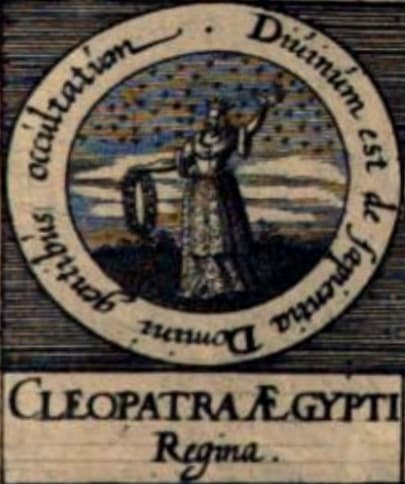
Ancient Egyptian · Science
Cleopatra the Alchemist
Unknown – present
Overview
Cleopatra the Alchemist (Greek: Κλεοπάτρα), sometimes called Cleopatra the Wise, was an Egyptian or Greco‑Egyptian alchemist, philosopher, and technical writer active in Roman Alexandria between roughly the 3rd and 4th centuries CE.[1][4][5][12] She is regarded as one of the earliest documented women in the history of experimental alchemy and early chemistry and is best known for her work Chrysopoeia of Cleopatra ("Gold‑Making"), a short but influential treatise combining practical recipes, symbolic diagrams, and hermetic philosophy.[1][3][4][5][6][12] Widely credited in premodern tradition as one of only four women who discovered the philosopher’s stone, she became a central figure in hermetic lore and in the visual history of alchemy through the famed ouroboros motif that appears in her manuscript.[1][3][5][6][9][10][12][13]
Early Life and Background
No direct ancient source records the birth date, family background, or early education of Cleopatra the Alchemist, and modern scholarship stresses that virtually all biographical details are unknown.[1][4][6][12] The surviving evidence consists of later citations to her writings and the single‑leaf manuscript of the Chrysopoeia, preserved in a medieval copy.[1][3][4][5] On the basis of language, style, and intellectual milieu, historians locate her activity in Alexandria, the cosmopolitan capital of Roman Egypt, sometime during the late 3rd or possibly early 4th century CE.[1][4][5][8][12]
Alexandria in this period was a major center of Greek learning, philosophical schools, and technical arts, including medicine and alchemy.[10][12] Many scholars therefore infer that Cleopatra likely belonged to the Greek‑speaking scholarly circles that transmitted hermetic, gnostic, and technical literature, though her precise ethnic identity—Egyptian, Greek, or mixed Greco‑Egyptian—cannot be firmly determined.[1][4][5][13] Her name, written in Greek, and the hermetic idiom of her work place her within the broader late antique Greek alchemical tradition associated with figures such as Zosimos of Panopolis and Mary the Jewess.[1][4][5][6][10][12]
Intellectual Milieu and Career Beginnings
Cleopatra’s career must be reconstructed from references in later hermetic literature and emblem books, rather than from a chronological narrative.[1][4][6][9][12] She is consistently described as an alchemist who undertook practical experiments in the laboratory, striving to perfect chrysopoeia—the making of gold—through controlled operations of distillation, sublimation, and the manipulation of metallic and mineral substances.[1][2][5][6][12][13] Her work combines technical instructions with a dense philosophical symbolism that reflects the fusion of Greek philosophy, Egyptian religious motifs, and hermetic cosmology typical of late antique Alexandria.[1][3][5][6][10][12]
Some later sources link Cleopatra to other pioneering women alchemists, especially Mary the Jewess, who was associated with early distillation apparatus and the bain‑marie, and to more obscure figures such as Madea and Taphnutia.[6][9][12][13] Although these connections are not biographically secure, they show that medieval and early modern alchemical tradition remembered Cleopatra as part of a small but significant lineage of female adepts. In German physician and alchemist Michael Maier’s 17th‑century emblem book Atalanta Fugiens, she appears among four women reputed to have discovered the philosopher’s stone.[1][2][5][6][9][12][13]
Major Works: The Chrysopoeia of Cleopatra
Cleopatra’s principal surviving work is the Chrysopoeia of Cleopatra (Greek: Χρυσοποιία Κλεοπάτρας, "Gold‑Making of Cleopatra").[1][3][4][5][6][12] The text survives as a single sheet of papyrus reproduced in a medieval manuscript, composed of brief, enigmatic phrases and a series of diagrams and alchemical symbols rather than a continuous narrative.[1][3][4][5] Modern editors describe it as a highly compressed manual that presupposes extensive prior knowledge of alchemical theory and practice.[10][12]
The Chrysopoeia is particularly renowned for its depiction of the ouroboros, the serpent eating its own tail, forming a circle around an inscription that reads in Greek: hen to pan—"One is All"—a concise expression of hermetic monism, the idea that all diversity in the cosmos arises from a single underlying principle.[1][3][4][5][6][8][10][12] The ouroboros in her manuscript is accompanied by additional text explaining that the serpent has its poison according to two compositions, and that "One is All and through it is All, and by it is All, and if you have not All, All is Nothing."[1][3][6][8] Inside the ring appear the alchemical symbols for gold, silver, and mercury, linking the metaphysical concept of unity to the practical manipulation of metals.[1][3][6][8]
Scholars emphasize that this is one of the earliest known visual representations of the ouroboros in an explicitly alchemical context, and it profoundly shaped later hermetic iconography.[3][5][6][8][10][12] Beyond the serpent image, the Chrysopoeia contains a series of technical diagrams and notes—such as representations of distillation apparatus and coded sequences of operations—that suggest Cleopatra’s familiarity with laboratory equipment and with multi‑step transformations of substances.[1][4][5][10][11][12] The compressed style indicates that the manuscript may have served as a mnemonic aid for the practitioner rather than as an introductory manual.
Contributions to Early Chemical Technology
Several premodern authors, and many modern summaries, credit Cleopatra the Alchemist with the invention or early development of the alembic, a distillation apparatus that became fundamental to both alchemy and later chemistry.[1][2][5][6][11][12][13] The alembic generally consists of a cucurbit (vessel), a head that captures vapors, and a receiver where the distilled liquid condenses; it allowed practitioners to separate and purify liquids, essential for producing medicines, perfumes, and alchemical substances.[1][5][11][12]
The claim that Cleopatra invented the alembic cannot be documented with precise technical descriptions from her own hand, but her association with distillation technology appears repeatedly in historical discussions of early alchemy.[1][2][5][6][11][12] A modern study of Lavinia Fontana’s depiction of Cleopatra notes that tradition links her to both the alembic and the ouroboros motif, reinforcing her status as a symbol of alchemical innovation.[11] In broader histories of chemistry, she is frequently invoked as one of the first named women to contribute to the development of laboratory apparatus and chemical techniques, though the exact nature and extent of her technical inventions remain a matter of scholarly caution.[1][4][5][11][12]
Philosopher’s Stone and Hermetic Reputation
From the 17th century onward, Cleopatra the Alchemist’s reputation became closely tied to the legendary philosopher’s stone, the hypothetical substance that could transmute base metals into gold and confer immortality.[1][2][5][6][7][9][12][13] Michael Maier’s Atalanta Fugiens cites her as one of four women—alongside Mary the Jewess, Madea, and Taphnutia—who supposedly succeeded in producing the philosopher’s stone.[1][2][6][9][12][13] Later hermetic writers repeated this claim, turning Cleopatra into a near‑mythical exemplar of alchemical mastery.
Modern historians approach these assertions critically, noting that no direct ancient testimony survives to confirm that Cleopatra herself claimed to have achieved chrysopoeia in the literal sense of making gold.[1][4][6][12] Instead, the Chrysopoeia appears to combine allegorical language with practical hints, and its highly symbolic style suggests that "gold" may have had both material and spiritual connotations.[1][3][10][12] Nonetheless, in popular retellings of alchemy her name is frequently associated with the ultimate goal of the art, and contemporary media sometimes introduce her as an alchemist who "held the secret to making gold," even while acknowledging the legendary nature of the claim.[7][12]
Visual Culture and Artistic Reception
Cleopatra the Alchemist’s visual legacy has been particularly potent. The ouroboros motif and the hen to pan inscription from her Chrysopoeia circulated widely in medieval and Renaissance manuscripts, influencing the design of alchemical emblems and frontispieces.[3][4][5][6][10][12] In early modern Europe, artists and printers incorporated her serpent image into broader cycles of hermetic symbolism, often without explicit attribution, though modern iconographic studies trace the lineage back to her text.[3][4][6][10][11][12]
In the 16th century, Italian painter Lavinia Fontana created a work commonly referred to as "Cleopatra the Alchemist," which art historians interpret as an allegorical portrait drawing on the traditions of Cleopatra as a scientist and inventor, including the alembic and ouroboros.[11] In the 21st century, Cleopatra’s image and symbols have been re‑examined in fashion and design; for example, contemporary media coverage has discussed how luxury brands reference the ouroboros and hermetic motifs connected to her in modern collections, underscoring her continued presence in visual culture.[7]
Distinction from Queen Cleopatra VII
Because of the shared name and Egyptian setting, Cleopatra the Alchemist has sometimes been confused with Cleopatra VII Philopator, the last Ptolemaic queen of Egypt, famous for her political alliance with Julius Caesar and Mark Antony.[12][13] Modern scholarship clearly distinguishes the two figures. Cleopatra the Alchemist belonged to the Roman imperial period several centuries later and operated as a technical writer and philosopher, not as a ruling monarch.[1][4][5][12][13] Articles aimed at general readers emphasize that these are "not the same person" and caution against merging their biographies.[12][13]
The comparison has nevertheless inspired creative interpretations, with some modern essays speculating about the relationship between the scholarly patronage of Cleopatra VII and the later tradition of female alchemists in Egypt.[14][15] However, these connections remain conjectural and are not grounded in direct historical evidence.[12][13] For historians of science, maintaining the distinction between the queen and the alchemist is essential for accurate reconstruction of women’s roles in politics versus technical disciplines.
Personal Life
Despite the rich symbolic content of her surviving work, practically nothing is known about Cleopatra the Alchemist’s personal life.[1][4][6][12][13] No ancient source records her family relationships, marital status, children, or social position. Later hermetic tradition portrays her primarily as an adept and philosopher rather than as a biographical character, and modern attempts to imagine her private life—such as popular articles that describe her as a "mysterious" figure in Alexandria—are speculative.[12][13]
The absence of personal data is typical of late antique technical and hermetic literature, where authors often appear only through fragments of text, formulae, and diagrams. For women especially, the record is sparse, making Cleopatra’s very presence as a named author unusual and historically significant.[1][4][5][12][13] Her name functions as a rare marker of female participation in experimental and theoretical work in an era when scientific authorship was overwhelmingly male.
Later Transmission and Historical Reception
The transmission of Cleopatra the Alchemist’s work from late antiquity to the present occurred through a complex chain of copying, translation, and reinterpretation.[1][3][4][5][6][10][12] Greek alchemical texts circulated in Byzantine manuscripts, were later translated into Syriac and Arabic, and then re‑entered Latin Europe during the Middle Ages through both textual and practical channels.[10][12] Within this process, the Chrysopoeia of Cleopatra was preserved as part of an anthology of alchemical writings, and her name appeared in catalogues and marginal notes.
Medieval and Renaissance alchemists often cited Cleopatra indirectly, through collections and emblem books that reused her imagery without reproducing her full text.[3][4][6][10][12] In the 17th century, Michael Maier and other hermetic authors systematized the tradition, placing her among the exemplary adepts and elaborating the narrative of her success with the philosopher’s stone.[1][2][6][9][12][13] Enlightenment and 19th‑century historians of chemistry continued to mention her, typically in lists of early alchemists and in discussions of the origins of distillation apparatus.[1][4][5][11][12]
Modern scholarly interest in Cleopatra increased in the late 20th and early 21st centuries, as historians of science and gender studies sought to recover the contributions of women in technical fields. Academic articles and popular science pieces now highlight her as a "historical female scientist" who attempted to solve the mysteries of matter and transformation, emphasizing the intellectual sophistication of her diagrams and the hermetic ideas embedded within them.[10][12][13] Online encyclopedias and cultural history blogs present her as a key figure in the female lineage of alchemy.[1][3][5][9][12][13]
Legacy and Historical Impact
Cleopatra the Alchemist’s legacy can be assessed along several dimensions: her role in the history of alchemy and chemistry, her position in women’s intellectual history, and her continued influence on visual and symbolic culture.
In the history of alchemy, she embodies the fusion of technical practice with philosophical symbolism. The Chrysopoeia demonstrates that laboratory operations were framed within a broader cosmological vision, where unity, transformation, and eternity were expressed through images like the ouroboros and formulas such as "One is All."[1][3][5][6][8][10][12] Her association with the alembic and distillation underscores the material reality of alchemical work, connecting her to the lineage that eventually led to modern chemical apparatus.[1][5][11][12]
From the perspective of women’s history, Cleopatra stands out as one of the earliest named female practitioners in an experimental science, even though the discipline at the time was embedded in mystical and metallurgical traditions.[1][2][5][6][9][12][13] Alongside Mary the Jewess and a few other women, she challenges the assumption that ancient and medieval technical fields were entirely closed to women. Her inclusion in hermetic lists of adepts suggests that her contemporaries and successors recognized her expertise.[1][2][6][9][12][13]
In visual and symbolic culture, the ouroboros and hermetic aphorisms associated with Cleopatra have outlived their original context, resurfacing in modern esoteric movements, literature, art, and even fashion design.[3][5][6][7][10][12] The phrase "One is All" and the image of the tail‑devouring serpent have become general symbols of cyclical time and cosmic unity, often without explicit reference to their alchemical origin. Yet, careful historical research traces one of the earliest articulated forms of this symbol to her manuscript, securing her place in the genealogy of western esoteric iconography.[1][3][5][6][8][10][12]
Although many details of her life remain unknown and some aspects of her reputation are shaped by legend, Cleopatra the Alchemist continues to serve as a crucial figure in reconstructing the participation of women in early scientific and technical cultures and in understanding the rich interplay of image, text, and experiment in late antique Alexandria.[1][4][5][10][12][13]
Later Life and Death
No reliable historical record documents the later life or death of Cleopatra the Alchemist.[1][4][6][12] Reference works and scholarly entries consistently state that her dates of birth and death are unknown and that estimates of her period of activity—ranging from the 1st to the 4th century in some older classifications—are based solely on stylistic and contextual analysis of her surviving work.[4] More recent syntheses generally place her in the 3rd century, with the possibility that she remained active into the early 4th century.[1][2][5][8][12]
Because of this uncertainty, modern databases either omit specific dates or simply list her as a late antique alchemist of Alexandria.[1][4][5][6][12] The silence of the sources on her final years and death underscores the fragmentary nature of the evidence for many technical practitioners in antiquity, particularly women. Cleopatra thus emerges from the historical record primarily through her manuscript and the later echo of her name in hermetic tradition, rather than through a biographical narrative that can be firmly anchored in time.
Dated achievements
0 indexed.