← All women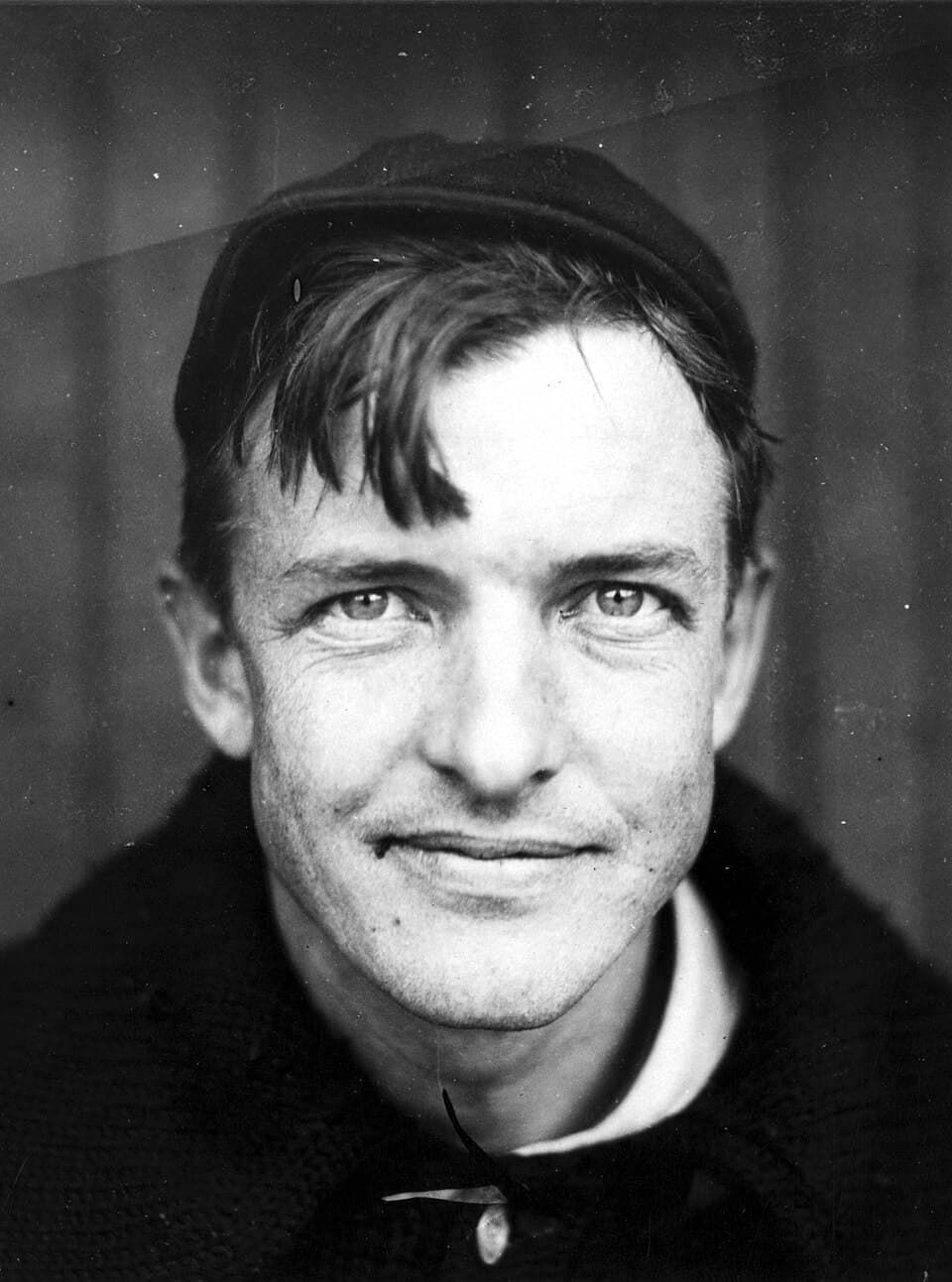
United States · Sports
Christy Mathewson
August 12, 1880 – October 7, 1925
Early Life and Background
Christy Mathewson, born Christopher Mathewson on August 12, 1880, in Factoryville, Pennsylvania, emerged from a small rural community to become one of the most influential figures in early American professional baseball.[1][2][10][16] His family background was comparatively comfortable, which allowed him access to formal education and organized sport at a time when many aspiring players came from industrial or working‑class environments.[5][6] This setting helped shape both his athletic career and the public image that later distinguished him from contemporaries.
Mathewson developed athletic skills early, playing baseball for local teams in northeastern Pennsylvania and gaining notice for his pitching talent in his teens.[7][16] In 1895 he entered Keystone Academy, a preparatory school, where he continued to play baseball and refine his abilities.[7] His success at Keystone positioned him for higher education, an uncommon path for ballplayers of his era.
After graduating from Keystone Academy in 1898, Mathewson enrolled at Bucknell University in Lewisburg, Pennsylvania.[5][16] There he studied subjects including forestry and distinguished himself as a multi‑sport athlete: he was a standout pitcher on the baseball team and an All‑America college football player, while also serving as class president.[5] His collegiate achievements reinforced a public narrative of Mathewson as intelligent, disciplined, and morally upright, qualities that later contributed heavily to his reputation as baseball’s "Christian Gentleman."[6][15]
Career Beginnings and Development
Mathewson left Bucknell in 1899 to pursue professional baseball, signing his first contract with Taunton in the New England League.[3][5][16] This step marked a significant transition: a college‑educated athlete entering the professional ranks at a time when such a move was still rare. His performance in the minor leagues soon attracted the attention of major‑league clubs.
He made his Major League Baseball debut with the New York Giants in 1900, a season often cited as his rookie year.[1][2][16] Early in his Giants tenure, he briefly passed through the Cincinnati Reds in a complex sequence of transactions that eventually returned him to New York in exchange for future Hall of Fame pitcher Amos Rusie.[3] Once re‑established with the Giants, Mathewson quickly became the team’s ace and one of the National League’s dominant pitchers.
Throughout the first decade of the 20th century, Mathewson’s career developed in parallel with the emergence of the so‑called "Deadball Era," characterized by low‑scoring games and an emphasis on strategy, fielding, and pitching. Delivering four principal pitches—including his famous "fadeaway", now understood as a screwball—with exceptional control and an easy, repeatable motion, he compiled a career earned run average (ERA) of 2.13 over 17 seasons.[16] His style emphasized intelligence and precision rather than raw power, contributing to his reputation as a cerebral craftsman on the mound.
Major Accomplishments and On‑Field Achievements
Mathewson’s statistical record ranks among the most impressive in baseball history. Over 17 major‑league seasons, almost all with the New York Giants, he recorded 373 wins, a total that places him near the top of all‑time lists and set a modern National League record for career victories in his era.[1][2][16] He achieved 12 consecutive 20‑win seasons, underscoring both his durability and his sustained excellence.[16]
In 1905, Mathewson led the Giants to a World Series championship and delivered one of the most celebrated pitching performances in postseason history. Facing the Philadelphia Athletics, he started three games, all of which he won, and pitched three complete‑game shutouts, allowing no runs over 27 innings.[1][13][16] These victories, played on October 9, 11, and 14, came within the span of six days and remain unmatched in World Series history in terms of consecutive shutouts by a single pitcher.[1][13] The 1905 Series cemented his reputation as baseball’s premier big‑game pitcher.
Mathewson also excelled in regular‑season competition. He won the National League pitching Triple Crown—leading the league in wins, strikeouts, and ERA—in 1905 and again in 1908.[16] His 1908 season is particularly notable: he pitched 425 innings, won 37 games, and lost only 11, a record of endurance and effectiveness that set a modern National League mark for wins in a season.[7][16] At various times he led the league in wins, strikeouts, ERA, and shutouts, ultimately holding or sharing dozens of individual, club, and league records.[7]
In 1913, he achieved a remarkable streak of 68 consecutive innings without issuing a walk, demonstrating extraordinary control and command.[13] This accomplishment, though less famous than his World Series exploits, illustrates the technical mastery that underpinned his success. By the time he retired, Mathewson’s record and reputation placed him in a small group of pitchers whose careers fundamentally shaped statistical and strategic understandings of the game.
Roles Beyond Pitching: Manager, Executive, and Writer
Mathewson’s influence extended beyond his performance on the mound. Late in his playing career, he briefly served as a player‑manager and later took on formal managerial responsibilities, including a stint managing the Cincinnati Reds.[1][18] These roles reflected both his strategic understanding of the game and the respect he commanded in clubhouses and among executives.
After returning from World War I service, he worked as a coach for the New York Giants from 1919 through 1921, helping guide younger pitchers and contributing to the team’s strategic planning.[7][18] In 1922, he became president of the Boston Braves, a position he held until his declining health made continued service impossible.[3][7][18] As an executive, he participated in the administration of the sport during a period when baseball was grappling with issues such as the aftermath of the 1919 "Black Sox" scandal and efforts to protect the game’s integrity.
Mathewson also wrote about baseball, contributing columns and serving as a public commentator who explained the game to readers. His prose, often emphasizing fair play and sportsmanship, reinforced the moral image associated with his name and helped shape public understanding of strategy and ethics in baseball.[6][18] Through coaching, executive work, and writing, he influenced not only how the game was played but also how it was discussed and perceived.
Awards, Honors, and Recognition
During his lifetime, Mathewson was celebrated as one of the greatest pitchers of his generation and widely admired as a national sports hero.[6][13] His achievements were chronicled in newspapers across the United States, and he became a central figure in the public promotion of baseball as a respectable national pastime.
Institutional recognition culminated after his death. In 1936, when the National Baseball Hall of Fame was established, Mathewson was chosen as one of the first five players elected, alongside Ty Cobb, Babe Ruth, Honus Wagner, and Walter Johnson.[3][14] The election results were announced on February 2, 1936, and he was later formally recognized at the Hall’s inaugural induction ceremony on June 12, 1936.[3][14] This placement in the Hall’s founding class signified that any narrative of baseball history must include Mathewson as a central figure.
Over time, he has been repeatedly listed among the greatest pitchers in the sport’s history by historians, statisticians, and institutions.[2][13][18] The Baseball Hall of Fame and research organizations such as the Society for American Baseball Research (SABR) have continued to highlight his career in exhibits, biographical essays, and statistical analyses.[3][16] Regional institutions, including local halls of fame in Pennsylvania, also honor his legacy as a native son who achieved national acclaim.[7]
Personal Life
Mathewson’s public image as a "Christian Gentleman" was closely tied to his personal life. Sources describe him as modest, clean‑living, and deeply committed to ideals of fair play.[6][15] His college education and leadership roles at Bucknell, such as serving as class president, contributed to perceptions of him as both intellectually and morally grounded.[5]
He married and maintained a family life alongside his professional career, though many biographical treatments focus more on his athletic and public roles than on detailed domestic narratives.[1][6][16] Nonetheless, his reputation for sobriety, religious faith, and respect for others shaped how fans, journalists, and fellow players remembered him. In contrast to stereotypes of rough or hard‑living ballplayers, Mathewson was often held up as a model for youth, illustrating that athletic success could coexist with educational attainment and moral seriousness.[6][13]
World War I Service and Health Challenges
In 1918, as the United States intensified its involvement in World War I, Mathewson joined the U.S. Army’s newly formed Chemical Warfare Service, a unit responsible for training troops in gas defense and handling chemical weapons.[8][18] His decision to enlist required him to step away from his baseball career at a time when he remained a highly respected figure in the sport.
During his service, Mathewson was accidentally exposed to poison gas while instructing soldiers, an incident that would have long‑term consequences for his health.[8] Though he survived the immediate effects, the damage to his lungs left him vulnerable to tuberculosis, a disease for which treatment options were limited in the early 20th century.[8][13] His wartime experience thus linked his personal story to broader narratives of sacrifice and the lingering health burdens borne by veterans.
Following the war, Mathewson’s health gradually deteriorated, forcing him to reduce his involvement in physically demanding activities and ultimately contributing to his early death in 1925.[3][13] His case has often been cited as an example of how wartime exposures continued to affect individuals long after the conflict ended, adding a somber dimension to his legacy.
Later Life and Death
In the years after World War I, Mathewson attempted to balance ongoing work in baseball with the management of his illness. He served as a coach for the New York Giants from 1919 to 1921, offering strategic advice and mentoring pitchers despite his declining health.[7][18] In 1922, he accepted the role of president of the Boston Braves, shifting into executive leadership and continuing to influence the sport from the front office.[3][7]
As his condition worsened, Mathewson spent extended periods in Saranac Lake, New York, a community known for sanatoria treating tuberculosis patients.[10][13] Despite the best available care of the era, his health did not recover. On October 7, 1925, at the age of 45, he died of complications related to tuberculosis.[2][10][13][16] Contemporary reports and later biographical accounts linked his illness to the lung damage caused by gas exposure during his wartime service.[6][8][15]
Mathewson’s death prompted widespread mourning. One biography notes that the response represented an unprecedented wave of public grief for an American athlete, reflecting both his status in baseball and his broader cultural standing.[17] His passing marked the end of a life that had spanned the transformation of baseball from a regional pastime into a central national institution.
Legacy and Historical Impact
Christy Mathewson’s legacy is multifaceted, encompassing statistical excellence, strategic innovation, moral symbolism, and wartime sacrifice. As a pitcher, he helped define the upper limits of performance in the "Deadball Era": 373 wins, a 2.13 ERA, multiple Triple Crowns, and unmatched World Series dominance remain central reference points in discussions of pitching greatness.[1][2][13][16]
Beyond numbers, Mathewson played a key role in reshaping baseball’s public image. His college education, leadership roles, and reputation for clean living contrasted sharply with contemporary stereotypes of unruly or disreputable ballplayers.[6] Journalists and fans frequently framed him as a reassuring figure who demonstrated that professional sport could align with middle‑class values of discipline, faith, and respectability. This narrative helped broaden baseball’s appeal and supported its emergence as a national pastime.
His service in World War I and subsequent illness linked the story of baseball to larger national concerns, highlighting how athletes, like other citizens, were drawn into global conflict and its enduring consequences.[8][13] The recognition of his sacrifice has contributed to continued interest in his life among military historians as well as sports scholars.
The National Baseball Hall of Fame has played a central role in sustaining Mathewson’s memory. By electing him in its inaugural class in 1936 and featuring his career prominently in exhibits and publications, the Hall has ensured that new generations encounter his story as foundational to baseball history.[3][14] Scholarly organizations such as SABR have further deepened understanding of his career through detailed biographical and statistical research.[16][18]
Mathewson’s enduring impact is evident in the continued use of his name in discussions of integrity in sports, his frequent appearance in lists of all‑time great pitchers, and the persistent fascination with his 1905 World Series performance. While his life did not intersect with women’s sports history in direct ways, the cultural shift he helped engineer—toward viewing athletes as exemplars of character and intellect—has had broad implications for how athletic achievement is evaluated across gender lines.
Dated achievements
7 indexed.
- Aug121880Science
Birth of Christy Mathewson
Christy Mathewson was born in Factoryville, Pennsylvania, later becoming one of the greatest pitchers in baseball history.
View details Britannica: Christy Mathewson - Oct091905Science
First shutout of the 1905 World Series
In Game 1 of the 1905 World Series, Mathewson pitched a three-hit shutout against the Philadelphia Athletics.