← All women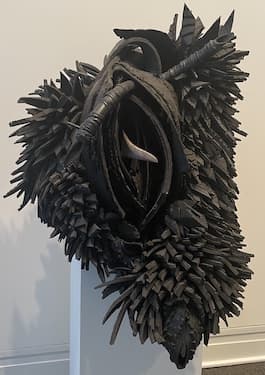
American · Arts
Chakaia Booker
1953 – present
Early life and education
Chakaia Booker was born in 1953 in Newark, New Jersey, and was raised in nearby East Orange.[2][4][7] Biographical profiles note that she learned to sew from women in her family, including her grandmother, aunt, and sister, an early skill that later informed her sculptural sensibility.[2][5][8] As a teenager, she made and altered her own clothing, developing an interest in fashion, structure, and self-presentation that would remain visible in her later work.[8][9] Her early artistic instincts were expressed not through conventional sculpture but through wearable forms and handmade garments, revealing a strong connection between craft, body, and material experimentation.[5][9]
Booker attended Rutgers University, where she earned a B.A. in sociology in 1976.[1][2][7] She later studied at the City College of New York, receiving an M.F.A. in 1993.[1][2][7] Her training in sociology is often seen as relevant to the social depth of her later art, which addresses race, labor, urban space, environmental waste, and the histories embedded in ordinary materials.[1][4][6] After college, she moved to Manhattan and participated in internships related to ceramics and basket weaving, experiences that helped sharpen her attention to form, texture, and construction.[8]
Career beginnings
Booker began her career in the 1980s by making wearable sculpture and other objects that combined found materials, textile techniques, and a strong sense of bodily presence.[5][12][13] Early works incorporated materials such as orange peels and bottle caps, and her practice initially drew from the inventive reuse of discarded items rather than from traditional sculpture media.[9] In the urban environment of New York City, she encountered the visual and material language that would define her mature work, including discarded tires and burnt rubber in the East Village.[8][11] These materials appealed to her for their accessibility, pattern, resilience, and symbolic complexity.[1][11][13]
By the early 1990s, Booker had begun integrating discarded construction materials into large outdoor sculptures.[1] Tires became her signature medium, which she cuts, twists, weaves, slices, and rivets into abstract compositions with dense surfaces and strong structural presence.[1][13] The material transformation is central to her artistic identity: what might otherwise be read as waste becomes, in her hands, a vehicle for formal invention and cultural commentary.[1][4][11] Her sculptures often evoke textiles, scarification, movement, and urban circulation while remaining fully legible as powerful abstract works.[4][6][13]
Major exhibitions and recognition
Booker received broader attention when her work was included in the 2000 Whitney Biennial, where her sculpture It’s So Hard to Be Green was shown.[1][4][6] The same year, her work also appeared in the Studio Museum in Harlem’s exhibition Passages, an institutional context that helped position her within the contemporary Black art canon.[1] In the early 2000s, she was increasingly recognized for turning recycled rubber into large-scale sculpture that could function in both gallery and outdoor settings.[1][4][11]
Her career advanced through major exhibitions and commissions. She received the Pollock-Krasner Grant in 2002 and a Guggenheim Fellowship in 2005.[1][4][12][16] In 2004, Storm King Art Center presented a solo outdoor exhibition of her work, a major milestone that underscored her ability to command large public spaces.[4] Later exhibitions at the Sam Fox School in 2010, ICA Miami in 2013, and Sarasota Art Museum in 2019 further expanded her institutional visibility.[10][14][16] Her public art project Mass Transit in Indianapolis, realized in 2018, was described as her largest outdoor urban exhibition and her first community-specific project.[10]
Booker’s art is notable for the way it joins formal abstraction to social meaning. Her tire sculptures are widely understood as reflections on environmental transformation, industrial culture, and the histories attached to Black material life in America.[4][6][11][13] The visual force of the work comes from its layered textures and rhythmic patterns, but its conceptual force lies in the act of remaking discarded material into something monumental and enduring.[1][4] Over time, her practice has been acquired by museums and included in major collections, confirming her standing as a significant contemporary sculptor.[4][14]
Awards and honors
Booker’s professional recognition includes the Pollock-Krasner Grant, the Joan Mitchell Foundation fellowship, and a Guggenheim Fellowship.[1][4][12] She has also been featured in exhibitions at important institutions such as the Whitney, the Studio Museum in Harlem, Storm King Art Center, ICA Miami, and the Sarasota Art Museum.[1][4][10][14][16] These honors reflect not only critical success but also the increasing institutional appreciation of artists working with recycled materials and socially resonant abstraction.[1][4][11]
Personal life
Available biographical sources emphasize that Booker is private about her personal life.[5] The consulted references do not document a marriage, children, or other family details beyond her upbringing and the women in her family who taught her to sew.[2][5][8] She is described as living and working in New York, with a studio practice that also extends to Allentown, Pennsylvania.[5][7][12] Her career narrative is therefore best understood through her artistic development and the public trajectory of her exhibitions rather than through a heavily documented personal biography.
Legacy and historical impact
Booker’s significance lies in her transformation of discarded tires into major contemporary sculpture. By the late twentieth century, she had established a practice that joined environmental consciousness, abstraction, and social commentary in a form that was unmistakably her own.[1][4][11][13] Her work helped expand the field of sculpture beyond traditional materials and reinforced the artistic importance of reuse, labor, and the urban environment. The fact that her sculptures can function both indoors and outdoors has made them especially adaptable to museums, sculpture parks, and civic installations.[1][4][10]
As a Black woman sculptor whose career advanced through persistence rather than through early canonization, Booker also represents an important corrective to older art-historical narratives that centered white male modernists. Her exhibitions and awards from the 2000s onward reflect a slow but meaningful shift in institutional recognition, one that acknowledged her as a leading contemporary artist rather than merely a maker of unusual materials.[1][4][12][16] Her public art, especially Mass Transit, further demonstrates how sculpture can engage community space while preserving formal complexity.[10]
Booker continues to be active in the twenty-first century, with ongoing exhibitions and inclusion in museum collections.[1][4][16] Her work remains important for its visual intensity, its engagement with waste and renewal, and its demonstration that marginalized materials can carry profound artistic and historical meaning.
Dated achievements
10 indexed.
- May052000Arts
Work Featured in "Passages" at Studio Museum in Harlem
Booker's sculpture was included in the group exhibition "Passages: A Survey of Works from the Permanent Collection" at the Studio Museum in Harlem.
View details National Museum of Women in the Arts - Chakaia Booker Documentation - May122004