← All women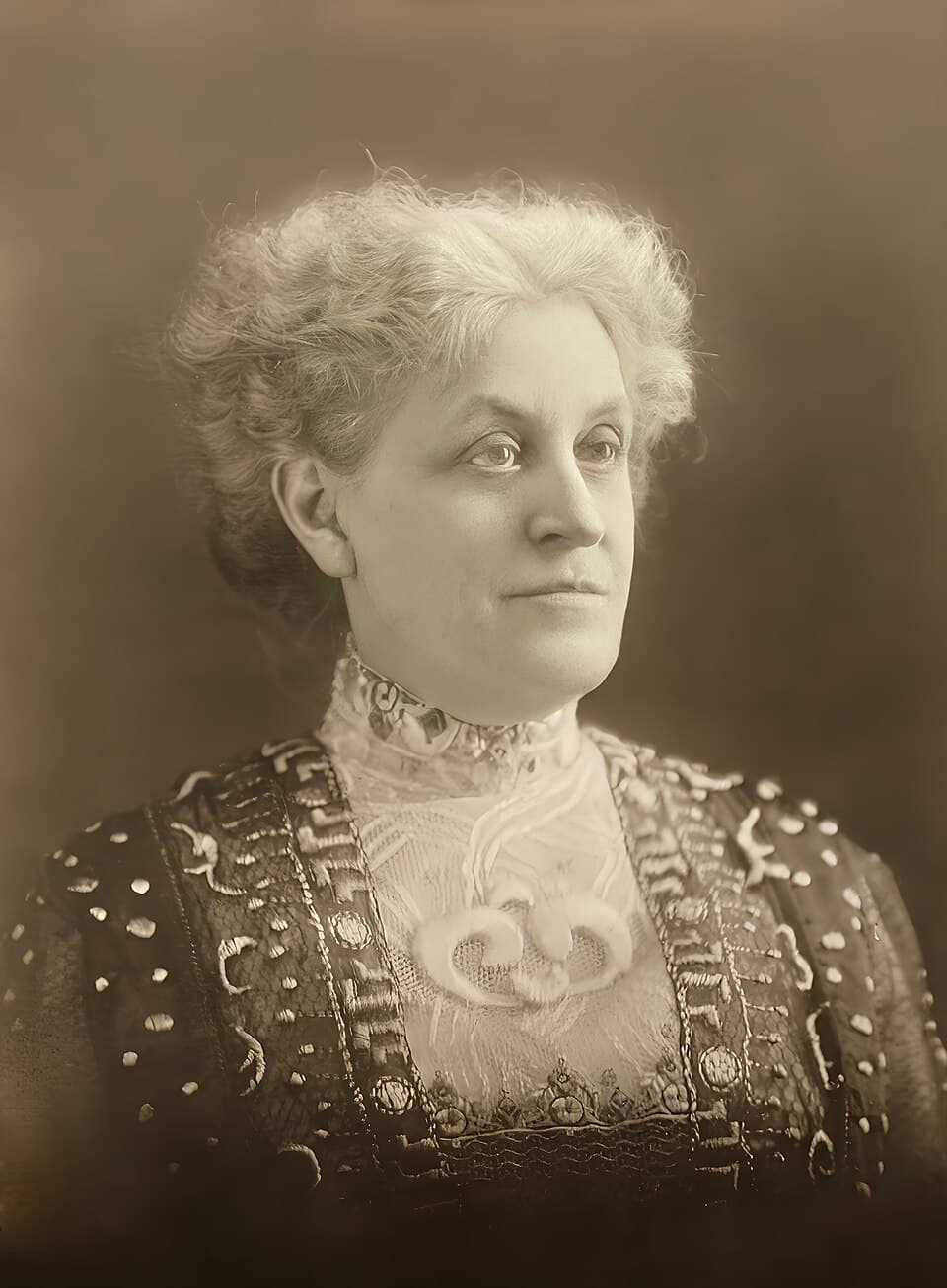
American · Politics · Activism
Carrie Chapman Catt
January 9, 1859 – March 9, 1947
Early life and family background
Carrie Chapman Catt was born Carrie Clinton Lane on January 9, 1859, in Ripon, Wisconsin, to Lucius and Maria Clinton Lane. She grew up in Iowa, in a household shaped by the values of work, discipline, and self-improvement, and she later drew on those traits in her reform career. Her childhood and youth unfolded during the years before women had secured broad access to higher education or political life, and those limits formed the backdrop against which her later accomplishments became so notable.
Catt attended Iowa State Agricultural College, graduating in 1880 as the only woman in her class. That distinction reflected both her personal determination and the constrained opportunities available to women in higher education in the late nineteenth century. Before committing herself fully to suffrage work, she taught school and held other practical jobs, experiences that sharpened her sense of organization and public responsibility. She also began to use her education in the service of her community, entering a profession in which women were still rarely given authority.
Early career and entry into public leadership
In 1883, Catt became one of the first women in the United States to be appointed a school superintendent, serving in Mason City, Iowa. Even though the available institutional source records only the year rather than the exact date, the appointment remains an important marker of her early barrier-breaking career. At a time when women were expected to remain on the margins of public administration, she moved into a role associated with authority, management, and oversight.
Her early life also included marriage to newspaper editor Leo Chapman in 1885. His death soon after their marriage left her widowed, and she later married George Catt, whose surname she retained. The newspaper world and her marital connections helped place her in contact with print culture and reform networks that would later prove important to her political work. She began to write and speak publicly on women’s issues, including suffrage, while steadily developing the administrative and rhetorical skill that made her a formidable organizer.
Rise in the woman suffrage movement
Catt’s national career in women’s rights began in 1890, when she addressed the National American Woman Suffrage Association at its convention in Washington, D.C. That appearance introduced her to the top ranks of the suffrage movement and launched her into national activism. Two years later, Susan B. Anthony asked her to speak to the United States Congress on the proposed suffrage amendment, a sign that Catt had already earned the confidence of movement leaders.
In 1900, Catt succeeded Anthony as president of the National American Woman Suffrage Association (NAWSA). Under her leadership, the organization became more disciplined, more strategic, and more effective at combining state campaigns with national pressure. She was widely recognized for a pragmatic style that contrasted with more spontaneous forms of reform politics. Catt believed that suffrage required careful organization, institutional alliances, and the steady building of public support.
Her influence soon became international as well. In 1904, she helped found the International Woman Suffrage Alliance, later known as the International Alliance of Women, linking reformers across national borders. This work reflected her belief that women’s political rights were part of a global democratic struggle, not merely a domestic American issue. Through travel, speeches, and writing, she promoted suffrage and women’s equality far beyond the United States.
The Winning Plan and the campaign for the Nineteenth Amendment
Catt returned to the presidency of NAWSA in 1915 and soon set about implementing the strategy that would become known as the Winning Plan. The plan coordinated state-level suffrage work with federal pressure, aiming to move the movement on multiple fronts at once. It was one of the most consequential organizing innovations in American reform history, because it treated suffrage as a national political campaign rather than a series of disconnected local efforts.
The Winning Plan matured during the difficult years of World War I, when suffrage activism had to compete with wartime nationalism and political resistance. Catt’s strategy helped keep the movement focused and disciplined. She and her allies worked to convince politicians that woman suffrage was no longer a fringe demand but an essential democratic reform. Her leadership contributed to the growing pressure that culminated in congressional approval and then ratification of the Nineteenth Amendment in 1920.
On August 26, 1920, the amendment was certified after Tennessee became the decisive state to ratify it. For Catt and her colleagues, this was the culmination of decades of organizing, lobbying, and coalition-building. It was a watershed in United States history, because it ended the formal exclusion of women from the vote and altered the nation’s democratic structure permanently. Catt’s strategic approach proved especially important because it had helped turn a moral cause into a constitutional reality.
On November 2, 1920, the first U.S. general election after suffrage victory took place, and millions of women voted for the first time. That moment made clear that women’s enfranchisement was not merely symbolic. It changed campaigns, parties, and civic culture by bringing women into the electorate as active participants. Catt regarded such participation as the practical reward for years of political struggle.
League of Women Voters and later activism
After the suffrage victory, Catt helped found the League of Women Voters in 1920, an organization designed to educate newly enfranchised women and help them participate effectively in civic life. The League reflected Catt’s conviction that voting rights had to be matched by political knowledge and sustained engagement. Her work after suffrage therefore focused not on retreat but on building institutions that would protect and use the new democratic opening.
Catt also continued to advocate for peace and international cooperation. Her reform vision extended beyond the ballot box to include broader social and political equality, and she remained active in women’s rights causes after the amendment’s ratification. She was respected not simply as a speaker but as an organizer who understood how institutions functioned and how public opinion could be shaped over time.
Her long career made her one of the most influential women in the history of American reform. She was often described as a key strategist, and later historians have credited her with helping to professionalize the suffrage movement. The methods she used—coalition-building, targeted messaging, legislative lobbying, and disciplined national coordination—became standard tools of modern advocacy.
Personal life
Catt’s personal life intersected with her public work in important ways. Her first marriage to Leo Chapman ended with his death, and she later married George Catt. Though she did not build her public reputation on family life, the realities of widowhood, remarriage, and financial self-support shaped her experience as a working woman in an era when many female public leaders were expected to remain dependent on male support. She also lived through the frustrations and compromises that faced women reformers who were trying to gain influence in male-dominated institutions.
Her career demanded extensive travel, public speaking, and political negotiation, all of which required resilience and emotional stamina. She balanced those demands with a personal commitment to reform that extended to peace work and international cooperation. Because of the limited surviving biographical record in many institutional summaries, the emphasis of her historical reputation rests more strongly on her public leadership than on domestic details.
Recognition and legacy
Catt was widely recognized during her lifetime as one of the most effective leaders in the suffrage movement. She was admired for her intelligence, administrative ability, and strategic patience. While formal honors varied, her greatest recognition was the success of the movement she helped lead. The passage and certification of the Nineteenth Amendment became her defining achievement, but her legacy also includes the organizational structures she helped create and the model of political activism she advanced.
Her importance endures in the institutions and traditions that followed her work. The League of Women Voters became one of the most important civic organizations in the United States, and the International Alliance of Women carried forward her global perspective on suffrage and equality. Historians continue to regard her as one of the central architects of modern women’s political power. Her career is also studied as an example of how reform movements can combine idealism with tactical discipline.
Catt died on March 9, 1947, in New Rochelle, New York. Her death marked the end of a life that had helped reshape American democracy. By the time she died, women had won the vote but still faced many forms of discrimination, so her legacy remained both triumphant and unfinished. She stands as a leading figure in the history of women’s rights, remembered for turning a long, contested struggle into a constitutional milestone.
Dated achievements
4 indexed.
- Jan091859Activism
Birth of Carrie Chapman Catt
Carrie Clinton Lane was born in Ripon, Wisconsin, on January 9, 1859.
View details National Park Service Biography of Carrie Chapman Catt - Aug261920Politics
Certification of the Nineteenth Amendment
On August 26, 1920, the Nineteenth Amendment was certified, granting women's suffrage.