← All women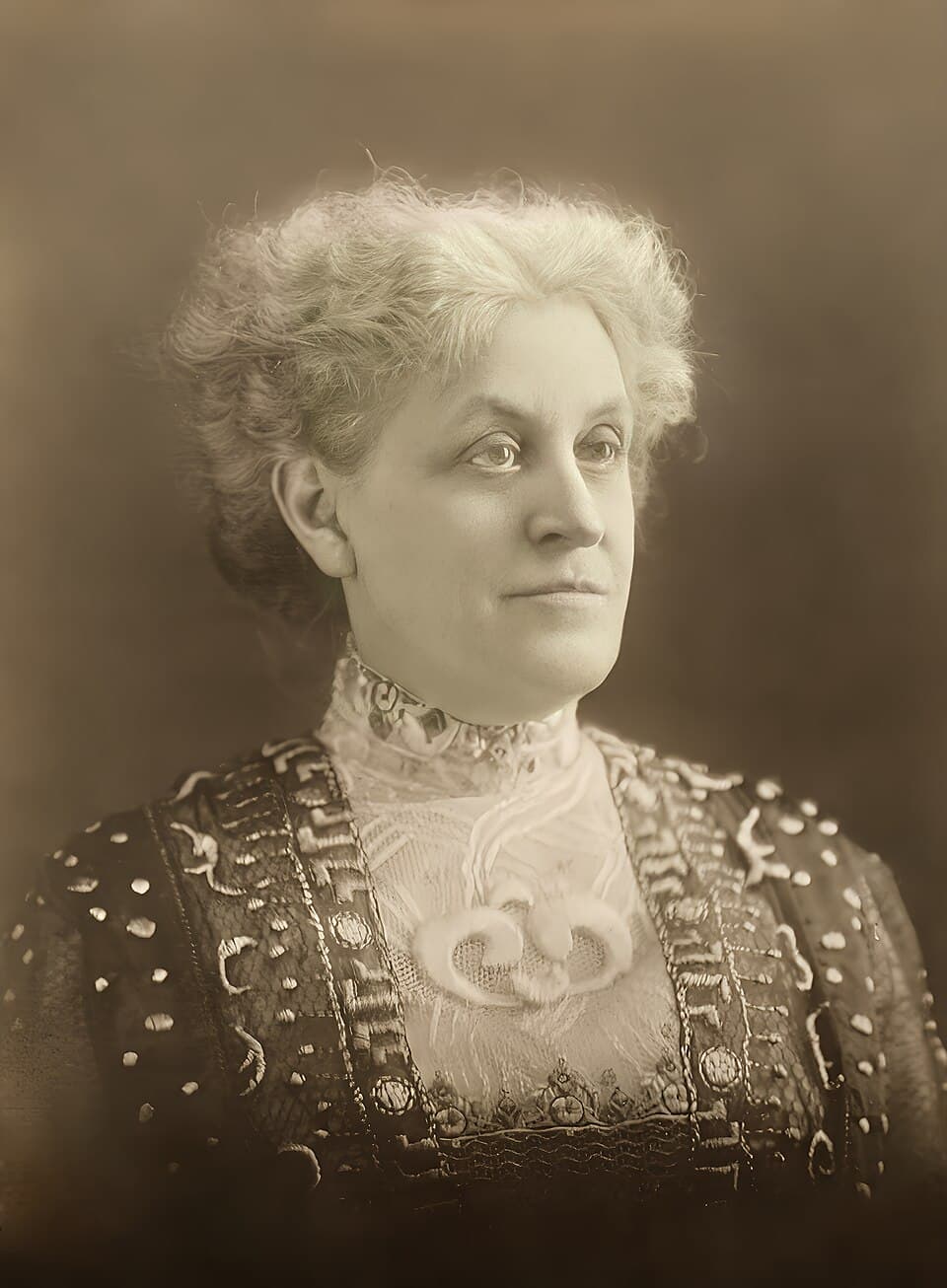
American · Activism · Politics
Carrie Catt
January 9, 1859 – March 9, 1947
Early Life and Background
Carrie Clinton Lane Chapman Catt was born on January 9, 1859, in Ripon, Wisconsin, to Lucius Lane and Maria Clinton Lane, farmers originally from New York.[1][4][11] When she was seven, the family moved to rural Iowa, where she grew up in an environment that combined frontier practicality with strong expectations for hard work and self-reliance.[1][3] This setting, in which women’s labor was indispensable yet politically unrecognized, deeply informed her later convictions about women’s rights and civic participation.[1]
Catt’s parents valued education, and she attended local schools in Iowa.[1] As a young girl she reportedly questioned why her mother could not vote when her father could, an early insight that crystallized her lifelong focus on political equality.[1][10] After high school she enrolled at the Iowa State Agricultural College (later Iowa State University) in Ames.[1][3][11] To finance her studies, she worked as a teacher, an experience that exposed her to the limitations placed on women’s professional advancement and strengthened her commitment to self-supporting independence.[1][8][11]
In 1880, Catt graduated from Iowa State Agricultural College as the only woman in her class, a distinction widely noted in later biographical accounts.[1][3][10][11] Her achievement highlighted both the barriers women faced in higher education and her determination to overcome them. During college she participated in debates and literary societies, honing the public speaking skills that would later make her one of the most effective suffrage orators in the United States.[3][11]
Career Beginnings and Development
Following graduation, Catt pursued a varied early career. She worked as a law clerk, then as a teacher, quickly rising to become a school principal and later a superintendent.[3][10][11] These positions were rare roles of authority for women at the time, and they provided her with practical experience in administration, resource management, and public oversight—all skills she would later transfer to national and international suffrage organizations.[11]
In 1885, she married Leo Chapman, a newspaper editor.[3][8][10][11] The couple lived in Mason City, Iowa, where she became co‑editor of his paper, The Republican, and wrote a regular column titled "Woman’s World" that discussed women’s issues and the suffrage question.[10][11] This journalistic work allowed her to articulate arguments for women’s political rights to a broader audience and to develop a keen sense of how public opinion could be shaped through media.[10][11]
The marriage was short-lived: in 1886, Leo Chapman died suddenly of typhoid fever while traveling in California.[3][8][11] Widowed and financially vulnerable, Catt returned to Iowa and increasingly turned her attention to organized reform work. In the same period, she joined the Iowa Woman Suffrage Association, marking her first step as a political activist.[3][8][11] She soon became a delegate to the National American Woman Suffrage Association (NAWSA), the leading national suffrage organization.[3][6]
In 1889, she married her second husband, George William Catt, a civil engineer whose income allowed her to devote more time and energy to reform work.[3][11] George Catt supported her activism, and the relative financial security of the marriage gave Carrie the freedom to travel, lecture, and take on growing responsibilities in the suffrage movement.[3][11]
Rise to National Suffrage Leadership
Catt’s rhetorical skill and organizational talent attracted national attention. In 1890, she delivered an address at NAWSA’s national convention in Washington, D.C., an appearance that marked her emergence as a national figure in the movement.[2][10] Her speech helped establish her reputation as a persuasive and disciplined strategist.
In 1892, Susan B. Anthony asked Catt to address the United States Congress on the proposed women’s suffrage amendment, a testimony that further demonstrated Anthony’s confidence in Catt as a future leader.[2][10][11] Anthony would later identify Catt as the person she wanted to succeed her as president of NAWSA.[2]
Catt increasingly took on roles as a writer, lecturer, and recruiter for the suffrage movement, traveling extensively to organize local chapters and "Political Equality Clubs" in Iowa and elsewhere.[2][8][10][11] Her work focused on building durable, disciplined organizations that could sustain long campaigns rather than relying solely on charismatic leadership or sporadic protests.[8][11]
In 1900, Anthony’s confidence was realized when Catt was elected president of NAWSA, succeeding Anthony in the role.[2][6][10][11] As president, Catt sought to broaden the movement’s appeal and modernize its tactics, integrating careful political calculation with mass organizing. She served in that position until 1904, then again from 1915 to 1920, guiding the association through the crucial years leading to the enactment of the Nineteenth Amendment.[5][6][10][11]
International Organizing and Peace Activism
Catt’s ambitions extended beyond U.S. borders. In the early 1900s, she helped organize what became the International Woman Suffrage Alliance (IWSA), later renamed the International Alliance of Women.[1][5][6][11] She played a central role in its founding in 1902–1904 and then focused her energies for several years on building suffrage movements across Europe and other regions, traveling widely to promote equal voting rights worldwide.[2][6][10][11]
Through the IWSA, Catt collaborated with suffragists from Britain, Scandinavia, and continental Europe, encouraging transnational exchanges of strategy and rhetoric.[6][11] Her international work reinforced her belief that women’s political rights were part of a global democratic transformation rather than a solely national issue.
Catt also emerged as an advocate for international peace. She supported efforts to resolve conflicts without war and connected women’s political empowerment to the possibility of more peaceful governance.[1][11] Her peace activism intensified during and after the First World War, when she argued that women’s exclusion from decision-making contributed to militarism and unchecked nationalism.[1][6][11]
The “Winning Plan” and the Nineteenth Amendment
When Catt returned to the United States and resumed the NAWSA presidency in 1915, the suffrage movement was at a critical juncture.[6][10][11] Several states, particularly in the West, had already granted women the right to vote, but national progress was uneven, and a federal constitutional amendment remained elusive.[6][11]
Catt responded by designing a comprehensive strategy known as the “Winning Plan”.[6][10][11] This plan coordinated state‑level campaigns for suffrage with a renewed push for a federal amendment. It called on NAWSA affiliates to pursue state reforms where possible while simultaneously lobbying Congress and the president for nationwide change.[6][11] The plan aimed to maintain momentum, build pressure across multiple fronts, and prevent fragmentation within the movement.
During 1919–1920, Catt led NAWSA in a sustained national campaign to secure ratification of the proposed Nineteenth Amendment.[1][2][10][11] She and her allies organized massive letter‑writing drives, legislative lobbying efforts, and political negotiations to win over skeptical lawmakers. Her work included personally seeking support from President Woodrow Wilson, whose eventual endorsement of the amendment was partly attributed to her relentless campaigning.[2][3]
The Nineteenth Amendment, guaranteeing that the right to vote could not be denied on the basis of sex, was finally ratified when Tennessee became the crucial thirty‑sixth state to approve it. Contemporary accounts describe August 26, 1920—the date the amendment was officially certified—as Catt’s "greatest achievement," marking the culmination of three decades of her suffrage organizing.[7][10] Although the sources consulted do not all give the certification date with equal detail, they consistently highlight her pivotal role in achieving this milestone.[1][7][10][11]
Historians recognize Catt as one of the ablest leaders and organizers of the woman suffrage movement, crediting her "Winning Plan" and disciplined national strategy with revitalizing a faltering NAWSA and securing the federal vote for women.[6][11]
Founding the League of Women Voters and Later Public Work
With suffrage secured, Catt turned her focus to ensuring that women could effectively use their new political power. In 1920, she helped found the League of Women Voters (LWV) to educate newly enfranchised women and encourage informed participation in elections.[1][5][9][10][11] The League promoted nonpartisan voter education, studied public policy, and encouraged women to see voting not as the endpoint of activism but as a continuing civic responsibility.[1][10]
Under Catt’s influence, the LWV became a national institution devoted to improving democracy through women’s engagement.[1][9][11] It organized study groups, published informational materials, and advocated for reforms such as child welfare protections, improved public health measures, and fair election practices. Catt’s leadership ensured that the League remained officially nonpartisan, focusing on issues rather than party loyalty.[1][10]
Catt continued to support international women’s organizations and peace work, maintaining ties with the International Alliance of Women and other transnational networks.[1][6][11] She wrote, lectured, and advised younger activists, positioning herself as an elder stateswoman of the movement while resisting efforts to reduce women’s political engagement to mere symbolic participation.
Awards, Honors, and Recognition
Throughout her life, Catt received significant recognition for her activism, though many honors were bestowed informally rather than through official medals or titles. She was widely described as "the brains of the woman’s suffrage movement," a phrase used by later commentators to capture her reputation for strategic brilliance.[7][10]
Biographers and reference works consistently identify her as a key architect of the Nineteenth Amendment and one of the most effective organizers in U.S. social reform history.[1][6][11] Educational and historical institutions—including the National Woman’s History Museum, the National Park Service, and state historical societies—feature her prominently in exhibits and online biographies.[1][2][4][6][8][9][10][11]
Although she lived before the era of many modern awards, her legacy is preserved through commemorative markers, museum displays, and institutional tributes. For example, the Women’s Rights National Historical Park and other historical programs highlight her contributions to suffrage and peace activism.[2][4][12]
Personal Life
Catt’s personal life was closely intertwined with her activism. Her first marriage to Leo Chapman introduced her to the world of journalism and political commentary through their newspaper work in Mason City, Iowa.[3][8][10][11] His death in 1886 left her widowed and contributed to her resolve to be self-supporting and to pursue public work rather than rely on traditional domestic roles.[3][11]
Her second marriage to George William Catt in 1889 provided emotional support and financial stability.[3][11] George Catt’s engineering career funded much of Carrie’s suffrage work, enabling her to travel widely and devote herself full-time to organizing. She did not have children, a factor that may have allowed her greater flexibility in a period when motherhood often constrained women’s public activities.[11]
Catt’s home life was described as supportive of her career, with George encouraging her leadership and sharing her belief in women’s political equality.[3][11] After his death (which occurred before her final years of activism), she continued to live independently and maintained an active schedule of travel, writing, and organizational work.[11]
Legacy and Historical Impact
Carrie Chapman Catt is widely regarded as one of the most important leaders of the American woman suffrage movement and a major figure in international feminism and peace activism. Her strategic innovations fundamentally reshaped how reform movements approached political change.[1][6][11]
The "Winning Plan", which coordinated state and federal campaigns, has been studied as a classic example of multi‑level political strategy.[6][11] By insisting on disciplined organization, detailed record‑keeping, and careful lobbying, Catt moved NAWSA away from purely moral appeals and toward a sophisticated engagement with party politics and legislative processes.[6][10][11]
Her founding of the League of Women Voters ensured that the suffrage victory did not remain a static achievement. Instead, it became the basis for an ongoing project of civic education and democratic reform that continues into the twenty‑first century.[1][5][9][10][11] The LWV’s enduring presence in American public life—conducting candidate forums, publishing voter guides, and advocating for fair elections—stands as a direct extension of Catt’s vision.
Internationally, Catt helped transform women’s suffrage from a series of national campaigns into a global movement. Through the International Woman Suffrage Alliance, she fostered connections among activists across continents and emphasized the universality of women’s claims to political equality.[1][5][6][11] Her peace activism also contributed to early efforts to link women’s rights with international governance and conflict prevention.[1][11]
Modern historians note both the strengths and limitations of her approach. While she was extraordinarily effective at mobilizing largely white, middle‑class women and navigating mainstream political institutions, the movement she led did not always center the experiences or rights of women of color, working‑class women, or immigrants.[1][11] These critiques form part of contemporary reassessments of the suffrage movement and underscore the complexity of Catt’s legacy.
Later Life and Death
After the ratification of the Nineteenth Amendment and the establishment of the League of Women Voters, Catt gradually reduced her day‑to‑day leadership responsibilities but remained engaged in public affairs.[1][10][11] She continued to write, advise suffrage and peace organizations, and speak on issues of democracy and international cooperation.
In her later years, Catt lived in New Rochelle, New York, from where she maintained correspondence with activists and monitored developments in women’s rights and world politics.[4][11] Biographical accounts state that she retired there and remained a respected elder of the movement, occasionally honored at events and consulted by younger leaders.[11]
Catt died on March 9, 1947, in New Rochelle, of heart failure following a gallstone operation.[4][5][11] She was 88 years old.[11] Her death marked the passing of a generation of suffrage leaders who had carried the movement from the era of Reconstruction through the upheavals of World War I and into the modern democratic age.
By the time of her death, the world had changed dramatically: women had gained voting rights in many countries, international organizations were beginning to codify human rights standards, and civic associations like the League of Women Voters were established parts of democratic societies. In this transformed landscape, Cariie Chapman Catt’s life work stood as a central thread in the broader story of women’s political emancipation.[1][5][6][11]
Her legacy endures in scholarly works, public memorials, and institutional histories that continue to recognize her as a masterful political strategist, suffragist, and peace advocate whose efforts permanently expanded the boundaries of democratic participation.[1][2][4][6][8][9][10][11]
Dated achievements
2 indexed.
- Jan091859Activism
Birth of Carrie Chapman Catt in Ripon, Wisconsin
Carrie Clinton Lane was born in Ripon, Wisconsin, on January 9, 1859, later becoming one of America's foremost suffrage leaders.
View details Carrie Chapman Catt - Wikipedia - Mar091947Activism
Death of Carrie Chapman Catt in New Rochelle, New York
Carrie Chapman Catt died on March 9, 1947, in New Rochelle, New York, at age 88, having lived to see women vote for nearly three decades.