← All women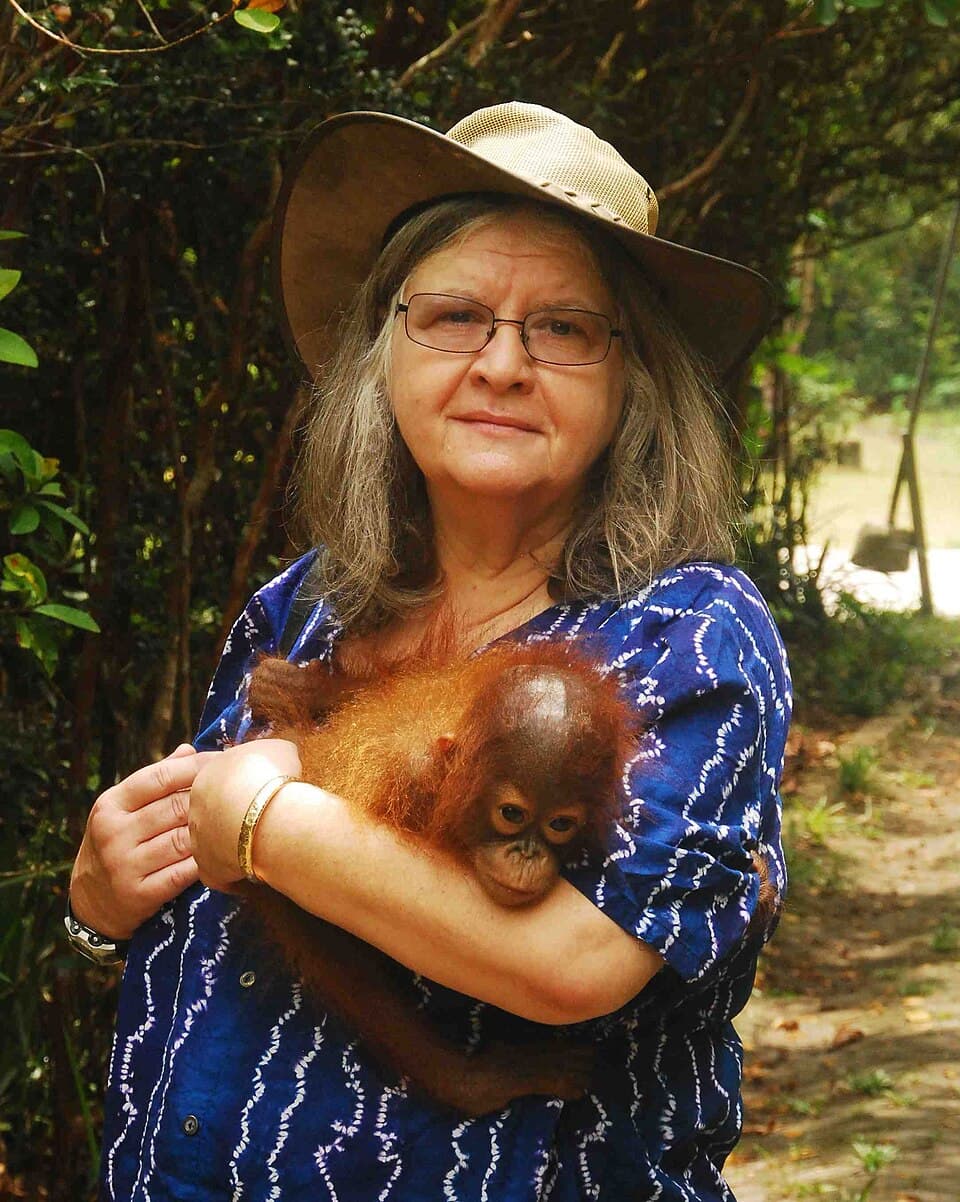
Lithuanian, Canadian · Science · Activism · Exploration
Birutė Galdikas
May 10, 1946 – March 24, 2026
Early life and background
Birutė Marija Filomena Galdikas was born on 10 May 1946 in Wiesbaden, Germany, to Lithuanian parents who had been displaced by the upheavals of World War II. Her family later moved to Canada, where she spent much of her childhood before eventually settling in the United States. Biographical sources describe her upbringing as one shaped by migration, resilience, and the experience of a family carrying Lithuanian identity across borders. Those early circumstances mattered, because Galdikas would later become a scientist whose life and work were defined by crossing boundaries—geographic, disciplinary, and institutional—in the pursuit of long-term field research.
Galdikas developed an early fascination with animals and exploration. By the time she reached university age, she had already formed an ambition to study primates in the wild, a goal that was unusual for the era and especially ambitious for a woman entering anthropology and field biology in the 1960s. She studied anthropology at the University of California, Los Angeles, where she earned graduate training that positioned her for fieldwork in primatology. Her later academic career included advanced research degrees and a professorial role at Simon Fraser University in Canada.
Her intellectual formation coincided with the rise of modern primatology as a field and with the influence of Louis Leakey, whose support was crucial in sending a generation of young women scientists into long-term studies of great apes. Galdikas became one of the best-known of those women, along with Jane Goodall and Dian Fossey. In that historical context, her emergence as a scientist was significant not merely because of the topic she chose, but because she entered a field still dominated by men and pursued a remote, physically demanding research agenda that many contemporaries considered impractical.
Career beginnings and the move to Borneo
Galdikas’s defining career breakthrough came in September 1971, when she departed for Indonesia to begin field research on orangutans. The month is documented in institutional histories of her work, and it marked the start of the project that would become the longest continuous study of any wild orangutan population in the history of science. The research took place in Indonesian Borneo, where she worked in and around Tanjung Puting, ultimately establishing what became known as Camp Leakey as a field base.
That decision was both scientific and personal. Orangutans were then poorly known compared with chimpanzees and gorillas, and the forests in which they lived were difficult to access, hot, wet, and ecologically complex. Galdikas spent years learning the behavior of a species whose arboreal habits, slow life history, and elusive nature made observation exceptionally difficult. Her fieldwork required not only scientific persistence but also survival skills, adaptability, and tolerance for isolation. In the early years, she encountered logistical obstacles that would have deterred many researchers: primitive infrastructure, tropical disease, and the sheer difficulty of observing wild orangutans for long enough to build reliable data sets.
Her work quickly moved beyond simple observation. Over time, she documented orangutan diet, ranging behavior, social patterns, development, and reproduction. She and her colleagues helped show that orangutans had a more complex ecology and longer developmental cycle than had previously been recognized. Later public summaries of her findings note that she documented long orangutan birth intervals and recorded hundreds of foods consumed by orangutans, evidence that dramatically deepened scientific understanding of the species. This combination of ecological and behavioral research made her field program foundational for orangutan biology.
Major accomplishments in primatology and conservation
Galdikas became internationally recognized as the world’s foremost authority on orangutans. Britannica describes her work as the longest-running longitudinal study by one principal investigator of any wild mammal, a distinction that reflects the extraordinary duration and consistency of her research program. That longevity is historically important because great ape populations change slowly; understanding them requires multi-decade observation across generations. Galdikas’s work therefore helped establish the importance of long-term field science for conservation biology.
In addition to documenting orangutan behavior, she became a leading conservation advocate. Her research revealed the vulnerability of wild orangutan populations to habitat destruction, capture, and trade. As forests in Borneo came under increasing pressure from logging, conversion, and development, her science took on an urgent protective dimension. The practical result was a career that fused research with intervention: rescue, rehabilitation, release, and habitat protection. The orangutan became not only an object of study but a conservation cause.
In 1986, Galdikas founded Orangutan Foundation International in Los Angeles to support her research and conservation work. The foundation became a central institutional vehicle for orangutan protection, helping finance field studies, rehabilitation, and environmental education. Her later public role as president and co-founder of OFI reinforced her reputation as both scientist and advocate. Through OFI, her work moved from a single field site to a broader international conservation network.
Her career also included a variety of academic and public-facing roles. She served as a professor at Simon Fraser University, where she was associated with research on primate behavior, ecology, evolution, and tropical rainforest conservation. Those responsibilities helped make her one of the rare scientists whose influence extended across fieldwork, university teaching, conservation policy, and public communication.
Awards, recognition, and public honors
Galdikas received substantial recognition over the course of her career. In 1983, she was awarded a Guggenheim Fellowship, a significant acknowledgment of her scholarly work. Such fellowships are important in academic history because they support sustained research and confer prestige on projects judged to have exceptional promise or achievement.
Her reputation broadened in the 1990s as the global conservation movement expanded and concern over orangutan habitat loss became more widely visible. She was reported to have received multiple honors for orangutan conservation and environmental protection during that decade. In 1997, she received the Tyler Prize for Environmental Achievement, one of the major international awards in environmental science and conservation. That recognition signaled the significance of her work beyond primatology alone: her field research had become a model for understanding how species survival depends on habitat, policy, and long-term stewardship.
Her public status was also strengthened by media coverage. She appeared in documentaries and institutional presentations and was frequently profiled as one of the great women field scientists of the twentieth century. As the third of the celebrated trio often called the Trimates, she occupied a place in the popular memory of women in science alongside Jane Goodall and Dian Fossey. That association mattered historically because it helped normalize the image of women as principal investigators in remote wildlife research, not merely assistants or lab-based scholars.
Personal life
Available biographical sources emphasize Galdikas’s professional life more than her private one. She was married to Rod Brindamour, and some sources use the compound surname Galdikas-Brindamour. Her personal life is otherwise less thoroughly documented in the provided sources than her scientific and conservation work. This relative scarcity of biographical detail is not unusual for major field scientists whose reputations were built largely through long immersion in research settings far from institutional centers.
Her daily life in Borneo was shaped by the demands of field science. Rather than a conventional academic career centered on laboratories or lecture halls, she spent years in rainforest conditions, often living close to the orangutans she studied. That choice had personal as well as professional consequences, requiring extraordinary endurance and a willingness to build a life around conservation work. She became known for committing to a subject and habitat that demanded patience, resilience, and repeated return to the field over decades.
Later life, death, and legacy
By the later decades of her life, Galdikas had become a central figure in the history of primatology and wildlife conservation. She continued to be associated with Orangutan Foundation International and with the long-running research and protection effort in Indonesian Borneo. She remained widely identified as the foremost living authority on orangutans until her death.
She died on 24 March 2026 in Los Angeles, reportedly from lung cancer. News of her death prompted reflections on the breadth of her influence: the scientific understanding of orangutan ecology, the institutional development of orangutan rescue and rehabilitation, and the broader place of women in field science. Her death also underscored the historical importance of the long-term research tradition she helped establish. In conservation terms, she represented a generation of scientists who combined observation with action and whose work became inseparable from the species they sought to protect.
Galdikas’s legacy is both scientific and cultural. Scientifically, she left an incomparable long-term record of orangutan life in the wild and helped define what sustained primate fieldwork could accomplish. Culturally, she became an emblem of women’s achievement in exploration and environmental science. Her career showed that rigorous observation, institutional persistence, and conservation advocacy could be combined in one life’s work. For women’s history, she stands as an important example of a scholar who overcame the expectations and barriers of her era to become a global authority in a field once regarded as inaccessible to women.
Dated achievements
3 indexed.
- May101946Science
Born in Wiesbaden, Germany
Birth of Birutė Mary Galdikas in Wiesbaden, Germany, to Lithuanian parents.
View details Britannica: Birute Galdikas - Sep011971Science
Began long-term orangutan field study in Indonesia
Began orangutan fieldwork in Indonesia, launching the longest continuous study of wild orangutans.