← All women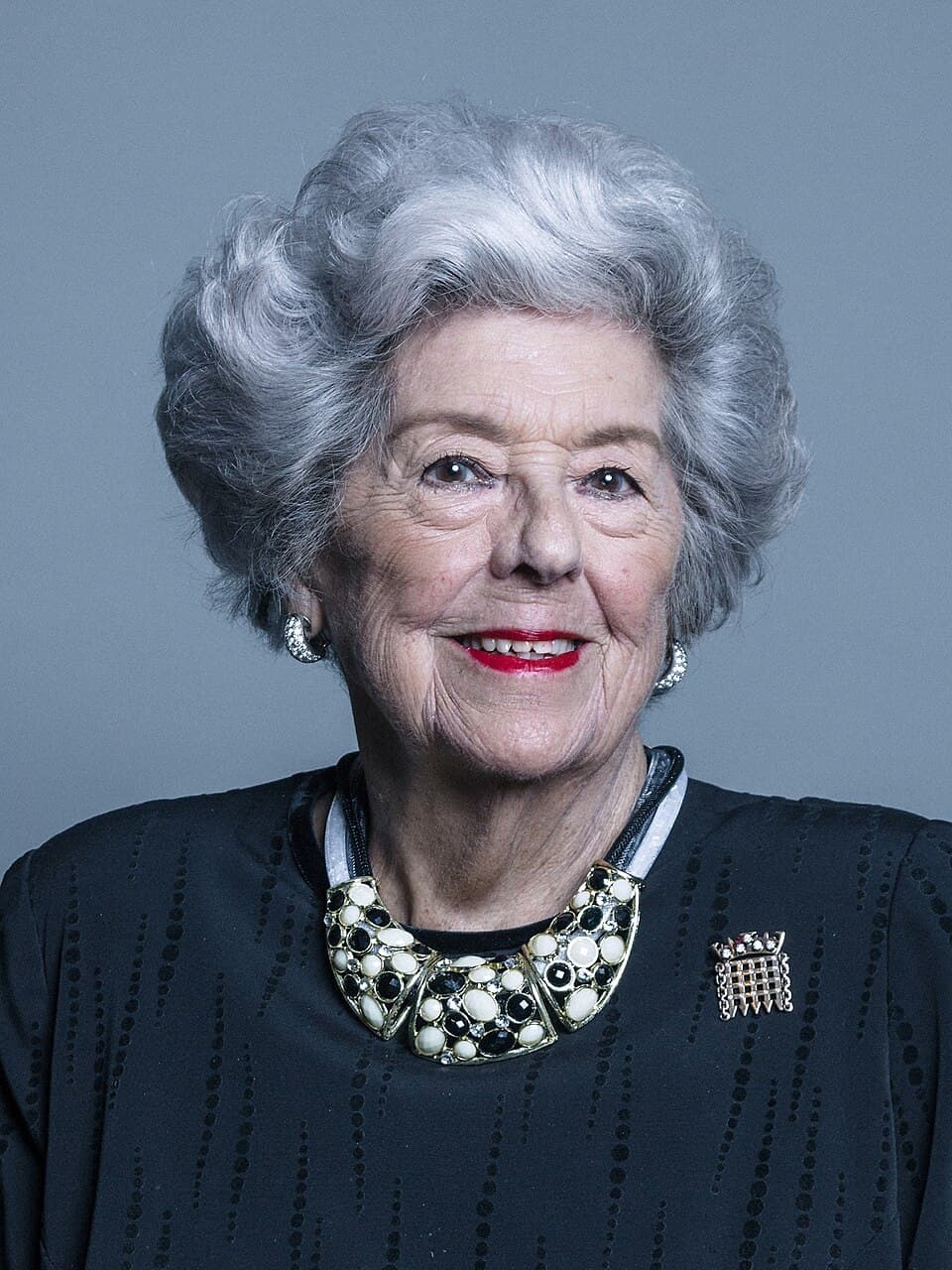
British · Politics
Betty Boothroyd
October 8, 1929 – February 26, 2023
Early Life and Background
Betty Boothroyd was born on 8 October 1929 in Dewsbury, West Riding of Yorkshire, England, a textile mill town whose industrial character shaped her formative years. She was the only child of textile workers and trade‑union activists, variously recorded as Ben or Archibald Boothroyd and his wife Mary.[1][2][3][11][16] Growing up in a working‑class household during the interwar period, she witnessed first‑hand the economic insecurity of industrial Britain and the importance of collective organisation in the mills.
Her parents’ union involvement and her mother’s activity in the women’s section of the Labour Party introduced Boothroyd early to political ideas and the value of civic engagement.[11][18] She attended local council schools and then studied at Dewsbury College of Commerce and Art, where she acquired secretarial and commercial skills that would later prove crucial in her parliamentary career.[1][9][11] These experiences grounded her in the culture of the labour movement and gave her both the confidence and the technical abilities to navigate political institutions that remained heavily male‑dominated.
Early Career and Entry into Politics
In the 1940s, Boothroyd pursued a brief but formative career in entertainment, touring with the renowned dance troupe The Tiller Girls.[4][15] This period developed her stage presence, resilience, and ability to project authority—skills that would later serve her well in the House of Commons. By the early 1950s, however, she turned decisively toward politics, having been a member of the Labour Party since her teens.[11][15]
Boothroyd moved to London and began working in the House of Commons as a secretary and political assistant to Labour MPs, including senior figures such as Barbara Castle.[11][15] This behind‑the‑scenes work immersed her in parliamentary procedure, constituency casework, and the day‑to‑day demands of the Commons. During the 1950s she made her first attempts to enter Parliament as an MP, contesting the marginal seat of Leicester South East in 1957 and Peterborough in 1959, but without success.[11][15] These defeats, in a period when very few women were selected or elected, underscored the structural barriers she faced, yet they did not deter her ambitions.
Boothroyd’s international experience further broadened her political horizons. In the early 1960s she spent time in the United States, where she worked as a legislative assistant to Representative Silvio O. Conte and engaged with American congressional politics.[1][4][11] She also participated in campaigning activities during the period of John F. Kennedy’s ascent, observing at close quarters a different model of legislative practice and political communication.[15] This exposure to another democratic system enriched her understanding of how parliaments function and how representatives interact with the public.
Upon returning to Britain, she deepened her involvement in local government. In 1965 she was elected to Hammersmith Borough Council, serving until 1968.[11] She also continued to contest parliamentary seats, including Nelson and Colne in 1968 and Rossendale in 1970, reflecting her persistent determination to secure a place in the House of Commons despite repeated setbacks.[11][15]
Labour Party Organiser and Parliamentary Breakthrough
By 1960 Boothroyd had become a full‑time organiser for the Labour Party, signalling her transition from support roles to strategic positions in party organisation.[1] Her work involved coordinating campaigns, supporting MPs, and helping to build Labour’s presence in constituencies, tasks that required both political acumen and logistical skill.
Her long‑sought breakthrough came in 1973, when she was elected Labour MP for West Bromwich in a by‑election.[1][11][12] The seat later became West Bromwich West, which she would represent until 2000.[1][6][7] Her victory was significant: at that time, women comprised only a small minority of MPs, and her election placed a working‑class woman with strong trade‑union roots into the national legislature.
Shortly after entering Parliament, Boothroyd expanded her role to the European stage. From 1973 to 1979, she served as a Member of the European Parliament (MEP), during the early years of British representation in European institutions.[1][12] This dual engagement—in Westminster and Strasbourg—gave her insight into evolving structures of European governance and the interplay between national and supranational politics.
Rise through Parliamentary Ranks
Within the House of Commons, Boothroyd steadily built a reputation as a diligent, independent‑minded MP. She served on various committees and became known for her interest in parliamentary procedure and the rights of backbenchers. Her skills and temperament made her well suited to presiding roles.
In 1987, she achieved a major step when she was elected Deputy Speaker of the House of Commons.[1][4] In this capacity she regularly chaired debates and oversaw question time, developing the commanding style and procedural expertise that would later define her speakership. At a time when women rarely occupied such central positions in parliamentary management, Boothroyd’s appointment marked a significant advance in women’s visibility in the running of the Commons.
Election as Speaker and Historic Firsts
Boothroyd’s career reached its high point in April 1992 following the general election that returned John Major’s Conservative government. On 27 April 1992, the House of Commons elected her Speaker, in succession to Bernard Weatherill, after a contested vote against Conservative MP Peter Brooke.[1][4][13] She thereby became the first woman Speaker of the House of Commons in its more than 700‑year history.[1][2][4][6][7][10][12][13]
Her election also carried other institutional firsts. She was the first Speaker in the 20th century to be chosen from an opposition party, a Labour MP selected under a Conservative government, reinforcing the principle that the Speakership transcends party lines.[4][17] Furthermore, she was the first Speaker appointed after the introduction of permanent television coverage of Commons debates in 1989, making the office far more visible to the public and turning her into a widely recognised figure across the country.[14][18]
Boothroyd’s election was greeted with cheering from MPs and quickly characterised as a moment that "overturned more than 700 years of parliamentary tradition."[13][18] Commentators and later historians described her as having "shattered the glass ceiling" in one of Britain’s most tradition‑bound institutions.[10][13][18] She remained, for many years, the only woman to have occupied the Speaker’s Chair, underlining the enduring significance of her achievement.[1][6][7][10]
Tenure as Speaker (1992–2000)
Boothroyd served as Speaker from 1992 to 2000, presiding over a turbulent and transformative period in British politics.[1][2][6][7] Her tenure spanned debates over Europe, constitutional reforms, and changes in party leadership, including John Major’s premiership and the landslide election of Tony Blair’s New Labour government in 1997.
She quickly became renowned for her firm but fair style. Boothroyd was a strict disciplinarian, unafraid to rebuke unruly MPs, but she combined this with warmth and humour that earned her broad respect. She insisted on clear, audible debate and was known for colourful admonitions that played well on television, helping to humanise the often obscure procedures of the Commons.
Symbolically, Boothroyd modernised the image of the Speakership by declining to wear the traditional wig, while retaining the gown and upholding the dignity of the office.[1] This decision reflected both a respect for tradition and a willingness to adapt it, reinforcing the idea that institutional authority need not be tied to antiquated symbols.
Substantively, she championed the rights of backbench MPs, endeavoured to make question time more effective, and worked to keep debates orderly yet inclusive. Observers credited her with maintaining the independence of the chair and navigating partisan tensions without favour. Through televised sessions, Boothroyd became a familiar presence in British households, arguably the first Speaker to attain a kind of public "cult" status via broadcast media.[14]
Retirement from the Commons and Life Peerage
In 2000, Boothroyd chose to retire as Speaker, bringing to a close eight years in the chair and nearly three decades as an MP for West Bromwich West.[1][2][6][7][12] Her departure was marked by tributes from all sides of the House, reflecting widespread recognition of her impartiality and skill.
The following year, in 2001, she was created a life peer as Baroness Boothroyd of Sandwell, in the West Midlands, and took her seat in the House of Lords.[1][12][18] By convention, former Speakers sit as Crossbench peers, and Boothroyd followed this tradition, continuing her parliamentary service in a non‑partisan capacity.[7][12] In the Lords she contributed to debates on constitutional issues and democratic participation, bringing her long experience of the Commons to scrutiny of legislation.
Major Works, Autobiography, and Public Engagement
Beyond her parliamentary duties, Boothroyd sought to share her experiences and perspectives with a wider audience. She published a memoir, "Betty Boothroyd: The Autobiography", which recounts her journey from a Yorkshire mill town and dancing with the Tiller Girls to the Speakership and the Lords.[5][19] The book offers insights into the personal sacrifices, political battles, and institutional quirks that accompanied her rise.
Boothroyd was frequently invited to speak at universities, civic organisations, and media outlets about democracy, parliamentary traditions, and women’s participation in politics. Institutions such as the Open University and Cambridge’s Newnham College highlighted her career as exemplary of social mobility and women’s advancement in public life.[11][10] She supported educational and civic initiatives aimed at making parliamentary processes more accessible and encouraging citizens—especially young women—to engage with politics.
Awards, Honours, and Recognition
Over the course of her career, Boothroyd received numerous honours. She was appointed to the Privy Council and later to the Order of Merit (OM), one of the United Kingdom’s most distinguished honours, recognising her exceptional service.[1][7][15] She also held the post‑nominal letters PC for Privy Councillor, underscoring her constitutional standing.
Universities and civic bodies awarded her honorary degrees and freedoms, acknowledging both her parliamentary achievements and her role as a trailblazer for women. Media coverage and obituaries consistently described her as a "formidable parliamentarian" and a "cult figure" of televised politics, reflecting the breadth of her public recognition.[13][14][16]
Personal Life
Boothroyd’s personal life was notable for its independence. Biographical sources emphasise that she never married and had no children, devoting much of her time and energy to her political career.[15] In interviews and her autobiography, she portrayed this as a conscious choice that allowed her to meet the intense demands of parliamentary work and the Speakership.
Her early years as a dancer and later as a political assistant in London contributed to a cosmopolitan outlook and a strong sense of self‑reliance. Friends and colleagues often described her as warm, witty, and hospitable, with a strong Yorkshire identity that she retained throughout her life. Despite her national prominence, she remained closely connected to her roots, regularly acknowledging the influence of her parents and the mill town culture of Dewsbury on her values.
Legacy and Historical Impact
Betty Boothroyd’s legacy in women’s and parliamentary history is profound. As the first woman Speaker of the House of Commons, she broke a barrier that had stood for centuries, demonstrating that women could preside over one of the world’s oldest representative assemblies with authority and distinction.[1][2][4][6][7][10][12][13] Her election from the opposition benches reinforced the independence of the Speakership, while her tenure during the era of televised debates helped to modernise the public image of Parliament.[14][17][18]
For women in politics, Boothroyd became a powerful symbol of what was possible. Her rise from a working‑class background, with no university education and early work as a dancer, challenged assumptions about the social and educational profiles expected of high‑ranking politicians. She showed that procedural mastery, fairness, and personal charisma could outweigh traditional markers of status.
Her speakership also contributed to a broader reconfiguration of parliamentary culture. By insisting on clear, orderly debate and by championing backbench rights, she helped to preserve the Commons as a forum in which diverse voices—including those of women and minority MPs—could be heard. Her refusal to wear the wig, combined with respect for the gown and rituals of the chamber, symbolised a balance between tradition and adaptation that has influenced subsequent Speakers.
Commentaries from institutions such as the History of Parliament Trust and media outlets have positioned Boothroyd as a landmark figure in the evolution of British democracy. She is frequently cited in studies of gender and politics as an example of a woman who, once inside the system, used a constitutional office to reshape perceptions of women’s leadership.[4][13][17][18]
Later Life and Death
In her later years, Boothroyd remained active in the House of Lords and public life, speaking on issues of constitutional reform, civic education, and democratic participation. She continued to be a respected voice on parliamentary matters and was often called upon to comment on contemporary political developments.
On 26 February 2023, Boothroyd died in a hospital in Cambridge, Cambridgeshire, at the age of 93.[1][2][6][7][16] The announcement of her death prompted widespread tributes. The Speaker of the House of Commons, Sir Lindsay Hoyle, described her as a "sharp and witty" guardian of the House, while politicians from across parties reflected on her fairness, strength of character, and encouragement of women in politics.[6][9]
Her funeral was held on 30 March 2023 at St George’s Church in Hepworth, near Huddersfield, West Yorkshire, close to the region of her birth.[18] The service brought together family, friends, and political colleagues, symbolically returning a national figure to her Yorkshire roots. Media coverage of the funeral reiterated her status as a pioneering woman who had left an indelible mark on British parliamentary life.
By the time of her death, Boothroyd stood in historical memory not only as Britain’s first female Speaker of the House of Commons but also as a vivid embodiment of social mobility, democratic commitment, and institutional modernisation. Her life narrative—from Dewsbury mill worker’s daughter to Baroness Boothroyd of Sandwell—continues to serve as an inspiring case study in the transformation of gender roles and class boundaries within British politics.
Dated achievements
7 indexed.
- Oct081929Politics
Birth of Betty Boothroyd
Betty Boothroyd was born in Dewsbury, West Riding of Yorkshire, England.
View details Wikipedia - Apr271992Politics
Elected first female Speaker of the House of Commons
First woman Speaker of the House of Commons, breaking 700 years of tradition.
View details