← All women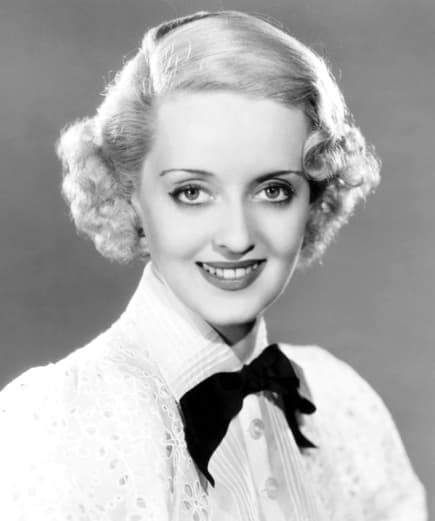
American · Arts
Bette Davis
April 5, 1908 – October 6, 1989
Early Life and Background
Bette Davis was born Ruth Elizabeth Davis on 5 April 1908, in Lowell, Massachusetts, United States.[1][3][5] Her father, Harlow Morrell Davis, was a patent attorney, and her mother, Ruth Augusta (Favor) Davis, had artistic inclinations and later worked in photography and portrait studios to support the family.[2][5][12] Davis’s parents had a troubled marriage, and they separated when she was a child; she, her mother, and younger sister Barbara eventually moved to New York State and then to New York City, where financial insecurity was a constant reality.[3][5][12]
Davis attended several schools, including Cushing Academy, a boarding school in Ashburnham, Massachusetts, where she became deeply involved in drama and school theatricals.[5][12] A pivotal moment occurred when she performed in a school play and realized that acting could be a vocation rather than merely an extracurricular interest.[12] Her fascination with the stage grew as she watched professional productions and devoured plays. She adopted the name "Bette" (with the French spelling) from the title character of Honoré de Balzac’s novel La Cousine Bette, an early sign of her deliberate construction of a distinct artistic identity.[1][12]
After graduating from Cushing Academy, Davis persuaded her mother to allow her to pursue professional acting. Ruth Augusta relocated with both daughters to New York City to facilitate Bette’s career ambitions, a move that underscored the mother-daughter alliance that would remain one of the central relationships in Davis’s life.[5][12]
Stage Training and Career Beginnings
Determined to obtain serious theatrical training, Davis enrolled at the John Murray Anderson/Robert Milton School of Theater and Dance in New York, where she studied acting alongside future film star Lucille Ball.[1][12] Her early professional work came in stock theater companies. In 1929 she joined director George Cukor’s stock company in Rochester, New York, where she honed her craft in a variety of roles, learning to project a strong stage presence and to avoid sentimentality—traits that would define her later screen persona.[8][12]
Davis made her Broadway debut in 1929 in the play Broken Dishes, followed by a role in Solid South (1930).[1][5][12] Although neither show was a major hit, her performances attracted attention from talent scouts. Her unconventional looks—large, expressive eyes, prominent jaw, and intense gaze—initially made producers uncertain about her suitability as a screen ingénue, but those same characteristics would later become central to her star image.[1][5]
In 1930, Davis traveled to Hollywood for a screen test with Universal Pictures. Legend has it that when she arrived at the studio, no one was there to meet her, and the gatekeepers did not recognize her name, an early indication of the obstacles she would face in an industry built on glamorous archetypes.[1][5][12] After a succession of minor and often unflattering roles, Universal declined to renew her contract, and Davis briefly seemed destined to return to the stage. Instead, she secured a contract with Warner Bros. in 1932, beginning one of the most significant actor-studio relationships of the era.[1][5]
Breakthrough in Hollywood
Davis’s official film debut came in Bad Sister (1931), a modest production that did little to showcase her talent.[1][5] She continued to appear in secondary roles until she was loaned to RKO for Of Human Bondage (1934), adapted from W. Somerset Maugham’s novel. Her ferocious portrayal of Mildred Rogers, a manipulative and cruel waitress, stunned critics and audiences.[1][5] Even though she did not receive an official Academy Award nomination initially, a grassroots write-in campaign underscored how strongly her performance had resonated with the public and the industry.
The film marked a turning point in Davis’s career and in the representation of women in Hollywood. Mildred was not likable, sympathetic, or conventionally glamorous—precisely the traits that made the role revolutionary for a female star. Davis’s willingness to appear unflatteringly and to embrace the character’s uglier impulses signaled a new kind of screen realism that would become her hallmark.[1][3][12]
In 1935, she consolidated her breakthrough when she won her first Academy Award for Best Actress for her performance in Dangerous (1935), playing self-destructive actress Joyce Heath.[1][3] The role allowed her to explore themes of addiction, self-loathing, and redemption. Many commentators have suggested that the award was partly a corrective for the Academy’s failure to nominate her the previous year, but regardless of the politics, it confirmed Davis as a major star and strengthened her leverage in negotiations with Warner Bros.[1][5]
Stardom at Warner Bros. and Major Works
Throughout the late 1930s and early 1940s, Davis became the pre‑eminent dramatic actress on the Warner Bros. roster and one of the most celebrated performers in Hollywood. She specialized in intense, complex women who often stood at odds with societal expectations.
- Jezebel (1938): In this Southern melodrama directed by William Wyler, Davis portrayed Julie Marsden, a headstrong New Orleans belle whose defiance leads to personal tragedy. The role earned her a second Academy Award for Best Actress and confirmed her ability to anchor prestige productions.[1][3][5]
- Dark Victory (1939): Davis played a wealthy young socialite confronting a terminal brain disease, bringing an emotional depth that made the film a touchstone for sentimental yet unsparing Hollywood melodrama. She received an Academy Award nomination for her performance.[1][5]
- The Letter (1940) and The Little Foxes (1941): These films deepened her reputation for portraying morally ambiguous women. As Leslie Crosbie in The Letter and Regina Giddens in The Little Foxes, she depicted characters whose ambition and ruthlessness challenged conventional gender norms.[1][5]
- Now, Voyager (1942): As Charlotte Vale, a repressed Boston heiress who experiences psychological transformation and romantic awakening, Davis defined one of the quintessential "woman’s pictures" of the era and earned another Academy Award nomination.[1][5][12]
By the early 1940s, Davis had achieved a record number of Academy Award nominations; she ultimately became the first person to accumulate ten acting nominations (including one write-in), a feat that underscored her dominance in serious dramatic roles.[1][10]
Struggle for Artistic Control and Industry Leadership
Davis’s relationship with Warner Bros. was famously contentious. Dissatisfied with what she saw as inferior scripts and typecasting, she sued the studio in the mid‑1930s to be released from her contract, arguing that the roles she was offered were unworthy of her talents. Although she lost the case in British court, the public battle highlighted the restrictive nature of studio contracts and made her an early symbol of performers’ resistance to studio control.[1][3][12]
In addition to her on‑screen work, Davis assumed a leadership role within the film industry. In 1941, she became the first woman elected president of the Academy of Motion Picture Arts and Sciences, breaking a gender barrier in one of Hollywood’s most visible institutions.[12] Her tenure was short and stormy—she resigned after clashing with other executives over issues including the distribution of war relief funds—but the very fact of her election was significant, signaling a shift in attitudes about women’s suitability for high‑profile institutional leadership.
During World War II, Davis showed a strong sense of civic duty. She was instrumental in founding the Hollywood Canteen (opened in 1942), a club where servicemen could eat and be entertained by major stars free of charge.[1][3][13] She chaired the organization and worked shifts there herself, reinforcing her public image as both patriotic and hardworking.
Postwar Career, "All About Eve," and Later Film Work
The postwar era brought shifts in Hollywood’s power structures and audience tastes. Davis’s relationship with Warner Bros. deteriorated, and by the late 1940s her box-office appeal appeared to be waning. She left the studio in 1949 after nearly two decades. Her career was widely considered to be in decline when she accepted the role that would become one of her defining performances: Margo Channing in All About Eve (1950).[1][3][5]
In Joseph L. Mankiewicz’s acerbic backstage drama, Davis played an aging Broadway star confronting professional insecurity and personal betrayal. Her sardonic wit, gravelly voice, and emotional vulnerability produced a performance that critics have often ranked among the greatest in film history. She received another Academy Award nomination, and the film itself went on to win the Oscar for Best Picture.[1][5]
Throughout the 1950s and 1960s, Davis continued to work steadily in film, television, and occasional stage productions, though the quality of the scripts she was offered fluctuated. Notable titles from her later career include:
- The Star (1952), in which she offered a quasi‑self‑referential portrayal of a washed‑up actress seeking a comeback.[1]
- Whatever Happened to Baby Jane? (1962), a macabre psychological thriller co‑starring Joan Crawford, which introduced her to a new generation of viewers and earned her another Academy Award nomination.[1][3]
- Hush...Hush, Sweet Charlotte (1964), another gothic-tinged melodrama that capitalized on her ability to suggest madness and emotional extremity.[1]
As she aged, Davis often confronted ageism and the scarcity of complex parts for older women by embracing roles that foregrounded those very issues, thus extending her reputation as an actress willing to appear abrasive, grotesque, or pitiable if the part demanded it.
Awards, Honors, and Recognition
Across a six-decade career, Davis received an extensive array of honors. She won the Academy Award for Best Actress twice, for Dangerous (1935) and Jezebel (1938), and accumulated a then‑record total of ten Academy Award nominations for acting, plus one notable write-in for Of Human Bondage.[1][3][10] Her repeated appearances on Oscar ballots cemented her as the benchmark for serious dramatic performance in the studio era.
In the realm of television, Davis won an Emmy Award in 1979 for Outstanding Lead Actress in a Limited Series or a Special, recognizing her work in the television film Strangers: The Story of a Mother and Daughter.[7] She also received a Cecil B. DeMille Award from the Golden Globes in 1974 for lifetime achievement in film, further acknowledging the breadth of her career.[7]
One of her most historically significant honors came in 1977, when she became the first woman to receive the American Film Institute’s Lifetime Achievement Award, an accolade previously reserved for male stars and directors.[1][7][10] This milestone emphasized both her centrality to film history and the changing gender dynamics of institutional recognition in Hollywood.
In 1987, Davis was a recipient of the Kennedy Center Honors, one of the United States’ highest cultural distinctions, celebrating her contribution to American performing arts.[7] By the time of her death, she had become a fixture in film reference works, best‑actress lists, and critical discourse on screen performance.
Personal Life and Public Image
Davis’s personal life was as turbulent and dramatic as many of her screen roles. She married four times and had three children.[1][3]
- Her first marriage, to musician Harmon Oscar Nelson in 1932, ended in divorce in 1938, in part due to the strains created by her rising stardom and long working hours.[1]
- In 1940 she wed innkeeper Arthur Farnsworth; the marriage ended tragically when he died in 1943 after a fall that revealed an undiagnosed skull fracture.[1][3]
- Her third marriage, to artist and airman William Grant Sherry in 1945, produced a daughter, Barbara (B.D.) Sherry, but ended in divorce in 1950.[1]
- In 1950 she married actor Gary Merrill, with whom she co‑starred in All About Eve. They adopted two children, Margot and Michael, before divorcing in 1960.[1][3]
Her relationship with her eldest daughter, B.D. Hyman, became highly publicized and strained after Hyman published an unflattering memoir in the 1980s, portraying Davis as domineering and emotionally volatile.[1][3] Davis responded in interviews and in her own later writings, defending her commitment as a mother and framing her intensity and high standards as extensions of the same traits that fueled her professional success.
Publicly, Davis cultivated an image of blunt candor and refusal to indulge in false modesty. She was known for her trenchant remarks about Hollywood, her co‑stars, and the acting profession, which contributed to a reputation for being "difficult" but also made her a compelling interview subject and cultural figure.[5][12]
Later Life, Illness, and Final Years
In the 1970s and 1980s, Davis continued to work despite mounting health challenges. She appeared in films such as Death on the Nile (1978) and television projects including Strangers: The Story of a Mother and Daughter, for which she received her Emmy.[1][7] Her career persisted even as new generations of performers and filmmakers transformed the industry around her.
Davis was diagnosed with breast cancer in the early 1980s and underwent a mastectomy. She subsequently suffered a series of strokes that affected her speech and mobility, but she refused to retire, adapting to her physical limitations and continuing to make public appearances.[2][5] In 1987 she published a candid memoir, This ’n That, reflecting on her career, health, and family conflicts.[1]
On 6 October 1989, Davis died in Neuilly‑sur‑Seine, a suburb of Paris, while returning from the San Sebastián Film Festival in Spain, where she had been honored.[2][3][5] The cause of death was metastasized breast cancer.[2][5] She was 81 years old. Obituaries around the world hailed her as one of the greatest film actresses of the twentieth century, emphasizing both her artistic achievements and her role in challenging stereotypes of femininity on screen.[1][3]
Legacy and Historical Impact
Bette Davis occupies a central place in the history of cinema. She is widely regarded as one of Hollywood’s greatest actresses, a performer whose work bridged stage-influenced theatricality and the more naturalistic styles that emerged later in the century.[1][3][10] Her characters were often unsympathetic, sardonic, or morally compromised, and she insisted that women on screen be allowed the same range of flaws and complexities traditionally granted to male protagonists.
Davis’s influence can be traced in several key areas:
- Acting Style: Her intense, highly focused approach—with its piercing gaze, precise line readings, and willingness to sacrifice conventional glamour—redefined screen realism for female performers and inspired later actors, including those of the New Hollywood generation and beyond.[1][5]
- Industry Practices: Her legal battle with Warner Bros., although unsuccessful in court, helped expose the inequities of long‑term studio contracts and contributed to later reforms in how performers negotiate creative control and project selection.[1][12]
- Institutional Barriers: As the first woman president of the Academy of Motion Picture Arts and Sciences and the first woman recipient of the AFI Lifetime Achievement Award, Davis broke gender barriers in the governance and recognition structures of Hollywood.[1][7][10][12]
- Cultural Iconography: Her image—sharp‑featured, alert, and uncompromising—became a cultural referent, invoked in songs, parodies, and homages (such as the 1981 pop song "Bette Davis Eyes").[1][3] She remains a symbol of female tenacity and artistic integrity.
Film scholars continue to study her performances for what they reveal about gender, power, and performance in the studio era. Retrospectives of her work are recurrent features at cinematheques and film festivals, and many of her films—particularly Jezebel, Dark Victory, Now, Voyager, and All About Eve—are fixtures in lists of canonical American movies.[1][5][12]
In the broader history of women in the arts, Davis stands out as a figure who carved out a career on her own terms, frequently at great personal and professional cost. Her readiness to fight for better scripts, more challenging roles, and institutional respect made her not only a leading actress of her time but also a trailblazer for subsequent generations eager to expand the possibilities for women in film.
Dated achievements
4 indexed.
- Apr051908Arts
Birth of Bette Davis
Ruth Elizabeth Davis was born in Lowell, Massachusetts, later known as Bette Davis.
View details Bette Davis Facts - Britannica - Mar051935Arts
First Academy Award win for 'Dangerous'
Davis won her first Academy Award for Best Actress for 'Dangerous' at the 7th Academy Awards.
View details