← All women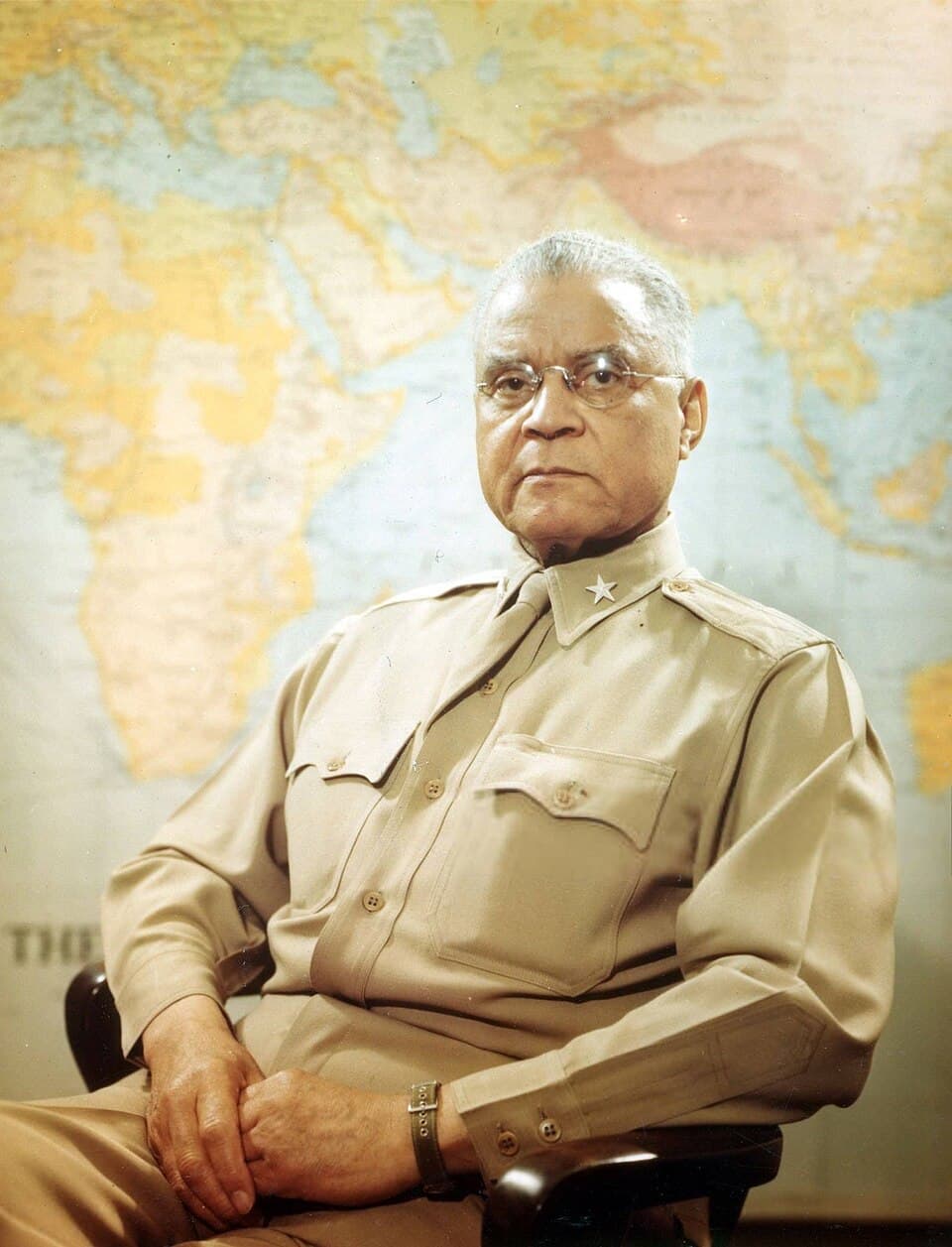
American · Politics · Activism · Law
Benjamin Oliver Davis Sr.
July 1, 1877 – November 26, 1970
Early Life and Background
Benjamin Oliver Davis Sr. was born in Washington, D.C., most commonly recorded as on July 1, 1877, though some historical research suggests he may have been born in May 1880.[1][3][4][7] His parents, Louis P. H. Davis, a messenger for the commissioner of the Internal Revenue Service, and Henrietta Davis, a nurse, were themselves the children of enslaved people.[4][7] Growing up in the nation’s capital in the late nineteenth century, Davis experienced the contradictions of a city that housed the federal government yet remained deeply segregated in housing, schooling, and employment.
Available sources indicate that Davis attended M Street High School (later Dunbar High School), one of the premier Black secondary schools in Washington, though he did not complete a college degree.[1][4][7] For a time he studied at Howard University, a leading historically Black institution, before leaving to pursue military service during the Spanish-American War.[2][7] His formative years were marked by awareness of both opportunity and systemic barriers: federal employment offered rare stability for African Americans, but professional advancement beyond clerical roles was extremely limited.
The uncertainty surrounding his precise birth date illustrates the broader challenges of documenting Black lives in the post–Civil War period. Historian Marvin E. Fletcher, drawing on census records, has argued for a birth date of May 28, 1880, while Davis’s own military records and headstone at Arlington National Cemetery affirm July 1, 1877.[3][5] The discrepancy highlights how African Americans often navigated imperfect or discriminatory recordkeeping systems. Regardless of the exact year, Davis’s youth unfolded against the backdrop of Jim Crow laws, racial violence, and the narrowing of Reconstruction-era gains, shaping his understanding of the obstacles that Black citizens faced in public institutions and the armed forces.
Entry into Military Service and Early Career
Davis’s military career began in the context of the Spanish-American War. In 1898, he joined the District of Columbia National Guard and was soon appointed a temporary first lieutenant in the 8th United States Volunteer Infantry, a segregated Black unit raised for wartime service.[5][7] He entered military service officially on July 13, 1898, demonstrating strong literacy and administrative skills that quickly drew the attention of senior officers.[5] Following the regiment’s demobilization on March 6, 1899, Davis chose to remain in the Army, enlisting as a private in Troop I, 9th Cavalry on June 18, 1899.[5]
The 9th Cavalry was one of the famed "Buffalo Soldier" regiments, composed of African American enlisted men led largely by white officers.[1][4][5] Davis advanced rapidly in the enlisted ranks, serving as a corporal and then squadron sergeant major. On February 2, 1901, he was commissioned as a second lieutenant of Cavalry in the Regular Army.[5] This transition from enlisted soldier to officer in a segregated system was itself a significant achievement; very few Black men were able to secure regular commissions at the turn of the twentieth century.
During the early years of his career, Davis served in a variety of postings, including extended duty in the Philippines following the Spanish-American War.[1][2][5] He undertook troop leadership, administrative responsibilities, and duties that required tact in dealing with both local populations and fellow officers. His performance built a reputation for reliability and competence that would be critical as he navigated a racially discriminatory promotion system in the decades ahead.
Career Development in a Segregated Army
Over the next four decades, Davis’s career unfolded within a U.S. Army that remained formally segregated and resistant to African American advancement. He served in the 9th and 10th Cavalry Regiments, commanded Black units, and held roles that increasingly involved advising on racial matters.[1][4][5][7] Despite his abilities, promotion was slow; structural racism within the officer corps meant that Black officers received fewer opportunities for command and professional education than their white counterparts.
Davis’s assignments included tours as a professor of military science and tactics at historically Black institutions and duty as a military attaché, positions that drew on his diplomatic skills and his understanding of the role African American soldiers could play in international affairs.[1][4][7] He also served on various boards and as an advisor on policies affecting Black troops. During World War I, while many Black units were relegated to labor and support roles, Davis continued to advocate for fairer treatment and more meaningful assignments, although systemic barriers limited his influence.
His perseverance in this environment demonstrated the daily realities of African Americans in federal service: constant exposure to discriminatory practices, restricted social spaces, and skepticism from colleagues, yet also responsibility for mentoring younger Black soldiers. Davis’s career trajectory provided an important model of how Black men—and, indirectly, Black women connected to military families and institutions—could navigate segregated structures while quietly pressing for change.
Breaking the General Officer Barrier
The pivotal moment in Davis’s career came in 1940. After more than four decades of service, he was promoted to brigadier general on October 25, 1940, becoming the first African American general officer in the history of the United States armed forces.[1][3][4][6] President Franklin D. Roosevelt approved the promotion during a period when the United States was preparing for potential entry into World War II and facing criticism for racial discrimination at home while espousing democratic values abroad.
Davis’s promotion was both symbolic and practical. Symbolically, it shattered a longstanding racial barrier and showed that African Americans could, at least in exceptional cases, rise to the highest levels of military leadership. Practically, it positioned Davis to influence policy toward African American soldiers, who were entering the armed forces in increasing numbers as mobilization intensified.[4][5][7] As a general, he was tasked with inspecting Black units, advising senior military leaders, and reporting on the conditions and morale of Black troops.
Many of his recommendations addressed issues such as segregated training camps, discriminatory assignments, and the limited presence of Black officers in command positions.[4][5][7] Though the armed services did not immediately implement all of his proposals, his reports articulated problems that would later be central to the desegregation debates of the 1940s and 1950s. Davis’s promotion also had a profound personal dimension: it served as a powerful precedent for his son, Benjamin O. Davis Jr., who would later become a pioneering general in the U.S. Air Force and commander of the Tuskegee Airmen.[9][10][12]
World War II Service and Advisory Role
During World War II, Davis Sr. played a crucial role as an inspector and advisor on matters concerning African American soldiers. He visited training camps, combat units, and support installations to assess the conditions under which Black troops served.[4][5][7] His reports documented inadequate facilities, limited opportunities for combat roles, and persistent discrimination in promotions and assignments.
Davis advocated for expanding the number of Black officers, integrating some training environments, and ensuring that Black units were used in combat rather than confined to labor battalions.[4][7] He argued that denying African American soldiers meaningful participation in combat undermined morale and contradicted the nation’s stated commitment to democracy. His work helped legitimate the claims of Black civil rights organizations and women’s groups that highlighted the inconsistencies between the fight against fascism abroad and racial injustice at home.
Although the military’s response to his recommendations was uneven, Davis’s efforts contributed to gradual changes in policy, including increased commissioning of Black officers and broader recognition of Black combat performance. Historians have noted that his advocacy laid groundwork for President Harry S. Truman’s Executive Order 9981 in 1948, which mandated equality of treatment and opportunity in the armed services and initiated formal desegregation.[5][7]
Retirement, Recall, and Final Military Service
Davis was first retired from active duty on July 31, 1941, after decades of service, but the exigencies of World War II led to his immediate recall; he returned to duty with the rank of brigadier general the following day.[5] This unusual sequence underscored the Army’s need for his expertise on matters relating to Black troops. Over the remainder of the war and into the postwar period, he continued to serve in advisory capacities, shaping evolving policies on race within the military.
He finally retired from the Army on July 14, 1948, having served approximately fifty years in uniform.[5][6] By that time, the United States had issued Executive Order 9981 and begun the slow process of desegregating its armed forces, a change to which Davis’s long service and advocacy had substantially contributed. His retirement coincided with the early stages of broader civil rights efforts that would gain momentum in the 1950s and 1960s.
Awards, Honors, and Recognition
Throughout his career, Davis received multiple military and civilian honors. U.S. Army records list his decorations as including the Bronze Star Medal and the Distinguished Service Medal (DSM), recognizing both meritorious service and exceptionally distinguished performance.[2][5] Internationally, he was awarded the French Croix de Guerre with Palm and Liberia’s Order of the Star of Africa, reflecting his contributions to allied efforts and diplomatic relations.[2]
In addition to these decorations, Davis was recognized by academic institutions. He received an honorary doctorate from Atlanta University, an historically Black institution that acknowledged his pioneering achievements and his role in expanding educational and professional horizons for African Americans.[2] These honors highlighted not only his military accomplishments but also his significance as a public figure whose career symbolized the possibilities of Black leadership in national service.
In later years, historians and museum institutions have continued to honor Davis’s legacy. The U.S. Army Center of Military History and the National Museum of the United States Army both feature biographical entries and exhibits explaining his role as the first African American general officer in the Regular Army and the armed forces.[4][5] These institutional recognitions help contextualize his life within broader narratives of civil rights, military history, and the evolution of federal policies toward race.
Personal Life and Family
Davis’s personal life intersected closely with his professional commitments. He married Elnora Dickerson, and the couple had at least two children, including Benjamin O. Davis Jr., who would follow his father into a barrier-breaking military career.[1][10][12] The family’s experiences reflected the particular challenges faced by Black military families, including frequent relocations, restricted access to housing and facilities on and near bases, and the emotional toll of navigating racist systems.
Within his household, Davis emphasized education, discipline, and perseverance, values that profoundly shaped his son’s development. Benjamin Jr. later recalled his father’s example as instrumental in his own determination to excel in the military despite discrimination.[10][12] The elder Davis’s role as a father thus had extended historical impact: the family produced two generations of pioneering Black generals, each of whom played central roles in changing the racial landscape of the U.S. armed forces.
Although less is documented about the women in Davis’s immediate family, their lives were deeply entangled with his career. His wife and daughter(s) navigated military communities dominated by white families, confronted segregation in schools and public spaces, and contributed to the informal support networks that sustained Black officers and enlisted men. Their experiences form part of the broader story of Black women in military and federal contexts, even when archival records foreground male service members.
Legacy and Historical Impact
Benjamin O. Davis Sr.’s legacy rests primarily on his role as the first Black general in any branch of the U.S. military and his sustained advocacy for African American soldiers.[1][3][5][7][12] His career demonstrated that Black leadership in the highest echelons of the armed forces was possible, even in the face of entrenched racism. By occupying a position previously reserved for white officers, he challenged assumptions about Black competence and authority, making it harder for institutions to justify excluding African Americans from senior roles.
Davis’s influence on policy, while often constrained, was nonetheless significant. His inspections and reports brought attention to discriminatory practices, inadequate facilities, and the underutilization of Black combat troops.[4][5][7] These findings informed debates within the War Department and provided evidence that civil rights organizations could cite in their campaigns for equal treatment. His work helped build the case that segregation undermined morale and military effectiveness, arguments that later shaped desegregation initiatives.
His legacy is also intergenerational. The success of his son, Benjamin O. Davis Jr., commander of the Tuskegee Airmen and later a general in the U.S. Air Force, is frequently linked to the elder Davis’s example.[9][10][12] Together, their careers created a family lineage of Black military leadership that inspired subsequent generations of officers, including women who entered the services after formal desegregation and rose to command positions. For women’s and civil rights history, Davis Sr.’s life illustrates how changes in male-dominated institutions like the Army can expand opportunities for all African Americans.
Modern scholarship and museum interpretation continue to reassess Davis’s contributions. Historians such as Marvin E. Fletcher, in works like America’s First Black General: Benjamin O. Davis, Sr., 1880–1970, have explored the complexities of his career, including the compromises he sometimes made within a discriminatory system.[5] These studies highlight his dual role as both a trailblazer and a figure constrained by the institutional norms of his time, enriching understandings of how structural change occurs in large bureaucracies.
Later Life and Death
After his final retirement in 1948, Davis lived quietly but remained a respected figure in military and African American communities.[5][6] He witnessed the growing civil rights movement, the formal desegregation of the armed forces, and the early stages of broader social change. As public awareness of the contributions of Black servicemembers increased, his own achievements received renewed attention.
Davis died on November 26, 1970, in North Chicago, Illinois.[1][3][4][5][7] He was later buried at Arlington National Cemetery, among presidents, senior military leaders, and other national figures.[1][4][5][7] His gravestone, listing his rank and service, stands as a visible acknowledgment of African American leadership in the nation’s military history.
By the time of his death, the U.S. military had undergone significant transformation. African American soldiers and officers, including women, served in integrated units and rose to higher ranks, though full equality was still a work in progress. Davis’s life thus spanned an era from near-total exclusion of Black people from senior military roles to the beginnings of formal inclusion. His death closed a chapter in which one man’s persistence within a segregated institution helped make possible a more inclusive future.
For contemporary researchers and educators, Benjamin O. Davis Sr. remains a key figure in understanding the intersection of race, federal power, and institutional change. His story illuminates how individuals can both adapt to and challenge discriminatory structures, and how their efforts can ripple across generations, shaping opportunities for Black women and men in the military and beyond.
Dated achievements
3 indexed.
- Jul011877Science
Birth of Benjamin O. Davis Sr.
Benjamin Oliver Davis Sr. was born in Washington, D.C., later becoming a pioneering African American career officer in the U.S. Army.
View details Benjamin O. Davis Sr. - Wikipedia - Oct251940Science
First African American General in the U.S. Military
Davis was promoted to brigadier general, becoming the first Black general officer in the history of the U.S. Army and the broader U.S. military.