← All women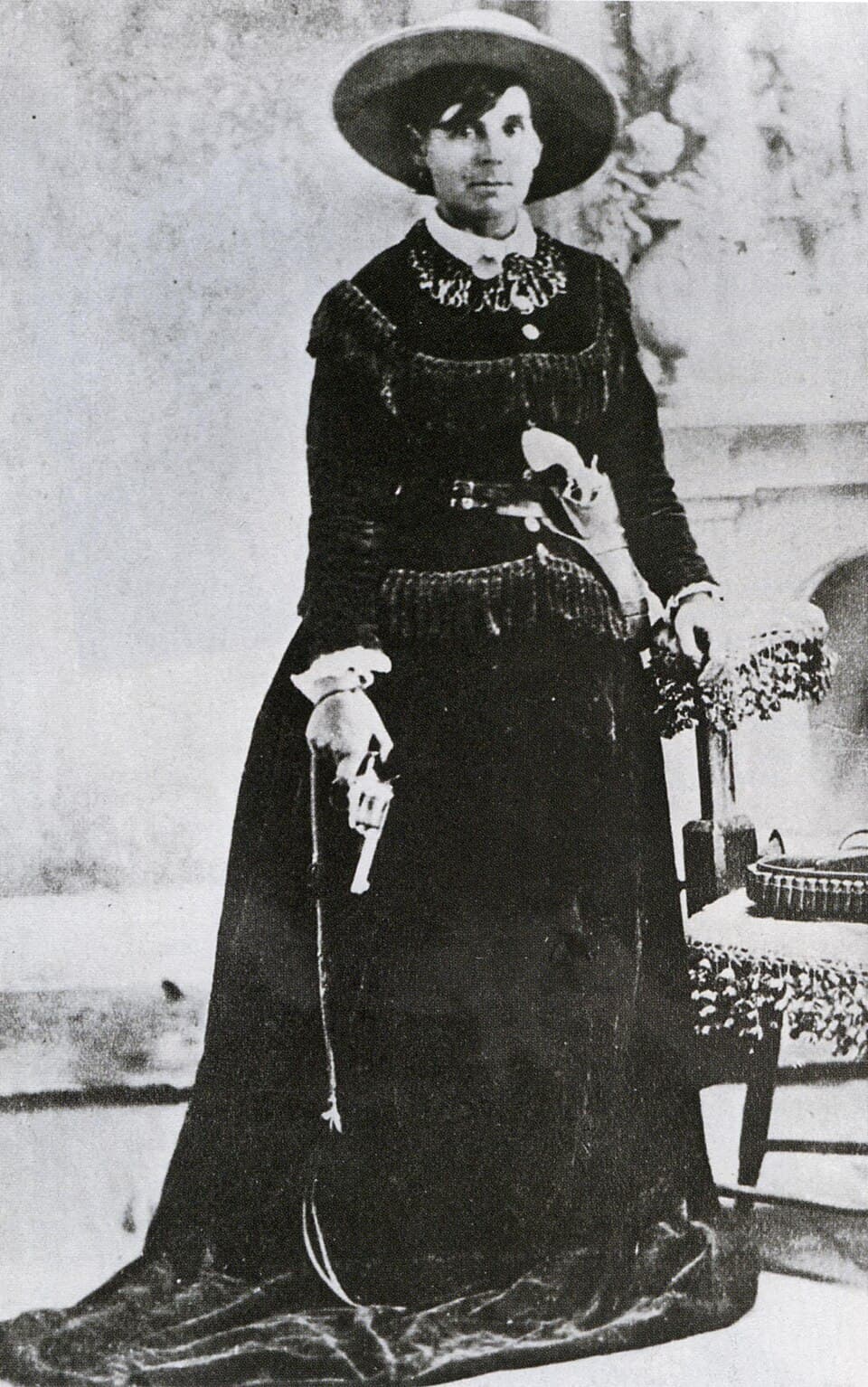
American · Law · Activism
Belle Starr
February 5, 1848 – February 3, 1889
Early Life and Background
Myra Maybelle Shirley, who would achieve lasting notoriety under the name Belle Starr, was born on February 5, 1848, near Carthage in Jasper County, Missouri. She was one of several children born to John Shirley, a farmer who later became a prosperous innkeeper and tavern-owner in Carthage, and his wife Elizabeth "Eliza" Hatfield Shirley. The Shirley family enjoyed comfortable, even genteel, circumstances by the standards of the rural Ozark region, and young Maybelle — as she was known in childhood — received a solid education at the Carthage Female Academy, where she studied Greek, Latin, and piano alongside more conventional subjects for girls of the period, such as needlework and deportment.
This early polish would later strike a strange contrast with the violent reputation she earned in adulthood, and many journalists and biographers have remarked on the irony of an educated, piano-playing young woman from a respectable family becoming one of the most notorious outlaws of the American frontier. Her comfortable upbringing was upended by the outbreak of the American Civil War. Missouri was a bitterly contested border state, riven by guerrilla warfare between pro-Union Jayhawkers and pro-Confederate Bushwhackers. The Shirley family sympathized with the Confederacy, and Belle's older brother, John Addison "Bud" Shirley, joined a pro-Confederate guerrilla band. Bud was killed by Union troops in 1864, a loss that devastated the family and, according to many accounts, hardened young Belle's sympathies toward the outlaw guerrillas who continued to operate in the region, including William Quantrill's raiders, among whose ranks were the young Cole Younger and Jesse and Frank James — men who would remain linked to Belle's life and legend for years afterward.
War, Relocation, and First Marriage
As the war ravaged Missouri, the Shirley family relocated to Scyene, Texas, near Dallas, around 1864, seeking to escape the violence and rebuild their livelihood. It was in Texas that Belle's associations with outlaws deepened. She reportedly maintained close ties with Cole Younger and other former Confederate guerrillas who drifted through the area after the war, men who had turned to robbing banks, trains, and stagecoaches rather than reintegrating into peaceful postwar society.
In 1866, Belle married Jim Reed, a childhood acquaintance from Missouri who had likewise ridden with guerrilla bands during the war and who, in peacetime, gravitated toward criminal enterprises including horse theft, bootlegging, and eventually robbery. The couple had two children: a daughter, Rosie Lee, nicknamed "Pearl," born in 1868, and a son, James Edwin "Eddie" Reed, born in 1871. Jim Reed's criminal activities escalated over the following years; he was implicated in a stagecoach robbery and other crimes, and became a fugitive from justice. Belle allegedly participated in or supported some of these ventures, though the extent of her direct involvement in this early period remains disputed among historians, clouded by decades of sensationalized retelling. Jim Reed was killed by a former associate turned bounty hunter in 1874, leaving Belle a widow with two young children.
Life in Indian Territory and Second Marriage
Following Jim Reed's death, Belle's life became increasingly entangled with the outlaw culture of the Indian Territory (present-day Oklahoma), a vast region largely beyond the jurisdiction of state law enforcement, governed instead by tribal courts and a small number of overworked federal marshals operating out of Fort Smith, Arkansas. This jurisdictional patchwork made the territory a magnet for fugitives, horse thieves, and bandits of all kinds.
In 1880, Belle married Sam Starr, a Cherokee man, and took up residence on a plot of land called Younger's Bend, along the Canadian River in the Cherokee Nation portion of Indian Territory. It was from this marriage that she acquired the surname by which history would remember her. Younger's Bend became something of a safe haven for outlaws, and Belle — now going by "Belle Starr" — cultivated a reputation for harboring fugitives, fencing stolen horses and livestock, and orchestrating criminal schemes from behind the scenes, even as she projected an image of respectability, dressing elegantly and riding sidesaddle on a fine black mare, a velvet skirt, and a plumed hat, a striking image that later fueled her mythologized "Bandit Queen" persona.
Legal Troubles and the "Bandit Queen" Legend
Belle and Sam Starr were both arrested in 1882 on charges of horse theft, and the case was tried before the formidable federal judge Isaac Parker, known as the "Hanging Judge," in Fort Smith, Arkansas — a court with jurisdiction over crimes committed in Indian Territory. Belle was convicted and served nine months in a Detroit house of correction in 1883, one of the relatively few instances in which she faced formal legal consequences despite widespread suspicion of her involvement in numerous crimes over the years. This conviction is among the best-documented episodes of her criminal career, as court records survive from the Fort Smith federal court.
Sam Starr was killed in a gunfight in 1886, and Belle subsequently took up with another man, Jim July (also known as Jim July Starr), a young Creek man considerably her junior, continuing her pattern of association with figures on the margins of the law. Throughout the 1880s, sensationalized newspaper accounts and dime novels — most notably a lurid, largely fictionalized biography published shortly after her death — transformed Belle Starr from a regional criminal figure of modest documented significance into a nationally famous legend, the female counterpart to outlaws like Jesse James. Much of what became "known" about her, including many dramatic anecdotes, originated in this sensationalized press coverage rather than in verified historical record, a pattern historians continue to untangle today.
Personal Life
Belle Starr's personal relationships were as turbulent as her public reputation. Her relationship with her son, Eddie Reed, was notably strained; she reportedly whipped him severely for mistreating a horse, and tensions between them persisted. Her daughter Pearl, by contrast, remained devoted to her mother's memory throughout her life. Belle's marriages — to Jim Reed, Sam Starr, and her later relationship with Jim July — each connected her more deeply to outlaw networks operating between Texas, Missouri, and Indian Territory, reinforcing her reputation as a woman who moved fluidly among criminal circles rather than merely being a victim or bystander to the men in her life, as some early accounts suggested.
Death and Unsolved Murder
On February 3, 1889, two days before her 41st birthday, Belle Starr was ambushed and shot from her horse while riding home to Younger's Bend from a neighbor's farm. She was struck in the back by a shotgun blast and killed, apparently by a second shot fired as she lay on the ground. No one was ever convicted of the murder. Suspects included her son Eddie Reed, with whom she had recently quarreled, and Edgar J. Watson, a tenant farmer on her land who had reportedly clashed with her over a lease dispute and who was rumored to have a violent past. The case was never definitively solved, and it remains one of the enduring mysteries of Old West history.
She was buried at Younger's Bend, and her grave marker, said to have been carved by her daughter Pearl, bears the image of a horse, a bell, and a clasped hand, along with a poetic epitaph.
Legacy
Belle Starr's afterlife in American popular culture has vastly outstripped the documented facts of her criminal career, which by most rigorous historical assessments was relatively modest compared to her legendary reputation — she was convicted only once, for horse theft. Nonetheless, sensationalized biographies published soon after her death, followed by decades of dime novels, pulp fiction, films, and television portrayals (including the 1941 film Belle Starr starring Gene Tierney and the 1980 television movie The Belle Starr Story), cemented her image as the "Bandit Queen" or "Petticoat Terror of the Plains," a rare female figure in the male-dominated outlaw mythology of the American West.
Historians and institutions such as the Texas State Historical Association, the Encyclopedia of Arkansas, and the Oklahoma Historical Society have worked to separate documented fact from embellished legend in her story, noting that much of the popular narrative surrounding her stems from unreliable, sensationalized sources written to sell books and newspapers rather than to record history accurately. Nevertheless, Belle Starr endures as a significant figure in the folklore of the American frontier, symbolizing both the disruptive gender-role possibilities and the brutal violence of the post-Civil War West, and continuing to inspire fascination well over a century after her unsolved murder.
Dated achievements
2 indexed.
- Feb051848Law
Birth of Myra Maybelle Shirley in Carthage, Missouri
Belle Starr was born Myra Maybelle Shirley on February 5, 1848, in Carthage, Jasper County, Missouri, to a prosperous innkeeping family.
View details Belle Starr - Encyclopedia of Arkansas - Feb031889Law
Belle Starr is ambushed and murdered near Eufaula, Indian Territory
Belle Starr was shot in the back and killed near her home in Indian Territory on February 3, 1889, two days before her 41st birthday; the murder was never solved.