← All women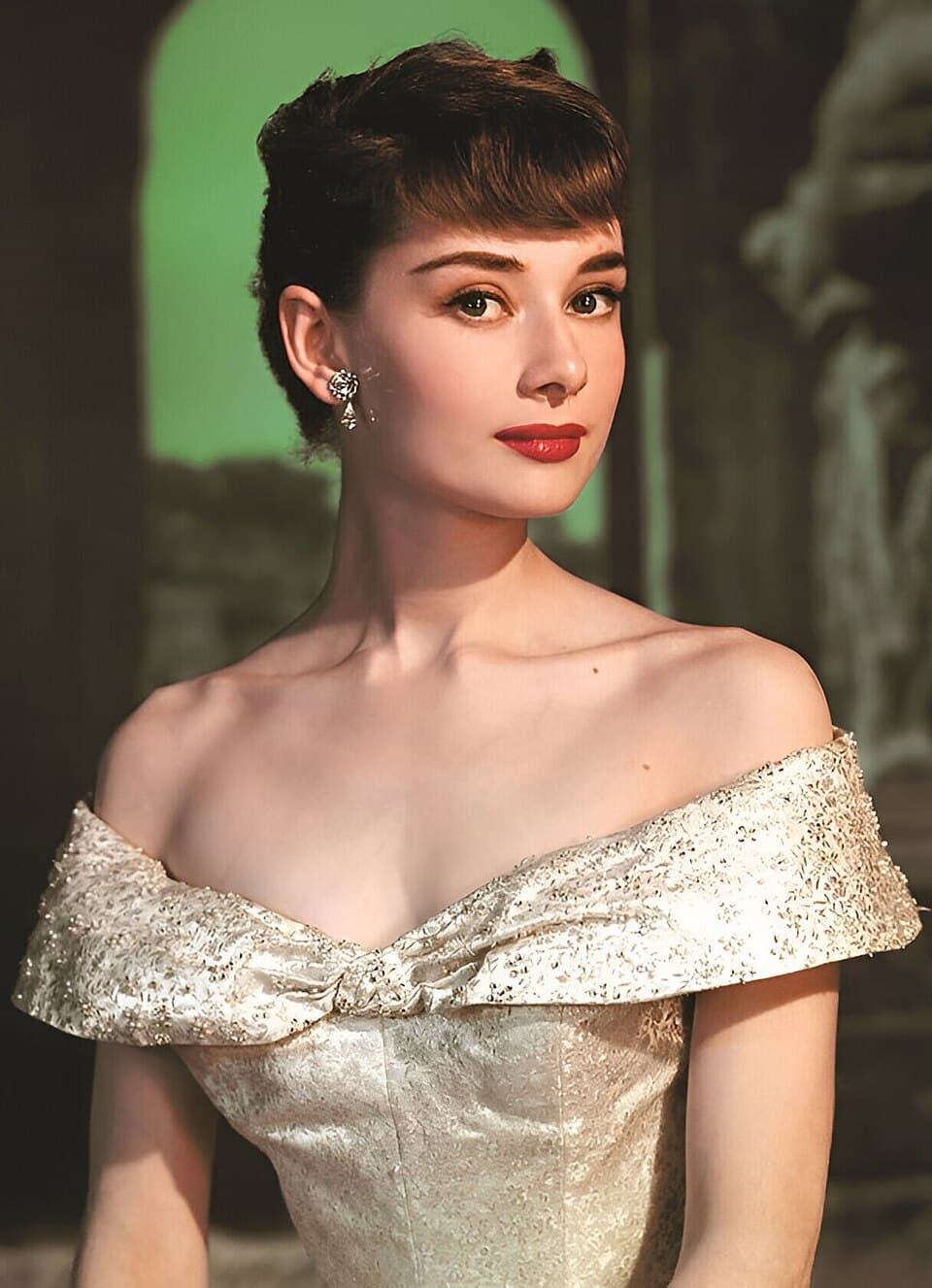
British, Dutch · Arts · Activism
Audrey Hepburn
May 4, 1929 – January 20, 1993
Early Life and Background
Audrey Kathleen Ruston, later known as Audrey Hepburn, was born on 4 May 1929 in Ixelles (Elsene), a municipality of Brussels, Belgium, to an English father, Joseph Victor Ruston, and a Dutch mother, Baroness Ella van Heemstra.[1][11][12] Her father worked in business and had ties to the British Empire, while her mother came from a minor Dutch aristocratic family and had social ambitions as well as an interest in the arts.[1][14] Audrey spent her early childhood moving between Belgium, England, and the Netherlands, reflecting her parents’ international lifestyle and the shifting political climate of interwar Europe.[1][13]
In the mid‑1930s, the family lived partly in England, where Audrey attended a small boarding school, but they later returned to the Netherlands.[1][9] As the Second World War unfolded, she was living in Arnhem and other Dutch towns under German occupation.[1][14] During the war, Hepburn experienced severe hardship, including food shortages and episodes of malnutrition, and she reportedly participated in clandestine dance performances to raise money for the Dutch resistance.[1][14] These years left a profound mark on her, instilling both resilience and empathy for civilians, particularly children, suffering in conflict.
After the war, Audrey pursued ballet training seriously, hoping to become a prima ballerina.[1][9] She studied in Arnhem and later in Amsterdam, and eventually in London at the Ballet Rambert school.[1][2] However, her height, physical effects of wartime malnutrition, and late start in intensive professional training limited her prospects for a top ballet career, leading teachers to advise her to consider acting.[1][2] This guidance, combined with her linguistic abilities and striking stage presence, helped shift her path from dance to drama at a moment when European film and theatre were rebuilding after the war.
Career Beginnings and Development
Hepburn’s earliest screen appearance came in 1948 with an uncredited role in the Dutch documentary feature "Nederland in zeven lessen" ("Dutch in Seven Lessons"), which introduced Dutch life to English audiences.[1] She soon began securing small roles in British films, including "One Wild Oat" (1951), "Young Wives’ Tale" (1951), and "The Lavender Hill Mob" (1951), gradually building a reputation for freshness and charm.[1][3] These films were made during a period when British cinema sought new faces and lighter stories in the postwar era, and her presence contributed to this trend.
In 1952, Hepburn had her first significant film role in "Secret People", playing a young ballerina.[1][16] She performed her own dance scenes, drawing on her intensive ballet training and showcasing both physical grace and emotional expressiveness. Although the film was not a major commercial success, critics noted her talent, and it helped demonstrate that she could carry more substantial dramatic material on screen.
A key turning point occurred when French author Colette saw Hepburn during the filming of "Monte Carlo Baby" and insisted that she play the title role in the stage adaptation of "Gigi".[9] The production moved to Broadway, and Hepburn made her American stage debut as Gigi in 1951, officially opening on 24 November of that year.[1] Her performance was celebrated for its youthful spontaneity and sincerity, and it introduced her to New York audiences and American critics, marking a transatlantic leap in her career.
Following her stage success, Hepburn’s screen test for "Roman Holiday" on 4 September 1951 impressed director William Wyler, who saw in her an unconventional but compelling leading lady.[1][13] Paramount cast her opposite Gregory Peck, and the film was shot in Rome, using extensive location work to capture the city’s postwar atmosphere. This moment represented her shift from European supporting roles to a central place in Hollywood’s evolving star system.
Major Works and Accomplishments
Hepburn’s definite breakthrough came with "Roman Holiday" (1953). The film premiered in the United States on 27 August 1953 and quickly became both a critical and popular success.[1] She played Princess Ann, a sheltered European royal who escapes official duties to explore Rome incognito. Her performance blended innocence, humor, and emotional depth, redefining expectations for a leading actress in romantic comedy. For this role, she won the Academy Award for Best Actress at the 26th Academy Awards on 25 March 1954, as well as a BAFTA for Best British Actress and a Golden Globe.[1][8] The recognition established her as a major international star.
In theatre, Hepburn further solidified her reputation with the Broadway play "Ondine", written by Jean Giraudoux and staged in 1954. She portrayed a water nymph opposite actor Mel Ferrer, whom she later married.[1][8] For this performance, she won the Tony Award for Best Actress in a Play, making her one of the few performers to receive both an Oscar and a Tony in such quick succession.[1][8] This dual success underscored her versatility across film and stage at a time when few actresses were equally celebrated in both media.
Throughout the 1950s, Hepburn starred in a series of high‑profile films. In "Sabrina" (1954), she played the chauffeur’s daughter transformed into a sophisticated woman after a stay in Paris, opposite Humphrey Bogart and William Holden.[1][2] In "War and Peace" (1956), she portrayed Natasha Rostova in an adaptation of Leo Tolstoy’s novel, confirming her capacity for serious dramatic roles.[1] The romantic musical "Funny Face" (1957) paired her with Fred Astaire, emphasizing her dance ability and collaboration with designer Hubert de Givenchy, whose costumes for her shaped mid‑century fashion.[1][3][14]
Hepburn continued to explore romantic drama and comedy in "Love in the Afternoon" (1957) and delivered a critically acclaimed performance in "The Nun’s Story" (1959), playing a Belgian nun grappling with obedience and personal conscience.[1][6] "The Nun’s Story" earned her Academy Award and BAFTA nominations and was praised for its sensitive exploration of vocation, colonial medicine, and internal conflict, all resonant themes in postwar society.
In the 1960s, she starred in several films that have become canonical in Hollywood history. "Breakfast at Tiffany’s" (1961), released in the United States on 5 October 1961, cast her as Holly Golightly, a stylish but vulnerable New York party girl.[1] The film’s opening sequence—Hepburn in a Givenchy black dress, pearls, and sunglasses, eating a pastry outside Tiffany & Co.—became an indelible cultural image. Despite later debate about departures from Truman Capote’s novella and problematic elements in the film, Hepburn’s performance contributed significantly to the evolving portrayal of single women and urban glamour.
She later played Eliza Doolittle in "My Fair Lady" (1964), an adaptation of the stage musical based on George Bernard Shaw’s "Pygmalion".[1][3] Although her casting was controversial because she replaced stage star Julie Andrews and some of her songs were dubbed by Marni Nixon, Hepburn’s depiction of Eliza’s transformation from a Cockney flower seller to a refined lady has remained one of her most recognized roles. The film itself became a major commercial success and is widely regarded as a classic of the musical genre.
Hepburn also took on suspense and thriller genres. In "Wait Until Dark" (1967), released in the United States on 26 October 1967, she portrayed Susy Hendrix, a blind woman besieged by criminals searching for a heroin‑filled doll.[1] Her performance required careful study of blindness and nuanced physical acting, earning her another Academy Award nomination. The film reinforced her range and adaptability at a time when Hollywood narratives increasingly featured women in high‑stakes psychological situations.
After a period of reduced acting activity, Hepburn made a brief return to film with "Robin and Marian" (1976) and later "Bloodline" (1979). Her final film role was in "Always" (1989), directed by Steven Spielberg, where she played Hap, an ethereal figure guiding the protagonist.[1] This late appearance underscored her enduring appeal and connected her legacy to a new generation of filmmakers.
Awards, Honors, and Recognition
Over the course of her career, Audrey Hepburn received numerous awards and honors across multiple media. Beyond her Academy Award for Best Actress (1954) and Tony Award for Best Actress in a Play (1954), she accumulated distinctions that contribute to what is often described as an EGOT profile—possession of Emmy, Grammy, Oscar, and Tony awards.[1][11]
She received a Emmy Award for Outstanding Individual Achievement – Informational Programming for her work on the documentary series "Gardens of the World with Audrey Hepburn" (awarded posthumously in the early 1990s).[8] She also shared in Grammy Awards for spoken word albums for children, including one released after her death.[8] These later honors demonstrated her ability to engage audiences beyond traditional acting roles, especially in educational and humanitarian‑oriented projects.
Hepburn’s film career brought additional awards, such as BAFTA Awards, Golden Globe Awards, and the Cecil B. DeMille Award for lifetime achievement in motion pictures, presented by the Hollywood Foreign Press Association.[8] In recognition of her humanitarian work, she received the Presidential Medal of Freedom in the United States on 14 December 1992.[1][2] After her death, the Academy of Motion Picture Arts and Sciences honored her activism with the Jean Hersholt Humanitarian Award, underscoring the dual legacy of her artistic and humanitarian contributions.[8]
Various organizations have ranked Hepburn among the greatest female screen legends. The American Film Institute placed her as the third greatest female star of classic Hollywood cinema.[16][17] She has also been inducted into the International Best Dressed List Hall of Fame, reflecting her influence on fashion and style.[16][17] These recognitions link her image to larger historical narratives about women in film, fashion, and public culture.
Personal Life
Hepburn’s personal life involved relationships that intersected with her professional career. In 1954, she married actor Mel Ferrer, with whom she had co‑starred in "Ondine".[1][8] The couple had one son, Sean Hepburn Ferrer, born in 1960.[1][2] Hepburn and Ferrer collaborated creatively on several projects and were widely covered in the media as a prominent artistic couple of the 1950s and 1960s. Their marriage ended in divorce in 1968.[8]
In 1969, she married Italian psychiatrist Andrea Dotti, with whom she had her second son, Luca Dotti, born in 1970.[8] Hepburn spent significant time in Italy during this period, stepping back from continuous film work to focus on family life and privacy. Her marriage to Dotti also ended in divorce in the early 1980s.[8] Later, she entered a long‑term relationship with Dutch actor and businessman Robert Wolders, which lasted until her death.[1][2]
Throughout her life, Hepburn was known for her modesty, discipline, and preference for a relatively private existence away from the pressures of constant Hollywood exposure.[1][3] She enjoyed gardening, reading, and spending time with her children. Biographers note that her experiences of war and family instability contributed to a strong desire for personal security and emotional stability, elements that shaped her choices to limit film work and prioritize family and humanitarian activities in her later years.[14]
Humanitarian Work and Activism
Hepburn’s humanitarian engagement became the defining feature of her later life. Drawing on her memories of wartime deprivation in the Netherlands, she expressed a long‑standing gratitude to UNICEF for the organization’s postwar assistance to children, including food and medical aid.[1][14] In the 1980s, she began to collaborate more formally with UNICEF and other humanitarian groups, ultimately being appointed a UNICEF Goodwill Ambassador on 31 March 1988.[1]
In this role, Hepburn undertook numerous field missions to countries facing crises. She visited Ethiopia during famine, Sudan, Bangladesh, Vietnam, and Turkey, among others, focusing on malnutrition, lack of clean water, limited access to education, and the impacts of conflict on children.[4][14] Her trips were documented by journalists and photographers, and she gave press conferences and speeches to describe conditions on the ground. Hepburn emphasized simple but vital interventions such as vaccinations, primary health care, and basic schooling.
Her humanitarian efforts coincided with a broader rise in celebrity advocacy, but Hepburn’s work stood out for its sustained, hands‑on character. She often insisted that media attention be directed toward the children and local workers rather than herself, reflecting a principled approach to representation.[4] UNICEF officials credited her with helping to raise substantial funds and with humanizing large‑scale statistics about hunger and disease. Her activism also contributed to evolving understandings of how women in the public eye could leverage fame for global policy influence.
Legacy and Historical Impact
Audrey Hepburn’s legacy operates across several domains: cinema, fashion, and humanitarianism. In film history, she is regarded as one of the central figures of Hollywood’s Golden Age, particularly for her work in the 1950s and 1960s.[1][17] The American Film Institute’s ranking of her as the third greatest female screen legend reflects her enduring impact on acting, narrative forms, and the representation of women in mainstream cinema.[16][17]
Her collaboration with French designer Hubert de Givenchy established a distinctive minimalist elegance characterized by clean lines, simple silhouettes, and carefully chosen accessories.[14] The "little black dress" she wore in "Breakfast at Tiffany’s" is widely credited with popularizing that garment as a staple of chic women’s fashion. Hepburn appeared on numerous magazine covers and is regularly cited as a style icon whose influence extends into contemporary fashion design and personal aesthetics.
In humanitarian history, Hepburn is remembered as a pioneering example of a major female film star dedicating late career years to international advocacy. Her work with UNICEF helped to normalize the idea that celebrities, particularly women, could act as serious partners in humanitarian diplomacy rather than only as ceremonial patrons.[4][14] The Presidential Medal of Freedom awarded to her on 14 December 1992 recognized this contribution and signaled that her activism had significance beyond the entertainment industry.[1][2]
Posthumously, Hepburn’s image continues to circulate widely in popular culture, in posters, biographies, documentaries, and educational materials. Books and films such as "The Audrey Hepburn Story" explore her life, while children’s biographies and illustrated volumes present her as a role model of kindness, perseverance, and grace.[1][18][19] Scholars and critics analyze her performances for their interplay of vulnerability and strength, seeing in her characters reflections of mid‑20th‑century tensions around class, gender, and modernity.
For women’s history, Hepburn’s importance lies in the way she combined artistic success with moral engagement. She navigated male‑dominated film industries, brought new dimensions to female characters, influenced global fashion, and later advocated forcefully for children’s rights. Her story illustrates the evolving opportunities and responsibilities faced by women with international visibility in the 20th century.
Later Life and Death
In her later years, Hepburn lived primarily in Switzerland, in the village of Tolochenaz, seeking a quieter life while continuing humanitarian travel.[1][2] She balanced visits to crisis regions with time at home gardening, reading, and spending time with her family and partner Robert Wolders. During the early 1990s, she was diagnosed with a rare form of cancer originating in the appendix, known as appendiceal cancer.[1][4]
Despite her illness, Hepburn continued some advocacy work and received significant honors, including the Presidential Medal of Freedom in December 1992.[1][2] Her health declined rapidly, and after surgical and medical treatments in Switzerland and the United States, she returned to Tolochenaz. On 20 January 1993, she died at home, aged 63.[1][4][12] Her funeral and burial in Tolochenaz were private but followed by global tributes in the press and at film institutions.
Following her death, her sons and colleagues helped sustain her humanitarian legacy. Foundations and initiatives bearing her name support children’s causes, and UNICEF continues to cite her work as foundational to its Goodwill Ambassador program.[4] The combination of her cinematic achievements and activist commitments ensures that Audrey Hepburn remains a central figure in discussions of 20th‑century culture, women’s roles in public life, and the enduring power of compassion in global affairs.
Dated achievements
10 indexed.
- May041929Arts
Birth of Audrey Hepburn
Audrey Kathleen Ruston was born in Ixelles/Elsene, Belgium.
View details Audrey Hepburn - Wikipedia - Sep041951Arts
Screen Test for "Roman Holiday"
Audrey Hepburn made a pivotal screen test for "Roman Holiday" on this day.
View details