← All women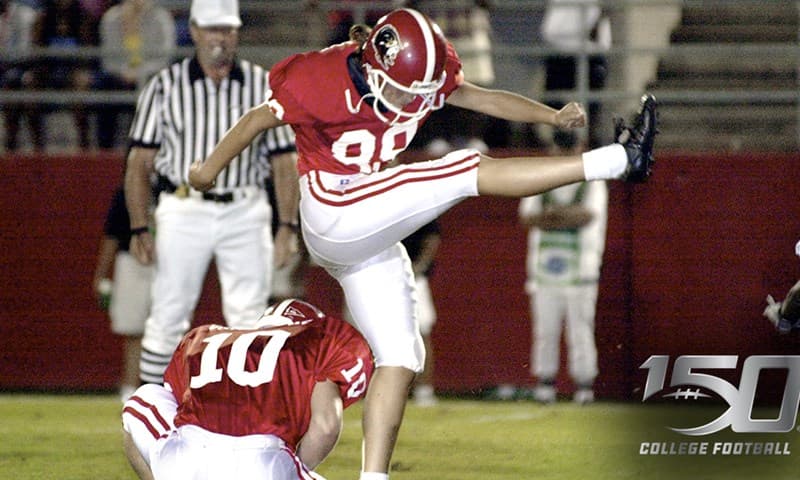
American · Sports
Ashley Martin
October 10, 1980 – present
Early Life and Background
Ashley Nicole Martin was born on October 10, 1980, in Atlanta, Georgia, to parents Wayne and Stacy Martin.[1] She grew up in Georgia, where she developed into a highly versatile athlete from an early age. Her official Jacksonville State University (JSU) athletics biography notes that she lettered in soccer, basketball, softball, football, and track at East Coweta High School, indicating both broad athletic talent and a willingness to cross conventional gender boundaries in sport.[1]
During her high‑school years, Martin was named Most Valuable Player of her soccer team as a freshman and earned All‑Regional Honorable Mention honors in her junior and senior seasons.[1] She also played club soccer for the Fayette County Lightening.[1] These experiences provided rigorous competition, honed her kicking and ball‑striking skills, and laid the foundation for her later capacity to perform under pressure in multiple collegiate sports.
Martin’s early exposure to football, although less extensively documented than her soccer career, is noted in JSU’s bio, which records that she lettered in the sport in high school.[1] In the context of the 1990s American South, where girls’ and women’s football participation was rare and often discouraged, such involvement is historically significant. It suggests that she was already comfortable operating in spaces where female athletes were unusual and that her family and local coaches were willing to support her unconventional athletic interests.
College Enrollment and Athletic Development
Martin enrolled at Jacksonville State University in Alabama, joining the Gamecocks women’s soccer program. She quickly established herself as an important member of the team. In the 1999 season, her freshman year, she started 12 of 21 games, finished as the team’s fifth‑leading scorer with nine points, and was second in game‑winning goals with two.[1] That season, she was also named to the Conference All‑Academic team, reflecting her ability to balance athletics with academic responsibilities.[1]
In 2000, Martin’s role grew further. She started 17 of 18 games, led JSU in assists with four, and ranked fifth on the team in goals and total points.[1] Her performance earned her a place on the 2000 Kick Out Cancer All‑Tournament Team, a recognition that underscored her impact in regional competition and her standing among peers in women’s collegiate soccer.[1] These early collegiate seasons show that, before she gained national attention as a football player, she was building a solid career as a soccer midfielder/forward with playmaking and scoring abilities.
Martin’s development as a soccer player coincided with a period of growing visibility for women’s sports in the United States. The success of the U.S. women’s national soccer team at the 1999 FIFA Women’s World Cup and increased support for Title IX enforcement created a cultural climate more receptive to women’s athletic achievements. Within this context, Martin’s contributions at JSU reflect how mid‑major programs were expanding opportunities for female athletes, even if their stories did not initially receive national media coverage.
Dual‑Sport Career and 2001 Season
The 2001 academic year marked a turning point in Martin’s athletic trajectory. She continued as a leading figure on JSU’s women’s soccer team, starting all 17 matches and leading the program in shots, goals, and points.[1] At the same time, she joined the Jacksonville State football team as a placekicker, undertaking a rare dual‑sport role at the NCAA Division I level.[1][2]
Balancing soccer and football commitments required navigating overlapping practice schedules, physical conditioning demands, and differing team cultures. JSU’s records and subsequent media accounts emphasize that Martin was a genuine roster member for both teams, not simply a promotional figure for football.[1][2] Her soccer responsibilities, including offensive and playmaking duties, continued throughout the fall, even as she prepared to execute high‑pressure kicks in football games.
In soccer, Martin’s 2001 season included several documented highlight performances. On September 18, 2001, she recorded two assists against Belmont University, a mark recorded as her career high for assists in a single game.[1] Three days later, on September 21, 2001, she scored two goals in a match at Mississippi State University, giving her a career‑high four points in a single contest.[1] On September 23, 2001, she added a game‑winning goal against the University of Tennessee at Chattanooga (UTC).[1] Across this period she scored four goals in three matches, a surge that led to her being named Atlantic Sun Conference Player of the Week during the week of September 24, 2001.[1]
These performances highlight her importance within JSU’s women’s soccer program and demonstrate that her barrier‑breaking football role was built on an existing foundation of competitive excellence. Her soccer achievements also illustrate the physical resilience and tactical versatility required to compete effectively in two sports during the same season.
Historic NCAA Division I Football Appearance
Martin’s most widely recognized accomplishment occurred early in the 2001 football season. On August 30, 2001, she took the field as a placekicker for Jacksonville State in a home game against Cumberland University in Jacksonville, Alabama.[1][2] In the course of a 72–10 JSU victory, Martin successfully converted three extra‑point attempts, scoring points in regular game action.[1][2]
Multiple sources—including her JSU athletics biography, an ESPN news report, coverage by the Feminist Majority Foundation, and later retrospectives by the Ohio Valley Conference—affirm that this game made Martin the first woman to play and score in an NCAA Division I American football game.[1][2] The ESPN report described the game as "making history" and emphasized that Martin’s kicks came in standard competitive circumstances.[2][4] The Feminist Majority Foundation’s news item similarly highlighted her barrier‑breaking role and situated her achievement within wider efforts to expand women’s opportunities in sport.[4]
Martin’s participation differed from earlier instances of women joining football teams in non‑scoring or lower‑division roles. Some sources have characterized her as one of the first women to score points in any college football game, but the most consistently documented and least contested framing is that she was the first to play and score in Division I competition.[2] This distinction is significant because Division I games carry heightened visibility, stricter competitive standards, and deeper symbolic association with mainstream American football culture.
Her three extra points on August 30 were not ceremonial. She replaced JSU’s starting kicker during the game and performed her role under typical game pressure, demonstrating the technical accuracy and mental composure associated with successful placekicking. Her performance challenged entrenched assumptions about women’s capacity to participate in the physical and psychological demands of high‑level football, particularly at a time when debates about women playing contact sports were still prominent.
Immediate Media Coverage and Public Reception
The day after the game, on August 31, 2001, national media began to cover Martin’s achievement. An ABC News report described her extra‑point kick as having "made college football history" and explicitly identified her as the first woman to play and score in an NCAA Division I contest.[3] The coverage featured interviews and commentary that emphasized the historic nature of the event, the reactions of teammates and coaches, and Martin’s own focus on doing her job rather than seeking publicity.
Other outlets, including ESPN and feminist advocacy organizations, carried similar stories, often highlighting Martin’s dual‑sport status and her previous soccer accomplishments.[2][4] The public reception, as reflected in these reports, was mixed but generally positive. Many commentators celebrated her courage and viewed her appearance as a sign of gradual progress toward gender equity in sport. Some skeptics questioned whether women should participate in football, reflecting broader cultural tensions of the early 2000s regarding women in physically demanding or traditionally male domains.
Despite these debates, Martin’s teammates and coaches publicly supported her presence on the team, noting that she had earned her roster spot through performance in practice and that her kicks contributed directly to the scoreboard.[2][4] The immediate media spotlight amplified her role from a campus event to a national symbol, placing her story within larger narratives about Title IX, women’s access to athletic scholarships, and the visibility of women’s sports.
Continuing College Career and Later Recognition
After the 2001 season, Martin remained a reference point in discussions about women in football. By 2003, sources such as Wikipedia and media retrospectives noted that she was one of only a handful of women to have scored points in college football, underscoring the rarity of such achievements at the time.[2] Her documented scoring appearance at the Division I level distinguished her from other female players whose opportunities were more limited or whose participation did not result in points.
In subsequent years, as other women attempted to join college football programs, Martin’s example was frequently cited. Her story served both as a precedent and as a reminder of the challenges facing women who aimed to compete in the sport. Discussions of later female kickers and players often referenced her 2001 game, establishing a loose lineage of women who have appeared in college football box scores.
Institutional recognition of Martin’s significance continued into the twenty‑first century. On August 14, 2019, the Ohio Valley Conference published a feature titled "JSU's Martin Kicked Her Way Into NCAA History" as part of the CFB150 celebration of 150 years of college football.[1] The article recounted her three extra points against Cumberland, reaffirmed her status as the first woman to score in a Division I game, and highlighted her place among a very small number of women who have recorded points in college football.[1]
The OVC retrospective situates Martin within the official historical narrative of the sport, ensuring that her name appears alongside more widely recognized figures in discussions of major turning points. It contributes to scholarly and institutional efforts to document women’s roles in football, a domain where records have often overlooked or minimized female participation.
Awards, Honors, and Academic Recognition
While Martin’s football milestone is her most famous achievement, she accumulated several honors in soccer and academics during her time at JSU. In 1999, she was named to the Conference All‑Academic team, reflecting her success in maintaining strong academic performance alongside heavy athletic commitments.[1] Such recognition illustrates that her collegiate experience aligned with the broader goals of student‑athlete programs, which seek to balance competitive success with educational attainment.
Her selection to the 2000 Kick Out Cancer All‑Tournament Team acknowledges her competitive impact in tournament play and situates her within regional efforts to use sport as a platform for advocacy and charitable causes.[1] In addition, the Atlantic Sun Conference Player of the Week award she received during the week of September 24, 2001, honored her prolific goal‑scoring over three matches and placed her among the top performers in the conference that season.[1]
These honors, while less widely publicized than her football appearance, are important for understanding the full scope of her contributions to JSU athletics. They demonstrate that Martin was recognized not only as a barrier‑breaker but also as a consistent contributor to her teams and a successful student‑athlete.
Personal Life
Publicly available biographical information about Ashley Nicole Martin focuses primarily on her athletic career at Jacksonville State University. JSU’s official bio records her full name, birthdate, birthplace, and parents, but it does not provide details about her marital status, children, or post‑college personal life.[1] Later media coverage and retrospective features similarly emphasize her role as an athlete and pioneer in college football, without extensively documenting her private affairs.[1][2][3]
Given the limited and sports‑centered nature of available sources, her personal life beyond her college years remains largely outside the historical record that can be reliably cited. This absence itself reflects common patterns in sports documentation, where women’s lives are often recorded primarily in relation to specific achievements rather than in holistic biographical detail.
Legacy and Historical Impact
Ashley Martin’s legacy rests chiefly on her status as the first woman to play and score in an NCAA Division I American football game. Her three successful extra‑point kicks for Jacksonville State against Cumberland University on August 30, 2001, represent a clear, well‑documented milestone in the incremental opening of college football to women.[1][2]
Her achievement has been cited in discussions of gender barriers in sport, in analyses of Title IX’s long‑term effects, and in media coverage of subsequent female football players. Organizations such as the Feminist Majority Foundation spotlighted her in their news coverage, emphasizing both the symbolic and practical importance of a woman competing and scoring in a major collegiate football game.[4] The continued recognition of her role in sources like the OVC’s 2019 CFB150 feature indicates that institutional memory has preserved her accomplishment as part of the official narrative of the sport’s evolution.[1]
Martin’s legacy is also entwined with her work as a multi‑sport athlete. Her simultaneous excellence in soccer—evidenced by leading JSU in shots, goals, and points in 2001 and receiving conference honors—shows that barrier‑breaking women in sport often bring established skill sets and competitive records from other disciplines.[1] This broader athletic profile challenges any tendency to view her football role as an isolated novelty and instead frames it as the extension of a long‑developed talent for kicking, spatial awareness, and composure under pressure.
From the perspective of women’s history, Martin’s story underscores the importance of documenting and preserving the experiences of women who cross into traditionally male sports. Her example has likely encouraged later generations of female athletes to consider opportunities in football and other high‑visibility sports previously closed to them. It has also highlighted the need for institutions to support such participation in substantive, rather than symbolic, ways.
Later Life and Status
Detailed accounts of Martin’s activities after her time at Jacksonville State are scarce in publicly accessible sources. Available documentation focuses almost entirely on her collegiate athletic career and its historical significance.[1][2] There is no reliable evidence in these sources of her holding patents, winning Olympic or world championship medals, setting formal world records, or occupying legislative office.
As a result, her later life must be understood primarily through the enduring influence of her college career. The periodic resurfacing of her story in media and institutional retrospectives, such as the 2019 OVC CFB150 feature, suggests that her role continues to be recognized within football and women’s sports history even as new generations of athletes emerge.[1]
No verifiable sources indicate a date of death for Ashley Nicole Martin, and she is treated in current records as a living former athlete. Her birthdate and collegiate accomplishments remain the most clearly documented anchors for her historical profile.[1][2]
Historical Assessment
In assessing Ashley Martin’s place in women’s history, several themes stand out. First, her Division I football first is a concrete, date‑specific event that can be clearly situated within the evolution of American football and Title IX implementation. Second, her dual‑sport status and soccer achievements reveal a multidimensional athlete whose barrier‑breaking act was supported by years of training and competitive success in another sport.
Third, the trajectory of her public recognition—from immediate national media coverage in 2001 to institutional retrospectives nearly two decades later—illustrates how women’s sports milestones can move from news events to historical markers. Finally, the relative scarcity of detailed information about her life outside athletics underscores ongoing challenges in documenting women’s experiences in ways that capture their full complexity.
Despite these limitations, the available record allows historians to identify Ashley Martin as a significant figure in the story of women’s integration into American football. Her three extra‑point conversions on August 30, 2001, remain an emblematic moment when a woman’s athletic skill translated directly into points on the scoreboard of one of the country’s most culturally charged sports.
Dated achievements
8 indexed.
- Oct101980Science
Birth of Ashley Nicole Martin
Ashley Nicole Martin was born in Atlanta, Georgia, to Wayne and Stacy Martin, later becoming an NCAA Division I football and soccer barrier-breaker.
View details Jacksonville State University Athletics Biography - Aug302001Sports
First woman to play and score in an NCAA Division I football game
As Jacksonville State's placekicker, Ashley Martin became the first woman to play and score in an NCAA Division I football game, converting three extra points.