← All women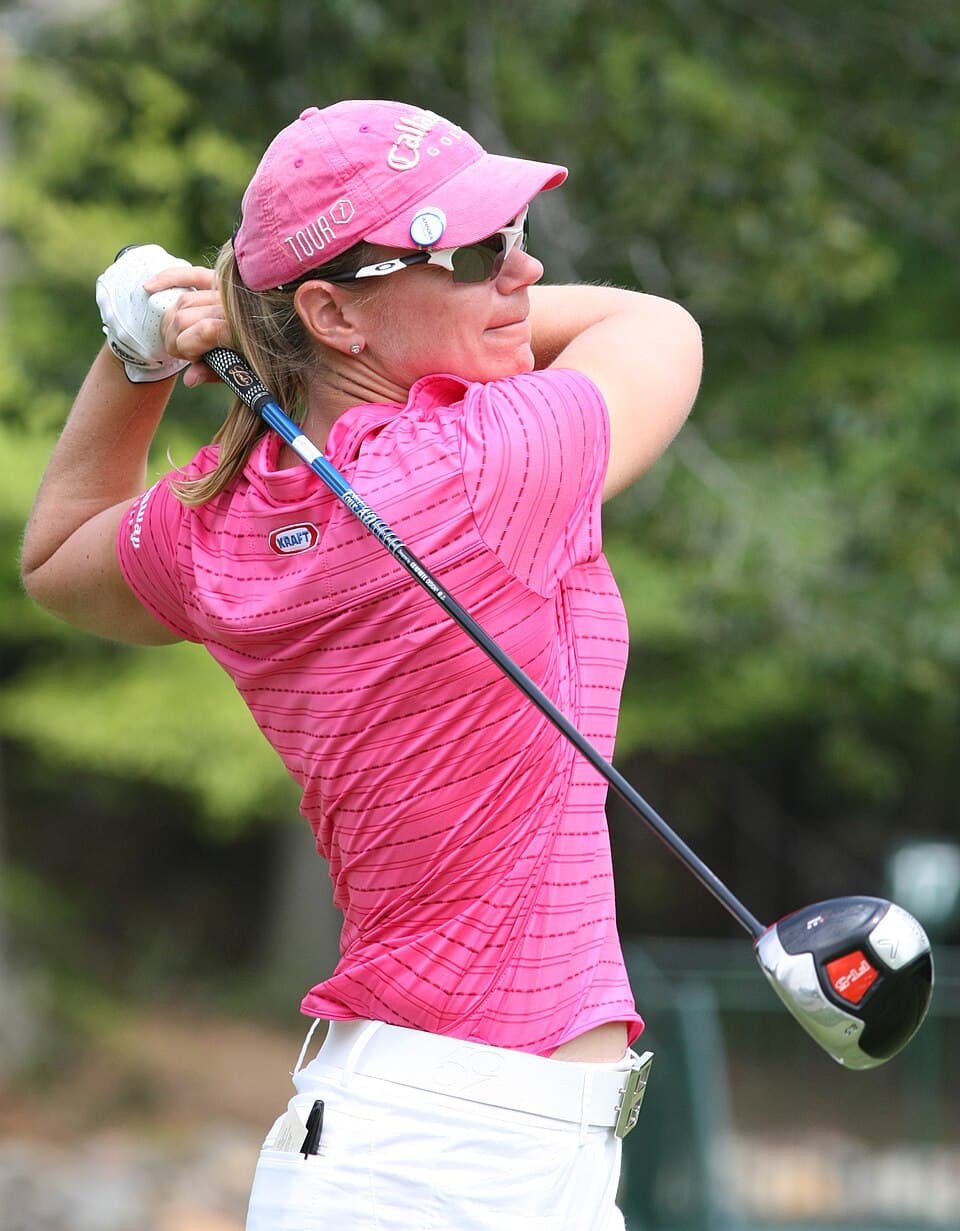
Swedish, American · Sports
Annika Sorenstam
October 9, 1970 – present
Early Life and Background
Annika Charlotta Sörenstam was born on 9 October 1970 in Bro, near Stockholm, Sweden.[1][2] She grew up in a middle‑class, sport‑oriented family; her father Tom worked in banking and her mother Gunilla was a bank clerk, both encouraging athletic participation for Annika and her younger sister Charlotta.[1] As children, the sisters tried several sports, notably tennis and soccer, before turning seriously to golf in their early teens.
Sörenstam began playing golf around age 12, initially at Bro-Bålsta Golf Club near her hometown.[6][13] Shy by nature, she is reported to have occasionally feigned injury or illness to avoid being introduced first on the tee, a personality trait that contrasts strikingly with the steely competitiveness she later displayed on the LPGA Tour.[1] Her junior development coincided with Sweden’s growing golf culture, which provided organized national programs for promising youth players.
Annika quickly excelled and became a member of the Swedish national golf team, competing in European amateur events and team championships.[6] Her performances attracted attention from U.S. college coaches, and she ultimately accepted a golf scholarship to the University of Arizona
At the University of Arizona, Sörenstam emerged as one of the leading players in women’s collegiate golf. She became a two‑time All‑American, contributing to Arizona’s position as a national powerhouse.[6] In 1991 she won the NCAA Division I women’s individual championship, a landmark victory in which she is widely noted as the first foreign‑born player and first freshman to take the title.[5][13] This achievement signaled that international players could thrive in the U.S. college system and presaged the increasingly global character of women’s golf. Alongside her collegiate accomplishments, Sörenstam continued to compete in major amateur events. She represented Sweden in the Espírito Santo Trophy (Women’s World Amateur Team Championship) and other European competitions, solidifying her status as one of Europe’s top young talents.[1] Her amateur success, especially in the U.S., attracted attention from sponsors and professional tours. After her standout amateur and collegiate career, Sörenstam decided to turn professional in the early 1990s. Sources differ slightly on the exact year, with several indicating she turned pro in 1992, while others list 1993 as the year she began her professional career.[1][7][11][14] What is clear is that she entered the professional ranks in the early 1990s and, in 1994, successfully earned her card for the LPGA Tour at her first attempt at qualifying school.[7] She also played on the Ladies European Tour (LET), where she won early titles and honed the precision‑based style that would come to define her game. Sörenstam’s first seasons on the LPGA Tour were solid but unspectacular compared with the dominance that would follow. She earned Rookie of the Year honors on the LET and gradually built confidence in the United States.[1] Her breakthrough came in the mid‑1990s, when she began to win regularly and contend in major championships. Sörenstam’s first major success arrived at the 1995 U.S. Women’s Open at The Broadmoor in Colorado Springs, where she captured her inaugural major championship.[1][4] This victory established her as a top‑tier LPGA player and demonstrated that European golfers could dominate on the biggest American stage. She followed up by defending her title at the 1996 U.S. Women’s Open at Pine Needles, becoming the first non‑American champion to retain the event, a barrier‑breaking achievement in U.S. women’s golf history.[13] Through the late 1990s and early 2000s, Sörenstam amassed ten major titles across the principal women’s championships: the U.S. Women’s Open, the LPGA Championship, the Kraft Nabisco Championship (now Chevron Championship), and the Women’s British Open.[1][4][5] She won the Kraft Nabisco Championship for the first time in 2001 and would claim it three times, known for her celebratory leap into Poppie’s Pond beside the 18th green.[1] From 2003 to 2005, she completed a remarkable three consecutive victories at the LPGA Championship, a three‑peat that underscored her sustained dominance.[1][13] In 2002, Sörenstam recorded one of the greatest seasons in LPGA history, winning 11 events, the most LPGA victories in a single season in nearly four decades.[2][5] That year she led the tour in scoring average, earnings, and virtually every statistical category, further cementing her status as the era’s defining player. On 2 April 2001, Sörenstam delivered what is often regarded as the single greatest round in women’s professional golf: a 59, shot during the Standard Register PING tournament at Moon Valley Country Club.[1][5] The round consisted of 13 birdies and 5 pars, with an inward and outward balance that showcased her precision and composure. She became the first woman in history to shoot 59 in an official tour event, breaking a psychological and statistical barrier. This performance exemplified Sörenstam’s analytical approach to the game. She was known for meticulous preparation, including detailed yardage books, fitness training, and statistical feedback that helped her refine strategy. Her emphasis on physical conditioning was ahead of its time on the LPGA Tour and contributed to a broader shift toward athleticism in women’s golf.[5] Across her career, Sörenstam won 72 official LPGA tournaments and at least 90–96 professional events worldwide, depending on how exhibitions and non‑tour events are counted.[1][5][6][8][10] She claimed ten majors and earned more than $22 million in LPGA prize money, far exceeding previous records and reflecting both her success and the expansion of purses during her era.[8][13] On 27 July 2003, Sörenstam won the Women’s British Open at Royal Lytham & St Annes, thereby completing the career Grand Slam of women’s major championships.[4] She had already won the U.S. Women’s Open, LPGA Championship, and Kraft Nabisco Championship; the British Open victory added the final piece. The win on a classic English links course demonstrated her adaptability to different styles of golf architecture and conditions. That same year, she was inducted into the World Golf Hall of Fame, becoming the youngest person ever admitted at the time of her induction.[19] Her Hall of Fame profile emphasizes her LPGA wins, major titles, and transformative impact on the sport, noting that she reshaped expectations for scoring, fitness, and professionalism in women’s golf. In May 2003, Sörenstam took another historic step by competing in the Bank of America Colonial on the PGA TOUR in Fort Worth, Texas.[1][6][20] She accepted a sponsor’s invitation and became the first woman in over 50 years to play in a PGA TOUR event, the previous having been Babe Didrikson Zaharias in 1945. Her participation generated intense media attention, debate, and scrutiny. Although Sörenstam narrowly missed the cut, her performance was respectable against elite male professionals, and the event is remembered primarily for its symbolic importance. By teeing it up in a men’s tour event, she challenged entrenched assumptions about gender and competition in golf. The Colonial appearance is often cited in women’s sports history as a milestone in visibility and boundary‑pushing, even though it did not lead to regular co‑ed competition at the tour level.[1][6] Sörenstam continued to win majors and regular LPGA events through the mid‑2000s. On 9 July 2006, she secured her third U.S. Women’s Open title at Newport Country Club, winning an 18‑hole playoff against Pat Hurst.[1][6] This victory reaffirmed her status as a major‑championship force more than a decade into her professional career. Toward the end of the 2000s, Sörenstam began to shift her focus away from full‑time competitive golf. She announced that she would step away from the LPGA Tour at the end of the 2008 season, and she did so after having accumulated 72 LPGA victories and numerous international titles.[1][5][6] Sources generally describe her departure as a retirement from regular tour competition rather than a complete end to playing, since she continued to appear in selected events. Parallel to her competitive career, Sörenstam developed a broad business portfolio under the ANNIKA brand. She launched ANNIKA Academy, a golf school focused on performance, fitness, and course management, located at the Reunion Resort near Orlando, Florida.[11] In April 2007 she formally unveiled Annika’s Academy of Golf Fitness, emphasizing the integration of athletic training and technical instruction. She also formed corporate partnerships, notably with Callaway Golf, and created lines of ANNIKA‑branded golf clothing and accessories.[5][11][13] Her success in combining sport and entrepreneurship is often cited as a model for modern athletes seeking to build brands and post‑competition careers. After retiring from full‑time competition, Sörenstam devoted considerable energy to the ANNIKA Foundation, a charitable organization she founded to promote women’s and junior golf.[5][6] The foundation hosts tournaments such as the ANNIKA Invitational, creating high‑level competitive opportunities for girl golfers around the world. Through these initiatives, Sörenstam has helped expand pathways into elite golf for young women, particularly those from regions where access to competitive play and coaching may be limited. The foundation’s events often combine competition with education on fitness, nutrition, and life skills, reflecting her holistic view of athlete development.[5] Sörenstam’s record‑setting career has been recognized with numerous awards. She won the Rolex LPGA Player of the Year award eight times, more than any other player in tour history.[11] She received multiple ESPY Awards, including six for most outstanding golfer and two for best female athlete, underscoring her visibility beyond golf.[11] In 2013, the PGA of America named her the PGA First Lady of Golf, with the announcement made on 7 November 2013.[6] This honor recognizes contributions to golf that extend beyond playing, marking her as a leading ambassador for the sport. Further solidifying her broader societal impact, Sörenstam was awarded the Presidential Medal of Freedom—the highest civilian honor in the United States—in 2021, cited for her achievements and contributions to the game of golf.[6] This distinction places her alongside a small number of athletes whose influence is considered nationally significant. Despite stepping away from regular LPGA play in 2008, Sörenstam occasionally returned to competition. In 2021 she re‑entered the spotlight by winning the U.S. Senior Women’s Open at Brooklawn Country Club on 8 August 2021.[6] The victory demonstrated that her skills and competitive instincts remained intact more than a decade after her main‑tour career ended. Her success in senior golf added a new chapter to her legacy, showing that high‑level performance can continue into later stages of an athletic career. It also drew attention to the developing ecosystem of senior women’s professional golf, an area historically overshadowed by men’s senior tours. Sörenstam’s personal life has intersected with her professional endeavors. She was previously married to David Esch, a golf equipment representative, during her prime years on the LPGA Tour.[1][16] After their divorce, she later married Mike McGee, son of former PGA TOUR player Jerry McGee. The couple wed on 10 January 2009 and have two children.[16] They reside in the Orlando, Florida, area, where Sörenstam bases her business and foundation activities. Sörenstam became a naturalized citizen of the United States while retaining her Swedish heritage, and she is frequently described as a Swedish‑born American golfer.[2][9] Some sources also note that she identifies as atheist, though religion has not been a central public theme in her career.[9] Annika Sörenstam is widely regarded by historians, journalists, and fellow professionals as one of the greatest female golfers of all time.[1][5][8] Her combination of 72 LPGA wins, 10 majors, and approximately 90–96 worldwide victories, along with her pioneering fitness and statistical approach, reshaped expectations for what women could achieve in professional golf.[1][5][6] Her dominance coincided with and contributed to a period of growth for the LPGA Tour, marked by increasing prize money, global participation, and television exposure. Sörenstam’s on‑course excellence and off‑course professionalism helped attract sponsors and elevate the tour’s profile. Many younger players, including future major champions from Europe, Asia, and the Americas, have cited her as a primary inspiration. Beyond numbers, her historical impact includes barrier‑breaking moments such as being the first woman in over 50 years to compete on the PGA TOUR and the first woman to shoot 59 in competition.[1][5][6][20] These milestones challenged gendered assumptions in golf and suggested that, given comparable competitive structures, women can achieve performance levels historically associated with men. Her post‑competitive work through the ANNIKA Foundation, her academy, and global junior events has extended her influence into leadership, mentorship, and institution‑building within the sport. By creating opportunities for girl golfers and emphasizing holistic athletic development, she has helped reconfigure the pipeline into elite women’s golf. In the years since her retirement from regular LPGA competition, Sörenstam has remained an active presence in golf. She continues to run ANNIKA‑branded businesses, design golf courses, and serve as a spokesperson and consultant for corporate partners.[5][11][13] She frequently appears at major championships, charity events, and junior tournaments, reinforcing her role as an ambassador for the sport. Her recognition with honors such as the PGA First Lady of Golf and the Presidential Medal of Freedom underscores that her impact reaches beyond the boundaries of professional tours.[6] As of the mid‑2020s, Sörenstam’s career offers a comprehensive case study in how one athlete can influence performance standards, business models, gender narratives, and youth development within a global sport. For women’s history, she stands as a central figure in the evolution of professional women’s golf and a symbol of excellence, longevity, and leadership.Collegiate Career and Amateur Success
Transition to Professional Golf
Breakthrough and Major Championship Success
The Historic 59 and Statistical Dominance
Career Grand Slam and World Golf Hall of Fame
Competing on the PGA TOUR
Later Major Wins and Retirement from Full‑Time Competition
Business Ventures and the ANNIKA Brand
The ANNIKA Foundation and Advocacy for Women’s Golf
Awards, Honors, and Recognition
Return to Competition and Senior Success
Personal Life
Legacy and Historical Impact
Later Life and Continuing Influence
Dated achievements
7 indexed.
- Oct091970Sports
Birth of Annika Sörenstam
Born in Bro, near Stockholm, Sweden, on 9 October 1970; future dominant LPGA champion and one of history’s greatest female golfers.
View details Annika Sörenstam – Wikipedia - Jul161995Sports
First U.S. Women’s Open victory
Wins her first major on 16 July 1995, claiming the U.S. Women’s Open at The Broadmoor and launching her era of LPGA dominance.