← All women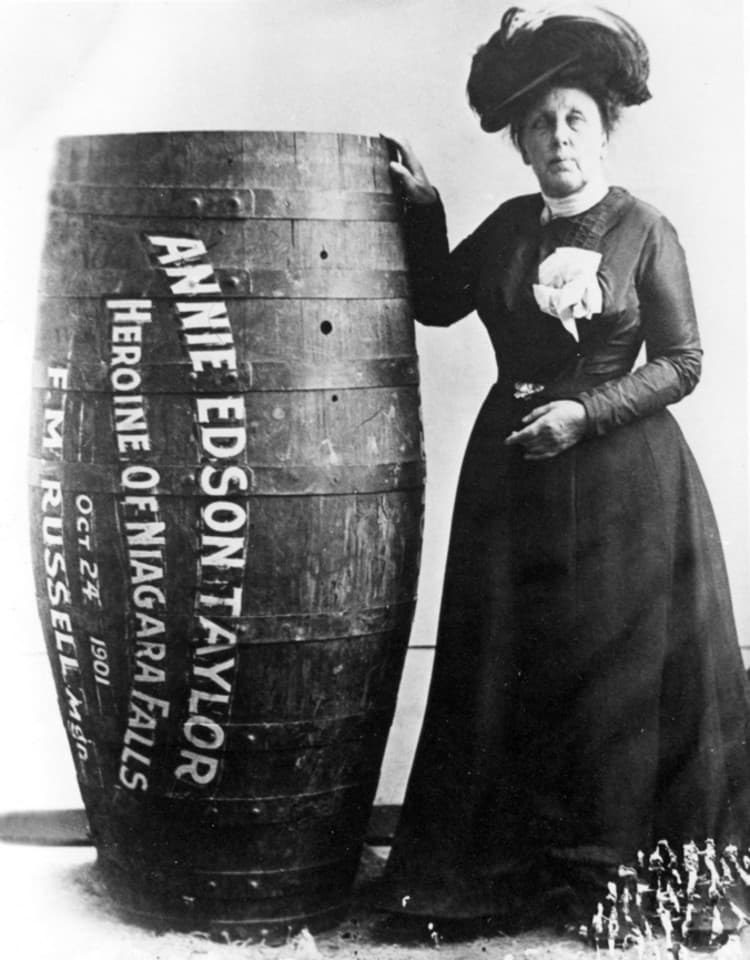
American · Exploration
Annie Edson Taylor
October 24, 1838 – April 29, 1921
Early life and background
Annie Edson Taylor was born on October 24, 1838, in Auburn, New York. Reference sources consistently identify her as an American schoolteacher who later became famous as a daredevil, although some secondary accounts disagree about her birth year. The strongest reference-style sources used here support 1838, and that date is treated as authoritative in this profile. Taylor’s early life unfolded in a period when women’s opportunities were constrained by law, custom, and economic dependence, making teaching one of the few socially acceptable professions available to women who needed their own income.
Little of Taylor’s childhood has survived in widely cited detail, but she was born into a society where women’s public identities were often defined by family, marriage, or domestic duty. Her later life suggests a woman with determination, adaptability, and a willingness to take risks when conventional paths did not provide stability. That background is important to understanding her famous Niagara Falls stunt: Taylor did not emerge from the world of professional athletics or entertainment, but from the ordinary and precarious labor market available to nineteenth-century women.
She eventually married David Taylor, and later accounts state that the marriage ended when he died during the Civil War. Sources also note the death of their only child in infancy. These losses appear to have contributed to a long period of instability in her adult life. Taylor taught school in various places, including Bay City, Michigan, and traveled widely in search of work. Her experiences as a widow and itinerant teacher shaped the practical logic behind the act that made her famous: she wanted money and visibility in a world that offered women few reliable avenues to either.
Career beginnings and the road to Niagara
Before her famous descent, Taylor worked as a schoolteacher and, by the end of the nineteenth century, was living under difficult financial circumstances. Secondary sources describe her as widowed and seeking a way to secure fame and economic security. According to the standard narrative, she decided that the first person to go over Niagara Falls in a barrel might attract enough attention to provide a living. This was a period when Niagara Falls already had a robust culture of tourism, daredevil performance, and newspaper publicity. Entering that arena required not only physical courage but also an instinct for self-promotion.
Taylor commissioned a specially reinforced barrel made of oak and iron. The barrel was designed to help cushion the impact of the descent and reportedly included a small peephole so she could see out. Her willingness to climb into such a device and ride it over the falls reflects the extraordinary risk she accepted. Women in her era were rarely encouraged to present themselves as public risk-takers, and Taylor’s plan challenged both gender expectations and assumptions about age. She was in her sixties, not her youth, when she prepared to attempt one of the most dangerous stunts imaginable.
The choice of Niagara Falls was not accidental. The falls had already become a symbol of natural power and spectacle, and by the early twentieth century they were a familiar stage for publicity seekers. Taylor understood that the event would be both a physical challenge and a media event. Her plan depended on newspapers, word-of-mouth, and the public appetite for extraordinary feats. That she was willing to stake her future on such a performance shows both her desperation and her confidence that she could survive it.
The Niagara Falls descent of 1901
On October 24, 1901, Taylor achieved the feat that made her a historical figure. Contemporary accounts and later summaries state that she was towed into the Niagara River and sent over Horseshoe Falls inside her barrel on her 63rd birthday. She survived the plunge, emerging alive after an ordeal that cemented her place in daredevil history. Several sources identify her as the first person to survive a trip over Niagara Falls in a barrel and the first woman to attempt the stunt.
The achievement was significant on multiple levels. First, it was a genuine first, not merely a publicity claim. Guinness World Records later recognized her as the first person to survive the drop over Niagara Falls, confirming the feat’s place in the record book. Second, Taylor’s accomplishment made her one of the earliest women to gain wide renown through an extreme physical act rather than through marriage, inheritance, or traditional public service. In that sense, she occupied a rare place in the history of women’s public performance.
Her survival also illustrates the growing power of spectacle in the modern media age. Taylor’s feat was not merely a personal test; it was a consumable public event, designed to be seen, reported, and remembered. That visibility brought immediate celebrity. Newspapers and popular histories soon described her as the “Queen of the Falls”, a title that captured both the singularity of her performance and the theatricality of her public image. The fact that she chose her birthday for the attempt added a layer of symbolic resonance that helped the story endure in public memory.
Publicity, celebration, and brief fame
After the plunge, Taylor became a celebrated curiosity. On November 2, 1901, she appeared at the Pan-American Exposition in Buffalo on the event’s Farewell Day and received thousands of visitors. This appearance shows how quickly her feat was absorbed into the entertainment and publicity circuits of the era. World’s fairs and expositions were central institutions of American modernity, and Taylor’s presence there signaled that she had become more than a local novelty: she was a widely recognizable public figure.
Accounts from the period and later historians suggest that she tried to use her fame to earn money, including through public appearances and lectures. Yet the financial rewards were limited. Although she was famous, she was not securely wealthy, and the attention that surrounded her did not produce the long-term economic stability she had hoped for. Her experience is a reminder that celebrity, especially for women outside established institutions, was often unstable and exploitative.
Her brief time in the spotlight also reveals the gendered nature of publicity at the turn of the century. Taylor’s survival challenged assumptions about women’s physical fragility, but the culture that celebrated her still tended to frame her as an eccentric attraction rather than as a professional athlete or entrepreneur. She was admired for her daring, but she was not fully integrated into a system that could sustain her after the spectacle ended.
Personal life
Taylor’s personal life is known mainly through the lens of loss and mobility. Sources describe her as a widow and note the death of her only child in infancy. These hardships likely contributed to the instability that defined much of her adult life. She taught in different places and moved frequently, including time in Michigan, before turning to the Niagara stunt. Her later years did not bring the permanent comfort she may have hoped for when she climbed into the barrel.
Because she became famous late in life, Taylor’s personal story is often overshadowed by the Niagara feat itself. Nonetheless, her widowhood matters historically: it placed her in the category of women who had to support themselves without the legal and economic protection that husbands often provided. Her decision to perform such a dangerous stunt was inseparable from those material realities. She was not simply seeking thrills; she was trying to survive in a society that made survival difficult for aging, widowed women.
Later life, death, and commemoration
Taylor never converted her fame into lasting wealth. Later accounts describe her dying in poverty, a fate that underscores how limited the material rewards of her achievement were. She died on April 29, 1921, at the Niagara County Infirmary in Lockport, New York. The contrast between her global notoriety and her final circumstances has shaped much of the modern interpretation of her life.
Even so, her name endured. She remained central to histories of Niagara daredevils and to broader discussions of women who crossed boundaries in public life. The story of Annie Edson Taylor has been preserved by museums, historical organizations, and reference works because it sits at the intersection of gender history, media history, and the history of performance. She was not the first person to attempt a spectacular feat for attention, but she was among the first women to use such a feat to claim public space so dramatically.
Her legacy is also complicated. She is remembered as a pioneer of extreme tourism and as the first person to survive a barrel descent over Niagara Falls, yet her story is tinged with exploitation, poverty, and uncertainty. Whether viewed as a daredevil, a self-promoter, or a determined widow trying to secure her future, Taylor occupies a lasting place in American women’s history. Her life illustrates how women in the late nineteenth and early twentieth centuries could create extraordinary visibility for themselves even when the world around them offered only limited reward.
Dated achievements
4 indexed.
- Oct241838Exploration
Birth in Auburn, New York
Birth of Annie Edson Taylor in Auburn, New York.
View details Wikipedia: Annie Edson Taylor - Oct241901Exploration
First person to survive going over Niagara Falls in a barrel
Annie Edson Taylor survives Niagara Falls descent in a barrel, a pioneering first.